
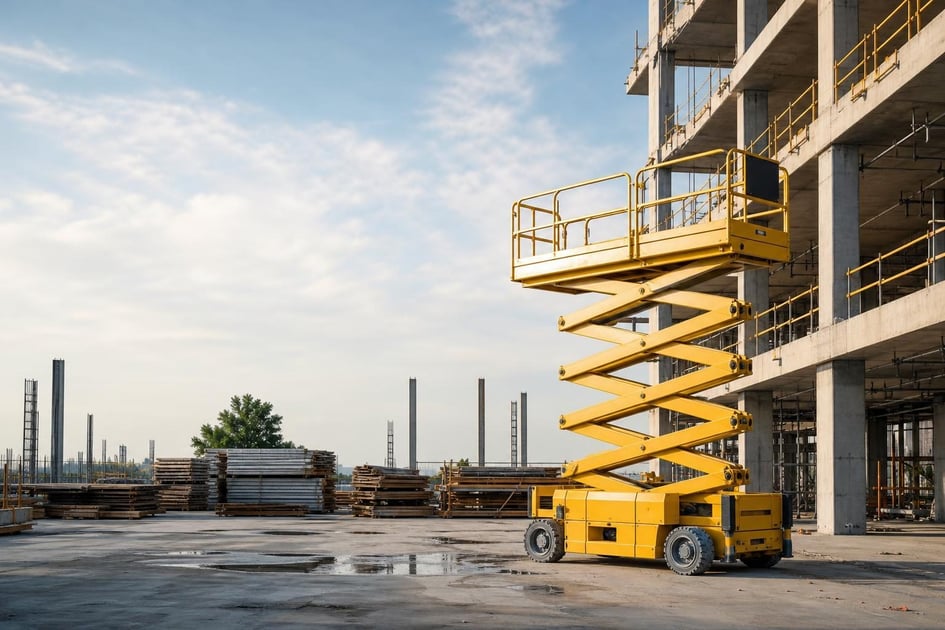
Most contractors and facility managers want one number: what will financing a scissor lift cost me? The honest answer is that rates vary by credit profile, equipment age and term. A brand-new 19-foot slab scissor lift might cost $10,000 to $15,000 to purchase, while a 32-foot rough-terrain model can run $30,000 to $50,000 or more. Your monthly payment depends on how much you finance, for how long, and your business's financial track record.
If you already have a quote in hand, you can see what financing you qualify for on that lift and get a decision, possibly the same day.
By the Numbers: Provide Capital finances new and used business equipment from $5,000 to $5 million. The equipment itself serves as collateral, which keeps financing accessible even when a bank wants additional security.
Factors That Shape Your Monthly Payment
Several variables move the monthly number more than any advertised rate.
Credit Profile
Lenders look at time in business, personal and business credit scores, and cash flow. A construction firm with three years of tax returns and steady revenue will see different terms than a newer operation still building its books. That does not mean younger businesses are out of options; it simply means the structure may require more documentation or a different advance rate. Bankruptcies, tax liens, and recent judgments will also influence the offer, though none of these automatically disqualify an application when the collateral is strong.
Equipment Age and Condition
New scissor lifts command better terms because the collateral value is predictable. Used lifts can absolutely be financed, especially if they are late-model units with documented maintenance. Older equipment may require a larger down payment or a shorter term to keep the loan-to-value ratio in line. Rates vary by credit profile, equipment age and term, so a 2019 lift will typically cost less to finance than a 2010 unit. Hours matter as much as years: a 2018 lift with 4,000 hours may be viewed differently than a 2018 lift with 800 hours.
Term Length
Stretching repayment over 60 months lowers the monthly outlay but increases total interest paid. A 24-month term builds equity faster and cuts total cost, though the monthly hit is heavier. Most scissor lift financing falls between 24 and 60 months, with some transactions extending to 72 months for larger amounts. Choose the shortest term your cash flow can tolerate to minimize total expense.
Key Insight: Scissor lifts hold resale value better than many small tools because they are essential across multiple trades. That strong collateral value is why lenders can offer competitive structures without blanket liens on all your business assets.
Get a fast decision on your equipment
Applying takes just a few minutes, and decisions can come as soon as the same day.
Start Your ApplicationNew vs. Used Scissor Lifts
The new-or-used decision affects both your payment and your maintenance budget.
New lifts come with manufacturer warranties, the latest safety features, and lower repair risk. They also depreciate the moment they hit your jobsite. Used lifts cost less upfront—often 30 to 50 percent below comparable new models—but may carry higher service costs and shorter remaining warranty periods.
| Factor | New Scissor Lift | Used Scissor Lift |
|---|---|---|
| Purchase price | $10,000–$50,000+ | $5,000–$25,000 |
| Financing term flexibility | Wider range, up to 60+ months | Often 24–48 months |
| Down payment | Often first/last payment | May require 10–20% |
| Collateral value | Strongest | Good for late-model; weaker for older units |
| Maintenance risk | Lowest | Moderate; inspect before buying |
Rates vary by credit profile, equipment age and term, so the used lift you found at auction could cost more per month than a new unit if the lender requires a shorter payback period. Always compare the total cost of ownership, not just the sticker price.
Pro Tip: If you are buying used, get the serial number and hour meter reading before you apply. Lenders verify collateral value through auction data and dealer pricing; having those details ready prevents delays.
Lease vs. Loan: Which Structure Fits?
Equipment financing and leasing are not the same thing, though the words get used interchangeably.
With an equipment loan, you own the scissor lift outright once the final payment clears. You record the asset and the liability on your balance sheet, and you claim depreciation and any applicable 2026 tax deductions. The equipment itself is the collateral, which keeps rates competitive relative to unsecured borrowing. This path makes sense if you plan to run the lift for five to seven years and want to build equity in a core asset.
A true lease—especially an operating lease—lets you use the lift for a set period with lower monthly payments, then return it, buy it out, or upgrade. This works well if you need a specific height capacity for a two-year contract and do not want to own the asset long-term. However, you do not build equity, and the buyout price at the end can be significant. You also lose the Section 179 first-year deduction, since you do not own the equipment.
If your plan is to keep the lift for five-plus years and put heavy hours on it, financing to own usually wins. If you need flexibility and predictable turnover, a lease structure deserves a look. Start an application to compare structures side by side for your specific deal.
Worked Cost Examples
These scenarios illustrate how term and down payment affect monthly outlay. Rates vary by credit profile, equipment age and term, so treat these as directional figures, not binding quotes.
A $15,000 new slab lift with first and last payment upfront might run in the low-to-mid $300 range over 60 months. Shorten that to 36 months and the payment jumps to the mid-$400 range, but you cut total interest significantly.
A $25,000 rough-terrain unit financed over 48 months with a modest down payment could land in the mid-to-high $500 range monthly. The same unit on a 24-month schedule with no down payment might push into the low $1,100 range, building equity faster but straining cash flow.
For a $40,000 package bundling two mid-size electric lifts, a 60-month term with standard advance might yield payments in the high $700 to low $800 range. Extending to 72 months, if available for the amount, could drop that below $700.
Tax Treatment for 2026
How you finance affects how you deduct.
Section 179
For tax year 2026, Section 179 allows businesses to deduct qualifying equipment purchases in the first year, subject to annual limits and phase-out thresholds. The exact dollar cap changes with inflation adjustments. Rather than guess the precise 2026 limit here, speak with your CPA—they can confirm the current threshold and whether your total equipment purchases for the year push you into the phase-out range. If you qualify, a financed scissor lift can deliver a first-year write-off even though you have not paid the full balance.
Bonus Depreciation
Bonus depreciation has been stepping down from its peak levels. For 2026, consult your tax advisor on the current percentage, as congressional action can shift the schedule. If applicable, it stacks with Section 179 in some scenarios, though the rules are nuanced and the benefit is lower than in prior years.
Lease Tax Treatment
If you structure the deal as a true operating lease, lease payments are typically deductible as a business expense. This simplifies bookkeeping but does not offer the large upfront deduction that Section 179 provides. Your CPA can model which approach leaves more cash in your business for 2026.
See what you qualify for
The equipment itself secures the financing, which keeps rates competitive. Checking your options takes minutes.
Check Your OptionsWhat Documentation You Need
Lenders need to verify three things: that your business can repay, that the equipment is worth the advance, and that you have skin in the game.
At minimum, expect to provide a business bank statement, your most recent tax return or financials, a quote or invoice for the scissor lift, and proof of insurance. If you are financing a used unit, the lender may want maintenance records or an inspection report. For transactions above $100,000, two years of financials and an interim balance sheet are common requests.
Having these ready before you apply shortens the timeline from quote to funding. Many deals that stall do so because the borrower is still tracking down paperwork while the seller moves on to the next buyer. If you are buying through a dealer, ask them for a detailed invoice that breaks out the base machine, accessories, freight, and taxes. Lenders need to know exactly what they are collateralizing.
Common Mistakes When Financing Lifts
Buying the Wrong Specs for the Job
A slab lift with non-marking tires is perfect for indoor warehouse work and useless on a muddy construction site. Know your surface, reach height, and weight capacity before you shop. Returning or exchanging heavy equipment is expensive.
Ignoring Total Cost of Ownership
The monthly payment is only part of the picture. Maintenance, insurance, transport, and training add up. A cheaper lift that needs $3,000 in immediate repairs can erase any financing savings. Budget for annual inspections, battery replacements on electric units, and hydraulic service.
Waiting Too Long to Apply
Inventory moves fast, especially in spring when Construction equipment financing demand peaks. Getting pre-approved locks in your buying power and may let you negotiate a cash-discount price with the dealer. According to U.S. Census Bureau construction spending data, activity ramps up in Q2, so the best used inventory gets picked over by March.
Not Checking for Liens on Used Equipment
If you buy a used lift from a private seller, verify there are no outstanding liens. Title issues can block the lender's security interest and derail funding. Run a UCC search or ask the seller for a lien release before you commit.
Overlooking Insurance Requirements
Lenders require physical damage insurance naming them as loss payee. If your current policy excludes certain equipment values or has high deductibles, update it before closing. A last-minute insurance scramble is a common cause of delayed funding.
Industry-Specific Use Cases
Scissor lifts cross many trades, and each has its own buying pattern.
In construction and maintenance, rough-terrain diesel lifts dominate outdoor jobs. Electrical contractors favor narrow slab models that fit through standard doorways. Warehouse and distribution operations run large fleets of electric scissors for racking and lighting work. HVAC technicians need mid-size units that handle duct weight without sacrificing maneuverability. According to the Small Business Administration equipment financing guidance, trades that rely on daily equipment mobility see faster payback on financed lifts than on owned dormant assets.
If you run a mixed fleet, Scissor Lifts financing can bundle multiple units under one schedule, simplifying bookkeeping. Some operators pair scissors with Spider Lifts financing for tight-access work, financing each under separate terms matched to the equipment's expected life.
Seasonality matters too. In northern states, contractors often buy in late winter to secure equipment before the spring rush. In warmer climates, purchasing happens more evenly through the year, though Q4 tax-driven buying is common everywhere. As Forbes reporting on equipment lending trends notes, businesses that time purchases around both tax deadlines and seasonal cash flow tend to secure better structures.
Qualification Criteria in Detail
Provide Capital serves businesses nationwide across construction, healthcare, dental, restaurant and food service, manufacturing, transportation, agriculture, HVAC, and forestry. Same-day approvals are possible when the file is complete.
We finance new and used business equipment from $5,000 to $5 million. The equipment itself is the collateral. That means you do not need real estate or unrelated assets to secure the deal. Credit profile, time in business, and equipment type all play a role, but the focus is on the asset's value and your ability to service the debt.
Startups or businesses with limited history may still qualify, though the structure might require additional guarantor support or a shorter term. There is no one-size-fits-all cutoff, which is why applications are reviewed individually rather than run through an automated scorecard alone. If your business has been operating for at least a year, generates consistent revenue, and the equipment supports income production, the file merits a look.
What Happens After Approval
Once approved, you receive a term sheet outlining the advance amount, payment schedule, and any conditions. Review it carefully, especially the insurance requirements and default provisions. After you accept and provide proof of insurance, the lender pays the dealer or private seller directly. You take delivery and put the lift to work.
Most contracts are simple interest with no prepayment penalty, meaning you can pay ahead or refinance later if your situation improves. Keep your payment record clean; it builds the relationship for your next equipment need, whether that is another lift, a truck, or shop machinery. The entire process from application to funding can move in as little as 24 to 48 hours for straightforward deals.
By the Numbers: A $20,000 scissor lift financed over 48 months might carry a monthly payment in the low-to-mid $400 range, while the same amount over 24 months lands in the high $800 range. Rates vary by credit profile, equipment age and term, so treat these as directional figures, not quotes.
Put the right equipment to work
From $5,000 to $5 million, new or used, Provide Capital helps businesses nationwide finance the equipment they need.
Apply TodayFrequently Asked Questions
Can I finance a scissor lift with bad credit?
We work with a range of credit profiles. Lower scores may require a larger down payment, a shorter term, or additional documentation, but the equipment's collateral value keeps the door open for many borrowers who would not qualify for unsecured credit.
How long does approval take?
Same-day approvals are possible for deals with clean documentation. More complex files or transactions near the upper end of the range may take 24 to 48 hours.
Do I need a down payment?
Many deals structure the first and last payment upfront rather than a traditional 20% down payment. Used equipment and challenged credit may require more. The exact structure depends on the file.
Can I finance a scissor lift from a private seller?
Yes, provided the seller can deliver clean title and the equipment passes valuation. Private-party deals require extra lien and title verification, so build in a little extra time.
Is there a penalty for paying off early?
Most equipment financing agreements are simple-interest with no prepayment penalty, but always verify this on your specific term sheet before signing.
What is the oldest scissor lift I can finance?
There is no hard age cutoff, but older units face stiffer terms. Lenders look at remaining useful life versus the repayment period. A 10-year-old lift on a 36-month term is harder to approve than a 5-year-old unit.
Can I bundle multiple lifts into one agreement?
Yes. If you are expanding a fleet, bundling simplifies administration and may improve the overall structure compared to separate small tickets.
Does financing affect my other business credit lines?
Because the lift itself is the collateral, the financing typically does not tie up your real estate or blanket business assets. This preserves your existing credit lines for payroll, materials, and other operating needs.
Ready to Finance Your Scissor Lift?
A scissor lift is a productivity tool, not a luxury. Whether you are replacing an aging unit or adding capacity for a busy season, the right financing structure keeps cash in your business while the equipment earns its keep. Review your quotes, gather your documents, and get a decision on your lift so you can put it to work.
Disclaimer: The information provided in this article is for general educational purposes only and is not financial, legal, or tax advice. Funding terms, qualifications, and product availability may vary and are subject to change without notice. Provide Capital does not guarantee approval, rates, or specific outcomes. For personalized information about your business funding options, contact our team directly.
