
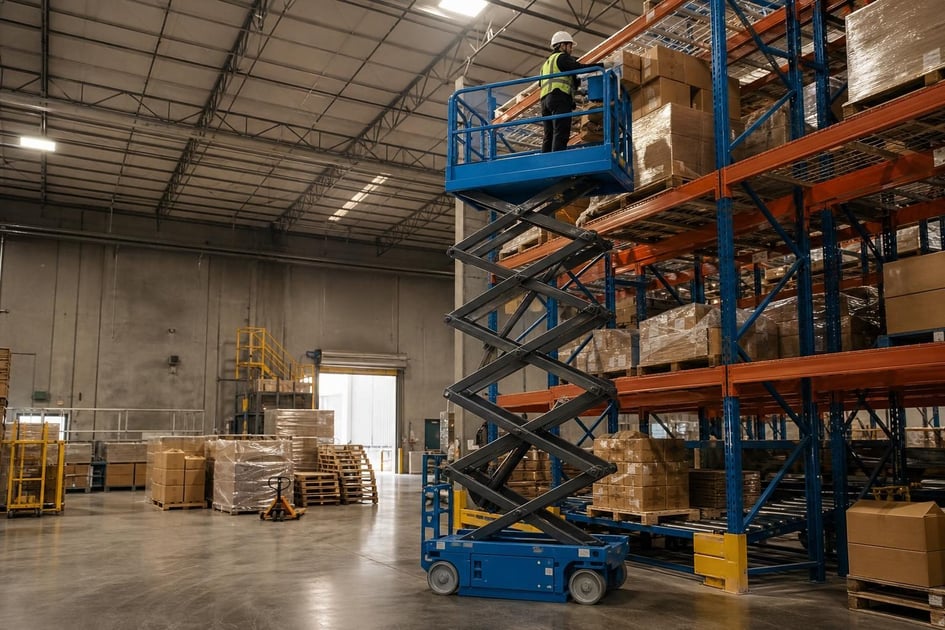
When Your Tennessee Crew Needs Height, Financing Gets You There
If you are buying a scissor lift for a Tennessee job site, warehouse, or maintenance yard, equipment financing lets you put the machine to work while you pay for it over time. The lift itself serves as collateral, which keeps rates competitive compared with unsecured borrowing. Provide Capital finances new and used business equipment from $5,000 to $5 million, and same-day approvals are possible once the file is complete. Rates vary by credit profile, equipment age and term, so the exact structure depends on your business and the specific machine.
Tennessee’s mix of booming construction in Nashville, heavy distribution around Memphis, and manufacturing across Knoxville and Chattanooga creates steady demand for scissor lifts. Whether you need a 19-foot electric slab lift for interior finish work or a 45-foot diesel rough-terrain unit for a subdivision build, spreading the cost preserves cash for payroll, materials, and fuel. If you are weighing a purchase, you can see what financing you qualify for on that scissor lift in a few minutes.
Key Insight: Tennessee’s spring construction rush typically runs from March through June, and lift inventories at regional dealers tighten by April. Financing pre-approval in February lets you reserve the exact model and delivery slot before the seasonal squeeze pushes prices higher or extends lead times.
Already have a machine in mind?
Provide Capital finances new and used equipment from $5,000 to $5 million, with same-day decisions possible.
Apply NowWhy Tennessee Buyers Finance Scissor Lifts
Equipment financing lets you put assets to work immediately while preserving operating cash. As Forbes Finance Council explains, using financing rather than cash on hand frees capital for other business needs. Tennessee’s economy makes this especially relevant. U.S. Census Bureau QuickFacts shows Tennessee employer establishments growing steadily, with total employment expanding across construction, transportation, warehousing, and manufacturing.
Because demand is spread across several industries, scissor lift use in Tennessee is year-round, but buying patterns are seasonal. Construction crews often time acquisitions before the spring build season. Warehouse operators, by contrast, tend to add lifts ahead of the holiday shipping surge in the third quarter. Financing smooths out these spikes: instead of tying up $30,000 or more in a single purchase, you keep liquidity for the unexpected expenses that always seem to arrive mid-project.
What Scissor Lifts Cost and How Financing Breaks It Down
New scissor lifts range widely by platform height, power source, and terrain capability. A new 19-foot electric slab lift often falls between $12,000 and $18,000. A 32-foot narrow electric model may run $20,000 to $35,000. Rough-terrain diesel lifts with platform heights above 40 feet can land between $40,000 and $70,000, depending on capacity and brand. Used units typically trade at 40 to 60 percent below new sticker prices, though runtime hours, battery health, and recent service history move that figure up or down. Refurbished machines with fresh batteries and reconditioned hydraulics usually sit in the middle of the new-to-used spread.
Financing structures match those price bands. Down payments generally range from zero to 20 percent, with stronger credit and newer equipment pushing the requirement toward the lower end. Terms commonly run 24 to 60 months, aligning the payment schedule with the useful life of the lift. Because the equipment backs the financing, lenders can offer longer terms and higher approvals than they would for an unsecured line. Monthly payments depend on the financed amount, the term, and the rate, which varies by credit profile, equipment age and term.
Here is how three common Tennessee purchase scenarios might look:
| Machine Type | Estimated Price | Typical Down Payment | Common Term |
|---|---|---|---|
| New 19-ft electric slab lift | $14,000 – $18,000 | 0% – 10% | 36 – 48 months |
| New 32-ft narrow electric lift | $26,000 – $34,000 | 5% – 15% | 48 – 60 months |
| Used 43-ft rough-terrain diesel | $22,000 – $35,000 | 10% – 20% | 36 – 48 months |
These are illustrative ranges. Your actual offer depends on time in business, credit history, and the specific unit. If the numbers look close to your budget, you can get a decision on your equipment, possibly the same day, by submitting a short application and the equipment quote.
By the Numbers: A Tennessee contractor financing a $28,000 scissor lift over 48 months with a 10 percent down payment could see monthly outlays in the mid-hundreds to low-thousands, depending on credit profile, equipment age and term. Over the life of the financing, the total cost of ownership still often beats renting by a wide margin if the machine runs more than 60 to 80 days a year.
Lease vs. Loan: What Tennessee Owners Should Know
Not every acquisition should be structured as a loan. A true or operating lease works like a rental with a fixed term: you make monthly payments, return the lift at the end, and walk away or upgrade. This suits businesses that refresh equipment every few years or face uncertain project pipelines. The trade-off is that you do not build equity, and the lessor may charge for excess hours or damage.
A finance lease, sometimes called a $1 buyout lease, is effectively a loan in lease clothing. You make payments, take depreciation and interest deductions, and own the lift outright for a nominal sum at the end. The monthly payment is usually higher than a true lease because you are paying down the full cost. An equipment loan is the most straightforward path: you own the lift from day one, the lender files a UCC lien on the equipment, and you make amortizing payments until the balance is zero.
From a tax perspective, true lease payments are generally deductible as a business expense. With a loan or finance lease, you typically deduct interest and claim depreciation through Section 179 or bonus depreciation, subject to 2026 tax-year limits and your CPA’s advice. The best structure depends on how long you plan to keep the lift, your current tax position, and whether you want to return the asset at term end.
Tax Treatment and Section 179 for 2026
For tax year 2026, Section 179 allows businesses to deduct the full purchase price of qualifying equipment in the year it is placed in service, up to an inflation-adjusted annual limit. The exact dollar cap changes each year with inflation indexing, so you should confirm the 2026 limit with your CPA before you file. Bonus depreciation is also available in 2026, though it is phasing down from prior-year levels, which means the first-year write-off may be smaller than it was in earlier tax years. Again, your accountant can model the precise benefit based on your entity type and taxable income.
If you choose a true lease rather than a loan, you do not depreciate the asset. Instead, you deduct lease payments as they are made. For some Tennessee businesses, especially S-corps and LLCs with pass-through income, the combination of a loan, Section 179, and bonus depreciation can produce meaningful first-year savings. For others, the simplicity of expensing lease payments is preferable. Either way, the equipment must be placed in service before year-end to count for 2026, so November and December purchases require fast funding and clear delivery documentation.
Pro Tip: If you are a Tennessee contractor in a high-growth year, buying in December and placing the lift in service before January 1 can accelerate your 2026 deduction. But do not let the tax tail wag the dog—only buy if the machine generates revenue. Run the numbers with your CPA, because AMT and passive-income rules can limit Section 179 benefits for certain owners.
Tennessee Industries That Depend on Scissor Lifts
Scissor lifts are not just for high-rise construction. In Tennessee, they show up across a wide range of sectors:
- Construction: Residential framing, commercial build-outs, and infrastructure repair from Memphis to Bristol all use slab and rough-terrain lifts. Construction equipment financing is built around tools that move dirt and steel, but the same structures work for lifts that move people.
- Warehousing and Distribution: Memphis and Nashville distribution centers use narrow electric lifts to reach overhead racking, change light fixtures, and service climate-control units. A single facility may keep two or three lifts on site year-round.
- Manufacturing: Automotive suppliers in Middle and East Tennessee use lifts for production-line maintenance, building upkeep, and inventory management. The machines often run indoors on smooth concrete, making electric slab lifts the standard choice.
- Agriculture and Forestry: Tennessee orchards, nurseries, and timber operations use rough-terrain lifts for pruning, spraying, and equipment repair. The ability to handle uneven ground makes diesel rough-terrain units more common here than in warehouse settings.
- Healthcare and Hospitality: Hospitals, hotels, and conference centers in Nashville and Chattanooga use compact electric lifts for ceiling repairs, lighting upgrades, and signage installation without tearing up interior floors.
Regardless of sector, the financing structure is similar: the equipment itself secures the transaction, and terms stretch from $5,000 to $5 million. If your next project requires vertical access, Scissor Lifts financing can cover the exact model your job demands, while Material Lift financing handles lighter vertical loads that do not require a full platform.
Find the right financing structure
Tell us about the equipment you need and we will show you the options that fit your business.
See Your OptionsNew vs. Used: Matching the Machine to the Job
New lifts carry full manufacturer warranties, zero runtime hours, and the latest safety features. For a Tennessee contractor running multiple crews daily, that predictability is worth the premium. New machines also tend to qualify for slightly longer financing terms and lower down payments because the collateral value is easier for the lender to verify.
Used lifts make sense when the machine sees occasional duty or when you need a specific size immediately and new inventory is back-ordered. A three- to five-year-old lift with under 1,000 hours can deliver years of service at a steep discount. Before you buy used, check the battery cycle count on electric models, look for hydraulic leaks under the platform, and verify that the control software is current enough to avoid discontinued parts. Ask for a recent inspection report, and if the seller cannot provide one, budget $300 to $500 for an independent mechanic’s review.
Refurbished units split the difference. Reconditioned lifts from reputable dealers often come with a 90-day to one-year warranty and fresh wear items. Financing on refurbished equipment typically falls closer to used terms than new, so expect a slightly higher down payment or shorter term than a zero-hour machine.
Common Mistakes Nashville and Memphis Buyers Make
The most expensive error is underspecifying the lift. A 19-foot slab lift will not reach second-story exterior framing on most commercial buildings, and a rough-terrain unit driven across finished tile will cause damage. Measure your typical working height, add at least six feet for worker reach and material clearance, and confirm whether you need a roll-out deck extension.
Transport is another overlooked cost. A mid-size scissor lift can weigh 5,000 to 7,000 pounds, which means you need a trailer rated for the load plus a truck that can pull it legally on I-40 or I-24. Buyers who forget this expense end up paying for delivery on every job or renting a truck they did not budget for.
Timing matters too. Waiting until April to buy for a May project means competing with every other contractor who just signed spring contracts. Financing pre-approval lets you buy in February or early March, when dealers still have incentives and floor-planning pressure to move inventory.
Finally, do not assume all used lifts are equal. A machine that spent its life in a climate-controlled Nashville warehouse is a different asset than one that worked outside in West Tennessee humidity. Rust on the undercarriage, corrosion in the battery compartment, and sun-damaged control cables are real issues that an in-person inspection catches before you sign.
What Documentation You Need and What Happens After Approval
The application process is straightforward. Most lenders ask for three to six months of business bank statements, a copy of the equipment quote or invoice, and basic business information including your EIN and time in business. If the lift is used, they may want photos, a serial number, and proof of ownership from the seller. For larger requests, two years of tax returns or a year-to-date profit and loss statement can strengthen the file.
Once submitted, underwriting reviews credit, cash flow, and collateral value. For well-documented applications on standard equipment, same-day approvals are possible. After approval, the lender issues a term sheet or agreement. You review and sign, the dealer or seller is paid directly or via escrow, and the lender files a UCC-1 on the equipment to secure its interest. You take delivery and put the lift to work.
Post-funding, your obligations are the monthly payment and insurance coverage naming the lender as loss payee. Most lenders do not impose hourly usage limits or maintenance requirements beyond what the manufacturer recommends, unlike many lease agreements. Once the final payment clears, the UCC is released and you own the lift free and clear.
If you are exploring government-backed options, the SBA 7(a) loan program supports equipment purchases up to $5 million, though dedicated equipment financing often moves faster for standard scissor lift acquisitions.
Put the right equipment to work
From $5,000 to $5 million, new or used, Provide Capital helps businesses nationwide finance the equipment they need.
Apply TodayFrequently Asked Questions
How do I choose the right platform height and capacity?
Measure the highest working surface you need to reach, then add six feet to account for worker height and material handling. Capacity matters too: a standard 500-pound platform works for one worker with light tools, but if you run two workers with drywall or HVAC materials, you need a 1,000-pound or higher rating. When in doubt, size up. A lift that is too small gets traded in quickly, and depreciation on a short-term ownership is expensive.
Does the lift have to be new to qualify?
No. Used and refurbished scissor lifts are financed regularly. The key factors are the machine’s age, runtime hours, and resale value. Lenders generally favor lifts less than ten years old with documented service history, but exceptions exist for well-maintained older units or rare models that hold value.
How fast can I get funded?
For complete applications with clear documentation, same-day approvals are possible. Funding usually follows within one to three business days after you sign and the dealer provides a final invoice. Delays typically come from missing paperwork, title issues on used equipment, or insurance binders that take extra time to arrange.
What do lenders review when I apply?
Lenders look at the full picture: credit history, business revenue, time in operation, and the equipment itself. A stronger credit profile unlocks lower down payments and longer terms, but owners with past challenges can still qualify by putting more money down or selecting a newer machine with stronger collateral value.
Can I pay off the financing early?
Most equipment loans allow early payoff, though some include a prepayment schedule for the first 12 to 24 months. True operating leases usually do not. Always ask your financing advisor to point out the prepayment language before you sign, especially if you expect a large seasonal cash influx or a pending contract payment.
Do I need to insure the lift?
Yes. The lender will require physical damage insurance naming them as loss payee. If you already have a contractor’s equipment policy, adding the lift is usually simple. If not, a standalone inland marine or equipment policy typically costs a small percentage of the machine’s value annually and covers theft, fire, and collision.
Is buying from a private seller more complicated than a dealer?
Not usually, but private-party transactions require extra diligence. The lender needs a clear title, a bill of sale, and often an independent appraisal. Some lenders cap the age or type of equipment they will finance on a private sale. Dealer purchases are simpler because the dealer handles title transfer and can provide warranty support.
Can I finance attachments or delivery costs too?
Soft costs like delivery, training, and initial parts packages can sometimes be rolled into the financing, depending on the lender and the size of the transaction. The equipment itself must still represent the majority of the financed amount. Ask whether your quote includes freight; if it does, the lender may be able to include it in the total.
Ready to Add a Scissor Lift to Your Fleet?
Tennessee’s economy rewards contractors, warehouse operators, and manufacturers who show up with the right tools. A scissor lift financed on competitive terms lets you bid bigger jobs, handle maintenance in-house, and stop relying on rental yards for daily height access. Whether you need a compact electric unit for a Nashville medical office build or a rough-terrain diesel lift for a Knoxville subdivision, the equipment itself secures the financing, and terms range from $5,000 to $5 million. Start an application in a few minutes and move your next project off the ground.
Disclaimer: The information provided in this article is for general educational purposes only and is not financial, legal, or tax advice. Funding terms, qualifications, and product availability may vary and are subject to change without notice. Provide Capital does not guarantee approval, rates, or specific outcomes. For personalized information about your business funding options, contact our team directly.
