
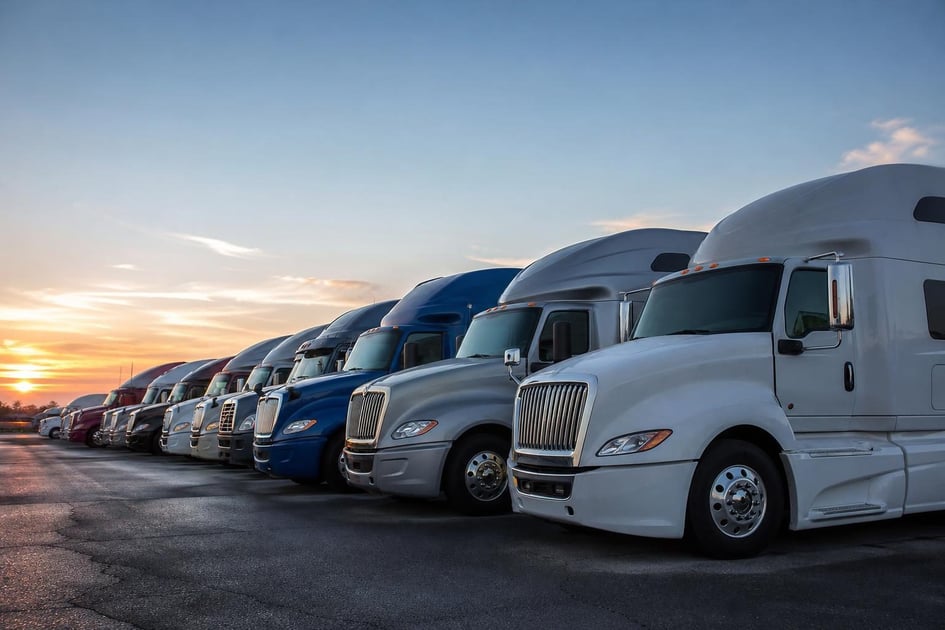
Semi truck financing breaks the cost of a Class 8 tractor into monthly payments while the truck itself secures the loan. That collateral-backed structure is why owner-operators with solid credit can access competitive rates even when a bank turns them down. At Provide Capital, we finance new and used semi trucks from $5,000 up to $5 million, with same-day approvals possible once your documentation is complete. If you are weighing your first rig or adding a tenth, see what financing you qualify for on that truck before you negotiate with the dealer.
What Semi Truck Financing Actually Covers
Most owner-operators assume financing covers only the tractor. In practice, a lender like Provide Capital can bundle the truck, warranties, delivery fees, and up-fitting into a single note. That matters because a $150,000 base cab can quickly become a $165,000 outlay once you add a headache rack, auxiliary power unit, and pre-delivery inspection.
The collateral is the equipment itself. Because the lender holds a security interest in the truck, rates vary by credit profile, equipment age and term rather than by real estate or personal guarantees alone. That structure also means you can finance a single truck or a fleet expansion without tying up your home or other business assets.
We serve Transportation equipment financing clients nationwide, from long-haul operators in Texas to refrigerated carriers in the Midwest. The application evaluates the truck’s expected resale value, your operating history, and the revenue the equipment will generate—not just a credit score.
Key Insight: Many dealers mark up financing through captive lenders by 1–3 percentage points above the rate the lender actually requires. Securing an approval through an independent equipment lender before you walk onto the lot gives you leverage to negotiate the cash price of the truck separately from the financing.
Get a fast decision on your equipment
Applying takes just a few minutes, and decisions can come as soon as the same day.
Start Your ApplicationNew vs. Used: How Age Affects Your Terms
The age and mileage of a semi truck change almost every term of your financing: down payment, rate, length of term, and whether the lender will approve the deal at all. Understanding these breakpoints before you shop keeps you from falling in love with a truck you cannot finance.
New Trucks (Current and Prior Model Year)
A new Class 8 tractor from Freightliner, Peterbilt, or Volvo typically runs between $165,000 and $250,000 depending on sleeper configuration and engine spec. Because the collateral is highest-quality, lenders offer the longest terms—up to 72 or 84 months—and the lowest down-payment requirements, often 10% to 20% for established operators.
New trucks also carry full manufacturer warranties, which lenders view as risk reduction. If the engine fails in year one, the repair does not come out of your cash flow, so you are less likely to miss a payment. That confidence translates into better rates for borrowers with strong credit.
Used Trucks (3 to 7 Years Old)
This is the sweet spot for many owner-operators. A four-year-old Kenworth T680 with 450,000 miles might cost $95,000 to $115,000—roughly half the price of new—while still offering modern emissions compliance and several years of reliable service. Terms on used trucks typically max out at 60 months, and down payments rise to 15% to 25%.
The key risk here is remaining engine life. A lender will check auction values and expected resale at the end of your term. If the truck will have 800,000 miles by month 60, the residual value may be too low to support a long loan, so expect a shorter term or larger down payment.
Older Trucks and Rebuilds (10+ Years)
Financing a truck with more than a decade of service or over 700,000 miles is harder but not impossible. Lenders cap terms at 36 to 48 months and may require 25% to 30% down. Some independent lenders specialize in glider kits or rebuilt engines, but the paperwork is heavier: expect to provide maintenance logs, rebuild invoices, and a third-party inspection report.
If you are considering an older truck to save capital, weigh the higher monthly payment against the lower purchase price. A $45,000 truck with 30% down and a 36-month term can strain cash flow more than a $110,000 truck on a 60-month note with 15% down.
Lease vs. Loan: Which Structure Fits Your Operation?
Owner-operators often confuse a loan with a lease. The difference is ownership. With an equipment loan, you hold title and build equity. With a lease, you are paying for use, and the lender owns the truck. Each structure has legitimate uses in trucking. The SBA offers guidance on equipment financing and leasing that breaks down when each structure makes sense for small businesses.
| Factor | Equipment Loan | FMV Lease | $1 Buyout Lease |
|---|---|---|---|
| Ownership | You own the truck; lender holds lien | Lender owns; you return or buy at fair market value | You own after final $1 payment |
| Down payment | 10%–25% | First and last payment | 10%–20% |
| Term | 36–84 months | 24–60 months | 36–72 months |
| Monthly cost | Higher than FMV, lower than $1 buyout | Lowest monthly cost | Higher monthly cost |
| Mileage limits | None | Yes, often 15,000–20,000 per quarter | None |
| Depreciation/Section 179 | Full eligibility | No; payments are expensed | Full eligibility |
| Best for | Owner-operators keeping the truck 5+ years | Short-term contracts or seasonal surges | Operators who want ownership with simpler underwriting |
If you drive 120,000 miles a year and plan to keep the truck for seven years, a loan almost always wins. If you are hauling peak-season retail freight for 18 months and want to hand the truck back, a fair-market-value lease preserves capital. Get a decision on your equipment, possibly the same day, and we will walk you through both structures.
What Lenders Look For: Qualification Criteria
Equipment lenders evaluate risk differently than banks. Because the truck is collateral, a weak credit score does not automatically kill the deal, but it does move you into a higher rate band and a larger down-payment requirement. Forbes Advisor outlines typical qualification thresholds for semi-truck financing, including down payment ranges and credit expectations.
Credit Profile
A FICO score above 680 generally unlocks the best terms. Scores from 620 to 679 still qualify at competitive rates, especially with two or more years in business. Below 620, expect to put 20% to 30% down and show compensating factors: a strong debt-service coverage ratio, a large cash reserve, or a co-signer with established credit.
Lenders also review your credit history for recent bankruptcies, repossessions, or judgments. A Chapter 7 discharge less than two years old is usually a stop; a Chapter 13 completed three years ago may be workable with 30% down and a detailed explanation.
Time in Business
Two years of operating history is the industry standard for the best rates. Businesses with less than one year of revenue are a separate risk category that most equipment lenders avoid. If you have one to two years, you can still qualify, but the down payment rises and the term shortens.
For established carriers with three or more years, lenders will ask for your last two years of tax returns and year-to-date profit and loss statements. They are looking for consistent revenue, not one blockbuster quarter.
Down Payment and Collateral
The down payment is your skin in the game. On a $130,000 truck, 15% down means $19,500. That equity absorbs first-year depreciation and gives the lender a buffer if you default. Some lenders allow you to substitute a trade-in equity for part of the down payment, but you will need a third-party appraisal or auction valuation.
By the Numbers: A borrower with a 720 credit score financing a $140,000 new sleeper cab over 72 months might see monthly payments in a range that varies by credit profile, equipment age and term. The same borrower on a 48-month note for an $85,000 used truck could see a higher monthly payment but substantially less total interest paid over the life of the loan.
See what you qualify for
The equipment itself secures the financing, which keeps rates competitive. Checking your options takes minutes.
Check Your OptionsThe Documentation You'll Need
Same-day approval is possible, but only if your paperwork is organized before you apply. Here is what an equipment lender typically requests:
- Driver’s license and social security card
- Last two years of personal and business tax returns
- Current profit and loss statement and balance sheet
- Three months of business bank statements
- Equipment quote or purchase agreement from the dealer or private seller
- Proof of insurance with the lender listed as loss payee
- USDOT and MC authority numbers, if applicable
- Driver qualification file, if you hold a CDL and operate under your own authority
For private-party sales, the lender will also require a lien search on the truck’s VIN and may insist on an independent inspection. Dealership sales are simpler because the title history is usually clean and the lender has existing relationships with the dealer.
Pro Tip: Organize your tax returns and bank statements in a single PDF before you start the application. Lenders process complete files in hours; incomplete files sit in queues for days while underwriters request missing pages. If you want same-day approval, send everything at once.
Cost Examples: Monthly Payments for Real Trucks
These examples illustrate how term, down payment, and credit band interact. Rates vary by credit profile, equipment age and term, so treat these as directional ranges, not quotes.
| Truck description | Price | Down | Term | Approx. monthly range |
|---|---|---|---|---|
| New sleeper, 2026 Freightliner Cascadia | $185,000 | 15% | 72 mo | Varies by credit profile |
| Used day cab, 2021 Peterbilt 579, 380k mi | $98,000 | 20% | 60 mo | Varies by credit profile |
| Older sleeper, 2015 Kenworth T660, 650k mi | $52,000 | 25% | 48 mo | Varies by credit profile |
| Glider kit, rebuilt engine, 2018 chassis | $75,000 | 30% | 36 mo | Varies by credit profile |
The total interest paid over the life of the loan drops sharply with larger down payments and shorter terms. On a $140,000 note, moving from 72 months to 60 months can save thousands in total finance charges, even if the monthly payment rises. Run the math both ways before you sign.
Tax Treatment for 2026
For the 2026 tax year, semi trucks purchased with an equipment loan may qualify for Section 179 expensing and bonus depreciation, allowing you to deduct a substantial portion of the purchase price in the first year. The exact deduction limits and phase-out thresholds are adjusted annually by the IRS. Because these figures change and because your eligibility depends on taxable income, business structure, and whether the truck is used more than 50% for business, speak with a CPA before you rely on any specific number.
If you structure the acquisition as a fair-market-value lease, you do not own the truck and cannot take depreciation. Instead, you deduct lease payments as an operating expense. For owner-operators who have already used their 2026 depreciation limits on other equipment, leasing can preserve deductions in future years.
The rules differ for S-corporations, LLCs, and sole proprietors. A CPA familiar with trucking will also help you navigate the heavy vehicle depreciation rules, which treat trucks over 6,000 pounds differently than passenger vehicles.
Common Mistakes Owner-Operators Make
Even experienced carriers trip over the same financing errors. Avoiding them saves money and stress.
Buying based on monthly payment alone. A 72-month term on a used truck with 400,000 miles means you may still owe money when the engine needs a rebuild. Match the term to the expected useful life of the truck.
Skipping the pre-buy inspection. On private-party sales, a $400 inspection can reveal $15,000 in deferred maintenance. Lenders may require it; even if they do not, pay for it yourself.
Not verifying title and lien status. A seller with an outstanding loan on the truck must pay it off before you take clean title. Escrow the transaction or have the lender handle the payoff directly.
Ignoring total cost of ownership. Fuel efficiency, DEF consumption, and expected maintenance vary enormously between a 2026 model and a 2015 model. A cheaper truck that gets 6.2 mpg versus 7.4 mpg can cost you thousands extra per year in diesel. Reuters reported in 2026 that diesel spending has hit record highs for U.S. truckers, making fuel economy a critical factor in total cost calculations.
Key Insight: Many owner-operators assume they must finance through the dealer to get the truck. Dealers often earn a flat fee or reserve from the finance company, which means their quoted rate is not necessarily the lowest available. Shopping your financing independently—before you negotiate—typically saves more than haggling over the truck price alone.
What Happens After You Apply
Once you submit a complete application, the timeline looks like this:
- Initial review (1–4 hours): The underwriter checks credit, verifies time in business, and reviews the equipment quote.
- Approval or conditional approval: You receive terms including down payment, rate range, and term. The approval is usually valid for 30 days.
- Documentation and verification: You provide proof of insurance, a copy of the purchase agreement, and any missing financials.
- Funding: The lender pays the dealer or private seller directly. You take delivery and begin payments 30 to 45 days later, depending on the funding date.
Same-day approvals are realistic for borrowers with clean credit and complete files. Complex deals—recent credit events, missing financials, or private-party sales with title issues—can take two to five business days.
After funding, the lender files a UCC-1 financing statement against the truck. Once you make the final payment, the lender releases the lien and you hold clear title. Keep your title release letter in a safe place; you will need it when you trade or sell.
Put the right equipment to work
From $5,000 to $5 million, new or used, Provide Capital helps businesses nationwide finance the equipment they need.
Apply TodayFAQ
Can I finance a semi truck with a 600 credit score?
Yes, but expect a larger down payment—often 20% to 30%—and a shorter term. The equipment itself is collateral, so a low credit score does not automatically disqualify you, but it does move you into a higher rate band.
How much down payment do I need for a used semi truck?
Down payments range from 10% to 30% depending on credit, time in business, and truck age. New trucks for established operators start around 10% to 15%. Used trucks over five years old usually require 20% to 25%.
Can I finance a truck from a private seller?
Yes. The lender will run a title search on the VIN, require an independent inspection, and may pay the seller directly after verifying payoff of any existing liens. Private-party deals take slightly longer but are common.
Does financing a semi truck build business credit?
If the loan reports to business credit bureaus, consistent on-time payments strengthen your business credit profile. Ask the lender whether they report to Dun & Bradstreet, Experian Business, or Equifax Business before you apply.
What is the longest term available for semi truck financing?
New trucks can be financed up to 72 or 84 months. Used trucks generally max out at 60 months, and trucks over 10 years old are usually capped at 36 to 48 months.
Can I include taxes, title, and up-fitting in the loan?
Most equipment lenders allow you to roll soft costs into the financed amount as long as the total does not exceed the truck’s appraised value or the lender’s advance limits. Ask your underwriter what is permitted.
What happens if I want to pay off the loan early?
Most equipment loans have no prepayment penalty, but some leases charge a fee for early termination. Review your agreement carefully. If early payoff is important to you, confirm the policy before you sign.
Do I need a CDL to finance a semi truck?
You do not need a CDL to apply, but you will need to show how the truck generates revenue. If you are an owner-operator with your own authority, the lender will verify your USDOT and MC numbers. If you are leasing the truck to a carrier, expect to provide the lease agreement.
Next Steps
Start by deciding whether you need a new or used truck, whether a loan or lease fits your mileage and holding period, and how much cash you can put down without straining operations. Then gather your tax returns, bank statements, and equipment quote in one folder.
With those in hand, start an application in a few minutes. We can often return a decision the same day, and because the truck secures the financing, you do not need perfect credit or a massive real estate portfolio to qualify. Whether you are adding a Dump Trucks financing unit to a construction fleet or expanding your over-the-road operation, the process is the same: apply, approve, fund, haul.
If you want to explore how other commercial vehicles are financed, read our guides on Semi Trucks financing, Tow Truck financing, and Reefer Truck financing. Each equipment type has its own residual value curve and underwriting norms, and the differences can save you thousands.
Disclaimer: The information provided in this article is for general educational purposes only and is not financial, legal, or tax advice. Funding terms, qualifications, and product availability may vary and are subject to change without notice. Provide Capital does not guarantee approval, rates, or specific outcomes. For personalized information about your business funding options, contact our team directly.
