
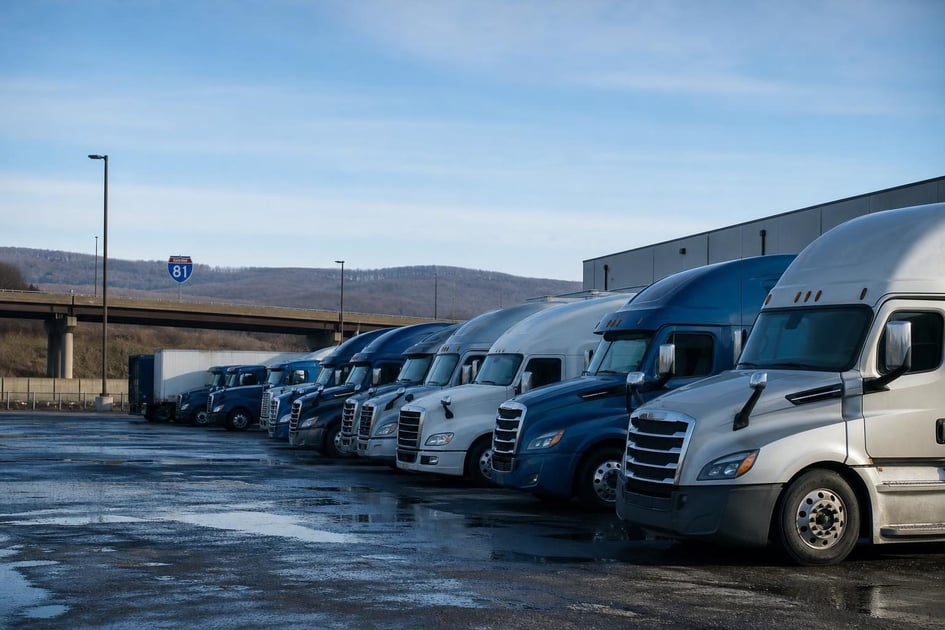
Semi truck financing in Pennsylvania works the same way it does across the country, with one difference: the loads you haul and the seasons you face are specific to the Keystone State. Whether you are hauling frac sand out of the Marcellus Shale region, produce from Lancaster County to the Port of Philadelphia, or flatbed freight along I-81 through Scranton and Harrisburg, the truck itself serves as the collateral. That keeps rates competitive and opens the door to same-day approvals for qualified buyers. If you are shopping for your first rig or adding a fifth unit to a small fleet, start an application to see what you qualify for on that truck before you commit to a seller.
Why Pennsylvania Demands Its Own Financing Conversation
Pennsylvania is not a generic freight market. The state sits between the Midwest manufacturing belt and the Northeast consumption corridor, which means owner-operators here run a wider mix of lanes than drivers in many other states. According to U.S. Census Bureau data on Pennsylvania, the state maintains a deep manufacturing base, significant agricultural output, and growing energy logistics needs. Those factors shape what kind of truck you need, how many miles you will put on it, and when you are most likely to need financing.
The I-80 corridor across the northern tier handles everything from cross-country van freight to timber out of the Allegheny National Forest. I-81 runs north-south through the spine of the state, serving distribution centers near Carlisle and Hagerstown. The Pennsylvania Turnpike moves freight between Pittsburgh and Philadelphia, connecting the Ohio Valley to the Delaware Valley ports. If your operation touches any of these corridors, your financing should account for the mileage, the terrain, and the seasonal surges.
Seasonality matters more in Pennsylvania than in states with milder winters. Road salt and heating oil deliveries spike from November through February. Agricultural harvest runs hard from September through early November. Construction season, which drives flatbed and dump trailer demand, compresses into late April through October. Owner-operators who finance a truck in March often do it to capture the construction season. Those who buy in August are usually positioning for harvest or holiday retail freight. A lender that understands Transportation equipment financing will structure payments around those cash-flow rhythms instead of treating every application like a generic long-haul operation.
Key Insight: Pennsylvania owner-operators who haul into New York City or New Jersey regularly should budget for higher toll and fuel costs than drivers running regional Midwest lanes. Lenders familiar with the I-80 and I-81 corridors factor those operating costs into approval decisions, which can improve your chances if your revenue supports the route.
Already have a machine in mind?
Provide Capital finances new and used equipment from $5,000 to $5 million, with same-day decisions possible.
Apply NowNew vs. Used: What PA Owner-Operators Actually Face
The decision between a new Class 8 sleeper and a used day cab is not just about purchase price. It is about uptime, warranty coverage, and how quickly the truck can start generating revenue. In Pennsylvania, where winter road salt accelerates corrosion and steep Appalachian grades strain drivetrains, the age and condition of the truck matter more than they might on flat interstate routes.
A new semi truck from a major manufacturer typically runs between $150,000 and $200,000 depending on sleeper size, engine spec, and emissions package. A three- to five-year-old used truck often falls in the $80,000 to $140,000 range. Older units, especially those with higher mileage or pre-emissions engines, can trade below $60,000. Because Provide Capital finances both new and used equipment from $5,000 up to $5 million, a single owner-operator and a ten-truck fleet can use the same program.
Used trucks in Pennsylvania move fast in the spring. Dealers in Pittsburgh, Harrisburg, and outside Philadelphia report that inventory turns quicker when construction season approaches. If you find a truck you want, it pays to have financing prearranged. Get a decision on your equipment, possibly the same day, so you do not lose the unit to another buyer.
| Factor | New Semi Truck | Used Semi Truck (3–5 Years) |
|---|---|---|
| Purchase price | $150,000–$200,000 | $80,000–$140,000 |
| Warranty | Full manufacturer coverage | Limited or expired; aftermarket plans available |
| Down payment expectation | Often 10–20% | May start at 5–15% depending on age and miles |
| Financing term | Up to 60–72 months | 48–60 months common; older units may see shorter terms |
| Maintenance risk | Low in first 3 years | Higher; budget $15,000–$25,000 annually for a 5-year-old unit |
| Depreciation | Steepest in years 1–2 | Slower; less negative equity risk |
One detail Pennsylvania buyers often miss: title brands. Trucks that spent their early life in the Northeast may have salt-related frame corrosion that does not show on a Carfax-style report but will fail a DOT inspection. Always get a pre-purchase inspection from a diesel shop that knows how to check for rust in frame rails, cab mounts, and fifth-wheel assemblies. If you are unsure about the truck's history, Semi Trucks financing specialists can walk you through what condition standards lenders expect.
Qualifying for Semi Truck Financing
Lenders evaluate three things: the borrower, the equipment, and the business cash flow. You do not need perfect credit, but you do need a track record. Most equipment lenders prefer at least two years in business, though some programs accept newer operations if the buyer has relevant industry experience and a reasonable down payment. As SBA guidance on small-business loans explains, equipment-backed financing often carries more flexible terms than unsecured credit because the collateral itself reduces lender risk.
Credit scores in the mid-600s and above generally unlock the most competitive structures. Scores below that do not automatically disqualify you, but they may require a larger down payment or a shorter term. Rates vary by credit profile, equipment age, and term length. Because the truck serves as collateral, lenders are often more flexible than they would be for an unsecured line of credit.
Time in business matters because equipment lenders want evidence that you can generate revenue with the asset. A driver with five years of W-2 trucking experience who is going independent for the first time is a different risk than a brand-new CDL holder. If you are transitioning from company driver to owner-operator, bring tax returns or 1099s that show your historical earnings. Some lenders will also accept a signed freight contract or rate confirmation as proof of future revenue.
Down payments typically range from 5% to 20%. New trucks with strong borrower profiles sometimes qualify with less money down. Used trucks older than seven years or with more than 700,000 miles may require 15% to 25% to offset the collateral risk. The goal is to create equity in the vehicle from day one so the loan balance does not exceed the truck's market value.
Pro Tip: If you are buying your first truck and have less than two years of operating history, consider adding a co-signer with established business credit or offering a larger down payment. Either move can shift an approval from a higher rate tier to a standard structure, saving thousands over the life of the loan.
Lease vs. Loan: Which Structure Fits Your PA Operation?
Equipment loans and equipment leases both let you put a truck to work without paying the full purchase price upfront, but they treat ownership, taxes, and end-of-term obligations differently. Pennsylvania owner-operators who plan to keep a truck for ten years and put a million miles on it usually favor loans. Those who want to refresh equipment every four years to avoid maintenance risk sometimes prefer leases.
| Feature | Equipment Loan | Equipment Lease (Capital or FMV) |
|---|---|---|
| Ownership | You own the truck; lender holds a lien | Lessor owns the truck; you may have a buyout option |
| Monthly payment | Higher, but builds equity | Often lower, especially on FMV leases |
| Mileage limits | None | May apply on some operating leases |
| Maintenance responsibility | Your responsibility | Your responsibility unless a full-service lease |
| Section 179 deduction | Eligible if you own | Eligible on capital leases; operating leases have different treatment |
| End of term | Free and clear title | Return, renew, or buy at fair market value or fixed price |
A loan makes sense if you have a trusted mechanic, run your own authority, and want the flexibility to modify the truck. A lease can make sense if you are running under another carrier's authority and want predictable payments with an easy upgrade path. Be careful with mileage caps. Pennsylvania owner-operators running long-haul out of the Port of Philadelphia or cross-border into Canada can rack up 120,000 miles a year quickly. Excess mileage charges on a lease can erase any monthly payment advantage.
See what you qualify for
The equipment itself secures the financing, which keeps rates competitive. Checking your options takes minutes.
Check Your OptionsTax Treatment for the 2026 Tax Year
For the 2026 tax year, Section 179 allows businesses to deduct the full purchase price of qualifying equipment in the year it is placed in service, subject to an annual limit. The exact dollar cap for 2026 is set by the IRS and adjusts for inflation. Because those limits are not finalized in public guidance at the time of writing, you should confirm the current-year ceiling with a CPA before making a purchase decision. What does not change is the underlying rule: if you buy and place a truck into service in 2026, you may be able to deduct a significant portion—or potentially all—of the cost under Section 179, provided your taxable income supports the deduction.
Bonus depreciation is also available in 2026, though the percentage has been stepping down from the 100% level seen in prior years. Again, the specific percentage for 2026 should be verified with your accountant. The combination of Section 179 and bonus depreciation can create substantial first-year write-offs, but only if the truck is used for business more than 50% of the time and is placed in service before December 31, 2026.
Lease payments, by contrast, are typically deducted as a business expense over time rather than front-loaded in year one. The structure that saves you the most in taxes depends on your revenue, profit, and existing deductions. This is not a do-it-yourself decision. Speak with a CPA who understands both transportation accounting and the 2026 equipment depreciation rules before you sign.
By the Numbers: A Pennsylvania owner-operator who purchases a $120,000 used sleeper cab and qualifies for a combined Section 179 and bonus depreciation deduction could potentially write off the majority of that cost in 2026. Even at a 25% effective tax rate, that deduction represents a $30,000 reduction in tax liability—money that can go toward fuel, insurance, or your next truck. Confirm the exact 2026 limits with your CPA before you buy.
Industry-Specific Use Cases in Pennsylvania
Pennsylvania's economy is not monolithic, and neither is its trucking. The financing structure that works for a flatbed hauler in Pittsburgh is different from what a reefer operator needs in the Lehigh Valley.
Energy and Frac Sand. The Marcellus and Utica shale plays in western and northern Pennsylvania generate demand for pneumatic tankers and heavy-spec day cabs. These trucks often run on private lease roads and see harder duty cycles than highway tractors. Lenders familiar with energy-sector equipment understand that a frac sand hauler may put 80,000 miles a year on a truck but generate higher revenue per mile than a dry van operator. If you are expanding into this space, Dump Trucks financing may also be relevant for your support fleet.
Agriculture. From dairy haulers in Chester County to grain transporters in Centre County, agricultural trucking in Pennsylvania is seasonal and time-sensitive. A reefer unit hauling produce to the Philadelphia Wholesale Produce Market needs reliable uptime during harvest windows. Financing terms for agricultural operators sometimes align with crop payment cycles, with heavier payments in the revenue months and lighter obligations in the winter.
Manufacturing and Distribution. The corridor between Allentown and Harrisburg is dense with warehouses and distribution centers. Day cabs and straight trucks moving shuttle freight between facilities do not need sleeper berths, which lowers the entry price. These buyers often finance multiple units at once and need a lender that can close quickly so they do not miss contract start dates.
Construction and Forestry. Pennsylvania's construction season is short. A dump truck or flatbed hauling material from quarries in York County or lumber from the Poconos needs to be on the road the day the ground thaws. Used construction-spec trucks with low gearing and reinforced suspensions are common in this segment. If your operation includes material handling, you may also want to explore Bucket Trucks financing for utility and tree-work support.
Common Mistakes Pennsylvania Buyers Make
The most expensive mistake is buying the truck before arranging financing. Sellers, especially private parties, rarely hold inventory while you sort out a loan. If you find a truck at a Pittsburgh auction or through a Facebook group, have your approval in hand before you bid.
Another common error is ignoring seasonal cash flow. A driver who finances a truck in October with payments based on summer construction revenue can find himself underwater by February when freight slows. Match your payment structure to your slowest quarter, not your best one.
Finally, do not assume every used truck with a clean title is structurally sound. Pennsylvania's use of road salt means corrosion is a bigger issue here than in southern states. Check the frame, the cab mounts, and the fifth wheel plate before you commit. A $40,000 truck that needs $15,000 in frame repairs is not a bargain.
What Documentation You Need
Equipment lenders move faster when you bring complete paperwork. Expect to provide:
- A valid commercial driver's license (CDL) with the correct endorsements
- Your most recent two years of tax returns or 1099s
- Three months of business bank statements
- A quote or purchase agreement from the seller, including VIN, year, make, model, and mileage
- Proof of insurance quote or binder for the specific truck
- Your motor carrier authority number or a letter of intent from the carrier you will lease onto
If you are buying from a private seller, the lender will also need the seller's payoff information if there is an existing lien, plus a copy of the current title. Some lenders require an independent appraisal for used trucks over a certain age or value. The entire process, from application to funding, can take as little as one business day if the file is clean. According to Reuters reporting on tight truck capacity, demand for reliable tractors remains strong, so having your documents ready gives you an edge in a competitive used market.
What Happens After Approval
Once approved, the lender issues a funding authorization or letter of intent. You sign the closing documents, which typically include a UCC-1 filing that secures the lender's interest in the truck. The lender then pays the seller directly or wires funds to escrow. You take delivery, activate your insurance, and start hauling.
Same-day approvals are possible, but same-day funding depends on how quickly the seller can provide a clear title and how fast your insurance binder is issued. If you are buying from a dealer, funding usually happens within 24 to 48 hours. Private-party sales can take longer if there is a lien to satisfy or if the title is held out of state.
After closing, your priority is to keep the truck insured and maintained. Most equipment loans do not have prepayment penalties, but you should confirm that in your closing documents. If you pay off the loan early, the lender releases the UCC filing and mails you the clean title.
Pro Tip: Set up automatic payments from your business checking account aligned with your freight payment cycle. Pennsylvania owner-operators who get paid weekly by their factoring company should consider weekly or semi-monthly ACH drafts instead of one large monthly payment. It smooths cash flow and reduces the risk of a missed payment during a slow freight week.
Ready to move forward?
More than 10,000 businesses have financed equipment with Provide Capital. See what you qualify for today.
Get StartedFrequently Asked Questions
Can I finance a semi truck with a 600 credit score?
Yes, though the structure depends on the full file. A 600 score with two years in business, a reasonable down payment, and verifiable freight income is very different from a 600 score with no operating history. Rates vary by credit profile, equipment age, and term length, so the best way to know your options is to apply and review the terms.
How much down payment do I need?
Down payments typically start around 5% to 10% for strong credit borrowers buying newer trucks. They can climb to 15% to 25% for older equipment, lower credit scores, or first-time owner-operators. There is no universal minimum; every application is evaluated individually.
Can I finance a truck from a private seller?
Yes. Private-party sales are common in Pennsylvania, especially for used day cabs and older sleeper models. The lender will need the seller's title information, a payoff letter if there is an existing loan, and may require an independent inspection. Funding can take a day or two longer than a dealer sale.
Is the trailer included in semi truck financing?
Usually not, unless the trailer is part of a single package deal and the lender agrees to secure both. Most semi truck loans cover the tractor only. If you need a trailer, you can finance it separately. Provide Capital finances trailers and other Reefer Truck financing equipment as standalone transactions.
How long are the terms?
Terms for new trucks often run 60 to 72 months. Used trucks usually see 48 to 60 months. Very old or high-mileage units may be limited to 36 months. The goal is to keep the term aligned with the truck's useful life so you are not making payments on a unit that is no longer revenue-generating.
Can I pay off the loan early?
Most equipment loans do not carry prepayment penalties, but you should verify this before signing. Paying off early saves interest and releases the lender's lien, giving you full equity in the truck sooner.
What if I haul cross-country instead of staying in Pennsylvania?
It does not matter where you haul as long as the truck is domiciled in the U.S. and properly insured. Lenders care about the revenue the truck generates, not the specific interstate. Just make sure your operating authority and insurance cover the lanes you run.
Do you finance both day cabs and sleeper cabs?
Yes. Day cabs are common in regional and construction applications around Pittsburgh and Philadelphia. Sleeper cabs dominate the long-haul and team-driver markets. Both are eligible as long as they meet the lender's age and condition requirements.
Your Next Step
If you have a truck in mind—or even if you are still comparing models—the next step is to get a financing decision. Provide Capital serves Pennsylvania owner-operators across every major corridor, from the Ohio border to the Delaware River. We finance new and used business equipment from $5,000 to $5 million, with same-day approvals possible for qualified buyers. See what financing you qualify for on that excavator, day cab, or sleeper tractor and move from shopping to hauling.
Disclaimer: The information provided in this article is for general educational purposes only and is not financial, legal, or tax advice. Funding terms, qualifications, and product availability may vary and are subject to change without notice. Provide Capital does not guarantee approval, rates, or specific outcomes. For personalized information about your business funding options, contact our team directly.
