
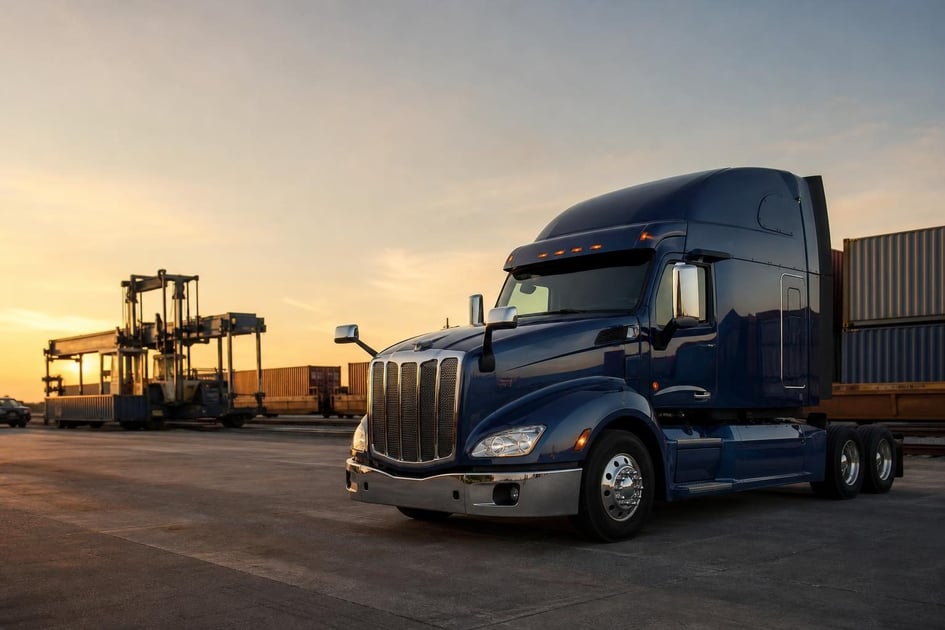
What Used Semi Truck Financing Actually Looks Like
Financing a used semi truck works exactly like financing the equipment itself: the truck is the collateral, which means the lender secures the loan against the vehicle rather than against real estate or a blanket lien on your entire business. For owner-operators and small fleet owners, this structure keeps the barrier to entry lower than unsecured credit and often produces more competitive rates than a general business term loan. At Provide Capital, we finance used semi trucks from $5,000 up to $5 million, with same-day approvals possible when the application file is complete. Rates vary by credit profile, equipment age and term.
The used truck market matters because most owner-operators cannot absorb the depreciation hit of a new tractor. A new Class 8 truck can lose 20 to 30 percent of its value in the first year alone. A three- to five-year-old unit has already absorbed that drop, letting the buyer finance a lower principal while still getting a truck with modern emissions equipment and several hundred thousand miles of remaining useful life. The trade-off is that lenders scrutinize used equipment more closely: mileage, engine history, and remaining warranty coverage all influence approval odds and down-payment requirements.
Key Insight: Lenders typically cap the age of a used semi truck at 10 to 15 years at the end of the loan term, not at the time of purchase. If you are financing a 2018 tractor on a five-year note, the truck will be 13 years old at payoff. Some lenders will approve that deal; others will not. Always confirm the age-cap policy before you shop.
Why Owner-Operators Choose Used Over New
The decision is usually arithmetic, not sentiment. According to Forbes reporting on owner-operator survey data, the average cost of a new vehicle was $145,000 and $60,000 for used, with entrepreneurs in the sector facing annual expenses upwards of $187,000 despite gross income averaging $258,000. A new sleeper cab from a major manufacturer runs between $145,000 and $200,000 depending on specifications, while a quality used unit in the three- to five-year range often sells for $60,000 to $110,000. That spread changes the monthly payment dramatically. On a $150,000 new truck with a modest down payment, the monthly obligation can run well into the mid-four figures. On an $80,000 used truck, the payment often lands in a range that leaves room for fuel, insurance, maintenance, and a reserve for unexpected repairs.
Insurance costs also favor used trucks. Physical-damage premiums scale with the value being insured, and a $70,000 tractor costs less to cover than a $180,000 one. For an owner-operator running under their own authority, that difference can free up several hundred dollars per month.
Resale strategy matters too. If you finance a new truck and need to sell within two years because freight lanes shift or a medical issue arises, you may owe more than the market value. With a used truck purchased at market-correct pricing, equity builds faster and the loan balance tends to track closer to resale value. That reduces the risk of being underwater if you need to exit the note early.
See what you qualify for on your next used semi truck before you start negotiating with sellers. Knowing your budget ceiling keeps you from falling in love with a truck you cannot comfortably afford.
How Used Semi Truck Financing Works
Collateral Structure
Equipment financing is a secured transaction. The lender files a UCC-1 lien against the specific truck, not against your business broadly. That matters for two reasons. First, it preserves your other assets and receivables from encumbrance. Second, because the lender has a hard asset to repossess and resell if necessary, the risk profile is lower than an unsecured advance, which translates into better pricing and longer terms for the borrower.
The loan-to-value ratio on a used semi truck typically ranges from 80 to 100 percent of the appraised or invoice price, depending on credit strength and equipment age. Strong borrowers with established operations can sometimes finance the full purchase price plus soft costs such as delivery, inspection, and initial registration. Borrowers with newer businesses or lower credit scores should expect to put 10 to 20 percent down.
The SBA's equipment financing guidance recommends reviewing your credit report and organizing financial information before contacting a lender. That preparation speeds underwriting and can improve the terms you are offered.
Terms and Amortization
Used semi truck loans usually run 36 to 72 months. The term is matched to the expected remaining useful life of the asset. A seven-year-old truck with 600,000 miles will not get a 72-month term because the lender does not want the collateral aged out before the note is repaid. A three-year-old truck with 300,000 miles is a different story and may qualify for the longer end of the range.
Payments are fixed and monthly. There is typically no prepayment penalty on a simple-interest equipment loan, but you should verify this explicitly because some lease-like structures do impose early-termination fees.
By the Numbers: A $75,000 used semi truck financed over 60 months with 15 percent down produces a principal balance of $63,750. Depending on credit and equipment age, the monthly payment can land in a range that is manageable for an owner-operator grossing $15,000 to $25,000 per month. Rates vary by credit profile, equipment age and term.
New vs. Used Semi Trucks: A Side-by-Side Look
Before you decide, it helps to see the trade-offs in one place. The table below compares the two paths on the factors that most directly affect financing and cash flow.
| Factor | New Semi Truck | Used Semi Truck (3-5 Years) |
|---|---|---|
| Purchase price | $145,000-$200,000+ | $60,000-$110,000 |
| First-year depreciation | 20-30% | Already absorbed |
| Typical down payment | 10-20% | 0-20% |
| Loan term available | 60-84 months | 36-72 months |
| Monthly payment range | Higher | Lower |
| Insurance cost | Higher | Lower |
| Warranty coverage | Full manufacturer | Limited or expired |
| Emissions compliance | Current | Verify EPA year and state rules |
| Maintenance reserve needed | Lower initially | Higher recommended |
The right column is not a downgrade. It is a different risk-return profile. If you are an experienced mechanic or you run a shop-capable yard, a used truck at the right price can generate more net revenue per mile than a new one. If you are a new owner-operator without maintenance support, the warranty and reliability of a new unit may justify the premium.
Semi Trucks financing through Provide Capital covers both new and used units. The application process is the same; the difference shows up in the term, down payment, and rate.
What Lenders Look For in a Used Truck Borrower
Credit and Time in Business
Lenders evaluate personal credit, business credit if it exists, and the length of time you have held your operating authority. A 720-plus personal credit score with two or more years in business will open the door to the best terms and the lowest down payments. A score in the mid-600s with six months of operating history is still financeable, but expect a higher down payment and a shorter term.
Time in business matters because trucking has a high first-year failure rate. Lenders mitigate that risk by requiring more skin in the game from newer operators. If you have been running under your own authority for less than a year, plan on 15 to 25 percent down and be ready to show freight contracts or lane history that demonstrates consistent revenue.
The Truck Itself
On a used deal, the collateral gets as much scrutiny as the borrower. Lenders want to see a clean title, a verifiable maintenance history, and an inspection report from a certified diesel shop. High mileage is not automatically a disqualifier, but it narrows the lender pool. A truck with 750,000 miles needs a stronger credit story than one with 350,000 miles.
Make and model matter too. Lenders prefer nameplates with strong resale markets and nationwide parts availability. A widely sold Class 8 tractor from a major manufacturer is easier to finance than a low-volume import with limited service support. Engine type also plays a role; pre-emissions or early emissions engines can face restrictions in certain states, and lenders factor that into their collateral risk.
Pro Tip: Before you commit to a used truck, pull its complete maintenance history and order an independent inspection that includes oil-sample analysis. A $400 inspection can reveal a $15,000 engine problem. Lenders increasingly require this documentation anyway, so doing it early speeds approval and protects you from buying a financed lemon.
Lease vs. Loan: Choosing the Right Structure
Equipment loans and equipment leases are both available for used semi trucks, but they work differently and produce different balance-sheet and tax outcomes.
A loan is straightforward: you borrow the money, buy the truck, and pay down the principal plus interest over time. At the end of the term you own the truck free and clear. The interest is deductible, and for tax year 2026 you may be able to take bonus depreciation or Section 179 expensing on the purchase, subject to current-year limits. Because you own the asset, you carry it on your balance sheet and you claim the depreciation.
A finance lease, sometimes called a $1 buyout lease, looks similar but is structured as a lease for accounting purposes. You make monthly payments and own the truck at the end for a nominal amount. The tax treatment can differ depending on whether the lease qualifies as a true lease or a finance lease under current IRS rules. For tax year 2026, consult a CPA to determine whether lease payments or depreciation gives you the better outcome based on your taxable income and bracket.
An operating lease, or true lease, is less common for used semi trucks but still available in some cases. You pay to use the truck for a set term and return it at the end. This preserves capital and keeps the liability off your balance sheet, but it is generally more expensive over the long run and may include mileage or condition restrictions that do not fit over-the-road trucking.
Most owner-operators who intend to keep a truck for its full useful life choose a loan or a finance lease. If you expect to trade every three years to avoid major maintenance, an operating lease may be worth exploring.
Tax Treatment for Tax Year 2026
The tax rules for equipment acquisition change regularly, and tax year 2026 is no exception. As of the 2026 tax year, Section 179 expensing and bonus depreciation remain available for qualifying business equipment, including used semi trucks, but the specific dollar limits and phase-out thresholds are set by legislation that can shift from year to year. Rather than quote a limit that may have been updated since this writing, the safest approach is to speak with a CPA who can apply the 2026 limits to your specific taxable income and entity structure.
What does not change is the basic principle: if you finance a used semi truck and place it in service during tax year 2026, the interest portion of your payments is deductible as a business expense. If you structure the deal as a purchase, you may also be able to deduct some or all of the cost through Section 179 or bonus depreciation, again subject to the 2026 limits and your CPA's guidance.
One common misconception is that you must pay cash to get the tax benefit. That is false. The IRS does not care whether you paid cash or financed the truck; the deduction is based on placing the equipment in service and meeting the qualification rules for the deduction type you elect.
State tax treatment varies. Some states conform to federal depreciation rules; others decouple or cap the deduction. If you operate across state lines, your CPA should model the impact in each jurisdiction where you file.
The Documentation Checklist
Same-day approvals are possible, but only when the file is complete. Gathering these documents before you apply will keep the process moving.
- Personal and business tax returns for the past two years
- Current profit-and-loss statement and balance sheet
- Bank statements for the past three to six months
- Copy of your commercial driver's license and medical card
- Operating authority (MC number) and proof of active insurance
- Vehicle identification number, year, make, model, and mileage
- Seller invoice or purchase agreement
- Independent inspection report
- Maintenance history if available
For newer businesses without two years of tax returns, substitute freight contracts, broker settlement statements, and a detailed business plan that includes projected revenue and expense lines. The more documentation you provide, the faster the underwriter can reach a decision.
Get a same-day decision on your equipment by submitting a complete application with your truck already identified. Pre-qualification without a specific unit is also available if you want to know your buying power before you shop.
Common Mistakes to Avoid
Even experienced operators make missteps when financing used equipment. Here are the ones we see most often.
Buying before qualifying. It is emotionally easy to fall in love with a truck at a dealership or auction, then scramble for financing. If the lender requires a 20 percent down payment and you only budgeted for 10 percent, you either lose the truck or pay a premium for secondary financing. Get your financing lined up first.
Ignoring the total cost of ownership. The monthly payment is only one line item. Used trucks need maintenance reserves. Set aside 10 to 15 cents per mile for repairs and unexpected component failures. If you run 100,000 miles per year, that is $10,000 to $15,000 annually. Budget for it. As Reuters reported on diesel spending pressures in 2026, fuel and maintenance together represent the largest operating-cost category for most carriers.
Overlooking emissions compliance. A 2014 truck with a pre-DEF engine may be cheap, but some states and ports now restrict entry for older emissions profiles. Verify that the truck can legally operate in every lane you intend to run.
Accepting the first offer. Terms vary by lender appetite, equipment age, and your credit profile. A difference of one or two percentage points in the rate can mean thousands of dollars over the life of the note. Rates vary by credit profile, equipment age and term, so it pays to compare.
Skipping the title search. Used trucks sometimes carry hidden liens or title brands such as salvage or rebuilt. A clean-looking cab can have a clouded ownership history. Run a title search and verify the lien release before you close.
What Happens After You Apply
Once you submit a complete application, the review process typically moves in three stages. First, the lender verifies your credit and business history. Second, the underwriter reviews the equipment specifics: age, mileage, condition, and valuation. Third, the file moves to documentation and funding. If the truck is already inspected and the title is clear, this final stage can complete within 24 to 48 hours.
The lender wires funds directly to the seller or, in some cases, issues a draft payable to the seller and you jointly. You take possession once the seller confirms receipt. Your first payment is usually due 30 to 45 days later, giving you time to put the truck to work before the note begins.
After closing, the lender holds the title until the loan is paid in full. You are responsible for maintaining full-coverage insurance with the lender listed as loss payee. Most lenders also require that you keep the truck in good operating condition and address any major mechanical issues promptly, since the vehicle is their collateral.
Key Insight: Some lenders offer seasonal payment structures for trucking operations that slow in winter. Instead of twelve equal payments, you may be able to structure lower payments in January and February and higher payments in peak freight months. Ask whether your lender accommodates seasonal cash flow if your lanes are weather-dependent.
Frequently Asked Questions
Can I finance a used semi truck with bad credit?
Yes, but the terms will reflect the risk. Expect a larger down payment, a shorter term, and a higher rate than a prime borrower. Some lenders specialize in near-prime and subprime equipment financing for borrowers with credit scores in the low 600s or below, provided the truck is solid collateral and the borrower can demonstrate consistent freight revenue. Rates vary by credit profile, equipment age and term.
How old can a used semi truck be to qualify for financing?
Most lenders cap the truck's age at 10 to 15 years at the end of the loan term. That means a 10-year-old truck might qualify for a 36-month note but not a 60-month note. Exceptions exist for well-maintained classics or trucks with rebuilt engines, but those deals usually require a larger down payment or a stronger credit profile.
Is a down payment always required?
No. Borrowers with strong credit and two or more years in business can sometimes secure 100 percent financing on a used semi truck. Newer businesses or borrowers with credit challenges should plan on 10 to 20 percent down. The down payment reduces the lender's risk and demonstrates your commitment to the asset.
Can I finance a truck from a private seller?
Yes. Equipment financing is not limited to dealership purchases. Private-party sales are common in trucking. The lender will still require a clean title, an inspection, and a purchase agreement. Funds are typically wired directly to the seller or held in escrow until the title transfer is complete.
Does financing a used truck affect my ability to get a loan for another truck later?
It can, but not necessarily negatively. A paid or paying equipment loan with no late payments strengthens your credit profile and demonstrates to lenders that you can manage secured debt. However, if your debt-service coverage ratio becomes too thin because you are carrying multiple large notes, the next underwriter may require a larger down payment or additional collateral.
What happens if the truck needs major repairs soon after purchase?
The loan continues regardless of mechanical condition. That is why an independent inspection and a maintenance reserve are essential. Some borrowers purchase an extended warranty or component protection plan at closing, financed into the loan if the lender allows. Without coverage, you are responsible for repair costs while continuing to make payments.
Can I pay off the loan early?
Most simple-interest equipment loans allow early payoff without penalty. Lease structures and some promotional-rate products may impose prepayment fees or require that you pay a portion of the remaining interest. Read the loan agreement carefully before signing, and ask your financing specialist to point out the prepayment language.
How does this differ from Transportation equipment financing for other vehicle types?
The core process is similar, but semi trucks carry unique considerations. Heavy-duty tractors log more miles, suffer more frame stress, and hold value differently than lighter commercial vehicles. Lenders that specialize in Dump Trucks financing or Tow Truck financing may not underwrite Class 8 highway tractors with the same terms. Working with a lender that understands the difference ensures you get a structure matched to the asset.
Ready to Move Forward?
Used semi truck financing is not complicated, but it does reward preparation. Know your credit standing, save your down payment, choose a truck with clean documentation, and gather your financials before you apply. The operators who close fastest and get the best terms are the ones who treat financing as a step in the purchase process, not an afterthought.
If you have a truck in mind or just want to know your budget before you shop, talk to a specialist about your specific machine. Provide Capital finances used semi trucks nationwide, from single-unit owner-operators to small fleets adding their fifth or tenth tractor. Same-day approvals are possible, and the equipment itself is the collateral. Rates vary by credit profile, equipment age and term. Get your numbers and make your next move with confidence.
Disclaimer: The information provided in this article is for general educational purposes only and is not financial, legal, or tax advice. Funding terms, qualifications, and product availability may vary and are subject to change without notice. Provide Capital does not guarantee approval, rates, or specific outcomes. For personalized information about your business funding options, contact our team directly.
