
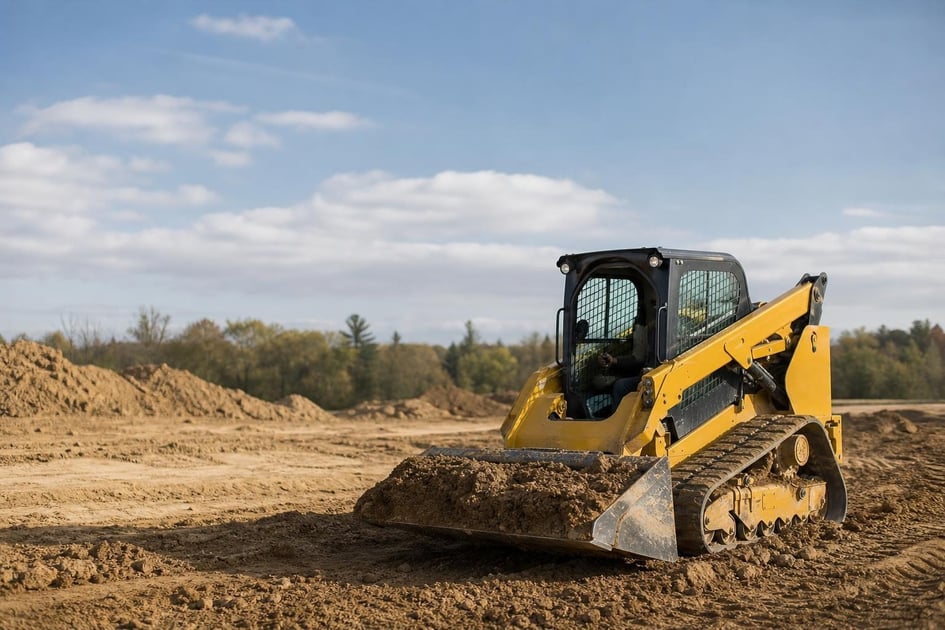
A used skid steer in the $25,000 to $45,000 range often starts at a monthly payment of a few hundred dollars for well-qualified buyers, while new machines running $60,000 to $75,000 or more can push payments past $1,200 depending on term and structure. Rates vary by credit profile, equipment age and term. Because the equipment itself serves as collateral, lenders can keep monthly costs competitive without requiring real estate or additional asset pledges from the borrower.
If you are weighing a specific machine, see what financing structure you qualify for in a few minutes.
What Drives Skid Steer Financing Costs
Equipment Age and Usage Hours
Lenders price risk in part based on how long the collateral will remain useful. A new skid steer with zero hours and a full manufacturer warranty commands stronger terms than a 3,000-hour machine with expired coverage. Most lenders consider anything under 1,500 hours as lower risk for a used unit, while machines approaching 5,000 hours may require a larger down payment or a shorter term. The make and model also matter. A Bobcat or Caterpillar unit with widespread dealer support and parts availability generally holds value better than a lesser-known import, which improves the loan-to-value ratio and can lower your cost.
Beyond hours, the type of skid steer affects pricing. Wheeled skid steers dominate the landscaping and construction markets and tend to carry lower financing premiums because resale demand is broad. Track loaders, often called compact track loaders, distribute weight better for sensitive ground but cost more upfront and can carry slightly tighter terms if the tracks are worn. High-flow hydraulic systems add capability for brush cutters and cold planers, yet they also raise the replacement cost if the hydraulic system fails. Lenders notice these details on the invoice.
Credit Profile and Time in Business
Your personal and business credit histories signal how likely you are to keep payments current. A FICO score above 700 and two or more years in business typically opens access to the most competitive structures. That does not mean younger companies or lower scores are shut out. Owner-operators with six months of operating history and scores in the 600s can still qualify, though the monthly payment may run higher to offset the additional risk. Lenders also look at recent bankruptcies, tax liens, and existing debt obligations. Keeping your current equipment loans current and maintaining low credit utilization helps.
Time in business matters because it demonstrates staying power. A company that has survived two full annual cycles has likely managed seasonal cash crunches, tax bills, and supplier payments. Lenders view that track record as evidence that the borrower can handle a new monthly obligation. If you are newer, prepare to show a strong personal guarantee and consistent bank balances to strengthen the file.
Term Length and Down Payment
Stretching a skid steer loan across 60 months lowers the monthly obligation but increases total interest paid over the life of the agreement. A 24- or 36-month term costs more per month yet reduces the overall outlay. Down payments typically range from zero to 20 percent for qualified borrowers. Putting money down lowers the financed amount and demonstrates skin in the game, which can improve the rate you receive. For a $50,000 machine, every $5,000 down reduces the principal and can trim the monthly payment noticeably.
Some borrowers ask for the longest possible term to preserve cash flow. That is a reasonable strategy if the machine will run full-time for five years. If you plan to trade the unit in three years, a 60-month term may leave you underwater, owing more than the machine is worth. Align the term with your actual holding period, not just your monthly comfort level.
Key Insight: Lenders often require a down payment on used skid steers older than five model years or with more than 2,500 hours, even from borrowers with strong credit. If you are shopping older iron, budget 10 to 15 percent upfront to avoid surprises at closing.
Get a fast decision on your equipment
Applying takes just a few minutes, and decisions can come as soon as the same day.
Start Your ApplicationNew vs. Used Skid Steer Financing
New skid steers generally qualify for longer terms and lower rates because the collateral value is predictable. Manufacturers like Bobcat, John Deere, and Caterpillar publish residual value data that lenders use to model risk. A new machine also carries warranty coverage, which reduces the chance that a borrower will face simultaneous repair bills and loan payments.
Used equipment financing is where many small contractors and landscapers operate. A two- to three-year-old skid steer with 800 to 1,200 hours can cost 30 to 40 percent less than new while retaining most of its productive life. The trade-off is a shorter available term and possibly a rate premium. Lenders may also require a recent inspection or appraisal for machines purchased through private-party sales rather than authorized dealers.
When deciding between new and used, consider your annual hours of use. A contractor running 1,500 hours per year may justify new for the warranty and term flexibility. An owner-operator using the machine 400 hours annually for seasonal property maintenance might capture better value in a low-hour used unit. Skid Steers financing options exist for both paths, with approvals possible the same day depending on documentation.
Equipment Loan vs. Equipment Lease
The choice between a loan and a lease changes who owns the asset, how the payment is structured, and what happens at the end of the term. A loan builds equity; a lease preserves capital. Neither is universally better. The right structure depends on your tax strategy, expected utilization, and whether you want to keep the machine long-term or upgrade every few years.
| Factor | Equipment Loan | Equipment Lease |
|---|---|---|
| Ownership | You own the skid steer after the final payment | Lessor owns the asset; you may have a purchase option at end |
| Down payment | Often 0% to 20% | Typically first and last payment upfront |
| Term length | 24 to 60 months common | 24 to 48 months common |
| Monthly cost | Higher if keeping long-term, but you build equity | Lower monthly outlay; payments may be deductible as operating expense |
| End of term | Free and clear ownership | Return, renew, or buy at fair market value or fixed residual |
| Best for | High-hour users keeping the machine 5+ years | Seasonal operators or those wanting regular upgrades |
A loan makes sense when the machine will remain in your fleet for its full useful life. You gain equity with every payment, and at the end of the term you own an asset with residual value. A lease works well when you need the latest emission-compliant model for municipal contracts or when you want predictable turnover without the hassle of resale. Seasonal snow-removal contractors sometimes prefer leases because the machine sits idle four months of the year, making equity buildup less urgent than cash preservation.
Pro Tip: If you anticipate selling the skid steer before the note is paid off, a loan can still make sense if the machine holds value. Leases sometimes carry stiff early termination fees. Read the end-of-term language before signing, especially if your workload is seasonal or project-based.
If you have a quote in hand and want to compare the two structures, get a decision on your equipment, possibly the same day.
Tax Treatment for the 2026 Tax Year
For the 2026 tax year, the IRS allows businesses to deduct qualifying equipment purchases under Section 179, subject to an annual limit adjusted for inflation. The exact dollar ceiling and phase-out threshold change each year, so you should confirm the current-year limits with your CPA before making a purchase decision. Bonus depreciation may also apply to new and used skid steers placed in service during 2026, though the percentage allowed has stepped down from prior years under the Tax Cuts and Jobs Act schedule.
If you finance the purchase, you generally can still take the Section 179 deduction even though you are making payments over time. The key is that you must place the equipment in service during the 2026 tax year and meet any applicable taxable income limits. Lease payments, by contrast, are typically treated as operating expenses and deducted as paid, which simplifies record-keeping but produces a different tax profile.
Depreciation recapture is another consideration. If you take a large upfront deduction under Section 179 and later sell the machine for more than its depreciated basis, you may owe taxes on the recaptured amount. This does not mean you should avoid the deduction; it simply means you need to plan for the eventual sale or trade-in. Your accountant can model the multi-year impact so you do not face an unexpected tax bill when you upgrade.
Because equipment finance taxation is complex and changes with federal legislation, always involve a qualified accountant. What saves the most money for one contractor may not apply to another depending on entity type, profit level, and existing depreciation schedules.
See what you qualify for
The equipment itself secures the financing, which keeps rates competitive. Checking your options takes minutes.
Check Your OptionsWho Qualifies for Skid Steer Financing
Provide Capital works with businesses across the credit spectrum, financing new and used business equipment from $5,000 to $5 million. For a skid steer specifically, approval hinges on a few concrete factors.
Credit scores in the mid-600s and above generally keep options open. Lenders also want to see that your business has been operating for at least six months, though two years or more unlocks better terms. If your company is newer, a strong personal credit profile and a solid bank balance can offset limited operating history. Small Business Administration loan programs illustrate how collateral-based financing can expand access to capital for businesses with shorter track records.
Debt service coverage ratio matters. Lenders want evidence that your monthly revenue can support the new payment on top of existing obligations. Providing three to six months of business bank statements is usually enough to demonstrate this. Revenue consistency counts more than absolute size. A landscaping company with $15,000 in steady monthly deposits may fare better than a general contractor with $40,000 one month and $2,000 the next.
Industry experience is another factor. A borrower with five years in excavation who is adding a second skid steer presents less risk than a new entrant buying their first machine. Construction equipment financing often weighs project pipelines and contract history alongside standard credit metrics.
Documentation You Need to Apply
Gathering paperwork before you apply shortens the timeline and reduces back-and-forth. Most applicants should have the following ready. If you are unsure what financial records to maintain, SBA guidance on funding a business offers a useful checklist that overlaps with what equipment lenders request.
- A signed equipment invoice or purchase agreement showing the serial number, year, make, model, and sale price
- Three to six months of recent business bank statements
- A voided business check for ACH setup
- Driver's license or other government-issued ID
- Business tax returns for the last one to two years, if available
- Proof of insurance naming the lender as loss payee, required before funding
For transactions over $100,000, lenders may also request interim financial statements or a current-year profit and loss report. Having these documents organized before you submit can mean the difference between a same-day approval and a multi-day delay.
If you are buying from a private party rather than a dealer, you may need to provide additional proof that the seller has clear title. Some lenders require a title search or a bill of sale notarized to prevent disputes. Ask your financing contact about private-party requirements before you commit to the purchase.
Where Skid Steer Financing Delivers the Most Value
Skid steers are one of the most versatile machines on a job site, which makes them attractive collateral. In construction, they handle grading, material transport, and demolition cleanup. A general contractor might pair a financed skid steer with Dump Trucks financing to move material without draining working capital. Census Bureau construction spending data shows that contractors nationwide rely on flexible equipment to adapt to changing project demands without locking up capital in single-purpose assets.
Landscapers use skid steers for soil prep, tree removal, and snow stacking in the off-season. Agricultural operations attach augers, bale spears, and grapple buckets to handle fencing, feeding, and light fieldwork. Forestry crews run brush cutters and mulchers on high-flow skid steers for land clearing.
Because the machine adapts to so many attachments, a single financed unit can replace several specialized machines. That versatility lowers the total equipment capital required and improves the return on each financed dollar.
By the Numbers: A mid-size construction company running a financed skid steer 1,000 hours per year at $75 per hour in billable rate generates $75,000 in annual revenue. Against a five-year term with a reasonable down payment, the machine can pay for itself and produce margin well before the note matures.
Common Mistakes to Avoid
Stretching the term to lower payments without considering equipment life is a frequent error. A skid steer with 4,000 hours already on the meter may not remain productive through a 60-month term. Match the payoff schedule to the expected useful life, or you risk owing money on a machine that is no longer generating income.
Another mistake is ignoring the total cost of ownership. Financing only covers acquisition. Fuel, maintenance, attachments, and insurance add thousands of dollars per year. Budget for these alongside the monthly note so that a repair bill does not create a cash crunch.
Borrowers also hurt themselves by submitting incomplete applications. Missing tax returns, unsigned invoices, or outdated bank statements trigger delays. If you are buying at auction or from a private seller, confirm that the seller can provide a clear title and bill of sale before you apply. Lenders will not fund against cloudy ownership.
A less obvious mistake is failing to match the attachment financing to the machine. If you need a high-flow brush cutter or an asphalt planer, confirm that the skid steer you are buying has the hydraulic capacity to run it. Financing a machine that cannot run your primary attachment is a costly mismatch.
What Happens After You Apply
Once you submit a complete application, the review process typically moves quickly. Many skid steer transactions receive a decision within hours, and same-day approvals are possible when the file is clean and the equipment is standard collateral.
After approval, the lender issues a term sheet or financing agreement spelling out the rate, term, payment amount, and any conditions. You review and sign. The lender then verifies insurance and may conduct a final equipment inspection or title check. Upon satisfaction of all conditions, funds are sent directly to the seller or dealer. You take delivery and the first payment is usually due 30 to 45 days later.
If additional documentation is needed, respond promptly. Delays almost always come from missing paperwork rather than from the credit decision itself.
Ready to move forward?
More than 10,000 businesses have financed equipment with Provide Capital. See what you qualify for today.
Get StartedFrequently Asked Questions
Can I finance a skid steer with bad credit?
Yes, though the structure changes. Borrowers with credit challenges may see shorter terms, a required down payment, or a higher monthly cost. The equipment collateral helps offset risk, so financing remains possible even when unsecured credit is not.
Is it better to finance or pay cash for a skid steer?
Cash avoids interest, but financing preserves liquidity for payroll, materials, and emergencies. Many owner-operators finance even when they have cash on hand, because the equipment generates revenue that exceeds the cost of capital. Talk to your accountant about the after-tax math for your situation.
How long can I finance a skid steer?
Terms typically range from 24 to 60 months. New machines may qualify for the full 60 months, while older used units often top out at 36 or 48 months. The goal is to align the payoff date with the machine's remaining productive life.
Can I include attachments in the financing?
Often yes. Buckets, augers, grapples, and other attachments can sometimes be rolled into the same equipment finance agreement if they are part of the initial purchase and listed on the invoice. Ask your financing contact to confirm before structuring the deal.
What is the minimum amount I can finance?
Provide Capital finances new and used business equipment starting at $5,000. Most skid steers, even older used units, exceed this threshold. Very low-cost attachments alone may not qualify unless bundled with the machine.
Do I need a commercial driver's license to finance a skid steer?
No. A CDL is not required to operate or finance a skid steer, since it is not licensed for road use in most jurisdictions. Standard business documentation and proof of insurance are sufficient.
Can I pay off the financing early?
Most equipment finance agreements allow early payoff, but the benefit varies. Some contracts use a simple interest structure where paying early saves meaningful interest. Others may include prepayment penalties or minimum interest charges. Review the prepayment language before signing.
Should I buy new or used?
High-hour operators and fleet owners often prefer new for the warranty and predictable maintenance. Owner-operators with lighter seasonal use frequently find better value in two- to four-year-old machines with under 2,000 hours. Evaluate your utilization, maintenance capabilities, and tax strategy before deciding.
Ready to Finance Your Next Skid Steer?
You now have a clear picture of what drives skid steer financing cost, how to structure the deal, and what documentation to prepare. The next step is to get a quote tailored to the specific machine you are considering. Whether you are buying new or used, adding your first skid steer or your fifth, start an application in a few minutes and see what terms are available for your credit profile and equipment choice.
Disclaimer: The information provided in this article is for general educational purposes only and is not financial, legal, or tax advice. Funding terms, qualifications, and product availability may vary and are subject to change without notice. Provide Capital does not guarantee approval, rates, or specific outcomes. For personalized information about your business funding options, contact our team directly.
