
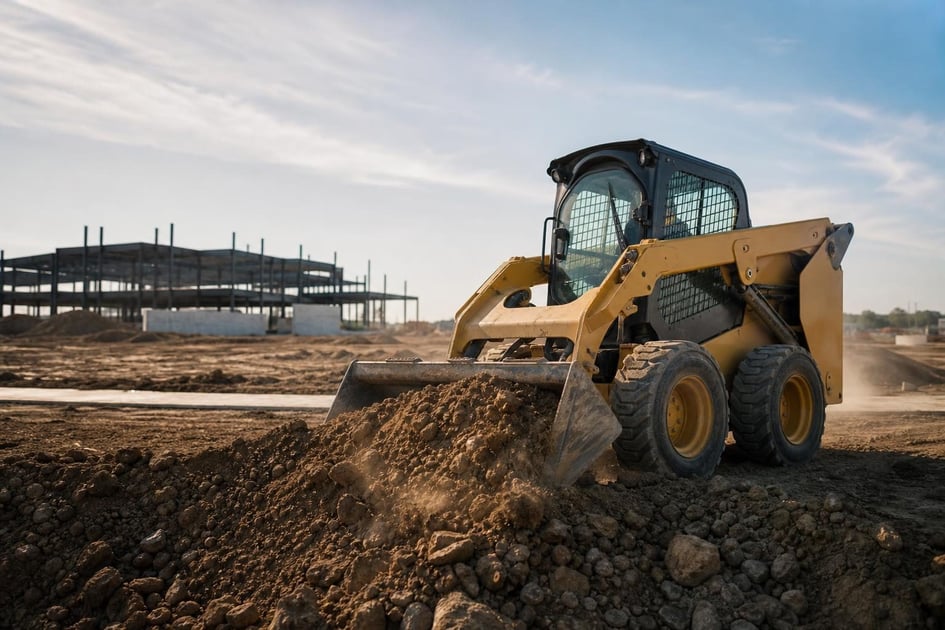
Getting financing for a skid steer starts with a short application and a few financial documents. Steady demand for loaders continues as U.S. Census Bureau construction spending data shows ongoing investment in private nonresidential projects. Most equipment lenders can review your file and give you a decision within one business day, sometimes the same day, because the machine itself serves as collateral. That collateral structure is what makes Skid Steers financing accessible to owner-operators and small crews who might not qualify for an unsecured bank line. If you have a quote or invoice for the machine, a few months of bank statements, and a clear business purpose, you are already most of the way there. Start an application in a few minutes to see what terms you qualify for on the loader you have picked out.
What Lenders Actually Review
Equipment lenders underwrite differently than banks offering unsecured term loans or Small Business Administration loan programs. Because the skid steer secures the financing, the lender weighs the asset and your ability to pay more heavily than your personal credit score alone. That does not mean credit is ignored, but it does mean the range of approved profiles is wider than many owners expect.
Credit Profile
Most lenders look for a personal credit score in the mid-600s or higher for the best terms, though some programs accept lower scores with additional collateral or a larger down payment. Rates vary by credit profile, equipment age and term length. A strong score with established business revenue usually unlocks longer terms and lower monthly payments. If your credit has recent dings, expect a shorter term or a request for a larger upfront payment.
Time in Business and Revenue
Lenders prefer at least one to two years of operating history, but some programs work with younger companies if the owner has relevant industry experience. You will typically need to show three to six months of business bank statements. If your gross monthly revenue can cover the proposed payment by a reasonable margin, you are in the conversation.
Equipment Details
The lender wants to know the year, make, model, hours, and condition of the skid steer. New machines from major brands finance more easily than aged or high-hour units from obscure manufacturers. A machine with a known service network and strong resale value reduces the lender's risk, which can improve your offer. If you are buying used, be ready to explain why the hours are where they are and whether a warranty or dealer inspection is included.
Key Insight: Lenders often cap financing at the invoice price or the machine's wholesale book value, whichever is lower. If you are paying a premium for a low-hour used skid steer with attachments, you may need to cover the gap between book value and purchase price out of pocket.
Already have a machine in mind?
Provide Capital finances new and used equipment from $5,000 to $5 million, with same-day decisions possible.
Apply NowNew vs. Used Skid Steers
The choice between a new and used machine shapes your financing terms, your monthly payment, and your total cost of ownership. Neither is always the better call; it depends on how many hours you plan to run per year and what kind of work the machine will do.
Financing New Machines
New skid steers typically range from $30,000 to $70,000 depending on size class and options. A new unit qualifies for the longest terms, sometimes up to 60 months or more, which keeps monthly payments manageable. You also get a full manufacturer warranty, which protects your cash flow from unexpected repair bills in the first few years. The downside is depreciation: a new machine loses value quickly in the first 12 to 24 months, so you will owe more than it is worth early in the loan.
Financing Used Machines
Used skid steers in the two- to five-year-old range often land between $20,000 and $45,000. They have already taken the steepest depreciation hit, so your equity position stays healthier. Lenders may shorten the term on used equipment, especially if the machine is over five years old or has more than 2,000 hours. Expect slightly higher rates on aged units because the collateral is riskier for the lender. If you buy used, get a mechanic's inspection and verify the hour meter. A rebuilt loader with undocumented maintenance can turn a bargain into a money pit.
Many contractors finance a mix: a new primary machine for heavy daily use and a used backup for occasional jobs. Construction equipment financing programs are built around this reality, letting you add a second or third machine as your backlog grows without requalifying from scratch.
Lease vs. Loan: Which Fits Your Business?
Equipment finance agreements generally fall into two categories: loans where you own the skid steer at the end, and leases where you may return, buy out, or upgrade the machine. The right structure depends on how long you plan to keep the unit, how you want to treat it on your books, and whether you want the residual risk.
| Factor | Equipment Loan | Finance Lease | True Lease / Operating Lease |
|---|---|---|---|
| Ownership at end | You own the skid steer after final payment | $1 or small buyout transfers title to you | You return the machine or buy at fair market value |
| Monthly payment | Higher than a true lease, lower than a finance lease | Typically the highest monthly cost | Lowest monthly payment |
| Tax treatment (2026) | Interest deductible; depreciate the asset or elect Section 179 | Depreciate the asset as if you own it | Payments generally deductible as operating expense; confirm with your CPA |
| Balance sheet | Asset and liability recorded | Asset and liability recorded | May stay off balance sheet depending on structure and accounting standards |
| Best for | Owners who plan to run the machine for 5+ years | Owners who want ownership with the lowest upfront cash | Contractors who want to upgrade every 2-3 years |
A loan makes sense if you want to build equity in a machine you plan to keep. A true lease works better if you want predictable trade-in cycles and lower payments now. Get a decision on your equipment, possibly the same day, and compare loan and lease structures side by side before you commit to a purchase.
Pro Tip: If you are a pass-through entity such as an S-corp or LLC, a loan with a Section 179 election in tax year 2026 can front-load your deduction, but the rules and limits change annually. Run the numbers with a CPA who knows your full tax picture before you choose a structure based on tax savings alone.
Tax Treatment for Tax Year 2026
The way you finance your skid steer affects your tax return, and the details matter for cash flow planning. Under current rules for tax year 2026, businesses that purchase qualifying equipment may be able to deduct the full cost in the year it is placed in service through Section 179, subject to annual limits and taxable income caps. Alternatively, you can spread the deduction over several years through standard depreciation schedules. Bonus depreciation rules have been phasing down, so the exact percentage available in 2026 depends on legislation in effect at the time of purchase. Because these provisions change frequently, you should confirm the current-year limits with a qualified CPA before you structure the deal.
If you choose a loan, you generally deduct the interest portion of each payment and depreciate the equipment itself. If you choose a true lease, the entire payment is often deductible as an operating expense, though the exact treatment depends on lease classification and your accounting method. Do not guess at these numbers. A CPA with construction or equipment-heavy clients can model the after-tax cost of each option in under an hour.
Find the right financing structure
Tell us about the equipment you need and we will show you the options that fit your business.
See Your OptionsWhat the Numbers Look Like in Practice
Below are illustrative monthly ranges for a mid-size skid steer financed over a common term. These are not quotes; actual payments depend on your credit, the machine's age, and the term you select.
By the Numbers: A $45,000 used skid steer with 1,200 hours might carry a monthly payment between $850 and $1,100 over a 48-month term. A $65,000 new unit with a warranty could run $1,100 to $1,400 over 60 months. Adding a grapple, bucket package, or high-flow hydraulics to the financing usually adds $30 to $80 per month per attachment depending on cost.
Down payments on equipment loans typically range from zero to 20 percent of the purchase price. Strong credit and a newer machine often qualify for no-money-down programs. If the unit is older or your profile is thinner, a 10 to 15 percent down payment improves your approval odds and lowers the rate. Remember that the equipment itself is the collateral, which keeps rates competitive compared with unsecured borrowing.
Industry Use Cases That Drive Purchases
Skid steers are not just for general construction. Landscapers use them for grading and sod prep. Demolition crews run grapple and hammer attachments. Agriculture operators move feed and clean barns. Forestry contractors run mulchers and brush cutters. The financing structure should match the revenue pattern of the work.
Construction crews with steady commercial contracts often prefer loans because the machine runs five or six days a week and pays for itself quickly. As Reuters business coverage has noted, small contractors face ongoing pressure from equipment costs and interest-rate uncertainty, making fast financing decisions a competitive advantage. Seasonal landscapers sometimes favor leases with lower payments during the off-season or shorter terms that align with their busy cycle. If you are adding a skid steer to an existing fleet that already includes Dump Trucks financing, you may be able to bundle the approval and simplify your paperwork.
Common Mistakes Owners Make
The most expensive error is buying the wrong size machine for the work. A compact frame skid steer rated at 1,500 pounds might save $10,000 upfront, but if your jobs regularly need 2,200-pound lift capacity, you will burn through undercarriage components and lose productivity. Match the rated operating capacity to your heaviest typical load, not your average one.
Another mistake is ignoring the total cost of attachments. A base machine price is only part of the story. High-flow hydraulics, quick-attach systems, and specialized buckets can add $5,000 to $15,000. If you finance the machine but pay cash for attachments, you may strain your liquidity right when you need it for payroll and fuel.
Finally, do not wait until your current machine is dead to apply for financing. If you are rushing to replace a broken loader, you have no leverage on price and no time to compare terms. Start the conversation while your current unit is still running so you can negotiate with the dealer from a position of strength.
Documentation You Will Need
Having your paperwork ready speeds up the process and improves your chances of same-day approval. Most lenders ask for:
- A copy of your driver's license or government-issued ID
- Three to six months of business bank statements
- A quote or invoice for the skid steer, including serial number, year, make, model, and hours
- Your business tax ID or Social Security number, depending on how the business is structured
- Proof of insurance listing the lender as loss payee, typically required before funding
If you are buying from a private party rather than a dealer, the lender may also require an independent appraisal or a purchase-and-sale agreement. Dealer purchases are simpler because the lender can verify the seller's legitimacy and handle the title transfer directly.
What Happens After Approval
Once approved, you will receive a term sheet or finance agreement spelling out the monthly payment, term length, any down payment required, and the total cost of the financing. Read it carefully. Look for prepayment penalties, late fees, and whether the loan is simple-interest or add-on interest. Simple interest is standard and cheaper if you pay ahead.
After you sign and submit any required down payment, the lender pays the seller. For dealer purchases, this usually happens within 24 to 48 hours. For private-party sales, it may take a few extra days while the lender verifies the title and drafts payoff checks if there is an existing lien. You take possession once the seller confirms payment, and your first payment is typically due 30 to 45 days later.
Most lenders report equipment loans to business credit bureaus. Paying on time builds your business credit profile, which makes the next machine easier to finance. Missing payments can trigger a faster default than a real estate loan because the collateral is mobile and depreciates quickly, so lenders act sooner. Treat the payment like payroll: non-negotiable.
Put the right equipment to work
From $5,000 to $5 million, new or used, Provide Capital helps businesses nationwide finance the equipment they need.
Apply TodayFrequently Asked Questions
Can I finance a skid steer with bad credit?
Yes, though the terms will reflect the added risk. Expect a shorter term, a higher down payment, or a slightly higher rate. The equipment itself is the collateral, so lenders have more flexibility than they would with an unsecured loan. Some programs specialize in credit-challenged borrowers who have stable business revenue.
How long can I finance a skid steer?
Terms typically range from 24 to 60 months. New machines qualify for longer terms, while used units over five years old may be capped at 36 or 48 months. Stretching the term lowers the monthly payment but increases total interest cost.
Do I need a down payment?
Not always. Strong credit and a newer machine can qualify for zero-down financing. If your credit is below average or the unit is older, a down payment of 10 to 20 percent improves your approval odds and may lower your rate.
Can I finance attachments with the machine?
Yes. Most lenders allow you to roll buckets, grapples, augers, and other attachments into the same finance agreement as long as the total amount is supported by the equipment value and your financial profile. Bundling keeps your payments in one place and preserves cash.
Is it better to lease or buy a skid steer?
Buy if you plan to keep the machine for its full useful life and want to build equity. Lease if you prefer lower payments, predictable upgrade cycles, and less exposure to resale risk. The tax treatment differs, so compare both structures with your CPA before deciding.
Can I pay off the loan early?
Most equipment loans allow early payoff, but some carry prepayment penalties in the first 12 to 24 months. Ask your lender for a clear answer before you sign. Simple-interest loans are usually the most favorable for early payoff because interest accrues only on the outstanding balance.
What interest rate will I get?
Rates vary by credit profile, equipment age and term length. We do not quote specific APRs because every file is different. The best way to know your rate is to submit an application and review the term sheet.
How fast can I get funded?
Same-day approvals are possible if your documentation is complete and the machine is from a reputable dealer. Most deals fund within one to two business days after approval. Private-party sales and incomplete paperwork are the most common causes of delay.
Your Next Step
If you have a skid steer picked out or even a short list of candidates, the next step is to get a real quote on financing. Rates vary by credit profile, equipment age and term length, and the only way to know your numbers is to run the application. Gather your bank statements and the machine quote, then see what financing you qualify for on that skid steer. A decision may come back the same day, letting you negotiate with the seller knowing exactly what you can spend.
Disclaimer: The information provided in this article is for general educational purposes only and is not financial, legal, or tax advice. Funding terms, qualifications, and product availability may vary and are subject to change without notice. Provide Capital does not guarantee approval, rates, or specific outcomes. For personalized information about your business funding options, contact our team directly.
