
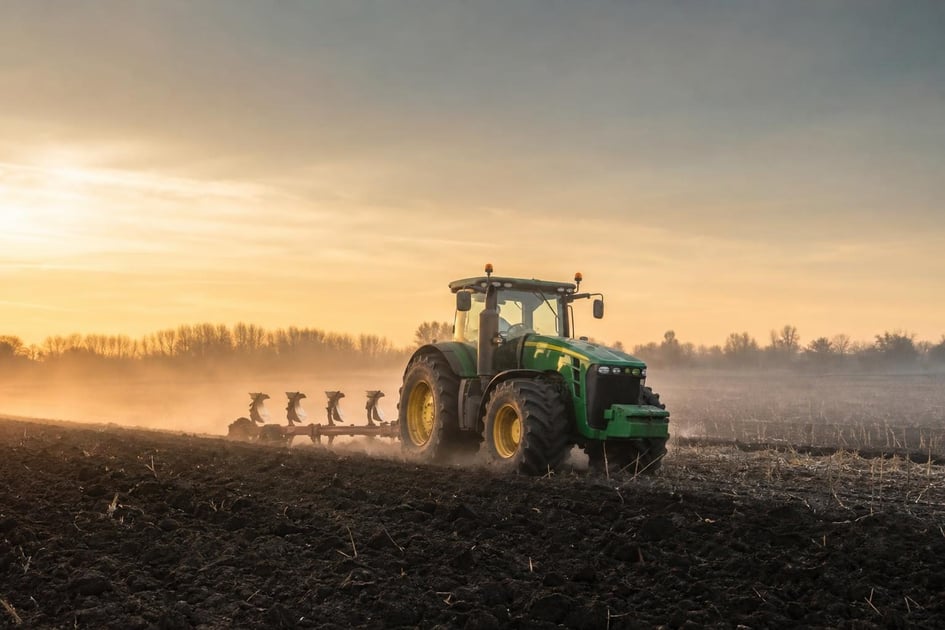
What Tractor Financing Covers
Financing a tractor means borrowing against the machine itself, not pledging your land or buildings. At Provide Capital, the equipment serves as collateral, which keeps financing accessible for owner-operators across the credit spectrum. We finance new and used tractors from $5,000 to $5 million, covering everything from a compact 25-horsepower utility machine for a landscaping crew to a 400-horsepower row-crop tractor for a commercial grain operation.
Eligible equipment includes traditional agricultural tractors, compact utility tractors, lawn tractors, and terminal tractors used in freight yards. If your business relies on the machine to generate revenue, it generally qualifies. That coverage extends to related implements—loaders, backhoes, and mowers—when bundled into the same transaction with the tractor itself. For a closer look at specific categories, see our guides on Tractors financing, Terminal Tractors financing, and Lawn Tractor financing. Operators in farming and ranching can also explore how we structure payments around seasonal cash flow on our Agriculture equipment financing page.
Same-day approvals are possible when the application is complete and the equipment is standard. The key is having your documentation ready before you shop, so the lender can verify collateral value and your ability to repay without delay. Many buyers make the mistake of finding the perfect machine at auction, then scrambling for paperwork while another bidder secures it. Pre-qualification solves that problem.
Key Insight: Because the tractor itself secures the loan, lenders weight the machine's resale value almost as heavily as your credit score. A late-model John Deere or Kubota with strong auction demand can help offset a shorter time in business or a past credit event, whereas an obscure brand with thin secondary-market data may require a larger down payment or a shorter term.
Get a fast decision on your equipment
Applying takes just a few minutes, and decisions can come as soon as the same day.
Start Your ApplicationWho Qualifies for Tractor Financing
Lenders look at three factors: credit history, time in business, and revenue consistency. A FICO score in the mid-600s or higher opens the most competitive terms, though scores below that do not automatically disqualify you. What matters is the overall story—steady bank deposits, a low debt-service coverage ratio, and a clear plan for how the tractor earns money. If you are a one-person excavation crew adding a compact tractor for residential jobs, show the lender your backlog of contracts and how the machine lets you take on grading work you currently subcontract.
Most equipment finance companies prefer two or more years in operation, but exceptions exist for strong-credit borrowers or when the equipment is new and the vendor is a recognized dealer. Startups and brand-new businesses face steeper hurdles because there is no track record of revenue to underwrite against the debt. If you have been operating for at least a year and can show three months of business bank statements, you are in the conversation. For agricultural operators, lenders may also look at acreage under management, crop insurance history, and off-farm income that stabilizes cash flow during drought years.
Rarely does a lender ask for a personal guarantee on a $5,000 lawn tractor, but larger agricultural equipment often triggers one, especially when the loan approaches six figures. The personal guarantee is not a mark against your business; it is standard practice in equipment finance for loans where the collateral depreciates quickly. Partnerships and multi-member LLCs should be prepared for all owners with 20 percent or more ownership to sign.
If you already have a tractor or a piece of equipment picked out, see what financing you qualify for on that tractor without affecting your credit score during the initial review. The application takes a few minutes and asks only for basic business information and the equipment details.
New vs. Used Tractor Financing
New tractors carry full manufacturer warranties, lower maintenance costs in the first few years, and longer available financing terms—often up to 84 months for equipment over $100,000. That lower risk profile means lenders can advance a higher percentage of the purchase price, sometimes 100 percent of the invoice plus soft costs like delivery and installation. For buyers who plan to put 500 or more hours per year on the machine, new can be the more predictable path.
Used tractors save money upfront but introduce uncertainty. Engines, transmissions, and hydraulic systems wear invisibly. For that reason, most lenders impose age and hour limits. A common rule of thumb is that the tractor must be no older than 10 to 15 years at the end of the loan term, and high-hour machines—those exceeding 8,000 to 10,000 hours—may require a larger down payment or a shorter amortization. Rates vary by credit profile, equipment age and term, so a 2016 model will typically carry a different monthly structure than a 2024 model for the same buyer.
Certified pre-owned programs from major dealers offer a middle ground. These units receive dealer inspections, fresh fluids, and limited warranties, which makes lenders more comfortable advancing money on older iron. Private-party purchases are financeable, but they require extra verification. The lender will want a certified appraisal or a dealer inspection to confirm serial numbers, hour-meter accuracy, and lien status before releasing funds.
Pro Tip: Before committing to a used tractor, request a fluid analysis from the seller. A lab report on engine oil and hydraulic fluid reveals internal wear that a fresh coat of paint hides. If the seller refuses, budget $300 to $500 for an independent mobile mechanic to inspect the machine on-site. That small outlay can prevent you from financing a tractor that needs a $15,000 engine rebuild in year two.
Industries That Rely on Tractor Financing
Tractors are not just for row-crop farms. Construction crews use them for land clearing and light grading. Landscaping companies run compact models with belly mowers through suburban housing complexes. Forestry contractors pull chippers and log splitters. HVAC and utility contractors use them to tow trenchers and cable plows across rough terrain. Each industry has different horsepower needs, seasonal income patterns, and equipment life cycles, which means the financing structure should match the work.
Agriculture remains the largest buyer segment, with planting and harvest seasons dictating when cash is available. That is why many lenders, including Provide Capital, offer skip-payment or seasonal structures for ag borrowers—heavy payments after harvest, minimal or no payments before planting. Construction and landscaping borrowers usually prefer level monthly payments because their revenue is more evenly distributed across the calendar, though northern operators may still see winter slowdowns.
Regional patterns also matter. Buyers in the Corn Belt often upgrade every three to five years to capture precision-ag technology, making shorter-term loans or leases attractive. Southern cattle operations may run tractors for 15 years or more, favoring longer loans with low monthly obligations. Understanding how your industry and region affect resale value helps you negotiate better terms. For heavy-equipment operators who also need hauling capability, our Dump Trucks financing page covers complementary equipment.
Equipment Loan vs. Lease: Which Fits Your Operation
The choice between a loan and a lease comes down to ownership intent, cash flow, and tax strategy. With an equipment loan, you take title immediately and claim depreciation and any available Section 179 deduction. With a lease, the lender retains title, you pay for usage, and you may have a buyout option at the end. Leases work well when you upgrade equipment every three to five years; loans make sense when you plan to run the tractor for a decade.
| Feature | Equipment Loan | Equipment Lease |
|---|---|---|
| Ownership | You own the tractor from day one | Lender owns it; you may buy out at end |
| Down payment | Often zero to 20 percent | Usually one or two payments upfront |
| Term range | 24 to 84 months | 12 to 60 months |
| Monthly obligation | Higher payment, but you build equity | Lower payment, but no equity until buyout |
| Tax treatment | Depreciation and Section 179 deduction for 2026 | Lease payments generally fully deductible as operating expense |
| Return condition | Not applicable—you keep it | Must meet wear-and-tear standards or pay penalties |
| Best for | Long-term keepers, high annual hours | Fleet rotation, technology upgrades, seasonal use |
Neither structure is universally better. A construction contractor running a tractor 1,500 hours a year will likely depreciate a purchased machine faster than a municipal parks department that replaces mowers every three seasons on a lease. The decision should be driven by your utilization rate, your tax bracket, and how long you intend to keep the asset.
By the Numbers: Provide Capital finances tractors from $5,000 to $5 million, with terms stretching from 24 to 84 months depending on the equipment age and borrower profile. A $75,000 compact tractor often structures between $1,200 and $1,800 per month over five years, while a $300,000 row-crop unit can land between $4,500 and $6,500 monthly over seven years. Those ranges shift with credit profile, equipment age and term, and are not quotes.
How the Application Process Works
The process is built for speed because equipment moves fast at auction and dealers do not hold inventory indefinitely. You submit a one-page application, a vendor invoice or equipment description, and three months of business bank statements. For larger requests—typically above $150,000—lenders may also request two years of tax returns and a year-to-date profit-and-loss statement. Having these documents organized before you shop puts you in a position to close the same day the seller accepts your offer.
Underwriting focuses on two questions: can you afford the payment, and is the collateral worth the advance? Credit pulls are usually soft during pre-qualification and hard only when you accept an offer. Same-day approvals are possible when the file is clean and the equipment is standard, but complex deals or private-party sales may take 24 to 48 hours while the lender verifies title and condition. If the tractor is coming from a dealer, the process is typically faster because the lender already knows the vendor and can rely on the invoice.
Once approved, you sign documents electronically. The lender pays the dealer or private seller directly via wire. You take delivery, put the tractor to work, and payments begin 30 to 45 days later depending on the funding date. The lender files a UCC-1 lien against the equipment, which is released once you pay off the balance. You will also need to show proof of insurance naming the lender as loss payee before funding. Get a decision on your equipment, possibly the same day, by starting the application now with your vendor quote in hand.
Find the right financing structure
Tell us about the equipment you need and we will show you the options that fit your business.
See Your Options2026 Tax Treatment for Financed Tractors
Tax year 2026 brings the same basic framework owners have relied on for years, but the exact dollar limits and phase-out thresholds for Section 179 and bonus depreciation are set by inflation adjustments and legislative updates. Rather than cite a limit that may change before you file, the safe approach is to speak with a CPA who can apply the 2026 rules to your specific situation.
Generally, if you purchase and place a tractor into service during the 2026 tax year, you may be able to deduct a significant portion of the cost under Section 179, provided your business use is over 50 percent. Bonus depreciation may allow additional first-year write-offs beyond Section 179, though the percentage has been stepping down in recent years. A lease, by contrast, treats payments as operating expenses, which avoids the complexity of depreciation schedules but sacrifices the large front-loaded deduction.
The IRS and SBA publish guidance annually on how equipment purchases interact with business deductions. For official context on how the agency views capital equipment, see the Small Business Administration resources on business financing and tax planning. Agricultural operators can also reference U.S. Census Bureau data on farm equipment and agricultural operations to benchmark their capital investment against regional trends.
Key Insight: Financing a tractor does not reduce your eligible Section 179 deduction. The tax code bases the deduction on placed-in-service date and business-use percentage, not on whether you paid cash or borrowed. A $150,000 tractor financed in December 2026 and put to work immediately can still yield a 2026 deduction, but only your CPA can confirm the exact amount under current-year limits.
What Tractor Financing Costs
Rates vary by credit profile, equipment age and term. There is no single APR that applies to every borrower. Instead, think in terms of monthly cash impact and total cost of ownership. The best way to compare deals is to look at the total dollars out of your business over the life of the contract, including any origination fees, documentation fees, and insurance requirements.
Consider a 60-horsepower compact tractor with a loader, priced at $65,000. On a 60-month equipment loan with a modest down payment, the monthly outlay typically falls between $1,100 and $1,600. Over the life of the loan, you pay the principal plus finance charges, but you own a machine with a 20-year service life. That makes the compact tractor one of the highest-utilization investments a small contractor can make.
Now scale up to a 250-horsepower row-crop tractor at $280,000, financed over 84 months. Monthly payments often land in the $4,200 to $5,800 range. The longer term keeps the payment manageable during low-margin years, though it increases total interest paid versus a 60-month structure. Rates vary by credit profile, equipment age and term, so a borrower with a 750 FICO and a new machine will see different numbers than a borrower with a 640 FICO buying a five-year-old unit.
For buyers on a tighter budget, a used 75-horsepower utility tractor at $35,000 on a 48-month term might run $750 to $1,050 monthly. The shorter term reflects the lender's desire to match the loan duration to the remaining useful life of the collateral. Leases invert the math. A $65,000 compact tractor on a 36-month lease with a 10 percent buyout might run $900 to $1,300 per month, but at the end you either return it, refinance the residual, or cut a check for the buyout. The lower monthly burden helps preserve working capital for seed, fuel, or payroll.
Common Mistakes Buyers Make
First, buying more tractor than the work requires. A 200-horsepower machine looks impressive, but if your average implement only needs 120 horsepower, you are burning fuel and finance charges on unused capacity. Match the tractor to the job, then finance the right size. Over-specifying is particularly common among first-time buyers who worry about outgrowing the machine in two years.
Second, ignoring the total cost of ownership. Finance charges are only one line item. Maintenance, insurance, and fuel often exceed the monthly payment over a five-year window. Budget for all three before you sign. A diesel tractor burning 5 gallons per hour at 600 hours per year adds up fast when fuel prices spike.
Third, failing to verify the seller's title. A tractor with a hidden lien cannot be used as clean collateral. Always request a title search or work with a lender who handles lien verification as part of funding. This is especially important at estate sales and farm auctions where ownership history may be unclear.
Fourth, mixing personal and business credit. If the tractor is for business use, apply in the business name using business bank statements. Personal credit cards and personal loans complicate your tax position and expose your personal assets unnecessarily. Keep the transaction clean from day one.
Fifth, forgetting to ask about prepayment penalties. Some lenders charge a fee if you pay off the loan early, while others use a "no prepayment penalty" structure as a selling point. If you anticipate a large seasonal payment or a refinancing event, negotiate this term before you sign. For broader perspective on how businesses manage equipment capital, Forbes coverage of equipment financing trends offers regular analysis of lending conditions.
Put the right equipment to work
From $5,000 to $5 million, new or used, Provide Capital helps businesses nationwide finance the equipment they need.
Apply TodayFrequently Asked Questions
Can I finance a tractor with bad credit?
It is possible, but terms tighten. Expect a larger down payment—sometimes 20 to 30 percent—and a shorter term. The equipment's value and your revenue deposits matter more than your credit score alone, so strong cash flow can offset past credit issues. Providing a detailed equipment description and a vendor invoice from a reputable dealer also helps the lender get comfortable with the collateral.
How long can I finance a tractor?
Terms range from 24 to 84 months. New, expensive tractors qualify for longer terms, while older or lower-dollar units are usually capped at 36 to 60 months. The goal is to avoid a situation where the loan outlives the machine's productive life. A 15-year-old tractor with 12,000 hours is unlikely to secure an 84-month term because the collateral value will drop below the remaining balance well before maturity.
Do I need a down payment?
Not always. Well-qualified buyers purchasing new equipment from authorized dealers can sometimes finance 100 percent of the invoice plus soft costs. Used equipment and lower credit scores generally trigger a 10 to 20 percent down payment requirement. The down payment protects the lender against the initial depreciation hit that occurs the moment the tractor leaves the lot.
Can I finance a tractor from a private seller?
Yes, but the lender will require additional verification. Expect to provide the serial number, photos, hour-meter reading, and possibly an independent appraisal. The lender wires funds directly to the seller only after confirming clean title. Private-party deals take slightly longer, but they are common in agriculture where neighbors sell equipment word-of-mouth.
Is a tractor loan tax deductible?
For tax year 2026, you may be able to deduct depreciation, Section 179 expensing, and interest on the loan, depending on your business structure and use percentage. Lease payments are generally deductible as operating expenses. Consult a CPA to apply current rules to your return. Do not assume last year's limits carry forward unchanged.
What documents do I need to apply?
At minimum, a completed application, a vendor quote or invoice, and three months of business bank statements. Larger transactions may require two years of tax returns and a current profit-and-loss statement. Having these ready before you shop speeds approval. Keep your business license and insurance agent's contact information handy as well.
Can I pay off the loan early?
Most equipment loans allow early payoff, but some include prepayment penalties or minimum interest clauses. Read the fine print before signing. If you anticipate a seasonal windfall or a large contract payment, negotiate the prepayment terms upfront. A loan with no prepayment penalty gives you flexibility to refinance if your credit improves or if rates drop.
Does financing cover attachments and implements?
Often, yes. Loaders, mowers, tillers, and backhoes can be bundled into the same financing package if they are part of the initial purchase. Bundling simplifies your bookkeeping with one monthly payment and one end-of-term date. Just make sure the implements are listed individually on the invoice so the lender can verify their value.
Next Steps
Tractor financing works best when you match the machine to the work, the term to the useful life, and the structure—loan or lease—to your tax strategy. Gather your business bank statements, settle on the make and model, and request a vendor quote. With the equipment details in hand, you can move from application to approval in a single business day.
Provide Capital serves construction, healthcare, dental, restaurant and food service, manufacturing, transportation, agriculture, HVAC and forestry nationwide. Whether you are adding a compact tractor to a landscaping fleet or upgrading a 300-horsepower row-crop unit before spring planting, we structure payments around how your business actually earns money. Start an application in a few minutes and see what terms are available for the equipment on your lot.
Disclaimer: The information provided in this article is for general educational purposes only and is not financial, legal, or tax advice. Funding terms, qualifications, and product availability may vary and are subject to change without notice. Provide Capital does not guarantee approval, rates, or specific outcomes. For personalized information about your business funding options, contact our team directly.
