
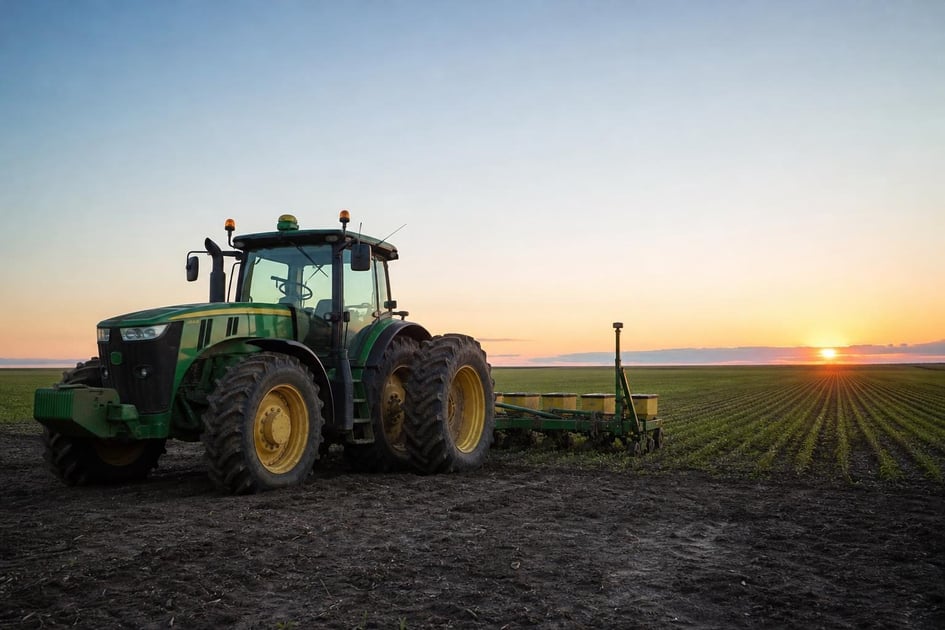
If you are buying a tractor and need financing, the requirements are straightforward: lenders want to see stable business revenue, a credit profile that shows you manage debt, and enough cash flow to cover the new payment. At Provide Capital, we finance new and used tractors from $5,000 up to $5 million, using the equipment itself as collateral to keep rates competitive. See what financing you qualify for on that tractor before you negotiate the purchase price.
Credit Profile and Business History
Most equipment lenders evaluate three things in order: personal credit, business longevity, and monthly revenue. According to SBA guidance on small-business funding, equipment loans are one of the most common ways to acquire machinery without draining working capital. You do not need perfect credit, but the score range you fall into will shape the term and structure of the deal.
Credit Score Tiers
Borrowers with personal credit scores above 680 generally receive the most favorable terms—longer durations and lower monthly payments. Scores between 620 and 680 are still financeable, though the lender may ask for a larger down payment or a shorter term to offset risk. If your score is below 620, approval is still possible in many cases, especially if the tractor holds strong resale value and your business shows consistent deposits. Rates vary by credit profile, equipment age and term, so the exact payment will depend on your specific situation.
Time in Business and Revenue
Two years in business is the standard benchmark, but it is not a hard cutoff. Newer operations face tighter scrutiny, but since this post is focused on established owner-operators, the key is demonstrating predictable revenue. Lenders typically want to see at least three months of business bank statements, though some file types may require six to twelve months. The goal is to prove that the tractor will generate enough income to cover its own payment.
Key Insight: A lender often calculates your debt-service coverage ratio by dividing monthly net operating income by the proposed equipment payment. A ratio of 1.25 or higher signals that the tractor pays for itself with room to spare, which can offset a weaker credit score or shorter time in business.
Already have a machine in mind?
Provide Capital finances new and used equipment from $5,000 to $5 million, with same-day decisions possible.
Apply NowNew vs. Used Tractor Financing
The age and condition of the tractor change the financing structure more than most buyers expect. New equipment carries lower rates because the collateral value is predictable. Used equipment can be financed just as quickly, but the down payment requirement and term length usually shift.
Financing a New Tractor
New tractors from major manufacturers hold value well, which makes them ideal collateral. Lenders often finance up to 100 percent of the invoice price for well-qualified buyers, though putting 10 to 20 percent down still improves the rate. Terms typically run from 36 to 84 months. Because the Tractors financing team at Provide Capital handles everything from compact utility models to 400-horsepower row-crop machines, the approval process is built around equipment-specific resale curves rather than generic small-business loan boxes.
Financing a Used Tractor
Used tractors are where many owner-operators find the best value, especially for secondary fieldwork or backup machines. Financing is available for units that are ten to fifteen years old, depending on hours and brand. Expect to put 10 to 30 percent down, with the exact percentage tied to the tractor's age, hour meter reading, and auction value. A used 2018 model with 2,000 hours will command better terms than a 2012 model with 6,000 hours, even if the purchase prices are similar. Rates vary by credit profile, equipment age and term, so the used-machine premium is usually modest for qualified buyers.
By the Numbers: A $75,000 used tractor financed over 60 months with a 15 percent down payment typically produces a monthly payment in the low four figures. A $150,000 new tractor on a 72-month term with 10 percent down often lands in the mid-to-high four figures. These are illustrative ranges—your actual payment depends on credit, collateral value, and term length.
Lease vs. Loan: Which Fits Your Operation?
Some buyers assume a lease is always cheaper. That is only true if you plan to return the equipment at the end. If you intend to keep the tractor for ten or fifteen years, a loan is usually the better economic fit because you build equity with every payment. Reuters business coverage regularly reports on interest-rate trends and commodity cycles that affect both equipment demand and financing costs.
| Factor | Equipment Loan | Equipment Lease |
|---|---|---|
| Ownership | You own the tractor after the final payment; title transfers. | You return or buy out the tractor at lease end. |
| Down Payment | Often 0–20%, depending on credit and equipment age. | Usually one or two payments upfront. |
| Monthly Payment | Higher than a lease in some cases, but you gain equity. | Lower monthly cost, but no equity unless you exercise a buyout. |
| Tax Treatment (2026) | Section 179 deduction or bonus depreciation available; speak to your CPA. | Payments may be fully deductible as an operating expense; confirm with your CPA. |
| Best For | Long-term owners who want the asset on their balance sheet. | Short-term projects or rapidly changing equipment needs. |
| End of Term | No balloon or residual; the tractor is yours free and clear. | Residual buyout, return, or renewal. |
If you run a mixed fleet and need flexibility, a lease on a specialized tractor for a three-year project can make sense. If you are a row-crop operator who runs the same machine for 2,000 hours a year, the loan almost always wins. Get a decision on your equipment, possibly the same day, and compare both structures side by side.
Tax Treatment for Tractors in 2026
For tax year 2026, tractors qualify as Section 179 property, meaning you can elect to deduct the full purchase price in the year you place the equipment in service, subject to annual dollar limits and a total equipment purchase phase-out threshold. The specific dollar limits are adjusted annually for inflation. Because these figures change and your tax situation is unique, consult a CPA to confirm the exact 2026 limits and how they apply to your return.
Bonus depreciation may also be available for 2026, though the percentage has been stepping down from prior years. Again, a CPA can tell you whether bonus depreciation or Section 179 produces the larger first-year write-off for your operation. If you finance the tractor, you still qualify for these deductions even though you did not pay cash upfront. The interest portion of your payments is generally deductible as well. Do not take a deduction figure from an older article and assume it still applies—tax year 2026 rules are what matter for purchases made this year.
Find the right financing structure
Tell us about the equipment you need and we will show you the options that fit your business.
See Your OptionsDocumentation You Will Need
Having your paperwork ready before you apply can cut the approval time from days to hours. Most applications require:
- A completed one-page application with basic business and personal information.
- Three to six months of business bank statements.
- An invoice or equipment description, including year, make, model, and serial number.
- A copy of your driver's license.
- Voided business check for automatic payment setup.
For larger transactions—approaching $1 million or more—lenders may also request two years of business tax returns and a current year-to-date profit and loss statement. The equipment itself serves as the collateral, so there is usually no need to pledge real estate or other assets. That is one reason Agriculture equipment financing through specialized lenders moves faster than general bank loans.
Industry-Specific Financing Scenarios
Tractors serve wildly different purposes across industries, and the financing structure should match the revenue cycle of the work. Census Bureau economic census data confirms that agriculture, construction, and landscaping remain heavy equipment buyers.
Row-Crop and Livestock Operations
A Midwest corn-soybean operation buying a 300-horsepower tractor for tillage and planting needs a term that aligns with the crop cycle. Many lenders structure payments to skip the winter months or to match the months when grain checks arrive. A used tractor in this category might cost $120,000 to $180,000, while a new equivalent can run $300,000 to $450,000. Both are well within the range that equipment lenders handle routinely.
Construction and Land-Clearing
Construction contractors often buy tractors with loader attachments for site prep, grading, and material handling. These machines work harder and accumulate hours faster, so a shorter term—48 to 60 months—prevents you from owing money on a machine that has lost most of its resale value. If you also run Dump Trucks financing through the same lender, bundling the approvals can streamline your fleet expansion.
Landscaping and Municipal Work
Compact tractors with belly mowers or backhoes are popular with landscaping crews and municipal maintenance departments. These units start around $25,000 used and $40,000 new, making them easy to finance with minimal down payments. Because the revenue is often monthly and predictable, lenders like to see a straightforward bank-statement pattern rather than seasonal spikes.
Pro Tip: If you are buying at auction, get a pre-approval letter before you bid. Auction purchases move fast—sometimes requiring payment within 24 to 48 hours—and a pre-approval lets you bid with a hard ceiling already in place. Tell your lender the auction house and expected hammer price so they can prepare the funding wire in advance.
Common Mistakes Buyers Make
The biggest error is shopping for the tractor before understanding what payment you can support. A $200,000 machine with no money down creates a very different monthly obligation than a $100,000 machine with 20 percent down. Calculate the payment range first, then shop within it.
Another mistake is ignoring the total cost of ownership. Fuel, maintenance, and insurance add up. A newer tractor under warranty may carry a higher monthly payment but lower repair bills, while an older paid-off unit can drain cash in the shop. Run the numbers for the full ownership period, not just the financing term.
Finally, do not let a dealer shop your credit to multiple lenders simultaneously. Each hard inquiry can ding your score. Work with one specialized equipment lender who can give you a clear yes-or-no and a specific term without broadcasting your file to a dozen banks.
What Happens After You Apply
Once you submit your application and bank statements, the lender reviews your credit, verifies your revenue, and values the collateral. For tractors, this means checking auction data, dealer wholesale guides, and comparable sales. If the loan-to-value ratio looks sound and your cash flow covers the payment, approval can come the same day.
After approval, you receive a term sheet outlining the monthly payment, term length, and any down payment required. Review it, sign the documents electronically, and the lender pays the seller or dealer directly. You take delivery and start using the tractor immediately. The entire process—from application to funding—often takes 24 to 48 hours for transactions under $500,000, and a few days longer for complex deals up to $5 million.
Put the right equipment to work
From $5,000 to $5 million, new or used, Provide Capital helps businesses nationwide finance the equipment they need.
Apply TodayFrequently Asked Questions
Can I finance a tractor with bad credit?
Yes, though the structure changes. Expect a larger down payment—sometimes 20 to 30 percent—and a shorter term. The equipment itself is the collateral, so a tractor with strong resale value can carry the deal even when the credit profile is thin. Rates vary by credit profile, equipment age and term.
How much down payment is required?
Well-qualified buyers can sometimes finance 100 percent of a new tractor. For used tractors or lower credit scores, 10 to 30 percent down is typical. The exact percentage depends on the equipment age, your business revenue, and your credit history.
Can I finance a tractor from a private seller?
Yes. Private-party sales are common in agriculture. The lender will still need an equipment description, photos, and sometimes an independent appraisal. Once approved, the lender wires funds directly to the seller and takes a lien on the tractor.
Is a personal guarantee required?
Most equipment loans under $5 million require a personal guarantee from the business owner, especially for closely held companies. This is standard practice and does not mean the lender doubts your business—it simply aligns incentives.
How long are tractor financing terms?
Terms range from 24 to 84 months. New tractors often qualify for longer terms because the collateral value is predictable. Used tractors and borrowers with challenged credit usually see terms of 36 to 60 months.
Can I deduct the interest on my tractor loan?
For tax year 2026, the interest portion of your equipment loan payments is generally deductible as a business expense. The principal repayment is not deductible, but you may be able to take Section 179 or depreciation deductions on the equipment itself. Speak with your CPA to confirm what applies to your return.
Does the tractor have to be new to qualify?
No. Lenders routinely finance used tractors that are ten to fifteen years old. The key factors are the hour meter reading, maintenance history, brand reputation, and current auction value. Older specialty tractors—like antique restoration projects—may not qualify, but working farm and construction units do.
What is the minimum amount I can borrow?
Provide Capital finances equipment starting at $5,000. That covers compact tractors, sub-compact models, and many used utility tractors. There is no penalty for financing a smaller amount.
Buying a tractor is a major operational decision, and the financing should be as straightforward as the machine itself. Start an application in a few minutes and find out what terms are available for the equipment on your lot or at your dealer.
Disclaimer: The information provided in this article is for general educational purposes only and is not financial, legal, or tax advice. Funding terms, qualifications, and product availability may vary and are subject to change without notice. Provide Capital does not guarantee approval, rates, or specific outcomes. For personalized information about your business funding options, contact our team directly.
