
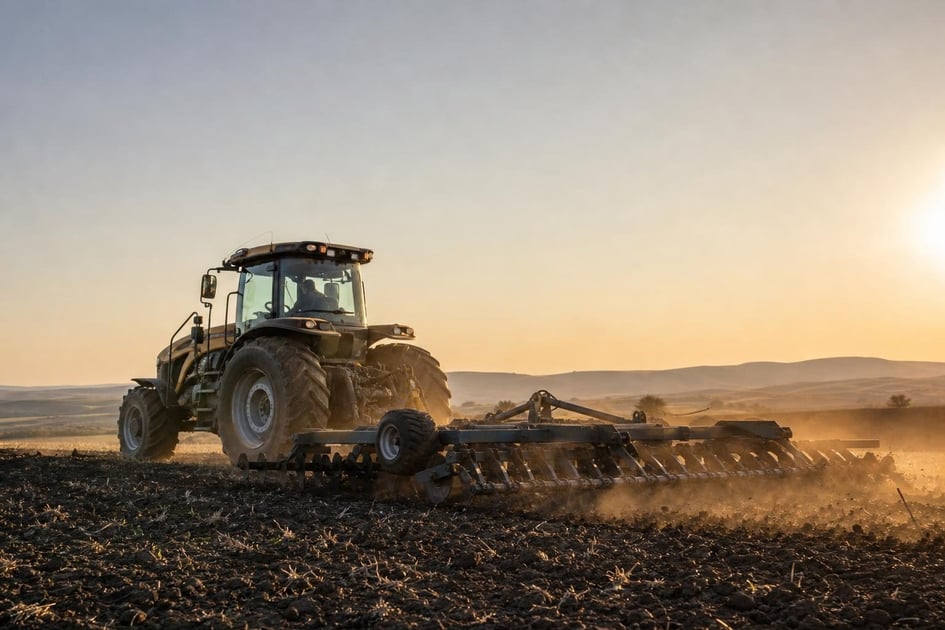
Tractor Financing Terms at a Glance
Most tractor loans run from 24 to 84 months, with the equipment itself serving as collateral. Loan amounts typically start around $5,000 and can go up to $5 million for large fleet purchases, though most owner-operators fall in the $50,000 to $250,000 range. Rates vary by credit profile, equipment age and term. If you have two or more years in business and a credit score above 640, you are generally in the strongest position. If you are looking at a machine right now, see what financing terms you qualify for on that tractor.
Key Insight: Lenders often reserve the longest terms—72 to 84 months—for new tractors under 100 horsepower. Used units and high-hour machines usually top out at 48 to 60 months because residual value drops faster once a tractor crosses 2,000 hours.
Already have a machine in mind?
Provide Capital finances new and used equipment from $5,000 to $5 million, with same-day decisions possible.
Apply NowWhat Determines Your Tractor Financing Terms
Credit profile and time in business
Your personal credit score carries significant weight, especially if your business has fewer than three employees. Most equipment lenders want to see a score of 620 or higher, though programs exist for lower scores with stronger cash flow. Time in business matters because under two years usually means a larger down payment or a shorter term. Lenders like to see 24 months of revenue history to feel confident in seasonal farm income. If you are a sole proprietor or partnership, the lender will almost always pull your personal credit even if the business has its own tax ID.
Equipment age, hours, and brand
A brand-new 2026 row-crop tractor will get more favorable terms than a 2012 utility tractor with 4,000 hours. New equipment holds value better, so lenders take less risk. That said, used tractors are financed daily; you just may see terms 12 to 24 months shorter than on a new unit. Specialty tractors—orchard, vineyard, or high-horsepower 4WD models—can sometimes require larger down payments because the resale market is narrower. Mainstream brands like John Deere, Case IH, and Kubota finance more easily than obscure imports because guide values are readily available. A tractor with a clean maintenance history and under 2,500 hours is treated as stronger collateral than one with missing records.
Loan amount and term length
Borrowing $5,000 to $50,000 often puts you in a different product tier than loans above $100,000. Smaller loans may carry slightly higher rates because the fixed administrative cost is spread over less principal. Terms stretch longer as the loan amount grows: a $500,000 combine or tractor package might qualify for 72 months, while a $15,000 subcompact might max out at 36. Your monthly payment drops with a longer term, but you pay more over the life of the loan. According to Wall Street Journal reporting, repayment terms for farm equipment typically range from one to ten years, with the machinery serving as collateral.
Seasonal income and cash flow
Farm revenue is not evenly distributed. A grain operation might book 60% of its income in October and November, while a dairy farm sees steady monthly checks. Lenders understand this, but they need evidence that you can cover the payment in the off-season. Providing 12 to 24 months of bank statements helps them see your cash cycle. If you have a forward contract or a written lease for the acreage the tractor will work, include it. That documentation can turn a marginal approval into a clear one.
How Tractor Horsepower Affects Financing
Horsepower is a proxy for price, which in turn drives term and down payment. Subcompact tractors under 40 horsepower often sell for $15,000 to $30,000 and are financed on shorter schedules. Mid-range utility tractors from 40 to 100 horsepower fall in the $40,000 to $90,000 range and usually qualify for 48 to 72 months. Row-crop and articulated 4WD tractors above 200 horsepower can exceed $300,000 and are the most likely to reach 84-month terms. Lenders also consider whether the horsepower matches the job. A 25-horsepower tractor on a 1,000-acre corn operation raises utilization questions, while a 350-horsepower unit doing occasional loader work looks like excess collateral risk.
By the Numbers: A $150,000 new tractor financed over 72 months might keep your monthly obligation under $2,500, depending on rate and structure. The same payment on a 48-month used tractor loan would limit your borrowing to roughly $100,000, which is why buyers often step down in horsepower or features when buying used.
New vs. Used Tractor Financing
The choice between new and used affects not just your payment but also your term options, warranty coverage, and down payment. New tractors depreciate rapidly in the first 24 months, yet lenders love them because the collateral value is predictable. Used tractors save you upfront cash but can require more money down if the unit is over five years old or has high hours. Auction purchases can be trickier than dealer sales because the lender has less transparency into the machine’s background.
| Factor | New Tractor | Used Tractor |
|---|---|---|
| Typical term range | 36–84 months | 24–60 months |
| Down payment | 0%–10% | 10%–20% |
| Rate structure | More competitive | Varies by age and hours |
| Warranty | Full manufacturer coverage | Limited or expired |
| Collateral value | High and predictable | Requires appraisal or guide |
If you are comparing a new unit against a three-year-old model, run the numbers over the full ownership period. A used tractor at $80,000 with a 60-month term may cost less per month than a $120,000 new unit over 84 months, but factor in repair reserves. A new tractor under warranty might save you $5,000 to $10,000 in maintenance during the first three years.
Lease vs. Loan: Which Structure Fits Your Operation
Equipment lease
A lease makes sense if you trade tractors every three to four seasons and want the lowest monthly outlay. You do not own the machine at the end unless you exercise a purchase option. For tax purposes, lease payments are generally treated as an operating expense, which can simplify bookkeeping. However, if you put 1,500 hours a year on a tractor and plan to keep it for a decade, leasing will cost more over time. There are two common lease types: fair market value (FMV), where you return the equipment at the end, and $1 buyout, where you own it after the final payment. FMV leases have lower monthly payments but leave you without an asset. Get a decision on your equipment, possibly the same day, and compare a loan structure side by side with a lease quote.
Equipment loan
A loan builds equity. Once the final payment clears, you own the tractor free and clear. This matters for operations that run machines until 8,000 or 10,000 hours. Loans also let you claim depreciation and interest deductions. If you expect to keep the tractor beyond five years, a loan is usually the better financial fit. The collateral is the tractor itself, so you do not need to pledge real estate or other assets in most cases. For the 2026 tax year, you can generally deduct interest paid on the loan, and you may be able to take Section 179 on the equipment cost even though you are financing it. Confirm the details with your CPA before you file.
Pro Tip: If you are buying a tractor for a specific contract job, match your financing term to the contract length. A 36-month municipal snow-removal contract pairs well with a 36-month lease or loan, so the machine is paid for when you rebid the work.
2026 Tax Treatment for Financed Tractors
Section 179 for 2026
For the 2026 tax year, Section 179 allows businesses to deduct the full purchase price of qualifying equipment in the year it is placed in service, subject to an annual limit adjusted for inflation. The exact dollar cap for 2026 depends on final IRS guidance. If you finance a tractor in 2026, you can generally claim the deduction even though you are making payments over time. Talk to your CPA about whether your taxable income supports the full deduction and how state rules may differ. Do not assume the 2026 limit matches what you claimed in 2025.
Bonus depreciation considerations
Bonus depreciation has been phasing down in recent years. For 2026, the percentage may be lower than in prior years, and the rules can change with new legislation. Rather than quote a percentage that might shift, the safest move is to ask your accountant how bonus depreciation interacts with Section 179 for your specific purchase. Financing does not change your eligibility; it simply spreads the cash outlay while you take the deduction upfront or over the schedule. If you use the tractor for both business and personal use, only the business percentage qualifies.
See what you qualify for
The equipment itself secures the financing, which keeps rates competitive. Checking your options takes minutes.
Check Your OptionsQualification Criteria in Detail
Provide Capital finances new and used business equipment from $5,000 to $5 million, with the equipment itself serving as collateral. That collateral structure keeps rates competitive because the lender has a tangible asset backing the deal. You do not need perfect credit, but you do need to show how the tractor generates revenue. For comparison, the SBA 7(a) loan program also caps equipment purchases at $5 million, though SBA deals often take several weeks longer than direct equipment financing.
Minimum requirements
Most applicants should have a personal credit score of 600 or better, though exceptions happen with strong cash flow or significant equity in other assets. Your business should be generating revenue; lenders need to see that the tractor will earn its keep. If your operation is seasonal, like many in agriculture, be ready to explain your cash cycle. Two years in business is a common benchmark, but well-documented first-year operations with contracted income can still qualify. If you are buying a $300,000 tractor, expect the lender to scrutinize your debt-service coverage ratio more closely than if you are financing a $20,000 compact.
What lenders look for in farm operations
Farm and ranch deals are evaluated differently than a dry-cleaning route. Lenders want to know your acreage, crop mix, or livestock count, because that drives utilization and revenue. A 200-horsepower tractor pulling a disc harrow across 2,000 acres of corn is easier to underwrite than a 50-horsepower unit doing occasional brush hogging on a hobby farm. Agriculture equipment financing specialists understand these distinctions and underwrite accordingly. Census Bureau data shows roughly 1.9 million farms operating in the United States, with average acreage near 491, so lenders have plenty of benchmark data to compare your operation against.
Documentation You’ll Need
Having your paperwork ready can cut the approval time from days to hours. Most lenders will ask for:
- A signed equipment quote or invoice from the dealer or private seller
- Your last three months of business bank statements
- A current year-to-date profit and loss statement
- Your most recent business tax return
- Personal financial statement if you own less than 100% of the business
- Proof of insurance naming the lender as loss payee
For used tractors, the lender may also require photographs, a serial number verification, and an independent appraisal if the sale price exceeds guide values by more than 10%. If you are buying at auction, you may need the auction listing, a condition report, and proof that the title is free of prior liens. The more documentation you provide upfront, the fewer back-and-forth requests you will face. Some lenders also want a brief narrative explaining how the tractor fits into your operation, especially if the loan exceeds $100,000.
Common Mistakes When Financing Tractors
One of the most expensive errors is financing a tractor for a longer term than you intend to keep it. If you sell or trade at month 36 on a 72-month loan, you may owe more than the machine is worth. This is called being upside down, and it forces you to roll negative equity into the next deal. Another mistake is ignoring the total cost of ownership: fuel, maintenance, and insurance can add $10,000 to $20,000 annually on a large tractor, which affects whether you can afford the payment in a bad year. Budget for at least one major repair reserve equal to three months of payments.
Buyers also stumble by not verifying hours and service history on used units. A low-price tractor with 3,500 hours and no documented hydraulic work is a riskier collateral piece than one with 2,500 hours and dealer service records. Always request a maintenance log and consider a pre-purchase inspection by a certified mechanic. Finally, do not wait until you are at the dealership to line up financing. Pre-approval gives you negotiating power and lets you compare dealer incentives against direct Tractors financing options.
What Happens After You Apply
Same-day approval process
Many applications receive a decision within a few hours, especially when the loan is under $250,000 and the equipment is standard collateral. The underwriter reviews your credit, verifies the equipment value, and checks that your cash flow supports the payment. If everything lines up, you can have an approval letter the same day you submit. Larger loans or specialized equipment may take 24 to 48 hours while the lender confirms guide values or orders an appraisal. If the underwriter has questions, respond quickly; a delayed answer can push your approval to the next business day.
Funding timeline and lien perfection
Once approved, the lender issues a purchase order or funds the seller directly. Private-party sales sometimes take 24 to 48 hours longer because the title and lien perfection require extra steps. Dealer sales are usually faster because the finance manager has done it hundreds of times. You will make your first payment roughly 30 to 45 days after funding, depending on how the lender structures the first due date. Some lenders offer a 90-day deferred payment option for seasonal operations, though interest may still accrue during the deferral.
Key Insight: Lenders prefer dealer purchases because the dealer handles title transfer, UCC filings, and delivery verification. If you buy from a private seller, expect to coordinate the lien search and title work yourself, which can add two to five business days to the closing.
Put the right equipment to work
From $5,000 to $5 million, new or used, Provide Capital helps businesses nationwide finance the equipment they need.
Apply TodayFAQ
Can I finance a tractor with a 600 credit score?
Yes. A score of 600 is often the minimum threshold for equipment financing, though your rate and term will reflect the increased risk. Strong revenue, a larger down payment, or newer equipment can offset a lower score. If you are below 600, consider adding a co-signer or increasing your down payment to 20%.
How long can I finance a tractor?
Terms range from 24 to 84 months. New tractors and larger loan amounts generally qualify for longer terms. Used tractors and smaller loans are usually capped at 48 to 60 months. Very large ag packages above $400,000 may stretch to 84 months if the collateral is new and the borrower is well-qualified.
Is a down payment always required?
No. Zero-down programs exist for well-qualified buyers purchasing new equipment. Used tractors, especially those over five years old, more commonly require 10% to 20% down. If your credit is challenged, expect to put down at least 10% even on a new unit.
Does the lender need to see my farm’s financials?
Yes. Lenders want evidence that the tractor will produce income. Be prepared to show bank statements, tax returns, or contracted work that demonstrates how the machine fits into your revenue model. For loans above $100,000, expect to provide a full financial package including a balance sheet.
Can I finance a tractor from a private seller?
Yes, but the process involves additional steps. The lender will verify the title is clean, order an appraisal if needed, and ensure the lien is properly recorded. This usually adds a few days to funding. Make sure the seller has a clear title in hand before you start the application.
Will financing a tractor affect my ability to borrow for other equipment?
It depends on your overall debt service coverage ratio. If the new payment still leaves you with adequate cash flow after existing obligations, most lenders will approve the deal. If you are already heavily leveraged, you may need to pay down other debt first or provide additional collateral.
Can I pay off the loan early?
Most equipment loans allow early payoff, but some have prepayment penalties or minimum interest clauses. Ask your lender for the exact prepayment language before you sign. A loan with no prepayment penalty gives you flexibility if you sell the tractor or refinance.
What happens if I miss a payment?
Contact your lender immediately. Because the tractor is collateral, prolonged default can lead to repossession. Most lenders prefer to restructure the deal rather than seize equipment, but communication is critical. If you know a slow season is coming, call before the due date to discuss a skip-payment or modification.
Next Steps
If you have a tractor quote in hand or are shopping dealers this week, start by getting pre-qualified. You will know your budget, your monthly range, and whether a 48-month or 72-month structure fits your cash flow. Start an application in a few minutes and see what terms are available for your next machine. Whether you need a compact tractor for a landscaping crew or a 300-horsepower row-crop unit for planting season, Dump Trucks financing and other heavy-equipment options are available through the same process.
Disclaimer: The information provided in this article is for general educational purposes only and is not financial, legal, or tax advice. Funding terms, qualifications, and product availability may vary and are subject to change without notice. Provide Capital does not guarantee approval, rates, or specific outcomes. For personalized information about your business funding options, contact our team directly.
