
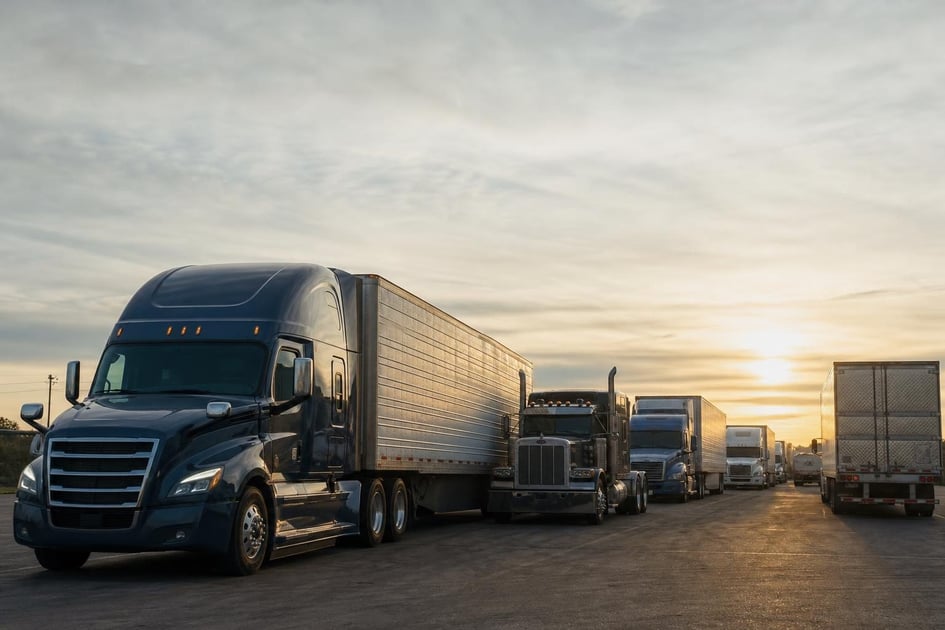
A transportation equipment financing calculator estimates your monthly payment based on four inputs: the equipment price, your down payment, the term length, and the rate range you expect. It is a planning tool, not an approval. The output helps you compare trucks, trailers, and financing structures before you submit an application. Because the equipment itself serves as collateral, transportation financing often carries more competitive terms than unsecured borrowing, but the exact payment still depends on your credit profile, equipment age, and term length.
If you are weighing a specific purchase, see what financing you qualify for on that truck or trailer and compare the estimate against the calculator output.
How Lenders Calculate Your Real Payment
Lenders use the same amortization math as any calculator, but they set the rate and term based on risk. Understanding what drives those two variables helps you use a calculator realistically.
Equipment Price and Down Payment
The amount financed is the purchase price minus any down payment. On a $150,000 Class 8 tractor, a 10% down payment reduces the financed amount to $135,000. A 20% down payment drops it to $120,000. The difference changes not only the monthly obligation but also the rate tier you land in, because more skin in the game reduces the lender's exposure. Some programs offer 100% financing for well-qualified buyers, yet even a small down payment often improves the structure.
Term Length and Its Trade-Offs
Transportation equipment terms typically run from 24 to 72 months. A longer term lowers the monthly payment but raises total interest because the balance declines more slowly. A shorter term saves total interest but demands more monthly cash flow. Many owner-operators match the term to the expected useful life of the asset so they are not making payments on equipment that has aged out of revenue service. For a new sleeper cab, 60 months is common. For a used day cab with high mileage, 36 to 48 months is more typical.
Rate Ranges and What Moves Them
Rates vary by credit profile, equipment age, and term length. A borrower with two-plus years in business, documented revenue, and a strong credit history will see more competitive terms than a first-time owner-operator with limited paperwork. New equipment qualifies for lower rates than used equipment because the collateral value is predictable. The transportation sector is cyclical, and lenders also adjust for market conditions, so the range you see in one quarter may shift in the next.
Key Insight: Lenders often reserve the longest terms for equipment under ten model years and 750,000 miles. A truck that exceeds either threshold may still qualify, but the rate adjustment and shorter amortization can raise the monthly payment significantly. Always request the maintenance history before applying; a clean record can offset age in the underwriter's model.
Get a fast decision on your equipment
Applying takes just a few minutes, and decisions can come as soon as the same day.
Start Your ApplicationNew vs. Used Transportation Equipment — Payment Impact
New trucks and trailers carry predictable collateral value, warranty coverage, and longer service life, all of which lower the lender's risk. Used equipment lowers the acquisition price but can bring higher rates and shorter terms because depreciation and repair risk are harder to forecast. The right choice depends on your cash position, annual mileage, and how long you plan to run the unit.
| Factor | New Class 8 Sleeper | Used Day Cab (5–7 Years) | New Dry Van Trailer |
|---|---|---|---|
| Typical price range | $150,000 – $230,000 | $60,000 – $110,000 | $40,000 – $70,000 |
| Common term | 48 – 60 months | 36 – 48 months | 36 – 60 months |
| Down payment often required | 0% – 15% | 10% – 20% | 0% – 10% |
| Collateral confidence | High | Moderate | High |
| Warranty coverage | Full manufacturer | Limited or expired | Full manufacturer |
The table above is illustrative. Actual terms depend on the specific unit, your business financials, and the lender's current guidelines. A used truck from a reputable dealer with a full inspection report can sometimes structure nearly as well as a new unit, while a new truck sold at auction without warranty may not.
For operators moving dirt, gravel, or freight in tight quarters, Dump Trucks financing covers both new and used units with the same collateral-backed structure.
Pro Tip: When comparing new versus used, look at total cost over the first three years, not just the monthly payment. A used truck with a lower payment but a $15,000 engine repair in month fourteen can erase the savings. Set aside a maintenance reserve equal to at least three months of payments on any used unit.
Loan vs. Lease for Trucks and Trailers
A calculator can show a payment for a loan, but transportation equipment is often structured as a lease. The difference matters for balance-sheet treatment, tax timing, and what happens at the end of the term.
Equipment Finance Agreement
An equipment finance agreement, or EFA, functions like a loan. You own the equipment from day one, take the depreciation and Section 179 benefits, and make fixed payments until the balance is zero. At the end, you hold clear title. This is the most common structure for owner-operators who plan to run the truck for its full useful life.
True Lease / FMV Lease
A fair market value lease, sometimes called a true lease, gives you use of the equipment for a fixed term with a lower monthly payment than an EFA. At the end, you can return the equipment, renew the lease, or purchase it at fair market value. The lessor retains ownership and depreciation rights. This structure works well for fleets that refresh equipment every three to four years or for assets that may become obsolete quickly due to emissions regulations.
$1 Buyout Lease
A $1 buyout lease is technically a lease for accounting purposes, but it behaves like an EFA. You make fixed payments and acquire the equipment for $1 at the end. The monthly payment is usually higher than an FMV lease but similar to an EFA. Some borrowers prefer this structure for balance-sheet or covenant reasons, but the economic outcome is nearly identical to a loan.
If you know which structure fits your operation, get a decision on your equipment, possibly the same day, and lock in the term before rates shift.
Section 179 and Tax Treatment in 2026
Transportation equipment that qualifies under IRS rules can generate significant first-year deductions. For tax year 2026, the maximum Section 179 expense deduction is $2,560,000, and the phase-out begins when total qualifying purchases exceed $4,090,000. Most heavy trucks, tractors, and trailers used more than 50% for business qualify for the full Section 179 amount, provided they are placed in service during the 2026 tax year.
Passenger-type vehicles rated between 6,000 and 14,000 pounds GVWR face a separate cap. For 2026, the Section 179 deduction for these heavy SUVs is limited to $32,000, with the remainder depreciated under normal schedules. Pure work trucks and tractors over 14,000 pounds GVWR are not subject to that cap. Bonus depreciation remains available in 2026 for qualifying property, though the interaction between Section 179 and bonus depreciation depends on your taxable income and business structure. Speak with a CPA before you model your tax outcome, because eligibility limits and state conformity rules change.
The SBA 7(a) loan program can also support equipment acquisitions, though many transportation borrowers prefer dedicated equipment finance because the collateral is the asset itself rather than a general business lien.
By the Numbers: A fleet placing a $200,000 Class 8 tractor and a $50,000 trailer into service in 2026 could potentially expense the full $250,000 under Section 179, assuming no other qualifying purchases push the total over the phase-out threshold and the business has sufficient taxable income. The deduction cannot exceed the income from the active conduct of the trade or business.
See what you qualify for
The equipment itself secures the financing, which keeps rates competitive. Checking your options takes minutes.
Check Your OptionsQualification Criteria Transportation Lenders Actually Review
Calculators ask for price and term, but lenders ask for documentation. Knowing what underwriters review helps you set realistic expectations before you run numbers.
Time in Business and Revenue
Most transportation lenders prefer at least one year in business, and two or more opens the door to better terms. Underwriters look at bank statements to verify that the proposed payment fits within actual cash flow. A common rule of thumb is that the equipment payment should not exceed a reasonable share of monthly revenue, though the exact ratio varies by lender and fleet size. Startups and newly formed carriers face tighter requirements; if you have less than a year of operating history, a larger down payment or a co-signer may be necessary.
Credit Profile
Personal and business credit both matter. A strong credit history shows the lender that you have managed debt responsibly. Collections, charge-offs, or recent bankruptcies do not automatically disqualify you, but they can move the rate up or cap the term length. Some lenders weigh recent payment history more heavily than older events, so a rough patch two years ago matters less than a current delinquency.
The Equipment Itself
The lender underwrites the truck or trailer as much as the borrower. Age, mileage, condition, and brand all affect value. A Class 8 tractor from a major manufacturer with a strong resale history is easier to collateralize than a niche brand with limited secondary-market demand. For Bucket Trucks financing, the aerial boom hours and inspection records carry as much weight as the chassis mileage.
Pro Tip: If you are buying from a private seller, order an independent inspection before you apply. Lenders often require it anyway for used equipment, and identifying frame rust or engine issues early prevents a declined application or a restructured deal after the fact.
Budgeting Beyond the Monthly Payment
A calculator shows the financing cost, but owning a truck or trailer brings additional obligations. Insurance on a financed Class 8 tractor typically runs higher than on a paid-off unit because the lender requires full coverage. Physical damage, bobtail, and cargo policies add to the monthly outlay. Fuel, maintenance, tires, tolls, and licensing also scale with miles driven.
Freight rates have climbed back toward sustainable levels in 2026 after a prolonged downturn, according to Wall Street Journal logistics reporting. Even so, owner-operators who budget only for the equipment payment often find themselves short when a major repair coincides with a soft patch.
The Federal Motor Carrier Safety Administration registers over 2.1 million motor carriers operating in the United States. The Census Bureau vehicle data shows how commercial trucks are distributed across industries and regions, offering a baseline for fleet planning. Many are single-truck owner-operators who learned quickly that the payment is only the start of the cost structure. Build a spreadsheet that includes the equipment payment, insurance, estimated fuel at your projected miles per gallon, maintenance reserves, and permits. If the net revenue after all costs leaves a margin you can live with, the financing makes sense.
Common Mistakes Owner-Operators Make
Even experienced operators miscalculate when they are eager to add capacity. Avoid these patterns.
Financing based on peak revenue. Freight rates fluctuate. A payment that is comfortable at $3.00 per mile may be unbearable at $2.20. Use a conservative revenue estimate when you set your maximum payment.
Ignoring the resale horizon. If you plan to trade the truck in three years, do not take a 72-month term. You will owe more than the truck is worth when you try to sell. Match the term to your hold period.
Skipping the pre-purchase inspection. A low price on a used truck is not a deal if the aftertreatment system needs replacement. A $10,000 discount disappears quickly when the DEF heater fails and the dealer offers no warranty.
Overlooking title and lien issues. Private-party sales can carry hidden liens or salvage titles. Verify the title status through your state motor vehicle division and request a lien release before you close.
What Documentation You Need
Having paperwork ready speeds the process from calculator estimate to funded deal. Most transportation equipment lenders request:
- A completed application with business and personal information
- Three to four months of recent business bank statements
- A copy of your CDL and, for some programs, your medical certificate
- The equipment invoice or purchase agreement, including the VIN and seller information
- Proof of insurance meeting the lender's coverage requirements
- For larger requests, two years of business tax returns and a current profit-and-loss statement
Not every program requires all of these. Application-only financing up to a certain threshold is common in the transportation space, meaning no tax returns or financial statements are needed for qualified buyers. The threshold varies by lender and borrower strength. Transportation equipment financing specialists understand that truckers need fast decisions, so they streamline document requirements where the credit and cash flow support it.
What Happens After Approval
Once a lender issues an approval, the process moves quickly. You will receive a term sheet or approval letter outlining the amount financed, payment, term, and any conditions. Review it for prepayment penalties, personal guarantees, and insurance requirements. If the terms match your calculator estimate, you sign and return the documents. The lender then pays the seller directly or funds your account, depending on the structure. Some deals close the same day; others take 24 to 48 hours if title work or inspections are pending.
After funding, the lender files a UCC-1 financing statement against the equipment to perfect its lien. You receive a payment schedule and, in most cases, can set up automatic withdrawals. If you sell the equipment before the term ends, you must pay off the remaining balance or arrange for the buyer to assume the financing, which most lenders do not permit without qualification.
Ready to move forward?
More than 10,000 businesses have financed equipment with Provide Capital. See what you qualify for today.
Get StartedFAQ
How accurate is a transportation equipment financing calculator?
A calculator is accurate on the math but approximate on the outcome. It computes the payment from the inputs you supply, but the rate and term a lender actually offers may differ based on your credit profile, equipment age, and current market conditions. Use it for budgeting, not for final planning.
Can I finance a used semi-truck or trailer?
Yes. Many lenders finance used transportation equipment, often with terms that reflect the unit's age and mileage. Used trucks between five and ten years old with documented maintenance histories generally qualify more easily than high-mileage units sold as-is.
Does using a financing calculator affect my credit?
No. A calculator runs entirely in your browser or on the lender's website without pulling credit. A hard inquiry only occurs when you formally submit an application and authorize the lender to review your credit report.
What is the typical term for a commercial truck loan?
Terms vary by credit profile, equipment age, and term length. New Class 8 tractors commonly run 48 to 60 months. Used trucks and trailers often carry 36 to 48 months. Some lenders offer shorter terms for specialized equipment or longer terms for new units with strong collateral value.
Do I need a down payment?
Not always. Well-qualified buyers can sometimes secure 100% financing, especially on new equipment. However, a down payment of 10% to 20% improves the rate, reduces total interest, and creates immediate equity. On used equipment, lenders more commonly require a down payment to offset depreciation risk.
Can I deduct the full cost of the truck in the first year?
For tax year 2026, heavy trucks and trailers used more than 50% for business may qualify for Section 179 expensing up to $2,560,000 in total qualifying purchases, with the phase-out starting at $4,090,000. The exact deduction depends on your taxable income, business structure, and other qualifying assets placed in service during the year. Consult a CPA before you rely on any tax figure.
What credit score do I need?
There is no universal minimum. Lenders look at the full profile, including time in business, revenue, and equipment quality. A strong credit history opens access to the best terms, but borrowers with past challenges can often still qualify with a larger down payment or a shorter term.
How long does approval take?
Some transportation equipment lenders offer same-day approvals for qualified applicants, especially on requests under $500,000 with clean credit and clear documentation. Larger requests or deals requiring additional verification may take 24 to 48 hours.
Next Step
Run your numbers in a calculator to set a budget, then gather your equipment details and bank statements. The gap between an estimate and an approval is measured in hours, not weeks, when you work with a lender that understands the transportation industry. If you have a truck or trailer in mind, start an application in a few minutes and find out what structure fits your operation.
Disclaimer: The information provided in this article is for general educational purposes only and is not financial, legal, or tax advice. Funding terms, qualifications, and product availability may vary and are subject to change without notice. Provide Capital does not guarantee approval, rates, or specific outcomes. For personalized information about your business funding options, contact our team directly.
