
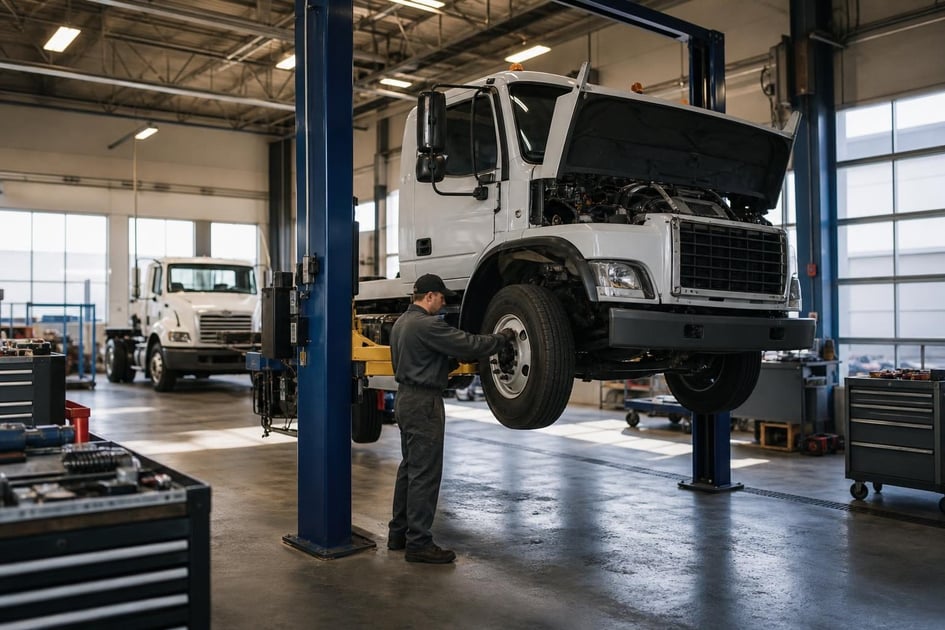
You Can Finance the Lift Without Touching Your Cash Reserve
You can finance a vehicle lift without a down payment. The lender secures the loan against the lift itself, which means you preserve working capital for payroll, parts, and daily operations. Most shops see the same-day decision if their financials are organized. If you are looking at a two-post model for general repair or a four-post alignment rack, see what financing structure you qualify for in minutes.
Already have a machine in mind?
Provide Capital finances new and used equipment from $5,000 to $5 million, with same-day decisions possible.
Apply NowWhat "No Money Down" Actually Means
No-money-down equipment financing is not a waiver of collateral. It simply means the lender covers 100% of the equipment cost, and the equipment serves as the security for the loan. You do not hand over cash at closing. The lender pays the vendor or dealer directly, and you repay over a fixed term.
This structure works because the collateral has resale value. A 10,000-pound two-post lift or a heavy-duty four-post inspection lift can be repossessed and resold if necessary, which lowers the lender's risk and keeps rates competitive. Rates vary by credit profile, equipment age, and term.
Because the lift is the collateral, you typically cannot use the same equipment to secure another loan simultaneously. The lender files a UCC-1 lien against the asset until the final payment clears.
Key Insight: Lenders often require the vendor to have a verified business license and a physical address. Private sellers on auction sites can trigger extra documentation requests, including third-party inspections and proof that the lift is not encumbered by a prior lien.
How Vehicle Lift Financing Works
The process starts with an application and equipment quote. You submit basic business and financial information, the lender evaluates the collateral and your ability to repay, and if approved, funds go directly to the seller. Equipment finance volume hit multi-decade highs in early 2026, according to Reuters reporting on equipment borrowing trends.
Application and Underwriting
Most applications take 10 to 15 minutes. You will need your business tax returns, recent bank statements, and the equipment invoice or quote. Some lenders also ask for a voided business check and your articles of incorporation.
Underwriting focuses on three factors: the value and condition of the lift, your business cash flow, and your credit history. A strong credit score can speed approval, but subprime options exist for owners with blemishes. Because the equipment backs the loan, lenders are often more flexible than they would be for an unsecured line of credit.
Approval and Funding Timelines
Same-day approvals are possible when the file is complete. If the lift is new, in stock, and the vendor is an established dealer, funding can occur within 24 to 48 hours. Used lifts or private-party sales may take longer because the lender needs to verify condition and title.
Types of Vehicle Lifts Commonly Financed
Shops finance everything from light-duty scissor lifts to heavy-duty truck alignment racks. The most common types include:
- Two-post lifts: Ideal for general repair, tire work, and brake service. They require a thicker concrete floor, typically 4 inches minimum at 3,000 PSI.
- Four-post lifts: Better for storage, alignment, and vehicles that stay elevated longer. They distribute weight more evenly and need less slab reinforcement.
- Scissor lifts: Popular for quick-lube bays and wheel service. They offer a smaller footprint but limited under-vehicle clearance compared to post lifts.
- Alignment lifts: Built with integrated turnplates and slip plates. These command higher prices but generate revenue directly through alignment services.
- Vehicle inspection lifts: Used by state inspection stations and fleet maintenance bays.
Vehicle Lift financing covers the full category, while Two Post Vehicle Lift financing targets the most common shop installation.
New vs. Used Vehicle Lifts
New lifts come with manufacturer warranties, predictable installation costs, and longer useful life. Used lifts cost less upfront but may need hydraulic refurbs, cable replacements, or adapter upgrades. Lenders treat them differently.
| Factor | New Lift | Used Lift |
|---|---|---|
| Financing availability | Wide; most lenders prefer new | Available; requires inspection |
| Typical term | 3 to 7 years | 2 to 5 years |
| Rate impact | Lower; collateral value is certain | Higher; depreciation risk |
| Warranty | Usually 2 to 5 years | Limited or none |
| Installation | Included or quoted separately | Buyer often pays removal/transport |
| UCC lien priority | Clean title | Must verify no prior liens |
A used 12,000-pound four-post lift might cost $4,000 to $6,000 plus rigging, while a comparable new unit runs $8,000 to $12,000 installed. If the used lift needs $1,500 in cylinder seals and cable work, the total cost gap narrows.
Pro Tip: Before financing a used lift, request a load-test certificate from the seller. ANSI/ALI ALCTV certification is the industry safety standard. A lift without current certification may fail inspection and cannot be used in a commercial bay until it is re-certified, a process that can cost $800 to $1,500.
Lease vs. Loan: Which Structure Fits?
An equipment loan makes you the owner from day one. You claim depreciation and interest, and at the end of the term you hold an unencumbered asset. A lease splits into two flavors: a fair-market-value (FMV) lease and a $1 buyout lease.
With an FMV lease, you make lower monthly payments and return the lift at the end of the term or buy it at fair market value. This works well if you expect technology to change or if you plan to move locations. A $1 buyout lease functions like a loan for tax and accounting purposes but may have different balance-sheet treatment.
Loans generally win for long-term shop owners who want equity and full control. Leases appeal to established owners who prioritize lower monthly payments and the option to refresh equipment without resale hassle.
By the Numbers: A $15,000 alignment lift financed over 60 months might carry a monthly payment between $300 and $400, depending on credit and term. The same lift on a 36-month FMV lease could run $250 to $325 monthly, but you would owe a residual payment or return the equipment at the end.
Qualification Criteria in Detail
Lenders look at the whole file, not just a credit score. Small Business Administration guidance emphasizes that lenders evaluate cash flow alongside credit history when reviewing applications.
Credit Profile
Most equipment lenders want a personal credit score above 600 for standard approvals. Scores below that do not disqualify you, but they may shorten the term or require a stronger revenue story. Recent bankruptcies, open tax liens, or judgments within the past two years are bigger obstacles than a single late payment.
Time in Business
Two years in operation is the sweet spot. Some lenders accept six months if revenue is strong and the owner has prior industry experience. Seasonal shops should apply during their busy quarter when bank statements show the strongest cash flow.
Revenue and Cash Flow
Lenders typically want to see monthly revenue at least 1.2 to 1.5 times the proposed equipment payment. If the lift payment is $400 per month, your business should show roughly $5,000 to $7,000 in monthly deposits. They verify this with three to six months of business bank statements.
Equipment Specifications
The lift must be for commercial use and installed on business premises. Residential garage lifts are harder to finance because the collateral is not generating income. The lender may ask for photos of the bay, floor thickness details, and the install location.
Find the right financing structure
Tell us about the equipment you need and we will show you the options that fit your business.
See Your OptionsTax Treatment for 2026
The tax year 2026 offers significant incentives for equipment purchases, but the exact deduction limits depend on legislation passed by Congress. For 2026, Section 179 allows businesses to deduct the full purchase price of qualifying equipment, subject to a spending cap. Bonus depreciation may also apply, though the percentage has been phasing down in recent years.
Because tax law changes frequently, you should confirm the 2026 Section 179 limit and bonus depreciation rate with a CPA before you file. The deduction is only available if the lift is placed in service during the 2026 tax year. Financed equipment qualifies just like cash purchases, as long as you are legally obligated to make the payments.
Pro Tip: If you finance a lift in December 2026 but it does not arrive and get installed until January 2027, you cannot claim the 2026 deduction. Order lead times for American-made lifts can run 6 to 10 weeks during Q4, so plan your financing application by October if you want the equipment on your 2026 books.
Worked Cost Examples
Numbers vary by credit and term, but here are realistic scenarios for shops considering a lift purchase.
Example 1: Independent Auto Repair Shop
A shop owner wants a $12,000 two-post lift with delivery and installation. She finances 100% over 60 months. Her monthly payment falls in a range that leaves her cash flow intact. Over five years, she pays roughly $18,000 to $21,000 total, depending on the rate. During that time, the lift allows her to add brake and suspension work that generates an estimated $8,000 to $12,000 in additional annual revenue.
Example 2: Fleet Maintenance Bay
A construction company with in-house fleet maintenance finances a $22,000 four-post alignment lift for its diesel trucks. The term is 48 months. The monthly payment is manageable against the fuel and tire savings from keeping alignment in-house. Construction equipment financing often bundles lifts with other fleet service tools under a single master agreement.
Example 3: Tire and Wheel Shop
A tire shop adds a $9,000 scissor lift to speed mounting and balancing. Financed over 36 months, the payment is low enough that four additional tire sets per month cover it. The lift pays for itself before the note matures.
Industries That Rely on Vehicle Lifts
Auto repair shops are the obvious buyers, but lifts serve a wider market. Fleet maintenance operations for utilities, municipalities, and delivery companies keep lifts in-house to avoid vendor downtime. Heavy equipment dealers use lifts to service skid steers and compact excavators. Agricultural operations lift tractors and combines for seasonal maintenance.
Even industries not traditionally associated with automotive work need lifts. A landscaping company with a dozen diesel trucks saves money by doing its own oil changes and brake jobs. A food distributor with refrigerated box trucks maintains its own fleet to meet tight delivery schedules. U.S. Census Bureau business data shows automotive repair and maintenance as one of the largest small-business employment sectors.
Common Mistakes When Financing Lifts
Buying the lift before checking floor specs is the most expensive error. A two-post lift exerts over 15,000 pounds of concentrated force at each column base. If your slab is only 3 inches thick, you will need a footing cut, which adds $1,500 to $3,000 to the job.
Another mistake is forgetting soft costs. Delivery, rigging, electrical work, and compressed-air lines are not always included in the equipment quote. A lender that covers soft costs can roll these into the financing, but you must disclose them upfront.
Owners also trip up by financing a lift that exceeds their bay height. A 12-foot ceiling cannot accommodate a four-post lift with a full-size truck on top. Measure floor-to-ceiling, accounting for lighting fixtures and door tracks, before you sign.
Key Insight: Some lenders cap the soft-cost percentage at 20% to 25% of the equipment price. If your lift costs $10,000 and installation is $3,500, the lender may only finance $12,500 total. Ask your vendor for a split invoice that separates equipment from labor so the lender can see exactly what is being financed.
Documentation You'll Need
Gather these items before you apply to avoid delays:
- Driver's license
- Voided business check
- Last two years of business tax returns (or one year if younger)
- Three to six months of business bank statements
- Equipment quote or invoice from the vendor
- Proof of business ownership (articles of incorporation or operating agreement)
- Commercial lease or mortgage statement for the shop
If you are buying used, add the serial number, year of manufacture, and photos. The lender may request an independent appraisal for lifts over five years old.
What Happens After Approval
Once approved, the lender issues a purchase order or funds the vendor directly. You schedule delivery and installation. After the lift is operational, the lender files a UCC lien. You receive a payment schedule, usually via ACH auto-debit.
Missed payments trigger the same consequences as any secured loan: late fees, credit damage, and potential repossession. If you hit a rough quarter, call the lender before you miss a payment. Many will offer a seasonal skip or restructure rather than repossess a depreciated asset.
Get a decision on your lift purchase, possibly the same day you apply, so you can book installation before your busy season hits.
Ready to move forward?
More than 10,000 businesses have financed equipment with Provide Capital. See what you qualify for today.
Get StartedFrequently Asked Questions
Can I finance a lift with bad credit?
Yes, but expect shorter terms and higher payments. Subprime equipment financing exists because the collateral reduces lender risk. A credit score below 600 may require six months of strong revenue or a co-signer.
Does the lender pay me or the vendor?
The lender pays the vendor directly in almost all cases. If you already bought the lift with cash, some lenders offer sale-leaseback or reimbursement financing, but this is less common and may require extra documentation.
Can I finance a lift from a private seller?
Sometimes. Private sales require clear title verification, a bill of sale, and often a third-party inspection. Dealer purchases are simpler because the vendor has a established business license and warranty support.
What terms are available for vehicle lift financing?
Terms typically range from 24 to 84 months. New lifts qualify for longer terms because the collateral holds value. Used lifts over 10 years old may be limited to 36 months.
Is the interest tax-deductible?
Yes. For the 2026 tax year, the interest portion of your equipment financing payments is deductible as a business expense. The principal repayment is not deductible, but you may be able to depreciate or expense the equipment itself under Section 179. Confirm the exact 2026 limits with your CPA.
Can I pay off the loan early?
Most equipment lenders allow early payoff, but some charge a prepayment penalty or keep a portion of the remaining interest. Ask for the prepayment policy in writing before you sign.
Do I need a business bank account?
Yes. Lenders deposit funds to business accounts and debit payments from them. Personal checking accounts are generally not accepted for commercial equipment financing.
Will financing a lift help my business credit?
It can. Equipment lenders often report to business credit bureaus. On-time payments build your profile. Missing payments hurts it, so treat the obligation as seriously as any term loan.
Next Steps
A vehicle lift is a revenue tool, not an expense. Financing it with no money down keeps your cash reserve intact for the moments you actually need it. Gather your quote, your last two tax returns, and three months of bank statements. Then start an application in a few minutes and move your shop closer to the next revenue tier.
Disclaimer: The information provided in this article is for general educational purposes only and is not financial, legal, or tax advice. Funding terms, qualifications, and product availability may vary and are subject to change without notice. Provide Capital does not guarantee approval, rates, or specific outcomes. For personalized information about your business funding options, contact our team directly.
