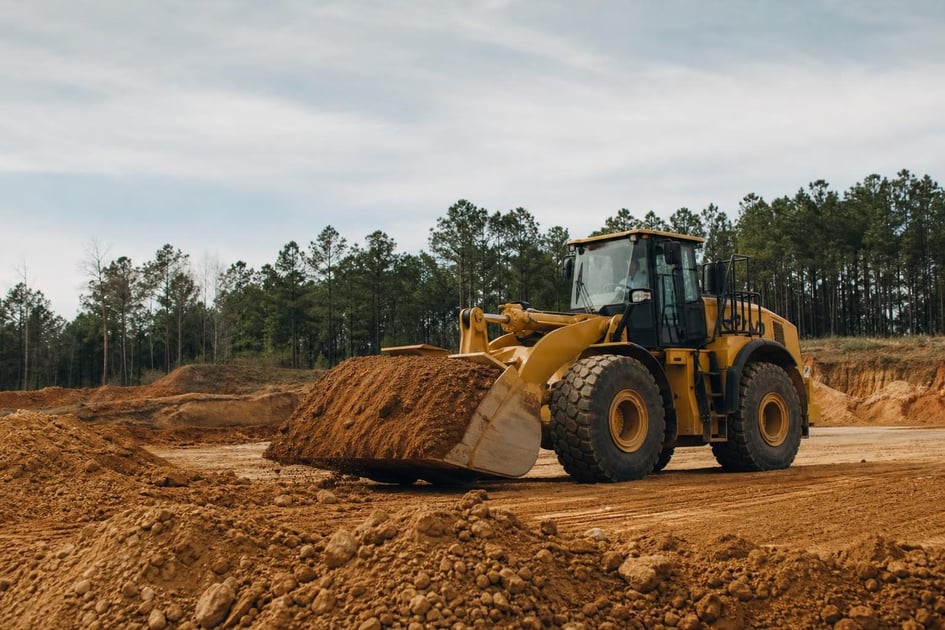
If you run a grading, site-prep, or material-handling operation in Georgia, you can finance a wheel loader with the machine itself as collateral. Rates vary by credit profile, equipment age and term. Same-day approvals are possible, and financing covers both new and used units from $5,000 up to $5 million. Because the loader secures the note, lenders can offer more competitive terms than an unsecured line of credit.
Why Georgia Contractors Finance Rather Than Pay Cash
Georgia's construction pipeline is busy. According to U.S. Census Bureau data, the state issued over 61,000 building permits in 2025, with the Piedmont region and coastal port areas leading volume. That activity keeps wheel loaders working six to ten months a year on everything from subdivision pad prep to port-related warehousing. Tying up $150,000 to $400,000 in a single machine strains cash reserves that might otherwise cover payroll, fuel bonds, or insurance deductibles. Financing preserves liquidity while putting revenue-producing iron on the job site.
Seasonal patterns matter here. Georgia's relatively mild winters let many crews work through January and February, but late-summer thunderstorms can delay site-prep schedules. A financed loader lets you scale up before the spring rush without draining the operating account during slower months.
The Georgia Landscape for Earthmoving
North Georgia's granite-derived soils chew up undercarriages, so contractors in the Piedmont and northeast mountains often favor wheel loaders with heavy-duty axles and solid-tire setups. Coastal Georgia's sandy loam is easier on equipment, but salt-air corrosion near the ports and barrier islands demands pressure-washing discipline. Lenders know these regional variables. A finance company that specializes in equipment understands why a 3-cubic-yard loader in an inland metro county might command higher resale value than an identical machine kept three miles from the Atlantic.
Key Insight: Georgia lenders and appraisers adjust residual values by region. A loader with 4,000 hours in the Piedmont often books higher than a coastal unit with 3,500 hours because salt exposure accelerates frame corrosion and electrical issues.
Get a fast decision on your equipment
Applying takes just a few minutes, and decisions can come as soon as the same day.
Start Your ApplicationNew vs. Used Wheel Loaders: What Lenders Look For
Both new and used wheel loaders are financeable, but the terms diverge. New machines from Caterpillar, Komatsu, John Deere, or Volvo carry full manufacturer warranties and predictable maintenance schedules. Lenders like that predictability; it lowers their collateral risk. Terms on new loaders often stretch to 60 or 72 months, keeping monthly obligations manageable.
Used loaders are a different underwriting conversation. Most equipment lenders cap financing at machines up to 10 to 15 model years old, though the exact cutoff varies by brand and condition. A 2019 loader with complete maintenance records and under 5,000 hours is easier to finance than a 2012 model with gaps in its service history. Rates vary by credit profile, equipment age and term, so expect a modest rate premium on older iron.
The inspection matters. For used units, lenders typically require an independent appraisal or a dealer pre-purchase inspection. They want confirmation that the axles, transmission, hydraulics, and bucket pins are sound. If you buy at auction, have the inspection arranged before you bid. A winning bid on a machine that fails the collateral review can leave you scrambling for alternative funding.
Manufacturer Programs vs. Independent Financing
OEM captive finance arms sometimes offer promotional terms on new loaders, but those programs usually require pristine credit and full documentation. Independent equipment lenders like Provide Capital can often move faster, approve a broader range of credit profiles, and finance used machines that manufacturer programs will not touch. If you need a same-day decision or your credit has a few dings, independent financing is usually the more flexible path.
Pro Tip: If you are buying used, ask the seller for the hour-meter reading, the last three maintenance invoices, and the original build sheet. Lenders review these three items first. Having them ready can shave a full business day off your approval timeline.
Lease vs. Loan: Side-by-Side Comparison
Deciding between an equipment lease and a term loan comes down to ownership intent, tax strategy, and monthly cash flow. Below is a practical comparison for a Georgia contractor evaluating a $250,000 wheel loader.
| Feature | Equipment Term Loan | Equipment Lease |
|---|---|---|
| Ownership | You own the loader; lender holds lien | Lessor owns the loader; you may have purchase option at end |
| Down Payment | Often 0% to 20% | Often 0% to 10% first/last payment |
| Term | 24 to 72 months | 24 to 60 months |
| Monthly Cost | Higher than lease; builds equity | Lower monthly; no equity unless exercised |
| Collateral | The loader itself | The loader itself, plus possible personal guarantee |
| Tax Treatment in 2026 | Section 179 deduction up to applicable limits; bonus depreciation may apply | Deduct lease payments as operating expense; consult your CPA |
| End of Term | Free and clear, or refinance balloon | Return, renew, or buy at fair market value |
| Best For | High-hour operators who wear machines out | Contractors who refresh fleets every 3–4 years |
The tax treatment distinction is critical for the 2026 tax year. Under Section 179, you may be able to deduct the full purchase price of a financed wheel loader in the year you place it in service, subject to 2026 limits and phase-out thresholds. For tax year 2026, the Section 179 deduction limit and the total equipment purchase cap are set by the IRS; consult a CPA to confirm the exact figures for your situation. Lease payments, by contrast, are typically written off ratably over the lease term as an operating expense. Neither route is automatically superior; the right choice depends on your tax bracket, expected annual hours, and whether you want to own the asset at maturity.
By the Numbers: A $250,000 loan over 60 months at competitive equipment-financing rates typically runs between $4,500 and $5,500 per month, depending on credit profile, equipment age and term. A lease on the same machine might run $3,800 to $4,800 monthly, but you will not build equity unless you exercise a buyout.
Qualifying for Wheel Loader Financing
Equipment lenders underwrite differently than banks offering unsecured working capital. Because the wheel loader serves as collateral, the credit decision weighs three factors roughly equally: your personal and business credit history, the equipment's value and condition, and your ability to repay from operating cash flow.
Credit score thresholds vary. A score above 680 generally unlocks the most competitive terms, but scores in the low 600s can still qualify with a larger down payment or a shorter term. If your business is established with two or more years of tax returns showing positive net income, that history often offsets a thinner credit file.
Time in business matters. Contractors who have been running equipment for three or more years usually see higher approval amounts and longer amortizations. That is not a hard rule, but it is a reliable trend. If you are newer, expect the lender to scrutinize your personal debt-to-income ratio more closely and possibly cap the advance at 80% to 90% of the machine's value.
What Credit Profile Gets You Same-Day Approval
Same-day approvals are possible when the file is clean: strong credit, clear equipment specs, a readable invoice or purchase agreement, and no liens or judgments. If there are complications—such as a prior bankruptcy, an open tax lien, or an overseas-built machine with limited comparable sales in the U.S.—the review extends to 24 or 48 hours. The fastest path to a yes is preparation. Have your documentation organized before you apply.
The Small Business Administration notes that its 7(a) loan program can be used for purchasing and installation of machinery and equipment, with most loans carrying a maximum of $5 million. While SBA-backed financing is one path, direct equipment lenders often move faster for collateral-specific transactions because they do not require the same government paperwork.
Documentation You Need to Apply
Lenders ask for a short list of items, and providing them upfront prevents delays. At minimum, expect to submit:
- A completed application with business and personal information
- The last two to three years of business tax returns (if the business has filed that long)
- A current year-to-date profit and loss statement
- A copy of the equipment invoice, listing, or auction receipt
- Proof of insurance naming the lender as loss payee
- A voided business check for ACH setup
For used purchases, add the maintenance history and any appraisal report. If the seller is a private party rather than a dealer, the lender may also want a bill of sale and a title search to confirm no outstanding liens on the serial number.
Insurance requirements are non-negotiable. The policy must cover the replacement value of the loader and list the finance company as loss payee. Most commercial equipment policies satisfy this, but if you are a smaller operator carrying only general liability, you will need to add inland marine or equipment-specific coverage before funding.
Find the right financing structure
Tell us about the equipment you need and we will show you the options that fit your business.
See Your OptionsGeorgia Industry Use Cases
Wheel loaders are not one-size-fits-all. The way you use the machine affects the financing structure, the insurance premium, and the resale value at the end of the term.
Site Development and Grading
In the Piedmont suburbs and along major interstate corridors, site developers run loaders 1,500 to 2,000 hours per year moving topsoil and grading pads. These machines depreciate faster but generate steady revenue. A 60-month term loan works well here because the cash flow supports the payment, and the contractor usually keeps the loader for its full useful life.
Agriculture and Poultry
South Georgia poultry houses and row-crop operations use smaller loaders—often 2- to 3-cubic-yard buckets—to move feed, bedding, and harvested goods. Usage is seasonal, peaking in spring and fall. A lease with a seasonal payment structure or a loan with a 90-day deferred first payment can smooth cash flow during the dormant winter months.
Forestry and Land Clearing
Middle and Southeast Georgia timber operations run loaders with grapple attachments to sort and deck logs. These are harsh conditions: dirt, sap, and long idle periods in wet weather. Lenders know forestry hours are harder on equipment than grading hours, so they may shorten the allowable term or require a slightly larger equity injection. Mentioning the attachment type and expected annual hours upfront prevents surprises in underwriting.
Waste and Recycling
Transfer stations and C&D recyclers around central Georgia use wheel loaders to push and sort material. These machines see constant cycling and high underhood temperatures. If you are financing a loader for this application, expect the lender to ask about the cooling system, radiator maintenance, and whether the machine has a debris-management package. A well-spec'd unit holds value better and finances more easily.
Common Mistakes Georgia Buyers Make
The most expensive errors happen before the application is submitted.
Overlooking regional resale value. A loader popular in Texas might sit on a Georgia dealer's lot for months. If the lender has to repossess and resell, they care about local demand. Stick to brands with strong dealer networks in the Southeast: Caterpillar, Deere, Komatsu, and Volvo all have multiple service centers in Georgia.
Buying at auction without pre-approval. Auction fever is real. Bidders routinely exceed retail value by 10% to 15% because they have not lined up financing. Get your approval letter or budget ceiling before you raise your hand. If you win, you have 24 to 48 hours to pay; scrambling for funds under pressure rarely yields good terms.
Ignoring the total cost of ownership. Finance the machine, but budget for tires, hydraulics, and preventive maintenance. A set of solid tires for a mid-size loader can run $8,000 to $12,000. If your cash is fully committed to the down payment, a blown transmission in month three becomes a crisis.
Mixing personal and business credit without a plan. Some sole proprietors apply under their personal credit to get a faster decision, then struggle when the debt dings their debt-to-income ratio during a home refinance. If the loader is for business use, apply in the business name with a personal guarantee. It keeps the bookkeeping clean and builds business credit.
Key Insight: Georgia auction volumes for construction equipment spike in March and November, tied to fiscal year-ends and spring mobilization. Lenders see higher default risk on auction purchases made without pre-approval because buyers often overbid. Pre-approval letters typically hold for 30 days, covering at least one major auction cycle.
What Happens After Approval
Once the lender issues a term sheet, review it carefully. Check the advance amount, the monthly payment, the term, any prepayment penalties, and the UCC filing details. If everything looks correct, sign and return the documents. The lender then verifies insurance and pays the seller directly.
Dealer purchases are straightforward: funds wire to the dealer, you pick up the machine. Private-party sales require a title transfer and lien perfection, which adds one to three business days. Auction houses usually demand immediate payment, so work with a lender that can wire same-day once documents are signed.
After funding, the lender files a UCC-1 against the serial number. This is standard and public. It does not prevent you from selling the loader later, but you must pay off the lien first. Keep your payment record clean; on-time equipment financing history is one of the fastest ways to build commercial credit and qualify for larger facilities later.
Recent data shows that U.S. business spending on equipment has grown for four straight quarters, supported by construction and infrastructure investment. That trend means lenders are active, but it also means quality used loaders move quickly. Having your financing lined up lets you act when the right machine appears.
Ready to move forward?
More than 10,000 businesses have financed equipment with Provide Capital. See what you qualify for today.
Get StartedFrequently Asked Questions
Can I finance a wheel loader with a credit score below 650?
Yes, though the terms adjust. Expect a larger down payment—sometimes 15% to 20%—and a shorter term. Rates vary by credit profile, equipment age and term, so a lower score means a higher monthly payment. Strong cash flow or a co-signer can improve the offer.
How fast can I get funded?
Same-day approvals are possible when the file is complete and the credit and equipment profiles are straightforward. Most transactions close in one to three business days. Complicated deals—private sellers, out-of-state purchases, or credit challenges—take longer.
Is a down payment always required?
Not always. Well-qualified buyers can sometimes secure 100% financing. If the equipment is used, older, or the credit profile is thinner, the lender may require 5% to 20% down. The exact amount depends on the overall risk picture.
Can I finance attachments and warranties?
Many lenders will roll in attachments—buckets, forks, grapples—up to a limit, usually 10% to 20% of the machine's value. Extended warranties and service contracts may also be financeable if they are included on the invoice. Soft costs like freight and training are sometimes covered; ask your lender.
What tax benefits apply in 2026?
For tax year 2026, Section 179 allows businesses to deduct the full purchase price of qualifying equipment up to the IRS limit, subject to a total equipment purchase phase-out threshold. Bonus depreciation may also be available at a percentage set by law for 2026. These rules change frequently; consult a CPA to confirm the exact limits for your situation.
Can I pay off the loan early?
Most equipment lenders allow early payoff, but some charge a prepayment penalty or a minimum interest period. Read the term sheet before you sign. If early payoff is likely, negotiate a simple-interest loan with no prepayment penalty.
Does the lender need to inspect the machine?
For used equipment, yes. The lender will either accept a dealer inspection, an independent appraisal, or their own visual review. New equipment bought from an authorized dealer rarely requires an independent inspection.
Can I buy from a private party?
Yes, but the lender will verify the title is clear and may require an escrow service or direct title transfer. Private-party sales take slightly longer than dealer sales because of the extra lien and title verification steps.
Ready to Put a Wheel Loader to Work?
Georgia's construction, agriculture, and forestry sectors run on reliable iron. If you are looking at a wheel loader for your next job, financing keeps your cash working elsewhere while the machine earns its keep. Get a same-day decision on your equipment and see how competitive the terms can be when the loader itself secures the note.
Provide Capital finances new and used business equipment from $5,000 to $5 million nationwide, including Wheel Loaders financing, Dump Trucks financing, and Skid Steer Loader financing. We also specialize in Construction equipment financing for contractors who need fast, straightforward decisions without the red tape of traditional banks. Talk to a specialist about your specific machine and keep your projects moving.
Disclaimer: The information provided in this article is for general educational purposes only and is not financial, legal, or tax advice. Funding terms, qualifications, and product availability may vary and are subject to change without notice. Provide Capital does not guarantee approval, rates, or specific outcomes. For personalized information about your business funding options, contact our team directly.