
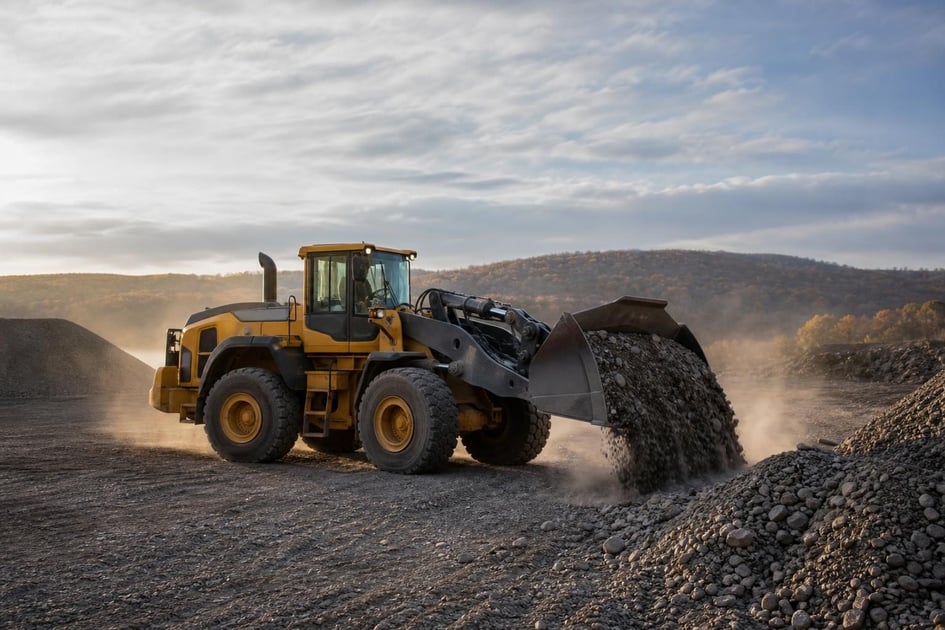
Financing a Wheel Loader in Pennsylvania
Pennsylvania contractors, quarry operators, and farmers can finance new and used wheel loaders from $5,000 up to $5 million through equipment lenders that use the machine itself as collateral. Because the loader secures the financing, rates stay competitive and same-day approvals are possible for well-qualified buyers. If you are staring at a purchase quote for a Cat, Deere, Komatsu, or Case loader, see what financing terms you qualify for in a few minutes without committing to the full cash outlay upfront.
Pennsylvania’s equipment market is driven by a mix of heavy civil construction, manufacturing plant work, agriculture, and forestry. The state logged roughly 261,400 construction jobs in mid-2026, according to Census Bureau data on Pennsylvania, with demand concentrated in data-center infrastructure, highway work, and warehouse development across the Lehigh Valley, central Pennsylvania, and the I-78 corridor. A wheel loader is not a luxury in these lines of work; it is the primary tool for material handling, site prep, and snow removal. Financing lets you put the machine to work immediately while preserving operating cash for labor, materials, and fuel.
Key Insight: Pennsylvania’s construction employment was down roughly 0.8 percent year-over-year as of mid-2026, but contractors report that data-center and power-generation projects are keeping backlogs healthy in the eastern half of the state. That means firms with modern, reliable equipment are better positioned to bid on the jobs that are actually breaking ground, while competitors with aging iron face higher maintenance costs and downtime.
Already have a machine in mind?
Provide Capital finances new and used equipment from $5,000 to $5 million, with same-day decisions possible.
Apply NowWhat Wheel Loaders Cost in 2026
Wheel loader prices vary by horsepower, bucket size, and attachment package. Compact loaders under 100 horsepower typically run from $60,000 to $130,000 new and $30,000 to $90,000 used. Small loaders in the 100-to-150-horsepower range generally cost $150,000 to $220,000 new and $70,000 to $150,000 used. Mid-size machines from 150 to 250 horsepower often fall between $220,000 and $450,000 new, with used units ranging from $90,000 to $300,000. Large production loaders above 250 horsepower can reach $450,000 to $800,000 new, and very large quarry machines can exceed $1 million.
Used financed sales averaged about $158,049 in early 2026 according to industry resale data, though hours, condition, and regional inventory move that figure up or down. In Pennsylvania, freight from midwestern auction yards or regional dealers adds $2,000 to $5,000 to the delivered cost, a line item many buyers forget to budget. If you are buying from a private seller or an out-of-state auction, make sure your financing covers the transport invoice as well as the machine.
New vs. Used: Which Loader Makes Sense to Finance?
New wheel loaders come with full manufacturer warranties, predictable maintenance schedules, and the latest emissions and telematics packages. For a contractor running multiple shifts on a data-center pad or a quarry operating six days a week, that uptime reliability can justify the premium. New machines also typically qualify for the longest financing terms, which keeps monthly payments lower even though the total financed amount is higher.
Used loaders cost less upfront and depreciate more slowly in the first year, but they carry more risk. A machine with 4,000 hours may need immediate work on the drivetrain, hydraulics, or bucket pins. Before financing a used loader, get an independent inspection and request the maintenance log. Lenders will want to know the year, make, model, hours, and serial number anyway, so use that same information to negotiate any needed repairs into the purchase price.
| Factor | New Wheel Loader | Used Wheel Loader |
|---|---|---|
| Purchase price | Higher upfront cost | Lower upfront cost |
| Depreciation | Steepest in years 1–2 | Slower after initial drop |
| Financing term | Often up to 60–72 months | Typically 36–60 months |
| Warranty coverage | Full manufacturer warranty | Limited or expired; budget for repairs |
| Qualifying for financing | Easier; lender knows residual value | Requires inspection and hour verification |
| Best for | High-utilization fleets, long-term ownership | Seasonal work, backup machines, tight budgets |
If your utilization rate will sit above 70 percent for the next two to three years, owning—whether new or used—usually costs less per hour than renting. Below 60 percent utilization, the carrying cost of ownership often exceeds the rental rate, so be honest about how many hours the machine will actually log.
Pro Tip: Pennsylvania buyers shopping in late fall and winter often find softer used-loader prices because construction fleets are shedding iron before year-end. Dealers are also more willing to negotiate on remaining new inventory before the manufacturer’s annual count. If you finance in November or December, you may still place the machine in service before December 31 to capture the current tax-year deduction, but only if your lender can fund and the seller can deliver in time.
How Equipment Financing Works for Wheel Loaders
Equipment financing is a secured transaction: the wheel loader itself serves as collateral. That structure reduces risk for the lender, which translates into competitive rates and faster turnaround than unsecured borrowing. At Provide Capital, we finance new and used business equipment from $5,000 to $5 million nationwide, including purchases from dealers, private sellers, and auctions.
The application process typically starts with a short form about your business, the equipment you are buying, and your requested term. You will need to provide a photo ID, a voided business check, and the equipment invoice or listing. Some transactions also require recent bank statements or tax returns, especially for larger amounts or newer businesses. Because the collateral is tangible and easy to value, decisions can come back the same day.
Rates vary by credit profile, equipment age, and term length. A well-qualified buyer financing a late-model loader may see lower rates and longer amortization than a buyer with challenged credit seeking a 15-year-old machine. The key is matching the term to the useful life of the equipment. Stretching a 10-year-old loader over 72 months can leave you upside down if the machine needs major repairs before the note is paid off.
Lease vs. Loan: Structuring the Deal
A loan means you own the loader outright once the balance is paid. You build equity, you can sell or trade at any time, and you claim depreciation and Section 179 deductions. A true or finance lease works more like rent-to-own: you make fixed payments and often have a nominal buyout at the end, such as $1 or 10 percent of the original cost. An operating lease is closer to a rental; you return the machine at the end of the term with no ownership stake.
For a Pennsylvania contractor who wants to own the iron and run it for 8,000 hours, a loan or finance lease is usually the better fit. For a firm taking on a two-year data-center project and uncertain about workload after completion, an operating lease preserves flexibility. The trade-off is that operating leases generally do not let you claim Section 179, though you can typically deduct the lease payments as an operating expense. Ask your CPA which structure aligns with your tax strategy for the 2026 tax year, and review SBA guidance on buying business equipment to compare the long-term cost of leasing versus owning.
By the Numbers: Industry benchmarks for heavy equipment target 70 to 85 percent utilization when deployed. Below 60 percent, the asset usually costs more in financing, insurance, and maintenance than it returns in billable hours. If a loader will run fewer than 1,000 hours per year, renting or a short-term lease is often the smarter financial move.
Tax Treatment for 2026
Wheel loaders qualify as Section 179 property, which means a business can elect to deduct the full purchase price in the year the machine is placed in service rather than depreciating it over multiple years. For tax years beginning in 2026, the Section 179 deduction limit is $2,560,000, and the phase-out begins when total qualifying equipment purchases exceed $4,090,000. Financed equipment qualifies as long as it is placed in service by December 31 and otherwise meets IRS requirements.
If your total equipment spending for 2026 falls below the phase-out threshold, you may be able to write off the entire cost of a mid-size loader in the first year. If you have already purchased significant equipment this year, the deduction begins to reduce dollar-for-dollar above $4,090,000. Bonus depreciation may still be available for amounts not covered by Section 179, but the rules shift periodically. Before you time a purchase around tax savings, confirm the current-year treatment with your CPA.
Find the right financing structure
Tell us about the equipment you need and we will show you the options that fit your business.
See Your OptionsQualifying for Financing
Lenders look at time in business, personal and business credit, annual revenue, and the equipment itself. A business with two or more years of operation, consistent revenue, and a credit score in the strong range will generally qualify for the best terms. Startups and newer businesses can still get approved, but they may need a larger down payment or a shorter term.
The equipment condition matters too. A 2024 loader with 800 hours from a Caterpillar dealer is easier to finance than a 2011 machine with 6,000 hours from a private seller in rural Pennsylvania. That does not mean the older machine is unfinanceable; it simply means the lender may ask for a larger down payment or may cap the term at 36 months instead of 60.
Common mistakes to avoid: applying to five lenders at once, which leaves multiple hard inquiries on your credit report; guessing at your revenue numbers instead of referencing bank statements; and failing to get a purchase agreement or invoice before applying. Have your paperwork ready, choose one lender that understands heavy equipment, and submit a complete package. Start an application for your wheel loader with the machine listing and your basic business information in hand.
Pennsylvania Industries That Depend on Wheel Loaders
Construction is the obvious market, but Pennsylvania’s economy puts wheel loaders to work across several sectors. In the Lehigh Valley and around Philadelphia, loaders move aggregate and topsoil on warehouse and distribution pad sites. In central Pennsylvania, they handle feed, manure, and bedding on dairy and crop operations. In the northern tier and western Pennsylvania, forestry crews use loaders to sort logs and build deck piles. State and municipal highway departments rely on loaders for road maintenance and snow removal from November through March.
Pennsylvania also has active quarrying and mining operations that run loaders in high-abrasion environments. Those machines wear faster, so buyers in that sector often favor used iron with known maintenance histories over new units that will take a beating immediately. As Forbes reporting on construction equipment technology trends notes, automation and telematics are reshaping fleet management, but the underlying demand for durable loading equipment remains steady across the Northeast. Construction equipment financing covers the civil side, but the same lending structure works for agriculture, forestry, and material-handling applications statewide.
Seasonal buying patterns are real in Pennsylvania. Spring triggers a surge in earthmoving and site-prep demand, which tightens used inventory and pushes prices up. Winter brings the opposite: contractors who do not plow snow may park equipment and sell excess iron, creating opportunity for buyers who can store and maintain a machine through the off-season. Planning your purchase six to eight weeks before you need the loader on a job gives you time to shop, inspect, finance, and transport without paying a panic premium.
What Documentation You Need
Have the following ready before you apply: a photo ID for each business owner, a voided business check, the equipment invoice or auction listing with serial number and hours, and your last three months of business bank statements. For transactions above a certain threshold, lenders may also request a year-to-date profit and loss statement or the prior year’s business tax return. If you are buying from a private seller, the lender will need the seller’s contact information and proof that they own the machine free and clear, or a payoff letter if there is an existing lien.
Some buyers try to finance a loader before they have chosen a machine. That is possible through a pre-approval, but the final funding amount and rate depend on the exact year, make, model, and condition. It is usually faster to pick the machine first, then apply with the specific asset identified.
After Approval: Funding and Taking Delivery
Once approved, the lender typically pays the vendor or private seller directly. You do not take possession of the cash; you take possession of the loader. Dealer purchases usually fund within 24 to 48 hours after all documents are signed. Private-party and auction purchases can take a few days longer because the lender must verify title and coordinate payoff of any existing liens.
Before you accept delivery, verify that the serial number matches the invoice and that any agreed-upon repairs are complete. Take photos of the machine from multiple angles and note any cosmetic or mechanical issues on the bill of lading. If the loader arrives with undisclosed damage, you want documentation before the driver leaves your yard.
Ready to move forward?
More than 10,000 businesses have financed equipment with Provide Capital. See what you qualify for today.
Get StartedFAQ
Can I finance a wheel loader from a private seller in Pennsylvania?
Yes. Equipment lenders regularly finance private-party purchases as long as the seller can provide clear title or a payoff letter. The lender pays the seller directly after verifying ownership and coordinating lien releases.
How long can I finance a used wheel loader?
Terms typically range from 36 to 60 months for used loaders, depending on the machine’s age and hours. Some lenders will stretch a late-model, low-hour unit to 72 months, while a 12-year-old machine may cap at 36.
Does financing a loader affect my ability to claim Section 179?
No. Financed equipment qualifies for Section 179 just like a cash purchase, provided the machine is placed in service during the tax year and your total equipment purchases fall within the current limits. For 2026, consult your CPA to confirm the exact ceiling and phase-out thresholds.
What credit score do I need to finance a wheel loader?
There is no universal minimum. Buyers across the credit spectrum obtain equipment financing, but rates and down-payment requirements adjust accordingly. Strong credit and established business history generally produce the most favorable terms.
Can I include attachments in the financing?
Usually yes. Buckets, forks, snow pushers, and other attachments that are part of the same purchase can often be rolled into the financing amount. The attachment value must be itemized on the invoice so the lender can verify collateral value.
Is same-day approval actually possible?
Same-day approvals are possible for transactions with complete documentation and straightforward credit profiles. Complex deals, large amounts, or applications requiring additional verification may take 24 to 48 hours.
Can I refinance an existing wheel loader?
Equipment refinancing is available, but it depends on the machine’s current value, your payment history, and the remaining balance. If you own the loader free and clear, a sale-leaseback may be an option to free up working capital.
What happens if I pay off the loan early?
Prepayment terms vary by lender and product. Some loans carry a fixed schedule with no prepayment penalty; others include a declining prepayment charge. Review the prepayment language in your finance agreement before signing.
Get Your Pennsylvania Wheel Loader Financed
Whether you are bidding on a warehouse pad in Allentown, clearing snow in Scranton, or moving aggregate in York County, a financed wheel loader lets you put the machine to work now and pay over time as it generates revenue. Pennsylvania’s mix of construction, agriculture, and forestry work creates year-round demand for reliable loading equipment, and the right financing structure keeps your cash flow intact while you build equity in a hard asset.
At Provide Capital, we finance Wheel Loaders financing for businesses nationwide, with transactions from $5,000 to $5 million and same-day approvals possible. We also finance related iron like Dump Trucks financing and Backhoe Loader financing if you are building out a full fleet. Review your machine listing, gather your bank statements, and apply to get a decision on your wheel loader, possibly the same day.
Disclaimer: The information provided in this article is for general educational purposes only and is not financial, legal, or tax advice. Funding terms, qualifications, and product availability may vary and are subject to change without notice. Provide Capital does not guarantee approval, rates, or specific outcomes. For personalized information about your business funding options, contact our team directly.
