
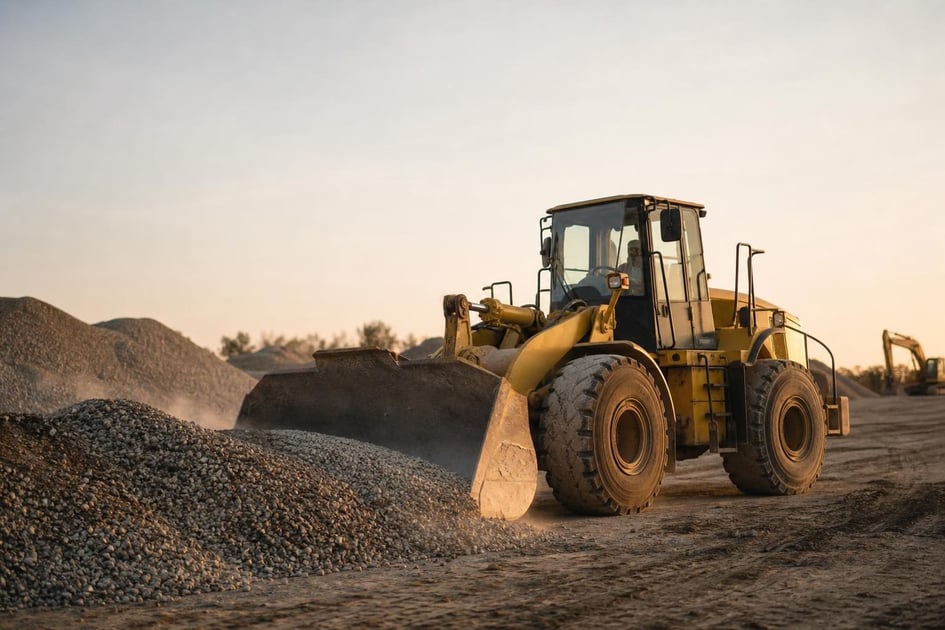
What Lenders Evaluate for Wheel Loader Financing
Getting a wheel loader financed comes down to three things: your business history, the machine itself, and how much equity you put into the deal. Lenders who focus on equipment financing look at the collateral first and your credit second, which is why rates vary by credit profile, equipment age and term rather than following a single published rate sheet. Even with higher interest rates over the past year, business spending on equipment has remained solid, which means lenders are still active in the construction and earthmoving space.
Credit history and business track record
Most equipment lenders want to see at least two years in business, though some programs accept 12 months if the revenue trend is strong. Your personal credit score still matters even when the business files its own tax returns, especially for owner-operators with fewer than five employees. A score in the mid-600s opens most equipment finance programs; below that, expect a larger down payment or a shorter term. If you have recent bankruptcies, tax liens, or judgments, disclose them upfront. Many lenders can work around old issues, but hidden ones discovered late will kill the deal.
If you are looking at a Wheel Loaders financing package, the fastest path is to pull your own credit report and business bank statements before you apply. That lets you correct errors and explain gaps before an underwriter sees them. You can see what financing you qualify for on that loader in a few minutes without a hard credit pull in many cases.
Equipment age, hours, and condition
The machine you are buying is the collateral. Lenders care about year, make, model, and meter hours because that determines residual value if they have to remarket it. New loaders typically qualify for the longest terms, up to 60 or 72 months depending on the lender. Used machines over five years old may still qualify, but the term usually shortens to match remaining useful life. High-hour units—those over 10,000 hours—can be financed, yet they often require 20 to 30 percent down to offset depreciation risk. A dealer inspection or fresh service records help, and some lenders require an appraisal for units priced above $100,000.
Down payment and collateral structure
Equipment financing rarely requires real estate collateral. The loader itself secures the loan. Down payments range from zero to 20 percent for established buyers with strong credit, but a first-time buyer or a lower credit profile should plan on 10 to 20 percent. The down payment does not go to the lender; it reduces the amount financed, which lowers your monthly obligation and the lender’s exposure. Some structures use a security deposit or a first-and-last payment instead of a traditional down payment, which preserves cash flow while still satisfying the lender’s risk model.
Key Insight: Lenders often reserve their best terms for units sold through authorized dealers with established remarketing agreements. A private-party sale can still be financed, but the approval may come with a shorter term or a higher equity requirement because the lender has no recourse if the machine is misrepresented.
Get a fast decision on your equipment
Applying takes just a few minutes, and decisions can come as soon as the same day.
Start Your ApplicationNew vs. Used Wheel Loaders: Financing Differences
New wheel loaders carry full manufacturer warranties, predictable maintenance schedules, and the longest available financing terms. Used wheel loaders cost less upfront but carry more residual-value risk for the lender, which translates into different structures.
| Factor | New Wheel Loader | Used Wheel Loader |
|---|---|---|
| Typical term | 48 to 72 months | 36 to 60 months |
| Down payment | 0% to 10% | 10% to 20% |
| Rate structure | Rates vary by credit profile, equipment age and term | Rates vary by credit profile, equipment age and term; older units may carry a modest premium |
| Collateral required | The loader only | The loader only; high-hour units may need an appraisal |
| Documentation | Invoice or purchase order | Invoice, serial-number verification, and sometimes an inspection report |
| Best fit for | High-utilization fleets, warranty coverage needs | Cost-conscious buyers, seasonal operations, backup machines |
Do not assume used means harder to approve. A three-year-old loader with 2,000 hours from a Cat or Deere dealer often finances as smoothly as a new unit. A 15-year-old machine with 12,000 hours and no service records is a different story. The difference is not the calendar age alone; it is the expected remaining life relative to the loan term.
When you are weighing a new machine against a used one, get a decision on your equipment, possibly the same day, so you can compare real monthly numbers instead of guessing.
Lease vs. Loan for Wheel Loaders
A loan makes you the owner from day one. You claim depreciation, you build equity, and you can sell or trade the loader whenever you want. A lease, specifically a $1 buyout or a fair-market-value lease, keeps the title with the lessor until the end. The monthly payment on a lease is often lower than a loan for the same term because you are paying for use plus residual, not full amortization.
For a contractor who runs a loader 2,000 hours a year and plans to keep it for seven years, a loan usually wins. For a landscaper who needs a bigger machine for a three-year municipal contract and wants to return it afterward, a fair-market-value lease can make more sense. The critical question is not which structure is cheaper in total dollars; it is which structure matches your holding period and tax strategy. We will cover tax treatment in the next section.
One trap to avoid: some leases include automatic renewal clauses or end-of-term fees that are easy to miss. Read the purchase option language. A $1 buyout lease is essentially a loan in disguise, while a 10 percent purchase option lease is true rental financing with a different accounting profile.
Tax Treatment for Wheel Loaders in 2026
Under the tax rules for 2026, wheel loaders generally qualify as seven-year MACRS property. That means you recover the cost through depreciation over seven years using the double-declining balance method, with a half-year or mid-quarter convention depending on when you place the machine in service. If you buy in the fourth quarter and that purchase pushes more than 40 percent of your total asset additions into the last three months, you must use the mid-quarter convention, which front-loads less depreciation than the half-year convention.
Section 179 expensing remains available for 2026, allowing you to deduct some or all of the equipment cost in the first year up to the statutory limit set for tax year 2026. The exact dollar limit and phase-out threshold for 2026 should be confirmed with your CPA before you close, because those figures adjust with inflation and any late legislative changes. Bonus depreciation may also apply at some percentage for 2026, but the rate has been stepping down in recent years. Again, verify the current percentage with your accountant rather than relying on last year’s schedule.
By the Numbers: A $120,000 wheel loader placed in service in 2026 could generate a first-year Section 179 deduction up to the 2026 limit, with any remaining basis depreciated over the seven-year MACRS schedule. On a 60-month loan at a typical equipment rate, the cash outlay in year one is often less than the tax deduction, creating a net positive cash flow in the first year for a profitable operation. Your CPA can model the exact impact.
Leases are treated differently. A true tax lease lets you deduct the full payment as a rental expense each month. A finance lease or $1 buyout lease is treated as a purchase for tax purposes, meaning you take depreciation instead of deducting the payment. The distinction matters at audit time, so make sure your lease agreement is structured correctly and your books match the tax treatment.
Documentation You'll Need to Apply
Equipment lenders keep paperwork lighter than banks doing general commercial lending, but they still need evidence that you can repay and that the machine exists. SBA 7(a) loans can also fund machinery, though equipment-specific financing usually closes faster because the collateral is the machine itself. Gather these items before you start:
- Business bank statements for the last three to six months
- Personal and business tax returns for the last two years
- A current personal financial statement listing assets, liabilities, and real estate
- The equipment invoice or purchase agreement, including serial number and seller information
- Proof of insurance with the lender listed as loss payee
- A copy of your driver’s license and, for some transactions, a voided business check
If you are buying from a private party, add a bill of sale and a lien search to prove the seller owns the loader free and clear. Dealers usually handle lien releases as part of the transaction. If you have an existing relationship with the lender and strong financials, some of these requirements may be waived for transactions under $150,000.
See what you qualify for
The equipment itself secures the financing, which keeps rates competitive. Checking your options takes minutes.
Check Your OptionsCost Examples and Payment Structures
These examples illustrate how financing terms shift with equipment age and borrower profile. They are not quotes; actual rates vary by credit profile, equipment age and term.
A new $250,000 wheel loader on a 60-month term might carry a monthly payment in the low four figures for a borrower with strong credit and two-plus years in business. The same buyer financing a $90,000 used loader from 2019 on a 48-month term might see a payment in the high three figures. A newer business with a mid-600s credit score putting 15 percent down on a $130,000 machine could land in the mid three figures over 48 months.
Term length is the biggest lever you control. Stretching from 36 to 60 months can drop the monthly payment by 30 percent or more, but you pay more in total interest over the life of the contract. If your loader generates revenue immediately—moving material, loading trucks, clearing sites—a longer term preserves working capital. If the machine is seasonal, ask about skip payments or quarterly structures. Not every lender offers them, but equipment-focused programs often build flexibility into the amortization schedule.
Pro Tip: Ask your dealer for the "out-the-door" price including delivery, attachments, and any dealer prep fees before you apply. Lenders base the approval on the total financed amount, and adding a $4,000 bucket or a $2,500 freight charge after approval can trigger a re-underwrite that delays closing by several days.
Industry-Specific Use Cases
Wheel loaders are not one-size-fits-all. A Construction equipment financing customer usually runs loaders 1,500 to 2,500 hours annually and needs quick-hitch buckets or forks. A forestry operator might spec a loader with guarding, larger tires, and a log grapple, pushing the price higher but also increasing the collateral value because the attachments are included in the financing.
U.S. Census Bureau construction data shows that spending on private and public projects drives the bulk of loader demand, so lenders in this space understand seasonal cash flow and job-based revenue.
In agriculture, a wheel loader often handles feed, manure, and snow removal. The hours are seasonal, so a lender may ask for cash-flow statements that show how revenue concentrates in harvest or planting windows. A snow-removal contractor buying in September should be ready to explain the winter revenue ramp; lenders know the pattern, but they want to see it in your bank statements.
Manufacturing and recycling yards use loaders for material handling. These machines often run multiple shifts, so the lender may ask about maintenance schedules and replacement cycles. A loader financing alongside a Skid Steer Loader financing package is common for contractors building out a fleet. Some lenders will bundle the two into one approval and one monthly payment, which saves on documentation and closing costs.
Common Mistakes Buyers Make
The most expensive mistake is buying the wrong spec for the work. A compact wheel loader with a 50-horsepower engine cannot replace a 150-horsepower machine on a demolition site. If you finance the wrong machine and have to trade it in six months, you absorb the depreciation hit plus any prepayment penalties.
Another common error is failing to shop the total cost. Focusing only on the monthly payment ignores the term, the buyout, and any origination or documentation fees. A lower monthly payment over 72 months can cost significantly more in total outlay than a higher payment over 48 months. Ask for the total of payments and the amortization schedule before you sign.
Buyers also hurt themselves by changing jobs or entity structures right before applying. If you are moving from a sole proprietorship to an LLC, wait until after the loan closes or apply under the older entity with the longer track record. A two-month-old LLC with no tax history looks riskier than a sole proprietorship with three years of Schedule C income.
Key Insight: Some buyers assume they need a commercial truck or dump trailer financed through the same lender to get approved for a loader. That is not true. Equipment financing is segmented by asset type, and a loader stands on its own collateral value. If you also need Dump Trucks financing, it can be handled separately or together depending on what saves you the most in fees and interest.
What Happens After You Submit
Most equipment finance applications receive an initial decision within a few hours to one business day. The lender reviews your credit, the equipment details, and your business bank statements. If the transaction is straightforward—strong credit, dealer sale, standard machine—you may get a same-day approval with documents to sign electronically.
If the deal needs manual review, the underwriter will ask follow-up questions: explain a large deposit, clarify a prior lien, or provide a longer bank statement run. Respond quickly. Underwriters work in queues, and a 48-hour delay in answering a question can push you to the back of the line.
Once approved, you receive a term sheet or finance agreement. Review it for the equipment description, serial number, payment amount, term, prepayment terms, and any personal guarantee language. Sign and return it with proof of insurance. The lender then pays the seller directly, or issues a check to you if it is a private-party sale. You take possession and the first payment is usually due 30 to 45 days later.
Put the right equipment to work
From $5,000 to $5 million, new or used, Provide Capital helps businesses nationwide finance the equipment they need.
Apply TodayFrequently Asked Questions
Can I finance a wheel loader with a 600 credit score?
Yes, though the structure changes. Expect a down payment in the 15 to 20 percent range and a term of 36 to 48 months. Rates vary by credit profile, equipment age and term, so a lower score does not automatically disqualify you; it shifts the risk pricing.
How long can I finance a used wheel loader?
Terms depend on the machine’s age and hours at closing. A unit that is two to four years old often qualifies for 48 to 60 months. A unit over ten years old may be limited to 24 to 36 months. The lender wants the loan paid down before the machine reaches the end of its economic life.
Is the down payment refundable if I change my mind?
The down payment goes to the seller, not the lender. Whether it is refundable depends on your purchase agreement with the seller, not the finance company. Read the dealer’s cancellation policy before you put money down.
Can I finance attachments with the loader?
Yes, most lenders will roll buckets, forks, grapples, and snow pushers into the same financing contract as long as they are on the same invoice and the total fits within the approval amount. This is common for Wheel Loaders financing packages.
Do I need to own a business to finance a wheel loader?
Equipment financing is designed for business use. If you are an owner-operator with a valid business entity and tax ID, you qualify. Pure consumer purchases are outside the scope of commercial equipment finance and usually require a different product.
Will financing a loader help my business credit?
Yes, if the lender reports to the business credit bureaus. Ask before you apply. Not all equipment lenders report, but many do, and timely payments build a tradeline that helps with future borrowing.
Can I pay off the loan early without penalty?
Some equipment finance agreements include a prepayment penalty or a minimum interest charge; others allow full prepayment with no penalty after a certain point. The only way to know is to read the finance agreement before you sign. If prepayment flexibility matters to you, ask your funding manager to point you to a program without a prepayment clause.
What happens if the loader needs major repairs?
You are still obligated to make the payments. The lender does not warranty the machine. If you bought new, the manufacturer’s warranty covers defects. If you bought used, consider setting aside a repair reserve or buying an aftermarket warranty at purchase. Some dealers offer warranty packages that can be financed into the deal.
Next Steps
Start by gathering your last six months of bank statements, your two most recent tax returns, and the equipment invoice or listing. Pull your credit report so there are no surprises. Then apply with a lender who understands equipment and can move quickly. Provide Capital finances wheel loaders from $5,000 to $5 million with same-day approvals possible, serving construction, agriculture, forestry, and other industries nationwide.
When you are ready, start an application in a few minutes and get a decision on the machine you need without the runaround.
Disclaimer: The information provided in this article is for general educational purposes only and is not financial, legal, or tax advice. Funding terms, qualifications, and product availability may vary and are subject to change without notice. Provide Capital does not guarantee approval, rates, or specific outcomes. For personalized information about your business funding options, contact our team directly.
