
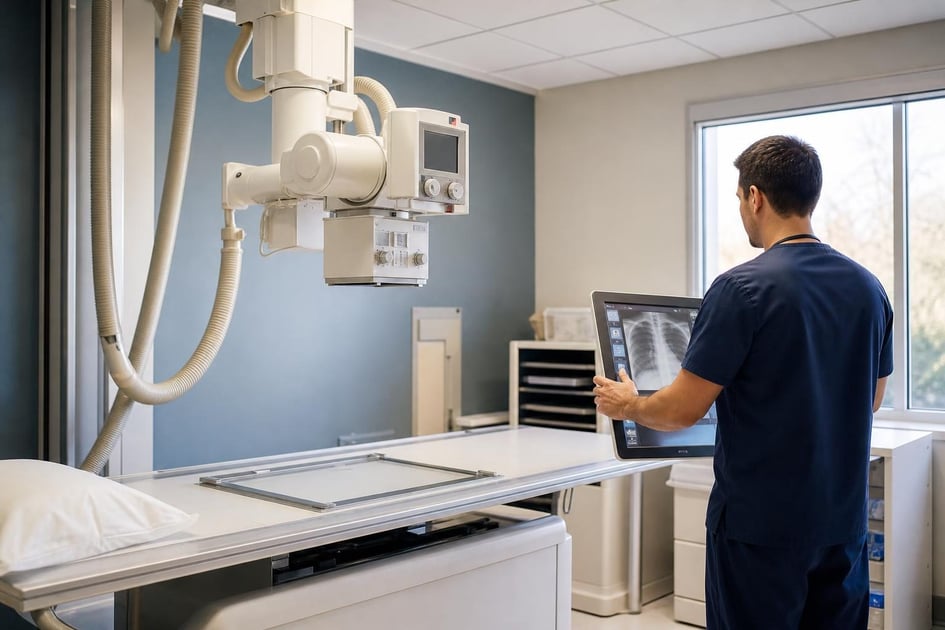
Financing an X-ray machine typically spreads the cost over 24 to 60 months, with monthly payments driven by the equipment's price, your credit profile, the age of the unit, and the term length. For most borrowers, that means budgeting anywhere from a few hundred dollars a month for a used chiropractic system to several thousand for a new digital radiography suite. Because the equipment itself serves as collateral, lenders can offer more competitive terms than unsecured borrowing, and same-day approvals are possible once the right documentation is in hand. Provide Capital finances new and used business equipment from $5,000 to $5 million, with the equipment itself securing the transaction.
If you are comparing quotes or preparing to buy, start an application to see what your monthly payment could look like based on the specific system you have selected. Whether you need X Ray Machine financing for a medical practice, a veterinary clinic, or an industrial NDT operation, the structure of the deal matters as much as the sticker price.
What Drives the Monthly Payment
Several variables move the final number. Understanding them helps you negotiate and avoids surprises during underwriting. U.S. Census Bureau data on healthcare capital expenditures shows that imaging equipment represents a significant share of annual investment for outpatient practices.
Equipment Type and Technology Level
A basic analog X-ray system costs far less to finance than a fully digital DR panel setup. Fixed units generally carry lower price tags than portable systems with wireless detectors. CBCT systems, which merge traditional X-ray imaging with 3D cone-beam technology, sit at the top of the price spectrum and often require larger down payments or shorter terms. The more specialized the technology, the smaller the secondary market, which can affect the lender's advance rate and your monthly obligation.
New vs. Used Equipment
New machines command higher purchase prices but usually qualify for longer terms and lower rates because they carry manufacturer warranties and predictable residual value. Used equipment lowers the total financed amount, yet lenders may cap the term at 36 or 48 months depending on age and condition. A five-year-old digital unit may still be an excellent purchase, but you should verify that replacement parts remain available before you commit to a loan secured by that asset.
Key Insight: Lenders often require a larger equity position on used X-ray equipment that lacks a current service contract. If you are buying used, obtaining a third-party inspection and a transferable service agreement can improve your approval odds and lower your rate.
Already have a machine in mind?
Provide Capital finances new and used equipment from $5,000 to $5 million, with same-day decisions possible.
Apply NowLoan vs. Lease: How the Structure Changes Your Cost
The choice between an equipment loan and a lease changes who owns the asset, how the payments are treated for tax purposes, and what happens at the end of the term. Both structures are common for X-ray equipment, and neither is automatically better. The right fit depends on your tax position, how long you plan to keep the unit, and whether you want to claim depreciation.
With an equipment loan, you own the X-ray machine from day one. The lender files a UCC lien against the equipment as collateral, and you pay down principal and interest over the term. Once the final payment clears, the lien releases and the asset is yours free and clear. You record the equipment on your balance sheet and depreciate it, which often produces larger tax deductions in the early years if you elect accelerated methods available for the 2026 tax year.
A finance lease, sometimes called a $1 buyout lease, functions almost identically to a loan for accounting and tax purposes in many cases. You make monthly payments and typically own the equipment at the end for a nominal amount. An operating lease, by contrast, is closer to a rental. The lessor retains ownership, and you return the equipment or purchase it at fair market value when the term ends. Operating leases can keep the debt off your balance sheet, though accounting rule changes have narrowed that benefit for many businesses.
| Feature | Equipment Loan | Finance Lease ($1 Buyout) | Operating Lease (FMV) |
|---|---|---|---|
| Ownership | Borrower owns immediately | Borrower owns after final payment | Lessor owns throughout |
| Monthly payment | Moderate; principal + interest | Similar to loan | Lowest monthly cost |
| Tax treatment | Depreciation + interest deduction | Depreciation + interest deduction | Lease payments expensed |
| End-of-term | No obligation; lien releases | $1 purchase option | Return, renew, or buy at FMV |
| Best for | Long-term ownership, tax deductions | Ownership with simple paperwork | Short-term needs or rapid obsolescence |
Rates vary by credit profile, equipment age and term, so the only way to know your exact cost is to run the specific numbers. Get a decision on your equipment, possibly the same day, by submitting an application with the invoice or equipment description attached.
Tax Treatment for the 2026 Tax Year
For the 2026 tax year, Section 179 allows businesses to deduct the full purchase price of qualifying equipment in the year it is placed in service, subject to an annual limit and a phase-out threshold. The exact dollar limits for 2026 are set by inflation adjustments from the prior year. Because these figures change annually, you should confirm the current-year limits with your CPA before you structure a transaction around them. Bonus depreciation may also apply to new and used qualifying equipment, though the percentage has been stepping down in recent years, making it especially important to verify the 2026 rate with a tax professional.
If you finance the purchase, you can generally still claim Section 179 or bonus depreciation even though you borrowed the funds. The deduction is based on placed-in-service date and qualified cost, not on whether you paid cash upfront. With a finance lease structured as a nominal buyout, the tax treatment typically mirrors ownership. With a true operating lease, you deduct the lease payments as a business expense rather than depreciating the asset. Each approach produces a different cash-flow and tax outcome, so run the scenario with your accountant before you sign.
Pro Tip: If you plan to place the X-ray machine in service near year-end, confirm with your lender that funding can close before December 31. Delays in delivery or installation can push your placed-in-service date into the next tax year and shift your deduction timing.
Who Qualifies and What Lenders Review
Equipment financing is secured by the X-ray machine itself, which lowers the lender's risk and opens the door to borrowers who might not qualify for unsecured credit. Still, underwriters look at several factors to set the rate and advance rate. SBA guidance on equipment loans emphasizes that collateral-based financing reduces reliance on unsecured credit benchmarks, which is why lenders can approve a wider range of credit profiles for equipment-backed transactions.
Credit Profile and Financials
Personal credit scores for the business owner or guarantor carry significant weight, especially for practices under two years old. A strong credit profile unlocks longer terms and lower rates. Lenders also review business bank statements to verify cash flow, looking for consistent deposits and healthy average balances. Negative days, recent overdrafts, or declining revenue trends can trigger a larger down-payment requirement or a shorter term. Most lenders want to see that your existing debt-service coverage leaves room for the new payment.
Time in Business and Industry Experience
Practices open for two or more years generally receive the most favorable terms. Recent acquisitions face tighter scrutiny, though they are not automatically disqualified if the buyer has relevant industry experience and strong personal credit. A chiropractor buying a second practice, or a technician moving from employment to self-employment, may still qualify if the down payment is sufficient and the equipment has strong resale value. Lenders prefer borrowers who understand the equipment they are buying because that reduces the risk of default due to buyer's remorse or underutilization.
New vs. Used: A Detailed Comparison
The new-vs-used decision affects more than the sticker price. New digital X-ray systems come with training, installation, and warranty coverage from the manufacturer. They also integrate more easily with modern PACS and EMR systems. For a practice that plans to keep the unit for ten years, new equipment often produces lower total cost of ownership despite the higher upfront financed amount.
Used equipment, especially refurbished digital systems that are three to five years old, can deliver excellent image quality at 40 to 60 percent of the cost of new. The key is verifying software licenses, detector lifespan, and tube-usage hours. Some used systems are sold as-is, which means you assume all repair risk. If you finance a used unit, the lender may require an independent appraisal or a dealer inspection report before funding. You should also budget for installation, calibration, and any required state inspections separately if they are not included in the seller's price.
By the Numbers: A new digital radiography system for a chiropractic or orthopedic practice typically runs between $30,000 and $75,000 depending on detector size and software features. A refurbished unit of similar capability often falls between $15,000 and $40,000. Portable digital systems add $5,000 to $15,000 over their fixed-room counterparts because of battery technology and wireless data transmission.
Find the right financing structure
Tell us about the equipment you need and we will show you the options that fit your business.
See Your OptionsIndustry-Specific Applications and Costs
X-ray equipment serves a wide range of industries, and the financing picture changes with the use case.
Chiropractic and Medical Practices
Chiropractic clinics typically need fixed or wall-mounted digital systems with high-frequency generators. Financing terms of 48 to 60 months are common because the equipment has a long useful life and strong resale value. Monthly payments vary widely based on whether the practice chooses a basic digital unit or a system with motion-analysis software.
Veterinary Clinics
Veterinary practices often finance digital radiography and dental X-ray systems simultaneously. Because veterinary equipment sees heavier wear and tear from patient positioning, some lenders slightly shorten the allowable term or require a larger down payment. Mobile veterinary units may add portable X-ray financing to a vehicle loan, which requires clear separation of the equipment collateral from the truck or trailer.
Dental Practices
Intraoral and panoramic X-ray systems represent a smaller capital outlay than medical units, but the total project cost rises quickly when cone-beam CT is included. Dental practices often bundle Digital X Ray Machine financing with chairside CAD/CAM or 3D imaging into a single equipment schedule, simplifying the monthly payment into one obligation.
Industrial and NDT Applications
Industrial radiography for non-destructive testing uses different equipment than medical practices, often involving cabinet X-ray systems, computed radiography scanners, or pipeline crawlers. These units can cost $100,000 or more and may require specialized installation and shielding. Lenders experienced in industrial equipment understand that NDT contracts can be seasonal, so they may structure payments to match your revenue cycle.
While this post focuses on imaging equipment, Provide Capital serves businesses nationwide across many sectors. If your operation also relies on heavy machinery, you can explore Forestry Logging equipment financing for additional capital needs.
Common Mistakes That Raise Your Total Cost
Buyers often focus on the monthly payment and overlook the total cost of ownership. Forbes analysis of medical equipment financing suggests that practices comparing multiple sources typically secure more favorable structures than those accepting the first quote. Here are the most common errors.
First, failing to budget for soft costs. Shipping, rigging, electrical upgrades, lead-lined drywall, and state radiation-inspection fees can add $5,000 to $20,000 to the project. If you only finance the equipment invoice, you pay those costs out of pocket. Some lenders allow you to roll soft costs into the financing if they are itemized on the vendor's quote.
Second, ignoring the service contract. X-ray tubes and digital detectors degrade over time. A service contract that covers parts, labor, and preventative maintenance protects the collateral value and keeps your practice operational. Lenders view a financed unit with an active service contract more favorably than one without coverage.
Third, choosing the wrong term. A 24-month term produces a higher monthly payment but lower total interest. A 60-month term eases cash flow but increases the finance charges. If you plan to upgrade the equipment in three years, a longer term can leave you upside-down, owing more than the unit's resale value.
Fourth, delaying the application until the last minute. Same-day approvals are possible, but they require clean documentation. Waiting until your old machine breaks down forces you to accept the first terms offered rather than comparing options.
Key Insight: Some vendors offer in-house financing at rates that appear competitive but bury costs in the equipment price. Always compare the vendor's all-in price against the cash price, and run the vendor's financing offer alongside an independent equipment loan quote. The lower monthly payment is not always the better deal if the equipment markup exceeds the interest differential.
Documentation to Have Ready
Preparing your file before you apply shortens the approval cycle and reduces back-and-forth. Most lenders request the following:
- A completed application with business and guarantor information
- Three months of business bank statements
- The current year business tax return, or the prior year if the current return is not yet filed
- A quote or invoice for the specific X-ray equipment, including serial numbers if used
- Proof of applicable licenses or certifications required by your state for radiation-producing equipment
For practices seeking more than $250,000, expect to provide two years of tax returns, a current profit-and-loss statement, and possibly a personal financial statement. The equipment itself is the collateral, but strong financials unlock better rates and higher advance rates. Having a clean, organized file can be the difference between a same-day approval and a week of document requests.
What Happens After You Apply
Once you submit the application and documentation, the lender reviews credit, verifies the equipment value, and checks that the proposed payment fits your cash flow. For requests under $250,000, many decisions come back within hours. Larger requests or more complex credit profiles may take 24 to 48 hours.
After approval, you receive a term sheet or finance agreement spelling out the monthly payment, term, buyout structure, and any upfront costs. Read it carefully to confirm there are no prepayment penalties if you plan to pay the balance early. Once you sign and the lender funds, the vendor is paid directly or reimbursed if you already purchased the equipment. The X-ray machine is delivered, installed, and placed in service. You then begin making monthly payments and, if applicable, claiming your 2026 tax deductions.
Ready to move forward?
More than 10,000 businesses have financed equipment with Provide Capital. See what you qualify for today.
Get StartedFAQ
Can I finance a used X-ray machine?
Yes. Used and refurbished digital X-ray systems are commonly financed. The lender may require an inspection or dealer certification, and terms may be slightly shorter than for new equipment. The key is verifying that software licenses are transferable and that replacement parts remain available.
Does financing require a down payment?
Not always. Well-qualified borrowers can sometimes finance 100 percent of the equipment cost, including soft costs. Borrowers with weaker credit or shorter time in business may be asked to put 10 to 20 percent down. Rates vary by credit profile, equipment age and term.
How long does approval take?
Many applications receive a decision the same day if the file is complete. Larger requests or complex credit histories may take one to two business days. Submitting all requested documentation upfront is the single best way to speed the process.
Can I deduct the full cost in 2026 if I finance the purchase?
In many cases, yes. Section 179 and bonus depreciation generally apply to financed equipment placed in service during the 2026 tax year, though exact limits and percentages should be confirmed with your CPA. The deduction is based on placed-in-service date and qualified cost, not on whether you paid cash.
What credit score do I need?
There is no universal minimum. Strong credit unlocks the best rates and longest terms, but because the equipment serves as collateral, lenders can approve borrowers across a wide credit spectrum. Stable revenue and a reasonable debt-to-income ratio often matter as much as the score itself.
Is an equipment loan better than a lease for X-ray machines?
It depends on your goals. Loans and $1 buyout leases usually allow you to claim depreciation and interest deductions, which can produce significant tax savings. True operating leases offer lower monthly payments but do not convey ownership tax benefits. Match the structure to your holding period and tax strategy.
Can I include installation and shipping in the financing?
Often, yes. Most lenders allow soft costs to be included if they are itemized on the vendor's quote or invoice. Electrical work, lead shielding, and shipping can usually be rolled into the financed amount, reducing your out-of-pocket expense.
What happens if I want to pay off the loan early?
Many equipment loans carry no prepayment penalty, but you should verify this before signing. Some leases use a fixed schedule that does not rebate future interest. Read the term sheet carefully, and ask your financing representative to confirm the payoff calculation.
Next Steps
X-ray machine financing cost depends on the equipment you choose, how you structure the deal, and the strength of your application. The best way to move from estimate to certainty is to run the numbers on your specific purchase. See what financing you qualify for on that X-ray system and get a clear picture of your monthly payment, term options, and any down payment required. Whether you need a basic digital unit or a full radiography suite, the right financing keeps your cash flow intact and gets you imaging faster.
Disclaimer: The information provided in this article is for general educational purposes only and is not financial, legal, or tax advice. Funding terms, qualifications, and product availability may vary and are subject to change without notice. Provide Capital does not guarantee approval, rates, or specific outcomes. For personalized information about your business funding options, contact our team directly.
