
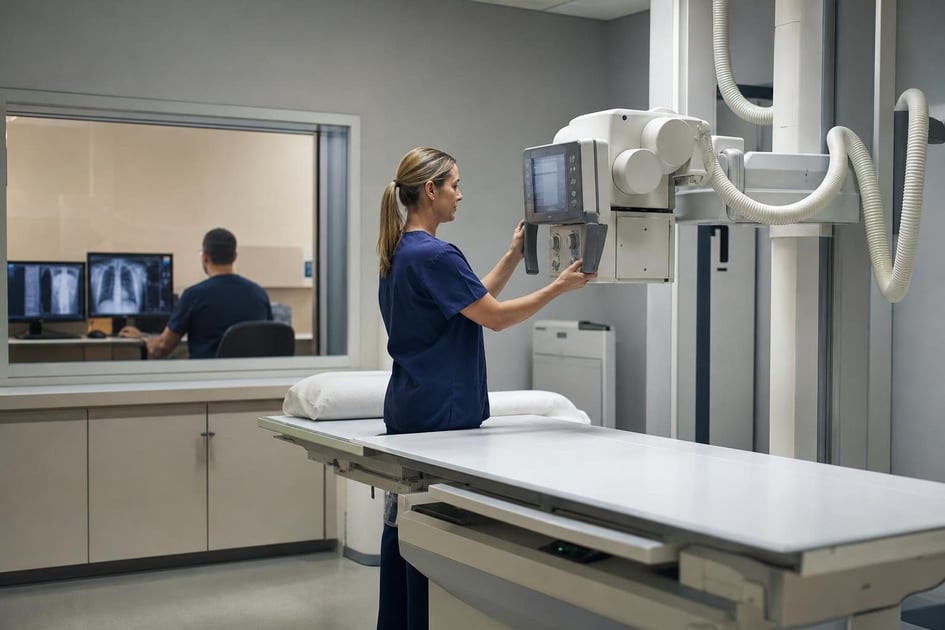
X-Ray Machine Financing Terms: What Practitioners Actually Pay
If you are buying a digital or analog X-ray system for a medical or dental practice, expect to finance anywhere from $5,000 for a refurbished portable unit to $500,000 or more for a new fixed-room digital system. At Provide Capital, we write equipment leases and loans from $5,000 up to $5 million, with the equipment itself serving as collateral. That collateral structure keeps rates competitive because the lender's risk is tied to an asset that retains value in the secondary medical market.
Rates vary by credit profile, equipment age and term. A practice with strong credit financing a new digital system on a 36-month term will see lower monthly payments than the same practice stretching the same cost over 60 months, but the total interest cost will be higher on the longer term. Used equipment usually commands a slightly shorter maximum term and a larger down-payment requirement because residual value is harder to predict.
Same-day approvals are possible when you submit a complete package—equipment quote, bank statements and a signed application—early in the business day. If you are shopping for a system now, see what financing you qualify for on that digital X-ray unit before you negotiate the purchase price.
Get a fast decision on your equipment
Applying takes just a few minutes, and decisions can come as soon as the same day.
Start Your ApplicationHow X-Ray Equipment Financing Works
Equipment financing for an X-ray machine is a secured transaction. As the SBA guidance on equipment financing explains, when you finance equipment you maintain ownership during and after all payments have been made, while the lender holds a lien against the asset. The lender files a UCC-1 lien against the equipment while you retain full use of it in your practice. Once the final payment clears, the lien releases automatically and you own the asset free and clear. Because the machine is the collateral, most deals do not require additional real estate or personal guarantees beyond a standard corporate guaranty.
Payments are fixed monthly amounts. Terms generally run from 24 to 72 months, though highly specialized C-arm or cath-lab systems sometimes stretch to 84 months when the cost justifies the extended amortization. There is no prepayment penalty on most Provide Capital loan structures, so if your practice has a strong year you can pay the balance down early and save on interest.
The financing covers the invoice cost of the machine plus soft costs such as delivery, installation and initial training up to a reasonable percentage of the equipment value. This matters for X-ray because digital systems require PACS integration, calibration and sometimes room shielding upgrades. Rolling those costs into the financing preserves your operating cash for payroll and supplies. If you need a decision on your equipment, possibly the same day, have your vendor quote ready when you apply.
New vs. Used X-Ray Machine Financing
New digital radiography systems offer longer useful life, full manufacturer warranty and easier compliance with current FDA guidelines. Used and refurbished systems cost less upfront but may carry higher service contracts and shorter remaining depreciable life. The financing terms reflect that difference.
| Factor | New X-Ray System | Used or Refurbished |
|---|---|---|
| Typical down payment | 0–10% | 10–20% |
| Maximum term | 60–72 months | 36–60 months |
| Rate structure | Most competitive | Vary by credit profile, equipment age and term |
| Warranty coverage | Full manufacturer warranty | 90-day to 1-year limited |
| Soft-cost inclusion | Up to 20% of equipment cost | Up to 10–15% of equipment cost |
| Typical useful life | 10–15 years | 5–10 years depending on tube and detector age |
A used system can make sense if you are opening a second location or adding a backup room, but verify the detector panel hours and tube count before you commit. Lenders will ask for a recent service report on any used unit financed above $50,000.
Lease vs. Loan: Choosing the Right Structure
Practices acquire X-ray equipment through a $1 buyout lease, a fair-market-value (FMV) lease, or a standard equipment loan. Each structure changes who owns the asset, how the payments are treated for tax purposes, and what happens at the end of the term.
Many industries, including healthcare, leverage equipment financing to support operations. Forbes Finance Council analysis notes that a healthcare provider might use equipment financing to access advanced diagnostic tools without the burden of upfront costs. With a $1 buyout lease, you make monthly payments and own the equipment outright at the end for a nominal $1. This structure functions almost identically to a loan for accounting purposes, and you claim depreciation and any applicable 2026 Section 179 deductions. An FMV lease treats the payments as operating expenses; you return the equipment or purchase it at fair market value when the lease ends. FMV leases work best when you expect technology to change before the term expires—digital detector technology has shifted rapidly over the past decade—but the total cost is usually higher if you end up buying the unit.
A standard equipment loan puts title in your name from day one. You depreciate the asset and deduct interest. For most practices that plan to keep a digital X-ray system for seven years or more, a loan or $1 buyout lease is the more economical path. If you anticipate upgrading to a new system within 36 months, an FMV lease preserves flexibility at the cost of a higher effective rate.
What Determines Your Rate and Term
Underwriters look at four main factors when pricing an X-ray equipment deal:
- Personal and business credit. Scores above 680 generally access the best tiers. Scores from 620 to 680 still qualify but rates move to reflect the incremental risk.
- Time in business. Two or more years of filed tax returns demonstrate stable revenue. Established practices with at least one full year of operation qualify more easily.
- Equipment age and type. New 2026-manufacture digital systems get the longest terms. Units older than seven years may require larger down payments or shorter amortization.
- Term length. A 24-month term carries a lower total finance charge than a 60-month term, but the monthly payment is higher. Choose the term that leaves your practice with comfortable cash flow after debt service.
Key Insight: Lenders price medical equipment differently than construction equipment because the secondary market is narrower. A digital X-ray detector has a specific buyer pool—other clinics and imaging centers—whereas an excavator sells at almost any regional auction. That liquidity difference means medical equipment deals sometimes require slightly stronger credit or a larger down payment than a similarly priced dump truck, even though both are financed through the same lender.
Tax Treatment for 2026
The tax advantages of financing X-ray equipment can be substantial, but the exact deduction depends on the structure you choose and your practice's tax situation. For the 2026 tax year, Section 179 allows qualifying businesses to deduct the full purchase price of financed equipment in the year it is placed in service, subject to an annual limit that adjusts for inflation. The specific dollar limit for 2026 has not been finalized in public guidance at the time of writing, so consult a CPA to confirm the current-year ceiling and whether your taxable income is sufficient to absorb the deduction.
Bonus depreciation may also apply to new and used equipment placed in service during 2026, though the percentage has been phasing down from prior years. Again, the precise percentage for 2026 depends on IRS guidance released during the year. Your CPA can model whether Section 179, bonus depreciation, or straight-line depreciation produces the best outcome for your practice. Do not take tax advice from a financing blog; use this information only as a starting point for a conversation with your accountant.
By the Numbers: A $150,000 digital X-ray system financed over 60 months at a competitive rate might carry a monthly payment in the low-$3,000 range. If your practice is in a 32% combined federal and state tax bracket and you deduct the payments or depreciation effectively, the after-tax cost of that first year can be materially lower than the cash outlay suggests. The exact savings depend on your entity type, state tax rate and whether you elect Section 179 for 2026.
Find the right financing structure
Tell us about the equipment you need and we will show you the options that fit your business.
See Your OptionsQualification Criteria
Provide Capital serves practices nationwide, from single-provider dental offices to multi-location imaging centers. Minimum requirements typically include a 600+ personal credit score, three months of business bank statements, and an equipment quote from a vendor or refurbisher. There is no hard revenue floor, but underwriters want to see that the monthly payment does not exceed a reasonable percentage of monthly deposits.
The U.S. Census Bureau business data shows that healthcare represents a significant share of employer firms in the United States, and those practices regularly reinvest in imaging technology to remain competitive. Medical and dental practices often qualify more easily than other businesses at the same revenue level because the equipment generates billable procedures. An X-ray machine in a busy orthopedic clinic can pay for itself in months if the practice codes imaging correctly. Lenders recognize that revenue linkage and factor it into the approval decision. Whether you need Digital X Ray Machine financing for a new suite or a replacement unit, the application process is the same.
Documentation You'll Need
Underwriters cannot move without paperwork. Gather these items before you apply to keep the process under 24 hours:
- One-page credit application
- Last three months of business bank statements
- Most recent business tax return (two years preferred)
- Current equipment quote or invoice, including serial number if used
- Business license or articles of incorporation
- Proof of insurance naming the lender as loss payee
Used equipment requires a recent inspection report or service log. If you are buying from a private seller rather than a dealer, the lender may also require an independent appraisal for transactions above $100,000. Having these documents ready when you call is the single biggest factor in whether you receive a same-day approval.
Common Mistakes Buyers Make
Even experienced practice managers misstep when financing expensive imaging equipment. The most common error is focusing only on the monthly payment and ignoring the total cost of ownership. A low monthly payment stretched over 72 months sounds attractive, but if the equipment is obsolete in year five you will be making payments on a machine you no longer use.
Another mistake is buying a system without confirming compatibility with your existing PACS or EMR infrastructure. A $200,000 digital radiography room becomes a $230,000 project when you add unexpected software bridges, workstation upgrades and IT labor. Build those costs into your financing request upfront.
Finally, do not assume that the equipment vendor's in-house financing is your only option. Captive finance companies often quote one rate while an independent lender can beat it by a meaningful margin because the independent lender views the equipment as collateral rather than packaging the profit margin of the machine into the finance charge. Shop the financing separately from the equipment price.
Pro Tip: If you are buying a used X-ray system, ask the seller for the tube count and detector-panel hours before you submit your financing application. Lenders frequently request this data for used medical equipment, and having it ready prevents a 48-hour delay while the underwriter waits for vendor disclosure. For units older than five years, budget for a 15% down payment rather than the 0–5% you might expect on new equipment.
What Happens After Approval
Once the credit team issues an approval, you receive a term sheet outlining the monthly payment, term, buyout structure and any documentation still required. Review it the same day if possible; most term sheets are valid for 10 business days. After you sign and return the lease or loan documents, the lender verifies insurance and pays the vendor directly. You never need to float the full purchase price on your line of credit.
Funding usually occurs within 24 to 48 hours of signed documents, though complex deals involving multiple vendors or international shipments can take slightly longer. The lender files a UCC lien against the serial number of the machine, and your first payment is typically due 30 days after funding. There are no hidden account-maintenance fees, and monthly statements are delivered electronically.
Ready to move forward?
More than 10,000 businesses have financed equipment with Provide Capital. See what you qualify for today.
Get StartedFrequently Asked Questions
Can I finance a used X-ray machine?
Yes. Used and refurbished X-ray systems are eligible for financing, though terms may be shorter and down-payment requirements higher than for new equipment. Expect to provide a recent service report for units priced above $50,000.
What credit score do I need to qualify?
Most approved applicants have personal credit scores of 600 or higher. Scores above 680 generally receive the most competitive structures. We look at the full financial picture, not just the score, so a strong cash flow can offset a lower number.
How long does approval take?
Same-day approvals are possible when your file is complete. Most decisions arrive within 4 to 24 hours. Funding typically follows 24 to 48 hours after signed documents.
Does the equipment need to be from a dealer?
No. Private-party sales are financeable, though transactions over $100,000 may require an independent appraisal. The equipment must have a verifiable serial number and a clear title.
Can I include installation and training in the financing?
Yes. Soft costs such as delivery, installation, calibration and initial training can usually be included up to a set percentage of the equipment value. Ask your financing manager for the exact percentage allowed on your specific deal.
Is there a prepayment penalty?
Most Provide Capital equipment loans carry no prepayment penalty. If you pay off the balance early, you save the remaining interest. Lease structures vary, so confirm the buyout language if early termination is important to you.
What industries do you serve?
We finance business equipment nationwide for construction, healthcare, dental, restaurant and food service, manufacturing, transportation, agriculture, HVAC and forestry. From Forestry Logging equipment financing to digital radiography systems, the equipment itself is the collateral.
Do you finance portable X-ray machines?
Yes. Portable units for chiropractic, veterinary and mobile imaging applications are eligible. Portable X Ray Machine financing follows the same qualification criteria as fixed-room systems, with terms matched to the expected useful life of the unit.
Next Steps
Buying an X-ray system is a major capital decision, but the financing process does not need to be complicated. Start by gathering your last three bank statements, a vendor quote and your most recent tax return. Then start an application in a few minutes and find out what terms your practice qualifies for. Whether you are adding a digital room to an existing clinic or replacing an aging film system, Provide Capital can structure a deal that keeps your cash flow intact and gets you imaging patients quickly.
Explore X Ray Machine financing options for your practice, or contact our team to review your quote and discuss term lengths that match your revenue cycle.
Disclaimer: The information provided in this article is for general educational purposes only and is not financial, legal, or tax advice. Funding terms, qualifications, and product availability may vary and are subject to change without notice. Provide Capital does not guarantee approval, rates, or specific outcomes. For personalized information about your business funding options, contact our team directly.
