How No-Down-Payment Agriculture Financing Works
Yes, you can finance agriculture equipment with no down payment. Lenders like Provide Capital structure farm equipment loans and leases that cover 100 percent of the equipment cost, using the machine itself as collateral. That leaves your cash in the operation for seed, fertilizer, labor, and fuel. Approval amounts range from $5,000 to $5 million, and because the equipment secures the financing, rates stay competitive based on your credit profile, equipment age, and term length.
Key Insight: Between planting and harvest, many row-crop operators run their operating lines close to the limit. A no-down-payment equipment loan preserves that liquidity for inputs that cannot be financed, such as custom application services or cash rent payments due March 1.
Lenders underwrite the equipment, not just the borrower. The combine, tractor, or irrigation system serves as the primary collateral. For loans, this is typically a secured equipment finance agreement. For leases, the lender retains title while you make payments. In either structure, the goal is the same: acquire the asset now, pay over 24 to 84 months, and keep working capital intact.
Loan Structure
A no-down-payment equipment loan amortizes the full purchase price plus any soft costs the lender allows—sometimes delivery, installation, or a warranty. You own the equipment from day one. The lender files a UCC-1 lien against the serial number. Once the final payment clears, the lien releases automatically.
Lease Structure
A $1 buyout lease or FMV lease can also be written with nothing out of pocket. At lease end, you either purchase the equipment for a predetermined amount or return it. FMV leases sometimes carry lower monthly payments than loans, but the total cost of ownership depends on the residual. If you plan to run a combine for ten years, a loan usually wins. If you upgrade every three seasons to capture technology improvements, an FMV lease deserves a look.
Get a fast decision on your equipment
Applying takes just a few minutes, and decisions can come as soon as the same day.
Start Your ApplicationWhat Qualifies for Zero-Down Financing
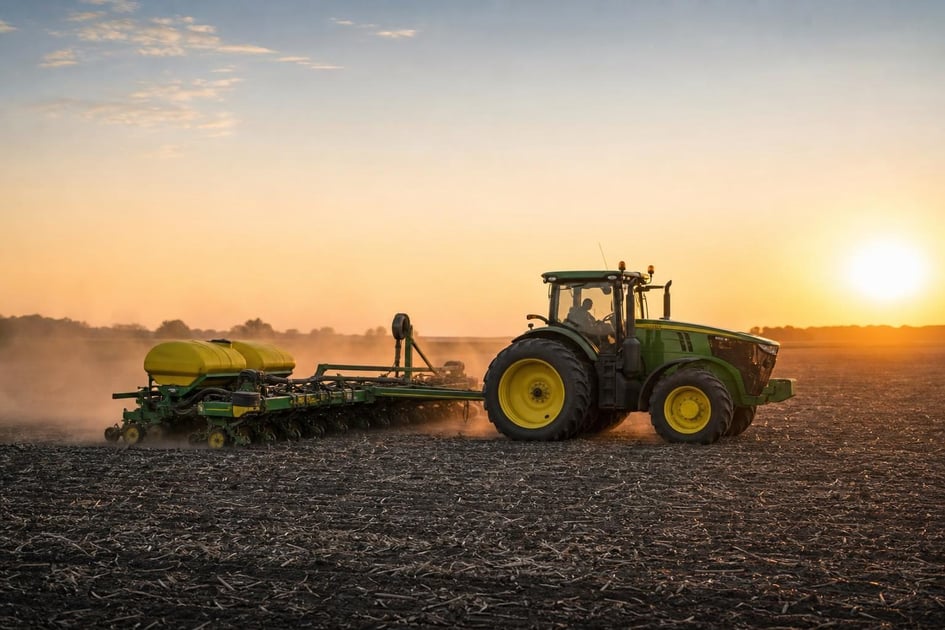
Provide Capital finances new and used agriculture equipment nationwide. Eligible assets include tractors, combines, hay balers, planters, sprayers, tillage equipment, grain carts, and harvesting attachments. We also finance related assets such as Skid Steers financing and Wheel Loaders financing when they are used in agricultural operations.
Equipment must have a verifiable serial number and a documented fair market value. For used equipment, most lenders prefer machines under 15 model years, though exceptions exist for low-hour, well-maintained classic tractors. The key is collateral value: if the equipment can be appraised and resold, it can likely be financed.
Pro Tip: Before you shop, gather the equipment's year, make, model, hours, and serial number. A seller who can provide a detailed maintenance log and recent appraisal will speed approval by several days. If you are buying at auction, request the auction company’s condition report in advance.
Who Qualifies
You do not need an 800 credit score. Provide Capital works with owner-operators, family partnerships, and mid-size farms across a range of credit profiles. Underwriters look at time in business, revenue consistency, equipment collateral value, and credit history.
Two years or more in business is ideal, but newer operations with strong collateral can qualify. Can you show farm income covering the new payment? Tax returns, Schedule F, and bank statements are the usual proof. The loan-to-value ratio depends on the machine's age and condition. Bankruptcies must typically be discharged two or more years; recent delinquencies slow the process but do not always kill it.
Same-day approvals are possible when the file is complete. That means application, equipment details, and proof of income all submitted together. If you are ready to move fast, see what you qualify for through our application page.
New vs. Used Farm Equipment: Financing Differences
New equipment carries full manufacturer warranty and predictable maintenance costs, which lenders like. Rates vary by credit profile, equipment age, and term, but new units generally qualify for longer terms and lower monthly payments because the collateral value is more certain.
Used equipment saves thousands on the front end. A three-year-old combine with 800 separator hours might cost 40 percent less than new but retain 85 percent of its productivity. The trade-off is shorter available terms—often 48 to 60 months instead of 84—and a larger payment because the lender limits exposure on depreciating collateral.
By the Numbers: A $400,000 new tractor financed over 84 months might carry a monthly payment roughly one-third lower than the same machine at five years old financed over 60 months, even if the used price is $280,000. The shorter term and higher rate on older iron drive the payment up. Run both scenarios before you decide.
Tax Treatment for 2026
Farm equipment is eligible for Section 179 expensing and bonus depreciation, but the exact limits change with legislation. For tax year 2026, consult your CPA on the current Section 179 deduction limit and phase-out threshold. In recent years, these provisions have allowed farmers to deduct the full or partial cost of qualifying equipment in the first year, which can offset the tax impact of a strong commodity year.
If you lease, the tax treatment differs. On a true lease, you typically deduct lease payments as an operating expense. On a $1 buyout lease, you may be treated as the owner for tax purposes and can claim depreciation. The distinction matters at tax time, so match the financing structure to your tax strategy. Do not take tax advice from a blog post; verify every figure against 2026 IRS guidance and your accountant's counsel.
Lease vs. Loan: A Side-by-Side Comparison
For farm operators deciding between a loan and a lease, the right choice depends on how long you plan to keep the equipment, your tax situation, and your cash flow rhythm. A loan gives you ownership from day one, builds equity, and usually allows unlimited hours without penalty. A lease can lower your monthly outlay and may offer flexibility at the end of the term, but it can also restrict usage or charge excess wear fees.
| Feature | Equipment Loan | FMV Lease | $1 Buyout Lease |
|---|---|---|---|
| Ownership | You own from day one | Lender owns; you may return or buy at FMV | Lender owns until final $1 payment |
| Down payment | Often $0 with strong credit | Often $0 | Often $0 |
| Typical term | 24–84 months | 24–60 months | 24–84 months |
| Monthly payment | Moderate | Lowest | Higher than FMV |
| Mileage/hours limits | None | May apply | None |
| Tax treatment | Depreciation and Section 179 | Deduct payments as rent | Typically depreciate as owner |
| Best for | Long-term ownership | Frequent upgraders | Ownership with lower initial cash |
Ownership matters in agriculture because equipment often runs for a decade or more. A loan matches that timeline. A lease makes more sense when technology is changing rapidly and you want to upgrade every few seasons without the hassle of resale. Either way, rates vary by credit profile, equipment age and term, so compare both structures on equal footing.
See what you qualify for
The equipment itself secures the financing, which keeps rates competitive. Checking your options takes minutes.
Check Your OptionsWorked Cost Examples
Understanding the math helps you budget. These examples are illustrative; your actual payment will depend on rates, term, and fees.
Example 1: Used Tractor. Purchase price $95,000. Term 60 months. Structure is a secured loan with no down payment. Estimated monthly payment: a lender might structure this around $1,800 to $2,100 per month depending on credit profile and equipment age.
Example 2: New Combine. Purchase price $750,000. Term 84 months. Structure is a secured loan with no down payment. Estimated monthly payment: often lands between $10,000 and $12,000 per month for well-qualified borrowers.
Example 3: Small Implements. Purchase price $18,000. Term 36 months. Structure is lease or loan. Estimated monthly payment: roughly $550 to $650 per month.
Remember, rates vary by credit profile, equipment age and term. These ranges reflect common structures in the current market.
Industry-Specific Use Cases
Row-Crop Operations
Corn and soybean growers often need to upgrade planters and combines during narrow windows. No-down-payment financing lets you lock in equipment in December or January, before year-end tax planning is complete, without drawing down the operating line. This is especially valuable when input suppliers demand early payment or when cash rent is due before the first crop insurance indemnity hits the account.
Livestock Producers
Cattle and dairy operations use financing for feed mixers, choppers, and handling equipment. These machines have long useful lives but high front-end costs. Spreading the cost over five to seven years matches the payment to the productive life of the asset. A dairy parlor upgrade or TMR mixer can run well into six figures, so preserving cash for feed and veterinary expenses is critical.
Specialty Crop and Orchard
Horticulture and vineyard operators need specialized tractors, sprayers, and harvesters. Because these machines are lower-volume, used inventory is scarce. New equipment financing with no money down preserves cash for labor-intensive harvest periods. A mechanical grape harvester or tree shaker can represent a major capital outlay that pays for itself only during a six-week window each year.
Agriculture Equipment Financing Nationwide
Provide Capital serves farmers and ranchers across all 50 states. Whether you are in the Corn Belt, the Great Plains, the Delta, or the Pacific Northwest, the application process is the same. We understand seasonal income and can structure payments to match your cash flow. Agriculture equipment financing is available for operations of every size, from a single tractor to a full fleet upgrade.
Common Mistakes to Avoid
Buying Too Much Machine
A 500-horsepower tractor looks impressive, but if your operation only needs 300, you are burning capital on depreciation and fuel. Match the equipment to the acreage and workload. Over-equipping is a silent profit killer.
Ignoring Total Cost of Ownership
Monthly payment is only one line item. Maintenance, insurance, and storage add up. A cheap machine with high repair costs can cost more over five years than a newer unit with a higher payment. Request a five-year ownership estimate from your dealer or mechanic before you sign.
Skipping the Inspection
Used farm equipment should be inspected by a mechanic you trust. A transmission rebuild on a large tractor can exceed $30,000. Build that risk into your decision. If the seller will not allow an independent inspection, walk away.
Financing Before You Know the Terms
Read the fine print on prepayment penalties, late fees, and UCC filing costs. Reputable lenders disclose these upfront. If they do not, ask. A no-down-payment deal should not hide fees in the back end.
Pro Tip: According to Reuters reporting on farm machinery spending, many farmers are delaying major purchases and opting for smaller implements to conserve cash. Financing a $100,000 implement with nothing down can keep your operation moving without the strain of a million-dollar capital outlay.
What Documentation You Need
To move fast, have these ready: completed application, last two years of tax returns business and personal, recent bank statements usually three months, equipment invoice or purchase agreement, proof of insurance binding upon funding, and any existing debt schedule the lender requests.
For auction purchases, a bill of sale and auction terms sheet replace the dealer invoice. If you are buying from a private party, the lender will need a purchase agreement signed by both sides. The cleaner your paperwork, the faster the approval.
What Happens After Approval
Once approved, the lender issues a funding letter or lease agreement. You review and sign. The lender then pays the dealer, auction house, or private seller directly. In most cases, funds move within one to three business days. You take possession, put the equipment to work, and payments begin 30 to 45 days later.
If you are trading in equipment, handle that separately. Trade equity does not count as a down payment in a zero-down structure, but it can reduce the amount financed if you prefer a lower payment. Many farmers use trade equity to cover the first few payments or to prepay insurance.
Ready to preserve your operating cash? Get a same-day decision on your equipment and see how much you can finance with no money down.
Ready to move forward?
More than 10,000 businesses have financed equipment with Provide Capital. See what you qualify for today.
Get StartedFrequently Asked Questions
Can I really finance farm equipment with nothing down?
Yes. Lenders like Provide Capital offer secured financing that covers 100 percent of the equipment cost for qualified buyers. The equipment itself serves as collateral.
Does no down payment mean higher rates?
Not necessarily. Rates vary by credit profile, equipment age and term. A strong borrower financing new collateral can still secure competitive rates with zero down.
What credit score do I need?
There is no hard cutoff. We look at the full file—credit history, farm revenue, and collateral value. Same-day approvals are possible for well-qualified applicants.
Can I finance used tractors and combines?
Yes. Used equipment is a large part of our agriculture book. The key is verifiable value and condition. Machines under 15 years old with documented maintenance are the easiest to approve.
How long does approval take?
When your documentation is complete, decisions often come same day. Complicated files—such as those with multiple entities or private-party sales—may take 24 to 72 hours.
Can I pay off the loan early?
Most equipment loans allow early payoff. Some leases carry prepayment penalties or require you to pay remaining rent. Ask your financing specialist to show you the payoff language before you sign.
Do I need to finance through the dealer?
No. Dealer financing is convenient, but an independent lender can often beat the terms or approve deals the captive lender declines. It pays to shop your financing separately from your equipment. As the SBA guidance on buying business assets notes, comparing rates and terms from multiple sources can save money over the life of the agreement.
Is leased equipment eligible for Section 179 in 2026?
On a true tax lease, you generally deduct payments as rent. On a finance lease or loan, you may depreciate the asset. Because 2026 tax rules depend on current legislation, confirm the exact treatment with your CPA before you file.
Next Steps
If you are weighing a tractor, combine, or implement purchase this season, talk to a specialist about your specific machine. We finance agriculture equipment nationwide from $5,000 to $5 million, and we can often give you an answer the same day you apply. With input costs rising and margins tight—Forbes analysis of farm finances shows the pressure operators face—keeping your cash in the field instead of tied up in a down payment is a sound operating decision.
Disclaimer: The information provided in this article is for general educational purposes only and is not financial, legal, or tax advice. Funding terms, qualifications, and product availability may vary and are subject to change without notice. Provide Capital does not guarantee approval, rates, or specific outcomes. For personalized information about your business funding options, contact our team directly.