Yes, You Can Finance a Bucket Truck with Challenged Credit
Bad credit does not automatically disqualify you from financing a bucket truck. Because the lender secures the transaction with the equipment itself, bucket trucks financing bad credit options exist for owner-operators who can demonstrate viable business income. The truck serves as collateral, which limits the lender’s risk and often keeps rates competitive compared with unsecured borrowing. That said, your credit profile, equipment age, and term length will shape the structure of your deal.
At Provide Capital, we finance new and used business equipment from $5,000 to $5 million nationwide, including bucket trucks used in forestry, electrical contracting, telecommunications, and construction. Same-day approvals are possible when your file is complete. If you are mid-purchase and worried about your score, the key is understanding what lenders actually weigh and preparing your documentation accordingly.
How Lenders Evaluate Bad Credit for Bucket Trucks
Lenders look beyond a single number. For specialized equipment like aerial lifts and bucket trucks, they care about whether the machine will generate revenue, how long you have operated, and whether your bank activity supports the payment.
Credit Score Ranges and Real-World Meaning
A FICO score below 580 is generally considered poor, while 580 to 669 sits in the fair range. If you are below 600, expect the lender to offset risk with additional conditions. Those conditions might include a larger down payment, a shorter term, or a stronger cosigner. Rates vary by credit profile, equipment age and term, so a borrower with a 640 score financing a three-year-old forestry bucket truck will see different numbers than a borrower with a 520 score financing a 12-year-old unit.
Time in Business and Revenue Stability
Two years in business with consistent revenue can offset a weaker personal credit file. Lenders typically review the last three to six months of bank statements. Steady deposits from contracted utility work or recurring tree-care jobs demonstrate that the truck will earn its keep.
The Equipment as Collateral
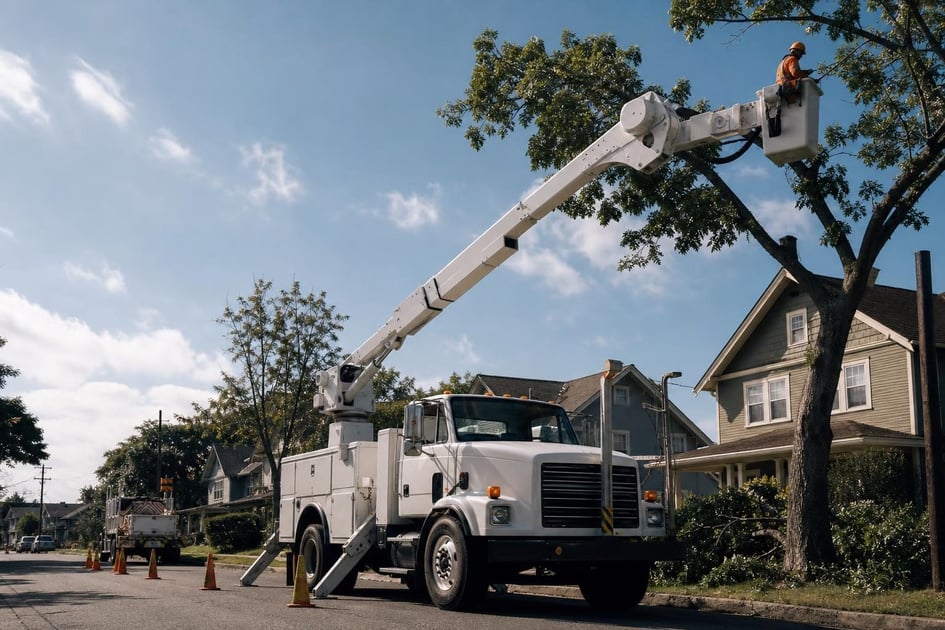
Bucket trucks retain value better than generalist vehicles because they serve niche trades. A 60-foot Altec mounted on a commercial chassis holds demand among arborists and electrical contractors. That retained value matters to the lender. If you default, the lender can repossess and resell into an active secondary market. This dynamic is why Bucket Trucks financing remains available even when other credit doors are closed.
New vs. Used Bucket Trucks: What to Buy with Bad Credit
The age and condition of the unit you choose directly affect approval odds and deal structure. Newer trucks with documented maintenance histories reduce lender risk. Older trucks cost less upfront but may carry restrictions.
New and Late-Model Units
New bucket trucks from manufacturers like Altec, Terex, or Versalift command higher price tags—often $150,000 to $300,000 depending on chassis and boom height. For a borrower with bad credit, a new unit can still make sense because the lender faces lower collateral risk. However, the larger loan amount requires stronger revenue proof. If you can document $30,000 or more in monthly gross revenue, a new-unit deal is feasible even with credit challenges.
Used Bucket Trucks (5 to 10 Years Old)
This is the sweet spot for many owner-operators repairing their credit. Prices typically range from $45,000 to $95,000. A lender views a well-maintained 2018 International with a 55-foot boom as solid collateral. Expect to put 10 to 20 percent down if your credit is below 620. The lower financed amount reduces the lender’s exposure and keeps your monthly obligation manageable.
Older and Refurbished Units
Trucks older than 10 years can be financed, but options narrow. Some lenders cap equipment age at the end of the term—meaning a 15-year-old truck on a 5-year term would be 20 years old at payoff, which may exceed policy limits. Refurbished units with recent certifications can help, but you will need detailed inspection reports. Rates vary by credit profile, equipment age and term, so older iron typically means a shorter amortization or higher equity injection.
Lease vs. Loan: Choosing the Right Structure
Bad credit borrowers sometimes assume a lease is easier to obtain. That is not always true for specialized trucks. Here is how the structures compare.
| Feature | Equipment Loan | $1 Buyout Lease | Fair Market Value (FMV) Lease |
|---|---|---|---|
| Ownership | You own the truck; lender holds lien | You own after final $1 payment | Return or buy at FMV at end |
| Down payment | Often 0–20% | Usually first + last payment | Usually first + last payment |
| Credit emphasis | Collateral + business cash flow | Stronger credit often required | Stronger credit often preferred |
| Tax treatment (2026) | Depreciation and Section 179 potential; consult a CPA | Payments may be deductible; consult a CPA | Payments may be deductible; consult a CPA |
| Better for bad credit? | Yes—equipment-backed collateral helps | Moderate credit may qualify | Usually requires stronger credit |
For most owner-operators with credit challenges, a traditional equipment loan is the practical path. You build equity with every payment, and the lender’s security interest in the truck itself keeps the door open. If you are also weighing other work trucks, Tow Truck financing follows similar logic, though bucket trucks carry unique collateral value in the utility and tree-care sectors.
If you have the equipment quote and six months of bank statements ready, get a same-day decision on your equipment and see what structure fits your situation.
What Documentation You Actually Need
Incomplete paperwork kills more bad-credit deals than the credit score itself. Lenders already perceive elevated risk; missing documents confirm the fear that you are disorganized. Bring a complete file.
- Equipment quote or purchase agreement: VIN, year, make, model, boom manufacturer, hours/miles, and seller information.
- Bank statements: Last three to six months, all pages, for your business account. Personal statements may be required for sole proprietors.
- Business license or registration: Proof the entity is active and in good standing.
- Proof of insurance: Binder showing physical damage and liability coverage naming the lender as loss payee.
- Current debt schedule: Especially if you have existing equipment loans or vehicle notes.
- Driver’s license and voided check: For identity verification and ACH setup.
If you are buying from a private party, add a lien search and a third-party inspection. Lenders want to know the title is clean and the boom operates to manufacturer specifications.
Qualification Criteria in Detail
Understanding the underwriting checklist lets you address weaknesses before you apply.
Credit Profile
While we do not publish minimum scores, borrowers under 600 should expect scrutiny on recent derogatory events. A bankruptcy discharged two years ago with clean credit since is different from a string of current 60-day late payments. Be prepared to write a short explanation letter for major events.
Time in Business
Startups with bad credit face the steepest climb. If you have less than two years under your belt, a significant down payment—sometimes 20 to 30 percent—can offset the absence of historical cash flow. After two years, lenders rely more on trailing revenue than on personal credit.
Revenue and Bank Activity
NSFs (non-sufficient funds) are red flags. Even one or two per month can derail an otherwise salvageable file. Low-ending balances below $500 on a regular basis signal cash-flow stress. Clean up your account for 60 to 90 days before applying.
Down Payment or Additional Collateral
Equity cures many credit sins. A 15 to 25 percent down payment on a used bucket truck can push a marginal decline into an approval. If cash is tight, some lenders accept additional equipment as collateral, though this is less common for bucket trucks because the primary unit is already specialized collateral.
Equipment Age and Specifications
Underwriters check auction and resale data. A 2020 Freightliner M2 with an Altec LR7 boom has quantifiable value. A homemade bucket truck on a converted RV chassis does not. Stick to name-brand booms on class 6 or higher commercial chassis. If the truck requires a CDL, verify that your drivers hold current credentials; some lenders view CDL-required units as higher risk if the operator pool is shallow.
Before you start shopping, see what you qualify for based on your credit profile and revenue.
Worked Cost Scenarios for Bad Credit Borrowers
These examples illustrate how deal structure changes with credit and equipment choices. Note that rates vary by credit profile, equipment age and term, so the following outlines principal and down payment logic rather than exact monthly payments.
Scenario 1: Used Arborist Bucket Truck
You are buying a 2018 International 4300 with a 60-foot Altec boom for $78,000. Your credit score is 580, and you have been in business for three years with $25,000 average monthly deposits. The lender approves the deal with a 20 percent down payment requirement. You put $15,600 down and finance $62,400. Because the unit is six years old and your credit is below 600, the lender offers a 48-month term to limit duration risk. Your monthly payment lands in a range manageable against your revenue, though the exact figure depends on your specific rate.
Scenario 2: New Telecom Bucket Truck
You need a 2026 Ford F-750 with a brand-new 55-foot insulated boom for $195,000. Your credit is 640, but you have a prior foreclosure two years ago. With 10 percent down—$19,500—you finance $175,500 over 60 months. The new equipment and stronger revenue ($40,000 monthly) support the larger advance, but the prior foreclosure keeps you out of the top-tier pricing band. The equipment itself secures the deal, and the lender files a UCC-1 on the truck.
Scenario 3: Refurbished Utility Bucket Truck
A 2012 Freightliner with a recently recertified boom sells for $52,000. Your credit is 560 and you are a one-year-old company. The lender requires 25 percent down—$13,000—financing $39,000 over 36 months. The short term reflects both the equipment age and the startup risk. This structure keeps the lender’s exposure low while giving you a revenue-producing asset to build business credit.
Across all three scenarios, the common thread is that the equipment value and your cash-flow story matter more than a single credit score. If you are comparing this to other commercial vehicles, remember that Transportation equipment financing covers a broad range of collateral, but bucket trucks often justify slightly more flexible terms because of their dedicated resale market.
Industry-Specific Use Cases
Bucket trucks are not generic. The industry you serve changes the specs you need and the revenue you can claim to underwriters.
Tree Care and Arboriculture
Arborists use non-insulated booms with chipper bodies. The work is seasonal in northern states, peaking in spring and fall. If you are applying in March, show lenders last year’s full-season deposits so they do not underweight your winter lull. A chip dump and tool storage body add value to the collateral.
Electrical and Utility Contracting
Insulated buckets are mandatory for live-line work. These units cost more and hold value longer. Utility contractors often carry Master Service Agreements with municipalities, which lenders love. Attach a copy of a pending PO or annual contract to your application.
Telecommunications and Cable
Telecom fleets run lighter booms, often 36 to 45 feet. While cheaper, they also face higher competition in the resale market. If you finance a telecom-spec bucket truck, emphasize the volume of recurring work from regional carriers.
Sign, Lighting, and Billboard Service
These operators need high-reaching booms with flatbeds or service bodies. The work is commercial, not residential, which means invoice sizes are larger. Show accounts receivable aging if you carry net-30 contracts with property management firms.
Common Mistakes Owner-Operators Make
Avoiding these errors can turn a declined application into an approval, even with bad credit.
Overbuying on Spec
A 75-foot over-center boom looks impressive, but if your work tops out at 45 feet, you are financing capacity you cannot monetize. Buy the minimum boom height that lets you bill the jobs you already have.
Skipping the Pre-Purchase Inspection
Bucket trucks hide expensive problems. Hydraulic leaks, cracked fiberglass booms, and outrigger weld failures can cost $10,000 to $30,000 to repair. Lenders know this. If you submit an inspection report from a certified aerial-lift technician, you signal professionalism and reduce the lender’s collateral risk.
Ignoring GVWR and CDL Rules
A bucket truck on a 33,000-pound GVWR chassis can be driven without a CDL in many states. Move to a 35,000-pound chassis and you need a CDL driver. If your crew lacks CDLs, buying the heavier truck adds operating cost and insurance complexity. Lenders may question your operational readiness.
Neglecting Insurance Before Funding
Some borrowers shop for insurance after approval. That slows funding. Bucket truck physical damage coverage is not standard commercial auto; it is specialty equipment coverage. Get a binder early. The lender will not release funds without it.
What Happens After Approval
Understanding the closing process prevents last-minute surprises.
Once approved, you receive a term sheet outlining the advance amount, down payment required, term length, and any collateral stipulations. Review it for prepayment penalties and administrative fees. If you accept, the lender orders a title search and UCC filing.
Funding typically occurs within one to three business days after the file is clear. The lender pays the seller directly; private-party deals sometimes require a payoff letter if the seller has an existing lien. You receive the title or ownership documents once the UCC is filed, though the lender retains a security interest.
Your first payment is usually due 30 to 45 days after funding. Set up ACH autopay to avoid missed payments, which further damage credit. Some lenders report to business credit bureaus, so timely payments can help rebuild your profile.
Tax Treatment for Tax Year 2026
For tax year 2026, Section 179 allows businesses to deduct the cost of qualifying equipment in the year it is placed in service, subject to annual dollar limits and a phase-out threshold that adjusts yearly. Because these figures change and your specific eligibility depends on taxable income, consult a CPA for the exact 2026 limits. Bonus depreciation may also apply to new and used qualified property, though the percentage and rules are subject to legislative schedules. Again, a CPA can model whether Section 179, bonus depreciation, or standard MACRS yields the best result for your return.
If you structure the acquisition as a loan, you generally own the truck and may depreciate it. If you lease, you may deduct lease payments as a business expense, depending on whether the lease is classified as a true lease for tax purposes. For definitive guidance, refer to IRS guidance on Section 179 and speak with your accountant before filing.
Frequently Asked Questions
Can I finance a bucket truck with a credit score below 600?
Yes, though you should expect additional requirements such as a larger down payment, shorter term, or documented revenue history. The equipment itself serves as collateral, which helps offset credit risk.
Will I need a down payment if my credit is poor?
Most likely. Borrowers with credit scores under 620 often need 10 to 25 percent down, depending on equipment age and time in business. Newer trucks and longer operating histories can reduce the equity requirement.
How long does the financing process take?
Same-day approvals are possible when your file is complete, including equipment details, bank statements, and insurance. Funding usually follows within one to three business days after acceptance and title verification.
Can I finance a private-party sale?
Yes, but the lender will require a clean title search, third-party inspection, and direct payoff to any existing lienholder. Private-party deals take slightly longer than dealership transactions because of title coordination.
What if the bucket truck is more than 10 years old?
Financing is available for older units, but terms may be shorter and down-payment requirements higher. Many lenders impose an age cap at the end of the loan term. A 12-year-old truck on a 3-year term is 15 at payoff, which may be acceptable; on a 7-year term, it may not.
Does financing a bucket truck help rebuild my credit?
Timely payments on an equipment loan can strengthen your business credit profile if the lender reports to commercial bureaus. It will not fix past delinquencies, but it adds a positive tradeline that demonstrates responsible use of secured credit.
Can I add a chipper body, tool storage, or other upfits to the loan?
Often yes, if the upfits are permanently attached and included in the seller’s invoice. Standalone accessories financed separately usually require a different structure. Include all specs on the initial quote so the lender can underwrite the total project.
Do I need a CDL to finance a bucket truck?
Not necessarily to obtain financing, but you need a legal plan to operate the truck. If the GVWR requires a CDL and your team lacks one, the lender may question operational feasibility. Some owner-operators hire CDL drivers or stick to sub-CDL chassis.
Moving Forward
Bad credit complicates bucket truck financing, but it does not end it. The decisive factors are the equipment’s collateral value, your business revenue, and the completeness of your application. Focus on buying a truck that matches your actual work, clean up your bank activity, and gather your paperwork before you shop. Rates vary by credit profile, equipment age and term, so comparing structures matters as much as comparing trucks.
When you are ready to pull the trigger, talk to a specialist about your specific machine and see what terms your business qualifies for. Getting the truck on your lot and back to work is the goal; the right equipment-backed financing gets you there without the runaround.
Disclaimer: The information provided in this article is for general educational purposes only and is not financial, legal, or tax advice. Funding terms, qualifications, and product availability may vary and are subject to change without notice. Provide Capital does not guarantee approval, rates, or specific outcomes. For personalized information about your business funding options, contact our team directly.