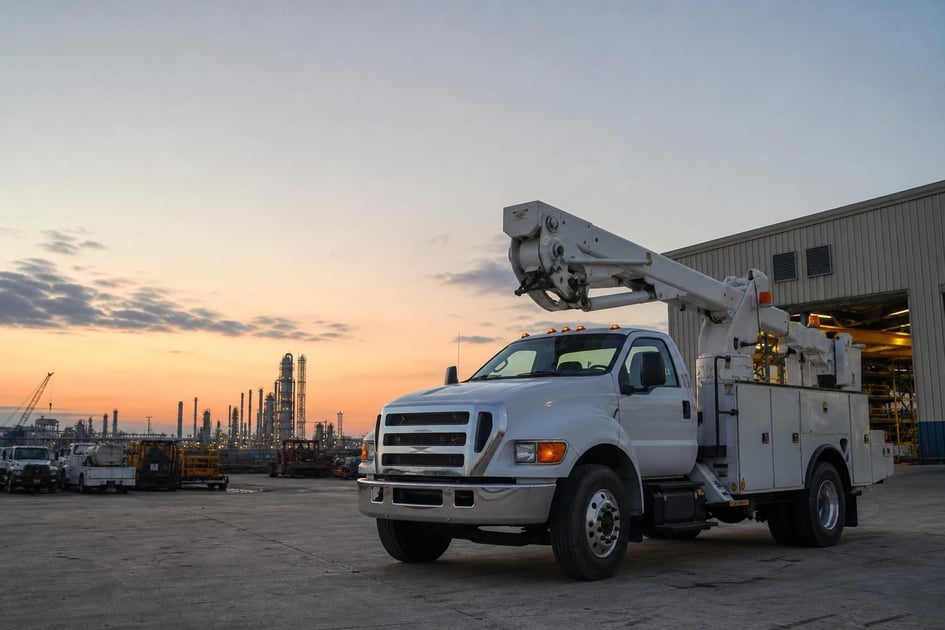
If you need a bucket truck for your Houston-area business, financing is available from $5,000 up to $5 million with the equipment itself acting as collateral. That collateral structure keeps rates competitive, and same-day approvals are possible depending on how quickly you submit the required documentation. Rates vary by credit profile, equipment age and term.
If you are shopping for an aerial lift unit, our Bucket Trucks financing covers new and used models from major manufacturers, with the truck itself serving as collateral.
Why Houston Contractors Prioritize Bucket Truck Financing
Houston is not a market where you can wait two weeks for equipment. Between hurricane recovery cycles, energy corridor maintenance, and nonstop residential development, crews need lift capacity now. The dominant industries driving demand here are tree care after Gulf Coast storms, electrical contracting for new subdivisions, telecom line work along the Port of Houston, and sign installation for the retail corridors along the Katy Freeway and the Grand Parkway.
Hurricane Season and Tree Care Demand
August and September represent the peak of the Atlantic hurricane season, and Houston sits squarely in the strike zone for tropical storms and flooding. When winds topple oaks and pines into power lines, tree service companies and utility contractors deploy bucket trucks for weeks of nonstop removal and repair work. Buying a truck in October or November is often too late to capture that revenue, so owner-operators shop in late spring and early summer to be ready. Financing lets you acquire the unit before the storm, rather than after prices spike.
The Energy Corridor and Industrial Maintenance
West of downtown, the Energy Corridor employs tens of thousands in petrochemical and refining operations. Those facilities require constant exterior maintenance on stacks, lighting, and pipe racks. Insulated bucket trucks rated for electrical work move between refinery turnarounds and commercial job sites. The Port of Houston adds another layer of demand, with maritime terminals needing regular signage, lighting, and structural inspections at height.
Residential Sprawl and Construction
The Houston metro adds thousands of homes per year across Montgomery County, Fort Bend, and the exurbs north of The Woodlands. Electrical contractors running new service drops, HVAC technicians installing rooftop units, and sign companies servicing strip malls all need aerial lift capability. A bucket truck replaces ladder crews, reduces liability, and lets one operator handle jobs that used to require three.
New vs. Used Bucket Trucks for Gulf Coast Conditions
Used bucket trucks dominate the Houston market, but the local climate creates specific inspection points you cannot skip. Humidity, salt air near the Ship Channel, and periodic street flooding mean corrosion hides in outrigger housings, boom pivot pins, and lower cab corners.
Age, Hours, and Corrosion
Most used units on the market range from 5 to 15 years old. Lower hours matter more than model year in this segment. A 2018 truck with 8,000 boom hours may present more wear than a 2015 unit with 4,000 hours if the newer machine worked coastal industrial sites. Ask for flood history documentation. After Hurricane Harvey in 2017, thousands of commercial vehicles in the Houston area took on water, and some still circulate in secondary markets.
New Truck Advantages
New chassis with new booms give you full manufacturer warranty, modern safety interlocks, and corrosion-resistant coatings. They also command higher financing amounts. Whether you buy new or used, the equipment serves as the collateral, which means you do not need to tie up real estate or other assets to secure the deal.
Lease vs. Loan for Bucket Trucks
How you structure the transaction affects your balance sheet and your tax position for 2026. Most Houston buyers choose between an equipment finance agreement, a fair market value lease, or a $1 buyout lease.
| Structure | Ownership | Payment Pattern | Tax Treatment (2026) | Best For |
|---|---|---|---|---|
| Equipment Finance Agreement | You own from day one | Fixed monthly until payoff | Depreciation and Section 179 may apply; confirm 2026 limits with your CPA | Buyers who want equity and full control |
| Fair Market Value Lease | Lessor owns; you return or buy at FMV | Lower monthly, balloon at end | Payments may be deductible as operating expense; verify with your CPA for tax year 2026 | Crews with short-term contracts or rapid obsolescence concerns |
| $1 Buyout Lease | You own after final $1 payment | Fixed monthly, no balloon | Similar to loan for tax purposes; consult your CPA on 2026 rules | Businesses that want ownership but predictable payments |
Rates vary by credit profile, equipment age and term, so the structure you choose should match your cash flow pattern, not just your tax strategy. If you are unsure how the 2026 depreciation rules affect your specific situation, review the latest IRS guidance on Section 179 and speak with a CPA before signing.
How the Financing Process Works
Provide Capital finances new and used business equipment nationwide, including the Houston metro. Applications can move from submission to decision the same day if documentation is complete.
Application to Approval
You will start with a short application covering your business history, the equipment details, and the requested term. A credit decision follows, often within hours. Same-day approvals are possible when the file is clean and the equipment invoice is straightforward. The process does not require a real estate appraisal or outside collateral beyond the truck itself.
Collateral and Rates
Because the bucket truck secures the transaction, lenders can offer more competitive terms than unsecured working capital products. Rates vary by credit profile, equipment age and term. A well-qualified buyer financing a late-model unit will see stronger terms than a startup financing a 20-year-old chassis. The truck remains the collateral in either case.
Documentation Checklist
To keep the file moving, have the equipment invoice or listing ready, including the seller’s contact information and the truck’s serial number. You will also need business bank statements, proof of insurance, and a copy of your driver’s license. If you are buying from a private party rather than a dealer, additional title verification steps may apply.
If you have your truck picked out and the invoice in hand, get a same-day decision on your equipment by starting the application now.
Tax Treatment for Tax Year 2026
For tax year 2026, the Internal Revenue Code may allow immediate expensing of qualifying business equipment through Section 179, subject to annual limits and phase-out thresholds set by Congress. Bonus depreciation percentages and rules may also apply to new and used equipment placed in service during 2026, though recent legislative changes have adjusted these benefits over time. Because caps, phase-outs, and qualifying property definitions shift, you should confirm the exact 2026 Section 179 limit and bonus depreciation rate with a CPA before relying on any tax strategy. For general background, review the latest IRS guidance on Section 179.
Houston Industries That Rely on Aerial Lift Equipment
Beyond tree care, bucket trucks serve a wide cross-section of Houston’s economy. Electrical contractors use insulated models to work safely near energized lines. Sign and lighting companies run non-insulated units to service highway billboards and parking lot poles. HVAC contractors deploy them for rooftop unit access in commercial parks. Municipalities and school districts maintain their own fleets for streetlight repair.
Many of these operators also run support vehicles. If your crew needs dump bodies for debris hauling alongside the aerial unit, explore Dump Trucks financing to complete the fleet. For businesses moving equipment between job sites across Texas, our Transportation equipment financing covers the broader hauling and logistics side of the operation.
Common Mistakes Houston Buyers Make
First, skipping the flood history check. Houston’s low-lying geography and repeated storm events mean a clean vehicle history report is not enough. Pull service records and inspect the undercarriage for mud in places that should be dry.
Second, mismatched boom height. A 45-foot boom works for residential tree trimming in The Heights, but it will not reach the top of a warehouse lighting grid in Baytown or a cell tower base. Match the boom spec to the highest expected job, not the average one.
Third, ignoring GVWR and CDL rules. A heavy bucket truck on a Class 7 chassis may require a commercial driver’s license. If your crew lacks CDL holders, you may need to shop lighter units or hire differently. Plan for that cost before you commit.
Qualification Criteria in Detail
Provide Capital serves construction, healthcare, dental, restaurant and food service, manufacturing, transportation, agriculture, HVAC, and forestry nationwide. For bucket trucks in Houston, we look at several factors.
Credit profile: A strong personal and business credit history opens the best terms, but subprime options exist. Rates vary by credit profile, equipment age and term, so a lower score may mean a higher payment or a larger down payment, but it does not automatically disqualify you.
Time in business: 2 or more years of operating history simplifies approval. Startups can still qualify with a stronger down payment or a co-signer, but they should expect more documentation requirements.
Equipment age: We finance both new and used units. Older trucks may require larger down payments or shorter terms to keep the loan-to-value ratio in line.
Down payment: While zero-down programs exist for well-qualified buyers, most transactions run smoother with 5 to 20 percent down. That equity reduces the lender’s risk and improves your approval odds.
Revenue and bank activity: Consistent deposits and manageable existing debt coverage matter. We use business bank statements to verify cash flow, not just tax returns.
Worked Cost Examples
Below are three realistic scenarios for Houston buyers. These are illustrative only; your actual payment will depend on credit profile, equipment age and term.
Scenario 1: Used arborist bucket truck. A 2019 International chassis with a 60-foot forestry boom. Purchase price $85,000. With a modest down payment and a standard term, the monthly payment might fall in the mid-hundreds to low-thousands range depending on credit and structure.
Scenario 2: New material handler bucket truck. A new chassis paired with a new 55-foot Altec insulated boom for electrical contracting. Purchase price $185,000. A longer term and strong credit could place the payment in the low-thousands to mid-thousands monthly.
Scenario 3: Heavy forestry package. A 75-foot chipper-body bucket truck set up for storm response. Purchase price $210,000. Given the higher dollar amount and specialized use, expect a review of your existing contract pipeline. Payments again depend on credit profile, equipment age and term.
None of these examples include tax benefits. For tax year 2026, a CPA can model how Section 179 or bonus depreciation might offset your net cost if you qualify.
Frequently Asked Questions
Do I need perfect credit to finance a bucket truck?
No. We work across the credit spectrum. Rates vary by credit profile, equipment age and term, so a lower score may mean a higher payment or a larger down payment, but it does not automatically disqualify you.
Can I finance a private-party purchase?
Yes. We finance dealer transactions and private-party sales. Private-party deals require extra title verification and a third-party inspection, but the rates and structures are similar.
Is same-day approval actually possible?
Same-day approvals are possible when your application is complete and the equipment listing is clear. Delays usually come from missing documentation, not from the credit decision itself.
What if the truck has high mileage or boom hours?
High-hour units can still qualify, especially if they have documented maintenance histories. Very high-hour or damaged booms may require a larger down payment or a shorter term. We finance new and used business equipment, so age alone is not a barrier.
Do you finance startups in Houston?
We do consider startups, particularly if the owner has relevant industry experience. Expect to provide a larger down payment or a personal guaranty. We do not offer guaranteed approval; every file is underwritten individually.
Can I include soft costs like delivery and installation?
In many cases, yes. Freight, upfit, and initial inspection costs can sometimes be rolled into the financing amount up to the appraised value of the completed unit. Ask your specialist during the quote phase.
What happens after I submit an application?
You will receive a credit decision, often within hours. If approved, we issue a term sheet. Once you accept and provide the equipment invoice and insurance binder, we fund the transaction and you take delivery.
Can I refinance an existing bucket truck?
Refinancing or sale-leaseback transactions are available for qualifying equipment. The truck must be free of liens and appraised at a value that supports the new financing amount.
Closing Next Step
Houston’s mix of storm-driven urgency, industrial scale, and residential sprawl makes the bucket truck one of the most versatile investments a contractor can make. Whether you are climbing poles after a hurricane or servicing a warehouse district near the Ship Channel, the right aerial unit keeps your crew productive and safe.
Start with the equipment. Pick the chassis, boom height, and body spec that matches your work. Then let the financing align with your cash flow. With amounts from $5,000 to $5 million and the truck serving as collateral, you can preserve your working capital for payroll and materials.
Talk to a specialist about your specific machine and see what you qualify for today. We work with businesses across Houston and nationwide, and we can often move from application to decision before your seller moves the unit to another buyer.
If you are ready to compare terms, see what you qualify for and get your Houston crew in the air this week.
Disclaimer: The information provided in this article is for general educational purposes only and is not financial, legal, or tax advice. Funding terms, qualifications, and product availability may vary and are subject to change without notice. Provide Capital does not guarantee approval, rates, or specific outcomes. For personalized information about your business funding options, contact our team directly.