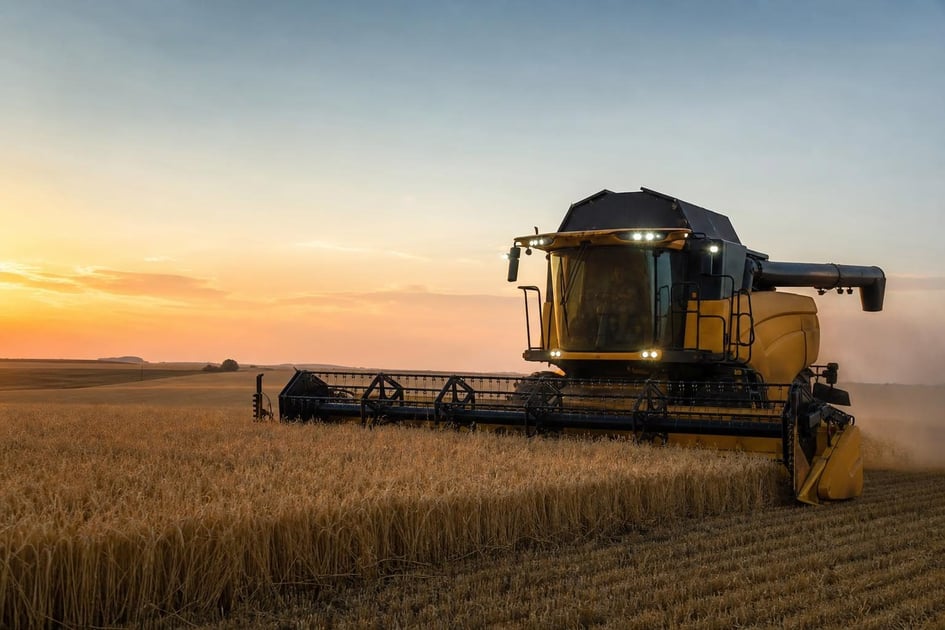
Yes. You can finance a combine with no down payment, and the equipment itself serves as the collateral. That structure keeps your cash in the operation for seed, chemical, fuel, and labor while you pay for the machine over time. At Provide Capital, combine financing runs from $5,000 to $5 million, and same-day approvals are possible when your documentation is in order. Rates vary by credit profile, equipment age and term, so the exact payment depends on the specific machine and your operation's financials.
By the Numbers: A new Class 7 or Class 8 combine with a 35-foot to 45-foot draper platform commonly falls between $350,000 and $650,000 before headers and technology packages. A three- to five-year-old model with under 1,000 separator hours often trades between $120,000 and $250,000. Late-model machines with high hours can drop below $100,000, while fully equipped flagship units can exceed $700,000.
How $0-Down Combine Financing Works
When a lender finances a combine with no down payment, it is not giving away the machine. It is securing the loan with the equipment as collateral. Because the combine has tangible resale value in the agricultural market, the lender can advance a high percentage of the purchase price—often the full amount—without requiring cash up front. That leaves your liquidity intact for the operating expenses that actually generate revenue.
The application process is straightforward. You submit a credit application, provide an equipment quote or invoice, and supply recent financials. Underwriters look at your credit history, cash flow, and the age and condition of the combine. If the deal fits the lender's parameters, you receive approval terms. In many cases, that turnaround happens the same day. Once you accept, the lender pays the dealer or private seller directly, files a UCC-1 lien on the combine, and you take delivery.
Rates vary by credit profile, equipment age and term. A new combine financed over five years will typically carry a lower rate than a ten-year-old machine financed over three years. Newer iron holds value better, which reduces the lender's risk. The term also affects the payment: stretching a $400,000 balance over 60 months produces a lower monthly outlay than compressing it into 36 months, though you pay more in total interest over the life of the loan.
Most combine loans are structured as equipment finance agreements or capital leases. At the end of the term, you own the machine outright with a $1 buyout, or you may have a small residual payment depending on the structure. The key point is that no-down-payment does not mean no-collateral. The combine is the collateral, which is why this product exists for owner-operators who need to preserve working capital.
For a broader look at how equipment loans and leases differ, review the SBA guidance on equipment financing and leasing.
See what you qualify for on your next combine without touching your operating line.
New vs. Used Combine Financing
The decision between a new and used combine shapes your payment, your term, and your maintenance budget. New machines offer the latest threshing technology, telematics, and manufacturer warranty coverage. They also command higher prices and longer financing timelines. Used machines cost less upfront but may carry higher per-acre repair risk and shorter available terms.
New Class 6 through Class 9 combines generally range from $300,000 to well over $700,000 once you add headers, precision-ag subscriptions, and extended warranties. Lenders will finance the full amount for qualified buyers, with terms stretching to 60 or 72 months on new iron. Because the collateral is strong, same-day approvals are common for applicants with solid credit and established operations.
Used combines—typically three to seven years old—offer the best value for mid-size grain operations. These machines often land between $100,000 and $275,000 depending on hours, brand, and header configuration. Financing terms on used equipment usually top out at 48 to 60 months, and the rate may be slightly higher than new because residual value declines faster. Still, a well-maintained combine with 800 to 1,200 separator hours can deliver years of reliable service at a fraction of the new cost.
Before you choose, look at total cost of ownership, not just the payment. A new combine under warranty may save $15,000 to $30,000 in repair costs over the first three years compared to a high-hour used machine. On the other hand, a used combine with a documented maintenance history and a recent concave/rotor inspection can be the smarter buy for an operator with a strong shop and a tight per-acre budget.
Recent AP News reporting on agricultural equipment tariffs highlights how trade policy continues to affect combine pricing and availability in 2026.
Lease vs. Loan: A Side-by-Side Look
Not every operation wants to own the combine outright. Leasing offers lower monthly payments and the flexibility to upgrade at the end of the term, which appeals to custom harvesters and large grain farms that cycle equipment every two to three seasons. A loan builds equity and leaves you with an unencumbered asset at payoff, which matters to farms that run machines for a decade.
| Factor | Equipment Loan | Operating Lease |
|---|---|---|
| Ownership | You own the combine after the final payment | Lessor owns the combine; you may have a buyout option |
| Down payment | $0 available for qualified buyers | Usually first and last payment upfront |
| Monthly payment | Higher than a lease for the same equipment | Lower monthly cost |
| Usage limits | No hourly or acreage restrictions | May include separator-hour caps or per-season acreage limits |
| Tax treatment | Depreciation and Section 179 deduction for tax year 2026; confirm details with your CPA | Lease payments generally deductible as operating expenses |
| End-of-term | $1 buyout or automatic ownership transfer | Return, renew, or purchase at fair market value |
| Best for | Owners who keep combines 5+ years | Operations that upgrade frequently or need lower payments |
Custom harvesters often prefer leases because they trade machines before major overhauls. A row-crop farm in Iowa or Illinois that puts 800 hours per year on a combine and runs it for eight years usually comes out ahead with a loan. If you are unsure which structure fits your tax situation, ask your CPA to model both scenarios for tax year 2026 before you sign.
Key Insight: Lenders calculate the advance ratio on a used combine based on auction and wholesale guide data, not the asking price. If a dealer lists a 2019 machine at $220,000 but the wholesale guide shows $195,000, the lender may cap the loan at the guide value unless you cover the difference. Always get a financing quote before you negotiate the final purchase price.
Who Qualifies for No-Down-Payment Combine Financing
No-down-payment programs are not reserved for only the largest farms. Lenders evaluate four main factors: credit history, time in business, cash flow, and collateral quality. You do not need perfect credit, but a track record of managing equipment debt helps. Most programs look for a minimum credit score in the mid-600s, though exceptions exist when cash flow is strong and the collateral is newer.
Time in business matters because farming is cyclical. An operation with three or more years of filed tax returns can demonstrate how it handles a bad yield year or a commodity-price dip. That history reduces lender risk. If your operation is newer, you may still qualify, but the underwriter will likely weigh personal credit and outside income more heavily.
Cash flow is measured through debt-service coverage ratio—essentially, does your operation generate enough revenue to cover the new payment after normal expenses? Many lenders want to see a coverage ratio of at least 1.25 to 1, meaning you bring in $1.25 for every $1.00 of debt payment. Seasonal operations can sometimes qualify with lower coverage if they show strong harvest-season cash inflows and a history of disciplined expense management.
The combine itself also influences approval. A one-year-old John Deere X9 or Case IH AF11 with factory warranty is easier to finance at 100 percent than a twenty-year-old machine with unknown maintenance history. If you are buying used, expect the lender to request an appraisal, a condition inspection, or a photo package showing hours, serial number, and overall condition.
Pro Tip: Apply for financing before you shop. A pre-approval letter tells the dealer you are a cash buyer in their eyes, which strengthens your negotiating position. It also prevents the awkward scenario where you agree on a price and then learn the lender will only advance 85 percent because the machine is older than expected.
Tax Treatment for Tax Year 2026
How you finance the combine affects your tax bill, and the rules change with the calendar year. For tax year 2026, Section 179 allows businesses to deduct the full purchase price of qualifying equipment up to an inflation-adjusted annual limit. The exact dollar ceiling for 2026 adjusts each year, so verify the current limit with your CPA before you file. If your combine purchase exceeds the cap, you can still depreciate the remainder under standard MACRS schedules.
Bonus depreciation continues to phase down in tax year 2026. The exact percentage depends on the current provisions of federal tax law, and Congress can adjust these rules before year-end. Rather than quoting a specific rate that may change, work with your accountant to determine whether bonus depreciation or Section 179 gives your operation the larger deduction for the 2026 tax year.
If you choose a loan, you generally take depreciation and any available first-year expensing. If you choose a true lease, you typically deduct the lease payments as operating expenses. Both approaches reduce taxable income, but the timing differs. A CPA with agricultural experience can model the net present value of each option against your projected 2026 and 2027 income.
One caution: do not let the tax tail wag the dog. A larger upfront deduction is valuable, but not if it pushes you into a structure with a balloon payment or restrictive hour limits that hurt your harvest window. Match the financing product to your operational needs first, then optimize the tax treatment.
Documentation You Need to Apply
Gathering paperwork before you apply speeds up approval and reduces back-and-forth. Most lenders request the following: a completed credit application, a detailed equipment quote or purchase agreement showing serial number, year, make, model, and price, the last three to six months of business bank statements, the most recent two years of business tax returns, a current personal financial statement, and proof of insurance naming the lender as loss payee.
Insurance is non-negotiable. The lender wants comprehensive and collision coverage on a combine that may be worth more than your house. Expect to carry a policy with deductibles of $1,000 or less and liability limits that satisfy the lender's minimums. If you already have a farm policy, your agent can add a lender-loss-payee endorsement. If you do not have coverage lined up, the lender may force-place insurance at a much higher premium.
For used private-party purchases, the lender may also want a bill of sale, a title search or UCC lien search to confirm no prior encumbrances, and a condition report. Some lenders require an independent appraisal for used combines over a certain age or dollar threshold. If the seller owes money on the machine, the lender will usually handle the payoff directly to ensure a clean title transfer.
Common Mistakes When Financing a Combine
The biggest mistake is buying more machine than your acres justify. A 100-foot-wide combine with a 500-bushel grain tank looks impressive, but if you farm 800 acres of soybeans, you are paying for capacity you cannot use. Match the machine to your acreage, crop mix, and custom-hire potential. A good rule of thumb is that your annual combine payment should not exceed 8 to 12 percent of your gross crop revenue unless you have significant custom-work income to offset it.
Another error is ignoring the header. A combine without the right header is just a very expensive tractor. Header costs range from $30,000 to $100,000 depending on width and type—draper, corn, or flex—and they can be financed alongside the combine. Make sure your quote includes the header you actually need, and confirm that the lender will advance funds for both the combine and the attachment under the same approval.
Operators also stumble by choosing a term that outlives the machine. Financing a 12-year-old combine over 60 months means you may still owe $40,000 when the machine is 17 years old and facing a $20,000 rotor or engine overhaul. A conservative approach is to keep the loan term shorter than the expected reliable life of the machine. For a used combine with 1,500 hours, that might mean a 36-month or 48-month term rather than stretching to 60 months.
Finally, read the prepayment language. Some equipment finance agreements include prepayment penalties or minimum interest charges that make it expensive to pay off the loan early if you sell the machine or receive an unexpectedly large crop insurance payment. Ask your financing specialist to point out the prepayment clause before you sign.
Seasonal Timing and Regional Considerations
When you buy matters almost as much as what you buy. Combine prices follow the agricultural calendar. Dealers are most motivated to move inventory between December and February, after harvest and before spring planting season. During this window, you may find year-end rebates, leftover new inventory at prior-model-year pricing, or aggressive trade-in allowances. Financing during this period can also align your first payment with spring revenue if the lender offers seasonal skip payments.
According to Reuters reporting on farm machinery spending trends, North American farmers are cutting big-ticket equipment purchases in 2026 due to high input costs and lower crop prices, which makes preserving working capital through financing even more important.
Regional crop patterns affect machine selection and financing urgency. A Corn Belt operator in Iowa or Illinois needs a combine ready by late September. A wheat producer in Kansas or Oklahoma harvests in June and July. A Delta farm running soybeans and rice may have two distinct harvest windows. If you are financing in July for a machine you need in August, build in extra time for funding and delivery. Same-day approval is possible, but shipping a combine across three states takes longer than wiring money.
Soil conditions and terrain also matter. A hillside combine with a lateral-tilt feederhouse costs more than a standard flat-ground machine but pays for itself in reduced grain loss on slopes. If your operation includes both row crops and small grains, factor in the cost of switching concaves and rotor configurations. These details belong in your equipment quote so the lender funds the full setup, not just the base machine.
Key Insight: Some lenders offer seasonal payment schedules that let you skip payments during planting and focus them during harvest. That structure matches cash flow for grain operations better than a flat monthly schedule. If your lender does not advertise seasonal skips, ask. Not every financing company accommodates agricultural cycles, but specialists in Agriculture equipment financing understand that a February payment is harder to make than a November payment.
What Happens After Approval
Once you accept the terms, the lender moves to fund. On a dealer purchase, the lender sends funds directly to the dealership, often within 24 to 48 hours of receiving a signed purchase agreement and proof of insurance. On a private-party sale, the lender may issue a check to the seller or wire funds after verifying title and payoff status. You should not take delivery until the lender confirms funding and lien perfection.
The lender files a UCC-1 financing statement in the state where the combine is located. This public notice protects the lender's interest in the collateral. It does not prevent you from using the machine, insuring it, or performing maintenance. It does mean you cannot sell the combine without paying off the lien. When you make the final payment, the lender releases the lien and sends you a termination statement.
Your first payment is typically due 30 to 45 days after funding. If you close in October, your first payment may not be due until December, which helps if harvest revenue arrives in November. Some lenders offer 90-day deferred first payments for qualified buyers, though interest accrues during the deferral. Ask about the exact accrual method so you are not surprised by a larger first payment or a longer amortization.
Throughout the term, keep the combine insured and maintained. Lenders rarely inspect collateral, but a total-loss event without insurance breaches your contract and can trigger immediate acceleration of the entire balance. Maintain records of major repairs and service intervals. If you need to refinance or trade up before the term ends, those records support a higher resale or trade value.
Get a same-day decision on your equipment so you can lock in off-season pricing before spring.
Frequently Asked Questions
Can I really finance a combine with absolutely no money down?
Yes. For qualified buyers, lenders can advance 100 percent of the combine's purchase price because the equipment itself secures the loan. You still need to cover insurance, delivery, and any taxes or fees not included in the financed amount, but the core machine price can be fully funded.
Does a used combine require a down payment?
Not necessarily. No-down-payment options exist for used combines, especially those under five years old with low hours. Older machines may require a small equity injection—sometimes 5 to 10 percent—because the collateral value is harder to predict. The exact structure depends on the lender's advance guidelines for the specific year and model.
How long can I finance a combine?
New combines commonly finance over 48 to 72 months. Used combines typically qualify for 36 to 60 months, depending on age and condition. A lender is unlikely to stretch a 15-year-old machine beyond 36 months because the collateral may not outlast the loan.
Will the lender check my personal credit?
Yes, in most cases. Even if the loan is in your farm's name, the lender will review your personal credit history because small and mid-size farms often have intertwined personal and business finances. A strong personal credit profile can offset a shorter business history.
Can I finance headers, precision-ag subscriptions, and warranties together?
Often, yes. Lenders will usually roll attachments that are part of the same invoice into the financing package. Software subscriptions and extended warranties may be treated differently; some lenders finance them, while others require them to be paid separately. Ask before you quote.
What if I need the combine delivered before harvest?
Apply at least two to three weeks before you need the machine. Same-day approval is possible, but shipping, inspection, insurance setup, and lien filing take additional time. If you are buying from a distant private seller, add another week for logistics and title verification.
Is a lease better than a loan for tax purposes?
It depends on your tax situation. Lease payments are generally deductible as operating expenses. Loans let you depreciate the asset and may qualify for Section 179 expensing in tax year 2026. The better choice is the one that aligns with your income projections and cash flow needs. Have your CPA run the numbers before you decide.
Can I refinance an existing combine loan?
Yes, if you have equity in the machine and your credit has improved. Refinancing can lower your payment, shorten the term, or pull cash out for operating expenses. The lender will order a current valuation to determine how much equity you have. If you owe more than the combine is worth, you may need to bring cash to the table to refinance.
Next Steps
Financing a combine with no down payment is a practical way to upgrade capacity without draining the operating account. The key is to match the machine, the term, and the structure to your acreage, crop mix, and cash flow cycle. Start by gathering your financials and an equipment quote, then apply for pre-approval. With the right setup, you can lock in off-season pricing and take delivery before your first acre is ready to cut.
If you are also adding supporting equipment, explore Skid Steers financing for your farm's loading and material-handling needs. For a full overview of how we serve grain and livestock operations, visit our Combines financing page or apply now to talk to a specialist about your specific machine.
Disclaimer: The information provided in this article is for general educational purposes only and is not financial, legal, or tax advice. Funding terms, qualifications, and product availability may vary and are subject to change without notice. Provide Capital does not guarantee approval, rates, or specific outcomes. For personalized information about your business funding options, contact our team directly.