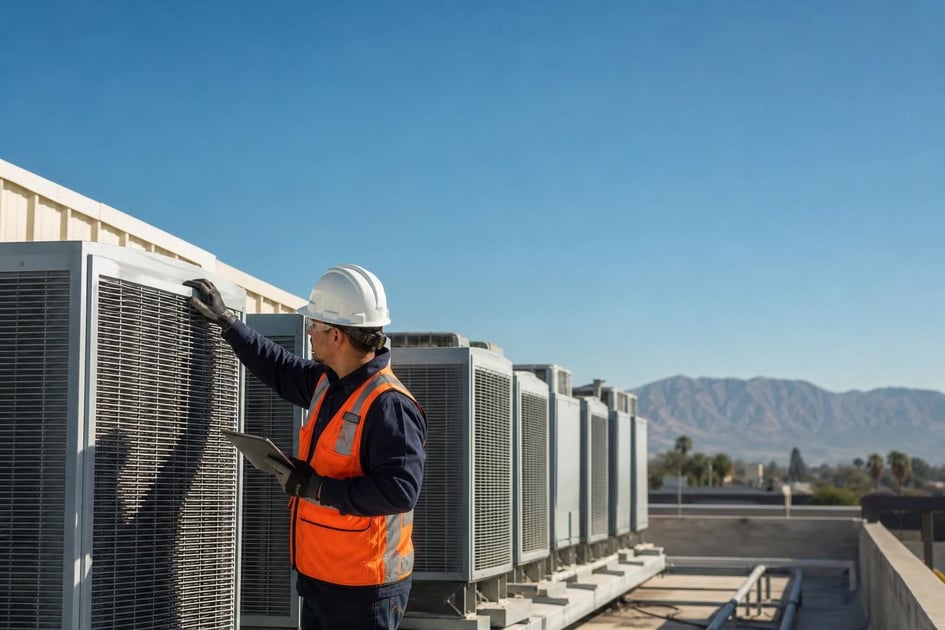
A 20-ton rooftop unit for a Central Valley food-processing plant can run $45,000 to $85,000 installed, and a 100-ton chiller for a Los Angeles County medical office can easily reach $125,000. Financing the system keeps your cash reserves intact, and because the equipment itself serves as collateral, rates stay competitive. Same-day approvals are possible for well-documented applications, and financing is available from $5,000 up to $5 million.
California’s energy codes, seismic requirements, and utility rate structures make commercial HVAC purchases more complex than in most other states. The right financing structure depends on whether you need to own the equipment outright, how long you plan to keep it, and how you want to handle the 2026 tax implications.
Why California HVAC Installations Cost More
California’s Title 24 Building Energy Efficiency Standards require commercial equipment to meet strict efficiency thresholds that exceed federal minimums. A rooftop package unit that qualifies in Arizona may not pass inspection in San Bernardino County without upgrades to the economizer, variable frequency drives, or controls. Those add-ons raise the upfront price 15 to 30 percent compared with identical-capacity units installed in neighboring states.
Seismic bracing adds another line item. The California Building Code requires HVAC equipment mounted on roofs or raised platforms to withstand earthquake forces. Engineering, brackets, and certified installation labor can add $3,000 to $8,000 per rooftop unit, depending on the zone and the structural complexity of the building.
Then there are utility demand charges. Pacific Gas and Electric, Southern California Edison, and San Diego Gas & Electric structure commercial rates with significant demand components based on peak kilowatt usage. An outdated HVAC system that spikes during August heat waves can drive thousands of dollars in demand penalties annually. Replacing it with a modern, efficient unit is not just a comfort upgrade; it is a direct hedge against some of the highest commercial electricity rates in the continental United States.
Key Insight: In California, the total installed cost of a commercial HVAC system is often 20 to 40 percent higher than the sticker price of the unit itself after you factor in Title 24 compliance hardware, seismic bracing, permits, and commissioning. Lenders who specialize in equipment financing understand this and can structure the loan to cover the soft costs alongside the equipment, provided the total falls within your approval limit.
Already have a machine in mind?
Provide Capital finances new and used equipment from $5,000 to $5 million, with same-day decisions possible.
Apply NowEquipment Financing vs. Paying Cash
Paying cash eliminates interest, but it also strips working capital at the exact moment you are investing in growth. For California businesses facing seasonal revenue swings—agriculture processors in Fresno, tourism operators in San Diego, or logistics warehouses in the Inland Empire—tying up $75,000 in a rooftop unit can leave you exposed when payroll or inventory peaks arrive.
Equipment financing preserves liquidity. The lender secures the loan with the HVAC unit itself, which typically means lower collateral requirements than an unsecured term loan. Terms generally range from 24 to 84 months, and monthly payments are fixed, making them predictable against fluctuating utility bills.
Because the equipment acts as collateral, lenders can offer decisions quickly. If you have your equipment quote, business bank statements, and tax returns ready, same-day approval is possible. The process moves faster than SBA-backed loans, though SBA guidance on equipment financing remains a useful benchmark for understanding how government programs treat machinery acquisitions.
| Factor | Paying Cash | Equipment Financing |
|---|---|---|
| Upfront cost | Full amount due immediately | Minimal to zero down payment |
| Working capital impact | High—cash leaves the business | Low—cash stays on the balance sheet |
| Speed of acquisition | Immediate | Same-day approval possible; funding in 24–48 hours |
| Tax treatment (2026) | Depreciated over MACRS schedule | Section 179 or bonus depreciation may apply; consult a CPA |
| Credit building | None | On-time payments strengthen business credit |
| End of term | You own the asset | You own the asset (loan) or return/upgrade (lease) |
Lease vs. Loan Structures for HVAC
Not all equipment financing works the same way. The structure you choose affects who owns the unit, who maintains it, and how the payments appear on your books.
Equipment Finance Agreement
An Equipment Finance Agreement, or EFA, is essentially a loan structured for equipment purchases. You make monthly payments, and at the end of the term you own the HVAC unit free and clear. This is the most common structure for commercial HVAC because these systems have long useful lives—often 15 to 20 years—and businesses want to capture the residual value. Commercial HVAC System financing through an EFA lets you deduct interest and depreciate the asset, subject to 2026 tax rules.
Fair Market Value Lease
An FMV lease works like a rental. You make lower monthly payments for the term—typically 36 to 60 months—and at the end you can purchase the unit at its then-current fair market value, return it, or upgrade to a new system. This structure makes sense if you operate in a county with rapidly evolving energy codes and want the flexibility to replace the unit when Title 24 standards tighten again. The trade-off is that you build no equity during the lease term.
$1 Buyout Lease
A $1 buyout lease straddles the line between a lease and a loan. You make payments throughout the term, then buy the equipment for $1 at the end. For accounting purposes, this is generally treated as a loan, and you may be able to take Section 179 deductions in the 2026 tax year. However, the documentation and approval standards are similar to an EFA, so the difference is largely in how the contract is titled.
Pro Tip: If you are financing HVAC for a leased building, check your lease term before choosing a 72-month equipment loan. A seven-year finance agreement outlasting a five-year commercial lease creates complications. Match your finance term to your lease term plus any renewal options, or choose an FMV lease that lets you walk away when the building lease expires.
Tax Treatment for the 2026 Tax Year
The tax implications of your HVAC purchase depend on whether you structure the deal as a loan, a capital lease, or an operating lease. For the 2026 tax year, Section 179 allows businesses to deduct the full purchase price of qualifying equipment in the year it is placed in service, subject to an overall business income limitation and a total investment cap. The exact dollar limits for 2026 are set by the IRS; if you are near the threshold, talk to a CPA before you sign.
Bonus depreciation may also apply to new and used HVAC equipment in 2026, though the percentage has been phasing down under current federal law. Because Congress occasionally adjusts depreciation schedules in late-year legislation, the precise 2026 percentage should be confirmed with your accountant before you file.
California state tax treatment does not always conform to federal rules. The Franchise Tax Board may disallow or modify certain federal depreciation deductions, so a strategy that saves money federally might not yield identical savings at the state level. A CPA familiar with California corporate tax can model both scenarios.
What You Need to Qualify
Equipment lenders evaluate three main factors: credit history, time in business, and the equipment itself. Because the HVAC unit serves as collateral, the risk profile is lower than with unsecured credit, which opens the door to newer businesses and borrowers with past credit challenges.
Credit and Operational History
Most lenders prefer a FICO score in the mid-600s or higher, but approvals are possible below that range when the equipment holds strong resale value and the business shows consistent revenue. Two or more years in business helps, though some programs accept applicants with as little as six months of operating history if cash flow is documented and stable.
Documentation to Have Ready
Having your paperwork organized speeds the process. Most applications require:
- A written quote or invoice from the equipment vendor or contractor
- Three to six months of recent business bank statements
- The most recent year of business tax returns
- A brief business summary, including ownership structure and time in operation
- Proof of applicable licenses or contractor agreements, if the lender requires them
For larger systems—say, a 200-ton chilled water plant for a manufacturing facility in Orange County—the lender may also request a site inspection or engineer’s report to confirm the equipment is being installed correctly and will hold its value.
If you have your vendor quote and bank statements in hand, get a same-day decision on your equipment and avoid the weeks-long wait typical of conventional bank loans.
By the Numbers: A mid-sized logistics warehouse in the Inland Empire running a 25-ton rooftop unit and a 10-ton split system can expect combined installed costs between $65,000 and $110,000, depending on ductwork modifications and Title 24 controls. Spread over a 60-month term, that preserves roughly $75,000 in working capital compared with paying cash, capital that can cover payroll during Q4 peak season or fund a second location expansion.
See what you qualify for
The equipment itself secures the financing, which keeps rates competitive. Checking your options takes minutes.
Check Your OptionsNew vs. Used HVAC Equipment
New commercial HVAC units carry full manufacturer warranties, meet current Title 24 standards, and qualify for the broadest range of financing programs. They also command the highest price. Used or refurbished units can cut the equipment cost by 30 to 50 percent, but California buyers need to be cautious.
Used equipment must still pass Title 24 inspection if it is being installed in a new project or a major alteration. A three-year-old rooftop unit from Nevada may lack the economizer controls or refrigerant monitoring required in California, and retrofitting those components can erase much of the savings. Additionally, lenders often finance used equipment at slightly shorter terms or require larger down payments because the collateral depreciates faster.
If you are considering used equipment, get a California-licensed contractor’s written opinion on what modifications are needed to bring the unit into compliance before you apply for financing. The lender will want to see that report.
Industry-Specific Considerations in California
California’s economy is not monolithic. The HVAC needs of a Modesto almond processor differ sharply from those of a Santa Monica dental group. According to U.S. Census Bureau County Business Patterns, the state hosts hundreds of thousands of employer establishments across dozens of industries, which means the scale of commercial HVAC demand here is unmatched anywhere else in the country. Here is how financing plays out across the major sectors.
Agriculture and Food Processing
The Central Valley’s agricultural sector relies on precise climate control for storage, sorting, and packaging facilities. Pre-cooling rooms and controlled-atmosphere storage require industrial-grade split systems and chillers that run year-round. Because harvest seasons create sharp revenue spikes, many processors prefer 24-month or 36-month terms to align debt service with cash flow. Industrial HVAC System financing is built for these higher-capacity, continuous-duty applications.
Logistics and Warehousing
The Inland Empire has become one of the busiest logistics corridors in the country. Distribution centers measuring 200,000 square feet or more need rooftop units rated for extreme heat and dust filtration. With U.S. power demand hitting record highs, these facilities face relentless pressure to cut peak demand charges. Financing allows operators to install high-efficiency units with smart controls without waiting for a capital budget cycle.
Healthcare and Dental
Medical offices in California must maintain specific temperature and humidity ranges for patient comfort and equipment calibration. A failed chiller in August can force closures and appointment cancellations. Because dental and medical practices often carry high student-debt loads on the owner’s personal credit, equipment-secured loans are especially valuable—the collateral reduces the lender’s reliance on personal credit scores.
Hospitality and Retail
Coastal tourism operators from San Diego to Monterey face compressed installation windows between tourist seasons. A hotel in Palm Springs cannot have its chiller down during July. Fast equipment financing lets hospitality businesses replace systems in the shoulder months and pay for the equipment across the high-revenue summer season. HVAC equipment financing for hospitality clients often structures payments to skip the low-revenue winter months.
Pro Tip: California contractors book up fast between March and May as businesses rush to beat the summer heat. If you are financing a replacement, get your approval letter before you solicit bids. A pre-approved financing letter signals to contractors that you are ready to move, which can bump you ahead of cash-quote clients waiting for board or owner approval.
Common Mistakes California Buyers Make
First, underestimating soft costs. Many owners budget for the unit alone and forget about crane rental for rooftop placement, seismic engineering, ductwork modifications, and commissioning. A lender experienced in California equipment finance will ask for a fully loaded quote upfront, but you should prepare one regardless.
Second, ignoring the utility rebate timeline. California utilities and regional energy districts offer rebates for high-efficiency commercial HVAC, but those rebates often arrive 90 to 120 days after installation. If your financing term assumes an immediate rebate credit, your cash flow will suffer during that gap. Structure your down payment or initial payments to absorb the delay.
Third, selecting the wrong refrigerant. California is phasing down hydrofluorocarbons under state law ahead of federal schedules. Buying equipment with refrigerants that face near-term phaseout limits your resale value and may trigger early replacement. Finance a unit with future-proof refrigerant to preserve collateral value for the full loan term.
Finally, failing to match the finance term to the equipment life. Financing a rooftop unit over 84 months when the useful life under California coastal corrosion conditions is only 12 years is reasonable. Financing it over 120 months is not.
Ready to move forward?
More than 10,000 businesses have financed equipment with Provide Capital. See what you qualify for today.
Get StartedFrequently Asked Questions
Can I finance HVAC equipment if my business is less than two years old?
Yes. Equipment-secured financing is available to businesses with as little as six months of operating history if revenue is documented and consistent. Strong credit and a detailed vendor quote improve your chances. Expect slightly shorter terms or a modest down payment compared with established businesses.
Does the lender pay my contractor directly?
In most cases, yes. Equipment lenders typically send funds directly to the vendor or contractor upon installation verification and receipt of a completed certificate of completion. This protects both parties and ensures the collateral exists before the loan funds.
Can I include installation, ductwork, and permits in the financing amount?
Soft costs like installation and freight can often be rolled into the equipment financing agreement, provided they are itemized on the vendor invoice and the total amount falls within your approval limit. Standalone permit fees paid to municipalities may need to be paid separately.
Will financing an HVAC system help my business credit?
Yes, provided the lender reports to business credit bureaus. Making consistent on-time payments on an equipment loan establishes a positive trade line. This is one reason some borrowers choose financing even when they have the cash available.
What happens if I need to replace the unit before the loan is paid off?
You remain responsible for the loan balance. However, many lenders allow you to finance the new unit and roll any remaining balance from the old loan into the new agreement, provided you qualify. This is sometimes called a wrap or upgrade program. Ask your lender about their specific policy.
Are there prepayment penalties?
Some equipment finance agreements include prepayment penalties or require you to pay all remaining interest. Others allow early payoff with no penalty. Read the term sheet carefully before signing, and ask your financing specialist to highlight any prepayment clauses.
How do I know if I should choose a loan or a lease?
If you plan to keep the building and the equipment for more than seven years, an Equipment Finance Agreement usually makes more sense because you build equity. If you operate in a leased facility with an uncertain renewal, or if you expect California energy codes to change dramatically within five years, a Fair Market Value lease preserves flexibility. Talk to a specialist about your specific machine and building situation before deciding.
Can I deduct the full cost in 2026?
Section 179 and bonus depreciation may allow significant first-year deductions for the 2026 tax year, but the exact limits depend on IRS guidance, your taxable income, and how the transaction is structured. California state rules may differ from federal treatment. Speak with a CPA before you rely on any specific deduction amount.
Getting Started
California’s commercial HVAC market demands equipment that meets strict energy codes, withstands seismic events, and operates efficiently under punishing utility rate structures. Financing lets you install the right system now rather than patching an aging unit through another summer.
Start by gathering your vendor quote, recent bank statements, and last year’s tax return. With those three items, most applications move from submission to decision within hours. Whether you need a single rooftop unit for a Fresno warehouse or a multi-chiller plant for a Los Angeles medical complex, equipment-secured financing keeps your cash working while the new system starts cutting your energy bills. See what you qualify for and get your project moving before the next heat wave hits.
Disclaimer: The information provided in this article is for general educational purposes only and is not financial, legal, or tax advice. Funding terms, qualifications, and product availability may vary and are subject to change without notice. Provide Capital does not guarantee approval, rates, or specific outcomes. For personalized information about your business funding options, contact our team directly.