What Commercial Oven Financing Means for California Operators
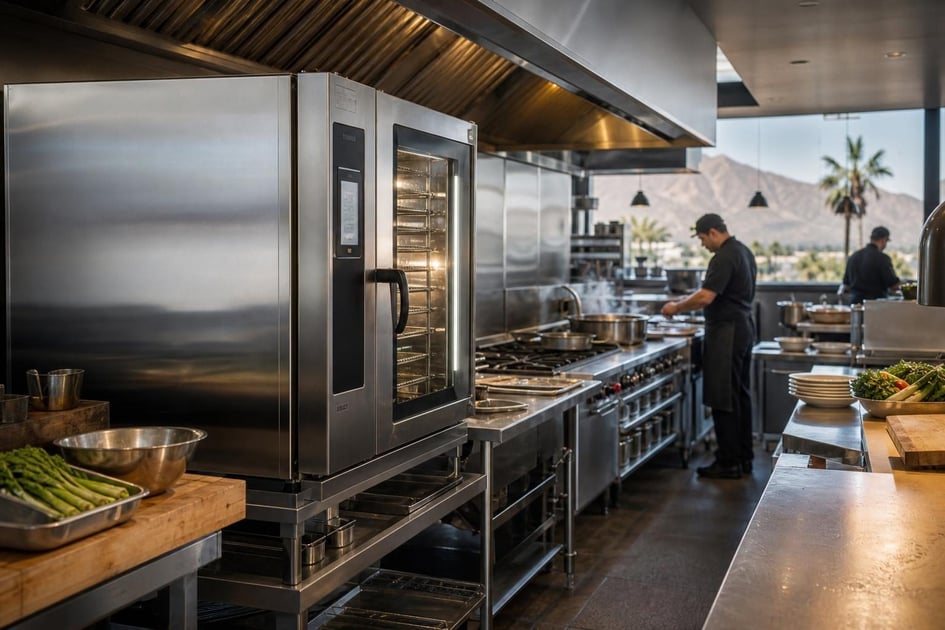
If you are buying a convection oven for a bakery in the Central Valley or a deck oven for a pizzeria along the coast, Commercial Ovens financing lets you spread the cost over time while the equipment itself secures the note. Provide Capital finances new and used business equipment from $5,000 to $5 million, which covers everything from a single reach-in oven to a full rack-oven line for a commissary kitchen. Because the equipment serves as collateral, rates stay competitive compared with unsecured borrowing, and same-day approvals are possible once your documentation is complete.
California’s food-service market operates under pressures that make preserving cash especially important. High energy costs and strict building codes mean operators often choose ovens that carry a premium but deliver lower lifetime utility bills. Financing closes that gap without draining the working capital needed for labor and inventory.
Key Insight: California’s Title 24 energy standards often push buyers toward certified high-efficiency models that cost more upfront. Lenders who specialize in equipment finance understand this and will write the loan for the full invoice, including delivery and installation, because the long-term utility savings support the collateral value.
Get a fast decision on your equipment
Applying takes just a few minutes, and decisions can come as soon as the same day.
Start Your ApplicationHow Much a Commercial Oven Costs and What Lenders Finance
Pricing varies widely by type and size. A standard half-size convection oven suitable for a small cafe might start near $5,000, while a double-stack gas convection or a rotating rack oven for high-volume production can run well into six figures. Lenders generally do not require a down payment on strong credit, but putting money down can improve the rate and shorten the approval time for newer businesses.
The amount you can borrow is driven by the equipment value and your business performance, not by real estate or personal assets outside the standard personal guarantee. Provide Capital looks at bank deposits, time in business and credit profile to set the advance and the term. If you are adding other cooking equipment, you can bundle a Commercial Range financing package into the same transaction, which simplifies paperwork and may improve the overall rate by increasing the total collateral value.
New vs. Used Ovens: Approval and Rate Differences
New equipment usually carries the longest available terms and the lowest rates because the residual value is predictable. Used ovens can still be financed aggressively, especially if they are late-model units from recognized manufacturers with service records. The age of the oven matters: once an oven passes 10 years, the pool of lenders willing to stretch beyond 36 months narrows, and the rate adjustment reflects the higher residual risk.
| Factor | New Commercial Oven | Used Commercial Oven |
|---|---|---|
| Typical term range | 24 to 72 months | 12 to 60 months |
| Rate outlook | More favorable | Slightly higher, varies by age |
| Warranty coverage | Full manufacturer warranty | Limited or expired |
| Documentation needed | Vendor quote or invoice | Invoice plus condition report |
| Down payment | Often $0 with strong credit | Sometimes 10% to 15% |
Rates vary by credit profile, equipment age and term, so the table above illustrates structure rather than a specific quote. The key is matching the term to the oven’s realistic useful life so you are not upside down when it is time to replace.
Pro Tip: Buying a used oven at auction can save thousands, but many lenders will not fund auction purchases without a pre-auction approval letter. Secure a conditional approval before you bid so you can act fast on auction day without paying cash.
Lease or Loan: Which Structure Fits a California Kitchen
The choice between a lease and an equipment loan depends on your tax strategy, how long you plan to keep the oven, and whether you want to own it outright at the end. With an equipment finance agreement, you own the oven from day one and claim depreciation and any available deductions. With a fair-market-value lease, you make lower monthly payments but return the equipment at the end unless you exercise a purchase option.
A $1 buyout lease is a middle path: the payments are higher than an FMV lease, but ownership transfers automatically for a nominal sum at the end. Restaurants that refresh their kitchens every 5 to 7 years often prefer the FMV structure, while bakeries and commissaries that run ovens for a decade or more usually choose a loan or $1 buyout.
Tax Treatment for Tax Year 2026
For the 2026 tax year, businesses that purchase ovens may be able to deduct the full cost under Section 179, subject to annual inflation-adjusted limits and taxable income ceilings. Bonus depreciation continues to phase down in 2026, so the upfront deduction may be smaller than in prior years depending on the equipment type and purchase date. The exact benefit depends on your entity structure, prior-year deductions and state tax rules, which in California do not always conform to federal treatment. Speak with a CPA before you structure the transaction so you do not leave money on the table or trigger an unexpected state liability.
By the Numbers: A bakery financing a $45,000 convection oven on a 60-month term with $0 down might see monthly payments in the mid-hundreds, while a $180,000 rack-oven line on a 48-month term typically runs in the low four figures. Rates vary by credit profile, equipment age and term, so treat these as directional ranges, not quotes.
Who Qualifies for Commercial Oven Financing
Provide Capital serves established businesses across construction, healthcare, dental, restaurant and food service, manufacturing, transportation, agriculture, HVAC and forestry nationwide. For a restaurant or bakery seeking an oven, lenders typically want to see at least 6 months of operating history, though 2 or more years strengthens the file and unlocks longer terms. There is no universal minimum revenue figure, but consistent monthly deposits that comfortably cover the proposed payment are essential.
Credit matters, but a sub-700 score does not automatically disqualify you. What hurts more than the number itself are recent bankruptcies, unresolved tax liens or patterns of nonsufficient funds in the business account. If your credit has blemishes but your revenue is solid and the equipment is essential to operations, the deal can still move forward, though the rate and term will reflect the additional risk.
Documentation to Prepare
Having these items ready speeds the process:
- A signed vendor quote or equipment invoice showing the oven model, serial number if used, and sale price
- 3 to 4 recent business bank statements
- The prior year’s business tax return, if available
- A brief equipment description explaining how the oven fits your operation
For transactions above a certain threshold, typically in the mid-five figures, lenders may also request interim financials or a debt schedule. If you need other equipment at the same time, such as a Commercial Mixer financing package, include those quotes upfront so the underwriter can structure a single facility.
If your file is strong, you can see what you qualify for and receive a same-day decision. Delays usually come from missing paperwork, not from the underwriting itself. The Small Business Administration offers guidance on preparing financial documents that can streamline any equipment finance application.
See what you qualify for
The equipment itself secures the financing, which keeps rates competitive. Checking your options takes minutes.
Check Your OptionsCalifornia-Specific Considerations for Food-Service Equipment
California’s restaurant and food manufacturing base is the largest in the nation by establishments, and that scale creates distinct financing patterns. Coastal operators often time purchases in late winter or early spring so new ovens are installed before the summer tourism surge. Inland agricultural processors may buy after harvest season when cash flow is strongest and before year-end tax deadlines.
Energy costs also shape buying decisions. A gas deck oven that is economical to run in other states can face higher operating costs in California depending on local utility rates and any pending infrastructure regulations. Electric convection and combi ovens with smart controls are increasingly popular, and lenders have become comfortable financing these higher-tech units because the market demand supports strong resale values. U.S. Census Bureau business data confirms the scale of the state’s food-service sector, which helps underwriters feel confident about collateral values.
Because California does not conform automatically to federal tax depreciation rules, the state-level deduction for your 2026 purchase may differ from the federal number. This is another reason to consult a CPA who understands both the federal Section 179 phase-down and California’s add-back rules before you sign.
Industries That Finance Commercial Ovens in California
The heaviest demand comes from full-service restaurants, quick-service chains, bakeries, hotel kitchens, catering commissaries and food-manufacturing facilities. Each uses a different oven type and therefore a different financing profile.
Full-service restaurants typically finance half-size or full-size convection ovens and may add a salamander or cheesemelter. Pizzerias look for deck or conveyor ovens, which carry higher price tags but are specialized enough that lenders recognize the revenue they generate. Bakeries need rack or revolving ovens with steam injection, and because these are often custom-ordered, financing that includes a deposit to the manufacturer is common. Hotels and catering companies may finance multiple units at once, turning to Restaurant Food Service equipment financing programs designed for larger outlays.
Food manufacturers in the Central Valley and Central Coast wine country use tunnel and rack ovens for production-scale baking and drying. These units routinely cost six figures and are financed over 48 to 60 months because they are core to the revenue model. Reuters business coverage has tracked how input costs and labor dynamics continue to shape capital decisions across U.S. food production, and California operators feel these pressures acutely.
Avoiding Common Mistakes
The most frequent error is waiting until the old oven fails before arranging financing. A rush purchase limits your vendor choice and weakens your negotiating position. Start the process 2 to 4 weeks before you need the equipment in place.
Another mistake is buying from a private seller without verifying clear title. If the seller still owes money on the oven and the lien is not released, the new lender cannot perfect its security interest. Always request a lien search or buy through a dealer who handles payoff.
Finally, some operators try to minimize monthly payments by stretching the term to 84 months or more on a piece of equipment with a 10-year useful life. While the payment drops, you can end up owing more than the oven is worth when it is time to replace. Match the term to the realistic lifespan of the unit.
What Happens After You Apply
Once you submit an application and the equipment details, an equipment finance specialist reviews the credit, the vendor and the collateral value. For requests within standard parameters, a conditional approval can come back the same day. You then review and sign the finance agreement, and the lender pays the vendor directly. You take delivery, install the oven and begin making monthly payments.
If the vendor requires a deposit before building a custom oven, the lender can often fund the deposit directly once the finance docs are signed, protecting both you and the manufacturer. Throughout the term, the lender holds a security interest in the oven, which releases when the final payment clears.
Ready to move forward? You can talk to a specialist about your specific machine and get a decision without a long wait.
Ready to move forward?
More than 10,000 businesses have financed equipment with Provide Capital. See what you qualify for today.
Get StartedFrequently Asked Questions
What credit score is needed to finance a commercial oven?
There is no hard cutoff. Strong credit in the upper-600s or higher unlocks the best rates and longest terms, but approvals are possible with lower scores when revenue and time in business are solid. Rates vary by credit profile, equipment age and term.
Can I finance a used commercial oven?
Yes. Used ovens are common in the secondary market. Lenders prefer units under 10 years old from major brands. You will need an invoice and often a condition report. Used equipment may carry a slightly shorter term or a modest down payment.
How long are financing terms for ovens?
New ovens typically range from 24 to 72 months. Used ovens usually run 12 to 60 months depending on age and condition. The term should align with how long you plan to use the equipment.
Is a down payment always required?
No. Well-qualified borrowers can often finance 100% of the cost, including soft costs like delivery and installation. Newer businesses or riskier credit files may see a down payment in the 10% to 15% range.
Can I include installation, delivery and ventilation in the loan?
Most equipment lenders allow you to roll delivery and installation into the financed amount as long as the total is supported by the equipment value and your cash flow. Ventilation hoods and fire-suppression systems are sometimes treated as improvements to real estate rather than equipment, so discuss the details with your specialist upfront.
What types of commercial ovens can be financed?
Convection, deck, conveyor, combi, rotisserie, rack and tunnel ovens all qualify. The key is that the oven is used for business purposes and is being purchased from a vendor or dealer with verifiable invoice documentation.
How fast can I get funded?
Same-day approvals are possible when your file is complete. After approval, funding usually occurs within 1 to 3 business days once the vendor is ready to ship or release the equipment. Custom-build ovens take longer because manufacturing time is outside the lender’s control.
Will financing an oven affect my ability to borrow for other equipment?
An equipment loan appears on your credit and reduces your monthly cash flow by the payment amount. However, because the debt is secured by a revenue-producing asset, many lenders view it more favorably than unsecured debt. Maintaining on-time payments can actually strengthen your profile for future equipment acquisitions.
Next Steps for California Operators
If you are weighing a new oven purchase against a used upgrade, or deciding between a lease and a loan, the right structure depends on your cash flow, tax position and how long you plan to keep the unit. Start by gathering your vendor quotes and recent bank statements. Then get a same-day decision on your equipment so you can lock in pricing and installation dates before the busy season arrives.
Disclaimer: The information provided in this article is for general educational purposes only and is not financial, legal, or tax advice. Funding terms, qualifications, and product availability may vary and are subject to change without notice. Provide Capital does not guarantee approval, rates, or specific outcomes. For personalized information about your business funding options, contact our team directly.