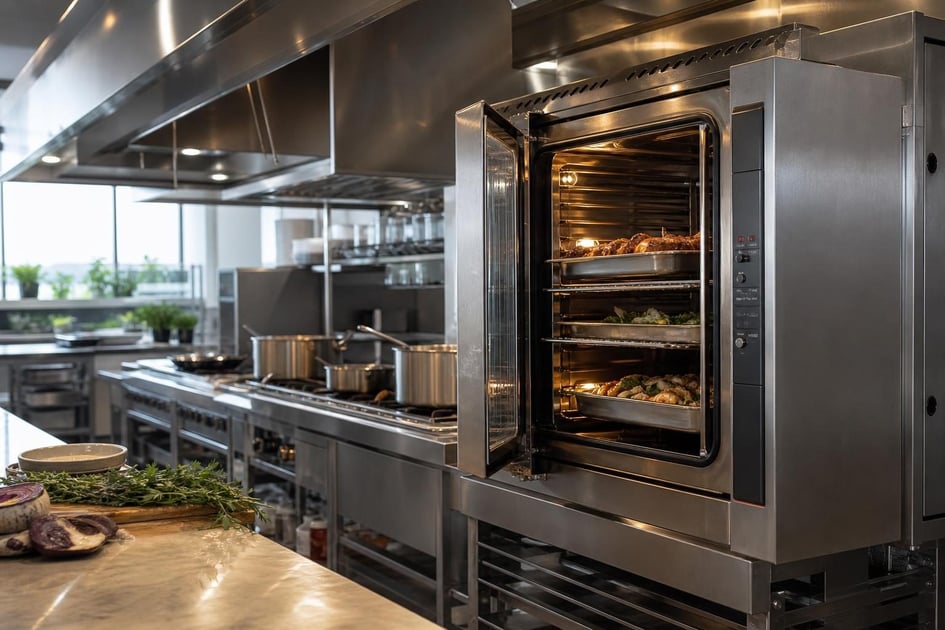
If you need a commercial oven and do not want to tie up cash in a down payment, equipment financing structured at 100 percent of the cost is available. The lender secures the loan with the oven itself, which means you can finance the full purchase price plus soft costs such as delivery and installation in many cases. Rates vary by credit profile, equipment age and term. Same-day approvals are possible if you have your documentation ready.
That setup is especially useful in 2026, when food costs and labor expenses are squeezing restaurant margins and preserving working capital matters more than ever. According to Bloomberg reporting on rising food costs, operators are facing persistent pressure on ingredients and wages. Equipment loans remain a primary funding tool for small businesses upgrading their kitchens, according to CNBC analysis of small business loan options. Holding onto cash for payroll, inventory and unexpected repairs while still upgrading your line makes operational sense.
Key Insight: A zero-down equipment loan does not mean the lender takes no security. It means the equipment itself serves as the collateral. Because the lender can repossess and resell a commercial oven if necessary, they are willing to finance 100 percent of the acquisition cost for qualified borrowers. That collateral requirement is what keeps rates competitive compared with unsecured credit.
What "No Money Down" Equipment Financing Actually Means
"No money down" simply means you are not required to contribute a cash down payment at closing. The lender advances the full amount needed to acquire the oven. You still sign a personal guarantee in most cases, and the lender files a UCC-1 lien against the equipment until the balance is paid.
How collateral secures the loan
With Commercial Ovens financing, the asset being purchased is the security. If your business has been operating for at least two years and shows stable revenue, the lender’s risk is lowered because the equipment has measurable resale value. Convection ovens, combi ovens and conveyor ovens from major brands all retain value on the secondary market, which matters to the underwriter.
Why zero-down does not mean zero commitment
You are still on the hook for every monthly payment. If you default, the lender can seize the oven and pursue any deficiency after resale. You also need to carry insurance that names the lender as loss payee. The benefit is cash-flow preservation, not a free pass on risk.
What Commercial Ovens Cost in 2026
Prices vary by type, size and brand. Here are the ranges you can expect before freight and installation:
- Single convection oven: $2,500 – $8,000
- Double-stack convection: $6,000 – $14,000
- Combi oven (half-size): $10,000 – $18,000
- Combi oven (full-size): $18,000 – $35,000
- Deck oven (single): $5,000 – $12,000
- Deck oven (double): $10,000 – $22,000
- Conveyor oven (countertop): $4,000 – $9,000
- Conveyor oven (floor model): $12,000 – $30,000
- Rotisserie oven: $6,000 – $15,000
Freight typically adds $300 – $800 depending on distance. Installation, ventilation hookups and gas or electrical upgrades can add $1,000 – $5,000. If you are replacing an existing unit in the same footprint, your installation costs sit at the lower end. If you are adding a combi oven that requires a new steam line and upgraded electrical service, expect the higher end.
By the Numbers: A mid-size independent bakery or pizzeria financing a $22,000 double-stack convection system with installation might see monthly payments in the mid-hundreds to low-thousands over a 60-month term, depending on credit and whether the unit is new or used. Over five years, that oven generates revenue every day while the payments are fixed.
Lease vs. Loan: A Side-by-Side Comparison
Restaurant owners often wonder whether to lease or finance. Both can be structured with no money down, but the long-term implications differ.
| Factor | Equipment Loan | Operating Lease |
|---|---|---|
| Ownership | You own the oven; lender holds a lien | Lessor owns the oven; you rent it |
| Down payment | Often $0 for qualified borrowers | First and last month, or $0 |
| Monthly cost | Fixed principal + interest | Fixed rental payment |
| Tax treatment | Section 179 and depreciation | Payments deducted as expense |
| End of term | You own it free and clear | Return, buy out, or renew |
| Best for | Ovens you will use 7+ years | Short-term needs or rapid upgrades |
For a core piece of equipment like a commercial oven that you expect to run for a decade, a loan usually wins on total cost. You build equity, and when the loan is paid off the payment disappears while the asset keeps working. A lease makes sense if you are testing a new concept and want the flexibility to walk away or upgrade in three years.
See what you qualify for and compare lease and loan structures side by side.
Qualifying for Commercial Oven Financing
Lenders look at four main factors. Understanding them before you apply speeds up the process and improves your offer.
Credit profile
Your personal credit score carries weight, especially for businesses with fewer than three employees. Most equipment lenders want to see a score above 600, and the best rates go to borrowers above 680. Negative marks like recent bankruptcies or unresolved tax liens will hurt, but they do not always disqualify you if the rest of the file is strong.
Time in business
Two years or more in operation is the sweet spot. If you have been open less than two years but can show prior industry experience or strong contracted revenue, you may still qualify. Startups and new businesses face tighter scrutiny and often need additional collateral or a larger guarantor.
Revenue and bank statements
Lenders typically want to see three to six months of business bank statements. They are looking for consistent deposits, healthy average daily balances and no frequent overdrafts. Annual revenue should generally be at least $120,000, though requirements vary by lender and deal size.
Documentation you will need
- Driver’s license
- Voided business check
- Last three to six months of business bank statements
- Equipment quote or invoice from the vendor
- Business tax returns (for loans above $150,000 or if requested)
Having these ready before you apply can mean the difference between a same-day decision and a week of back-and-forth.
Pro Tip: Get your equipment quote from a commercial dealer, not a consumer appliance store. Lenders prefer invoices from established foodservice distributors because the pricing is transparent and the resale value is documented. A quote from a recognized dealer also speeds up the funding process because the lender does not need to independently verify fair market value.
New vs. Used Commercial Ovens
Both new and used ovens can be financed with no money down, but the terms and rates differ.
When used makes sense
A two- to four-year-old convection or deck oven from a leading brand can cost 40 to 60 percent less than new. If the unit was well maintained and comes from a reputable dealer with a limited warranty, the savings are real. Used equipment financing sometimes carries a slightly shorter maximum term because the lender aligns the payoff with the remaining useful life.
When new is worth the premium
New ovens come with full manufacturer warranties, better energy efficiency and the latest safety certifications. In 2026, many jurisdictions are enforcing stricter ventilation and emissions standards. A new unit is more likely to comply without modification. Energy-efficient models can also lower utility bills enough to offset part of the higher payment.
Tax Treatment for 2026
For tax year 2026, the Section 179 deduction limit is $2,560,000, with a phase-out beginning when total qualifying equipment purchases exceed $4,090,000. The deduction is limited to your taxable business income, but unused amounts carry forward. In addition, 100 percent bonus depreciation is permanent for qualified property acquired after January 19, 2025, under current law.
That means a restaurant owner who buys a $20,000 combi oven in 2026 can potentially deduct the full cost in the first year, subject to income limits and coordination with other assets purchased during the year. The exact benefit depends on your tax bracket, entity type and overall equipment spend. Because state tax treatment varies and some states decouple from federal bonus depreciation, speak with a CPA before you decide whether to take Section 179, bonus depreciation or regular MACRS.
The Small Business Administration guidance on buying assets and equipment notes that financing can preserve cash while still allowing you to claim depreciation and expensing deductions, because ownership typically passes to you at purchase even when the lender holds a lien.
Common Mistakes When Financing Kitchen Equipment
Underestimating installation and infrastructure
The oven price tag is only part of the story. A gas deck oven may need a larger gas line. A high-speed electric convection oven might require 208V three-phase power that your building does not have. Ventilation hoods, fire-suppression systems and grease-duct modifications can exceed the oven cost on complex installs. Ask your contractor for a total project quote, then finance the full amount so you are not scrambling for cash when the electrician shows up.
Choosing the wrong term length
A 24-month term keeps total interest low but creates a high monthly payment that strains cash flow during slow seasons. A 72-month term lowers the payment but may have you still paying for an oven that is nearing the end of its life. For most commercial ovens, 48 to 60 months hits the balance between manageable payments and reasonable total cost.
Ignoring soft costs
Freight, installation, training and initial maintenance supplies are all part of getting the oven operational. Some lenders allow you to roll these into the financing amount; others cap the advance at the equipment invoice only. Ask upfront so you know whether you need cash reserves for the extras.
What Happens After You Apply
The process is straightforward if your paperwork is in order.
- Application: You submit the application and documents online or by phone.
- Review: The lender verifies revenue, checks credit and evaluates the equipment quote.
- Decision: For deals under $150,000, a decision often comes the same day. Larger deals or complex credits may take 24 to 72 hours.
- Documentation: You sign the finance agreement and UCC filing authorization.
- Funding: The lender pays the vendor directly. You take delivery and start cooking.
Because the collateral is a tangible asset with a clear serial number and invoice, equipment financing moves faster than unsecured working capital loans. The lender does not need to appraise real estate or dig into every facet of your business plan. They care about the equipment value, your ability to repay and your credit history.
Pro Tip: If you are buying from a private seller instead of a dealer, expect extra scrutiny. The lender will need to verify the serial number, condition and fair market value. A third-party inspection may be required. You can still get approved, but build in an extra three to five business days for the verification step.
Industry-Specific Considerations for Restaurants
Restaurants, bakeries and catering operations have unique needs when it comes to oven selection and financing timing.
Pizzerias running deck ovens often need multiple units stacked or lined up in a row. Financing the full line at once can make you eligible for better terms because the total loan amount is larger, but it also means a bigger monthly obligation. Some operators finance one oven at a time to keep payments conservative.
Bakeries depend on consistent temperature and steam injection. A combi oven that fails during a holiday rush can cost more in lost revenue than the monthly payment. That is why many bakery owners prioritize new units with strong service networks, even if the monthly cost is higher.
Caterers and ghost kitchens may need mobile or ventless ovens that can be relocated. If you lease your commissary space, check with your landlord before installing a gas line or heavy hood system. A ventless convection or rapid-cook oven might avoid infrastructure changes entirely, and those units are financeable just like built-in equipment.
Restaurant Food Service equipment financing covers ovens, ranges, mixers and the full kitchen line. If you are upgrading multiple pieces, bundling them into one application can simplify paperwork and sometimes improve pricing.
Get a same-day decision on your equipment whether you are buying one oven or outfitting an entire kitchen.
FAQ
Can I really get approved with no down payment?
Yes, if your credit and revenue profile meet the lender’s standards. The equipment itself secures the loan, so a cash down payment is not always required. Stronger files receive better rates and longer terms.
Does my personal credit matter if the loan is in my business name?
Yes. For small restaurants and owner-operated businesses, lenders almost always review the owner’s personal credit. A score above 650 improves your chances, and scores above 700 unlock the most competitive structures.
Can I finance a used commercial oven?
Yes. Used equipment financing is common. The lender will want to know the age, condition and brand. Well-known brands with established dealer networks finance more easily than obscure or imported units with no service support.
How long does funding take?
For straightforward deals with complete documentation, funding can happen in one to three business days. Larger transactions or private-party sales may take five to seven business days.
Can I pay off the loan early?
Most equipment finance agreements allow early payoff, but some include a prepayment penalty or a minimum interest charge. Ask your specialist to show you the exact prepayment language before you sign.
What happens if the oven needs repairs?
You are responsible for maintenance and repairs. The lender’s interest is financial, not operational. If the oven is under warranty, the manufacturer covers eligible repairs. Consider setting aside a small reserve for out-of-warranty service.
Can I finance the installation and delivery costs too?
Often yes. Many lenders allow you to include soft costs up to a percentage of the equipment value or a fixed dollar cap. Ask upfront so you know whether the quote needs to be itemized or bundled.
Do I need to carry insurance?
Yes. The lender will require property insurance that names them as loss payee. This protects both parties if the oven is damaged or destroyed.
Next Steps
If you are mid-purchase and need to preserve cash, equipment financing with no money down is a practical option. The key is to understand the total project cost, choose a term that matches the oven’s useful life and have your documentation ready so the process moves quickly.
Start by gathering your bank statements and equipment quote. Then talk to a specialist about your specific machine to see what structure fits your cash flow. Whether you need a single convection oven for a café or a full deck-oven line for a pizzeria, financing lets you get cooking now and pay as the equipment earns.
And if your kitchen upgrade includes a Commercial Range financing alongside your oven, bundling both into one application can keep things simple and get you funded faster.
Disclaimer: The information provided in this article is for general educational purposes only and is not financial, legal, or tax advice. Funding terms, qualifications, and product availability may vary and are subject to change without notice. Provide Capital does not guarantee approval, rates, or specific outcomes. For personalized information about your business funding options, contact our team directly.