
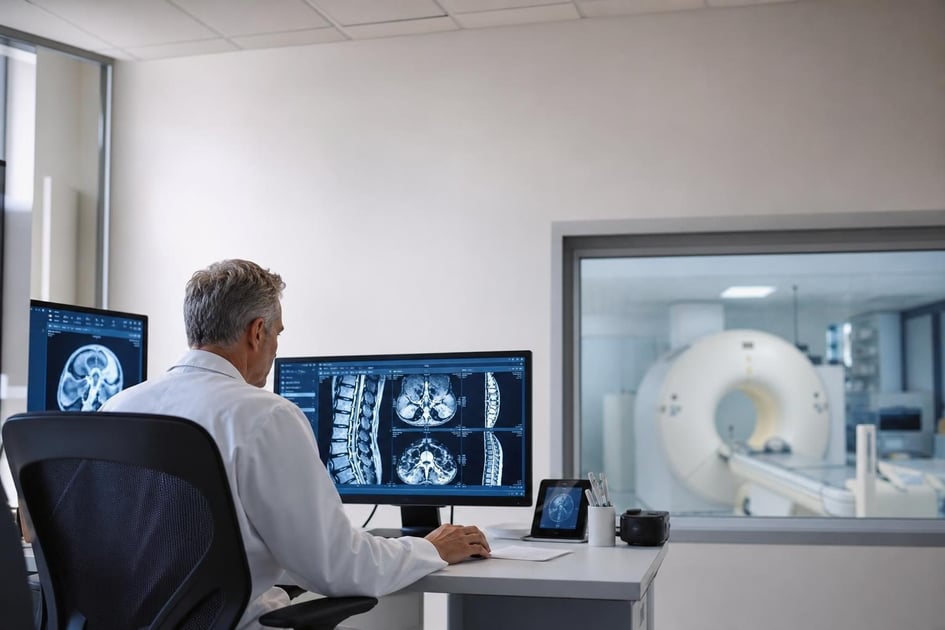
You Can Finance Healthcare Equipment with Bad Credit, but the Structure Matters
Yes, a medical practice can secure financing for essential equipment even when the owner’s personal credit is damaged.
The key difference is that equipment lenders underwrite the asset first and the borrower second.
Because the machine itself serves as collateral, a low credit score does not automatically disqualify an otherwise viable practice.
Rates vary by credit profile, equipment age and term, so the exact structure depends on the specific deal.
How Collateral-Backed Financing Changes the Credit Decision
The healthcare sector continues to expand, and U.S. Census Bureau data shows ambulatory healthcare services remain a major and expanding segment of the U.S. economy.
As patient volume rises, practices must add capacity without draining cash reserves.
Traditional unsecured lending relies heavily on FICO scores and personal balance sheets.
Equipment finance works differently.
The lender files a UCC lien on the asset, which means the equipment itself is the collateral.
This security interest lowers the lender’s risk and keeps rates competitive for a wider range of credit profiles.
For healthcare specifically, lenders prefer assets that hold resale value, such as diagnostic imaging systems, patient monitors, and sterilization equipment.
Key Insight: A lender evaluating a used C-arm or ultrasound machine will often weigh the wholesale liquidation value of that asset more heavily than a 120-point gap between a 660 and a 540 FICO score.
The equipment appraisal can carry as much weight as the credit report.
This does not mean credit is ignored.
It means a practice with strong bank deposits, a stable patient base, and 6 months of consistent revenue may still be considered for financing even if the owner’s credit was damaged by a past personal event.
The lender is buying the equipment with you, and both of you are relying on the asset to generate revenue.
What Lenders Review When Your Credit Is Low
Credit Score Thresholds and Compensating Factors
Most equipment finance companies do not publish minimum FICO requirements, but in practice, scores below 620 shift the deal into a tier that requires stronger compensating factors.
Those factors can include higher monthly revenue, a larger down payment, a shorter term, or a co-signer.
A score in the mid-500s is not an automatic decline if the equipment is essential to revenue and the practice can show 3 to 6 months of stable deposits.
Bank Statements and Cash Flow
Lenders typically request the last 3 to 6 months of business bank statements.
They are looking for average daily balances, NSF frequency, and total monthly deposits relative to the proposed payment.
A practice collecting $40,000 per month in patient revenue with a proposed equipment payment of $1,200 has a far better chance than a practice with $8,000 in monthly deposits and a $900 payment, even if the second owner has a higher credit score.
Time in Business and Industry Stability
Healthcare practices that have been operating for 2 or more years receive more flexible terms than practices with less than 2 years of history.
Time in business proves that the practice can navigate insurance reimbursement delays, seasonal patient volume shifts, and regulatory changes.
If the practice is younger, the lender may shorten the term to 24 or 36 months to match the limited operating history.
Equipment That Qualifies and Transaction Sizes
Provide Capital finances new and used business equipment from $5,000 to $5 million, with the equipment itself securing the transaction.
In the healthcare space, qualifying assets include MRI machines, CT scanners, digital X-ray systems, ultrasound units, C-arms, exam tables, physical therapy modalities, autoclaves, sterilizers, and patient monitoring systems.
We also support clinic infrastructure through Commercial Hvac System financing for climate-controlled procedure rooms and Wheel Loaders financing for large-scale campus expansion projects.
Whether you are replacing a single broken ultrasound or outfitting an entire ambulatory surgery center, the transaction size and the asset type drive the approval structure more than the brand name on the door.
Healthcare equipment financing at Provide Capital is designed around the revenue the equipment produces, not just the credit score of the guarantor.
As Reuters business coverage has noted, medical equipment costs continue to climb, which makes preserving cash through financing especially attractive for independent practices.
If you are unsure whether a specific machine qualifies, talk to a specialist about your specific machine and get a same-day decision on your equipment.
New vs. Used Medical Equipment
Healthcare practices often assume new equipment is easier to finance, but used machines can actually improve approval odds with challenged credit because the lower acquisition cost reduces the lender’s exposure.
The decision should be driven by uptime requirements, warranty coverage, and the equipment’s expected useful life.
| Factor | New Equipment | Used Equipment |
|---|---|---|
| Acquisition Cost | Higher upfront; slower depreciation curve | Lower upfront; steeper initial depreciation |
| Warranty Status | Full manufacturer coverage | Limited or expired; third-party service contracts recommended |
| Financing Term | Often 48 to 60 months | Often 36 to 48 months, matching remaining useful life |
| Approval Flexibility | Standard credit review | Lower loan balance can offset credit concerns |
| Resale Value | Higher at Year 5 | Lower; lender may require larger down payment on older units |
Used equipment can be an excellent path for a practice rebuilding credit, provided the machine has been inspected and comes with a verifiable service history.
Lenders will verify the serial number, model year, and condition before funding.
Lease vs. Loan: Which Works Better for Challenged Credit
Healthcare practices with lower credit scores are not restricted to high-rate loans.
Both equipment loans and leases are available, and each structure interacts differently with cash flow, balance sheets, and tax treatment.
| Structure | Ownership | Monthly Payment | Tax Treatment (2026) | Best For |
|---|---|---|---|---|
| $1 Buyout Lease | Practice owns at end | Higher than FMV lease | May qualify for Section 179 deduction in 2026; confirm limits with a CPA | Equipment with long useful life |
| Fair Market Value Lease | Lender owns; practice can purchase or return | Lower monthly cost | Payments often deductible as operating expense; verify 2026 rules with a CPA | Technology that obsoletes quickly |
| Equipment Loan | Practice owns immediately | Fixed principal and interest | Interest deductible; depreciation and possible Section 179 for 2026 per IRS guidance; consult a CPA | Practices building equity |
Pro Tip: If your credit is challenged, ask your lender to quote both a 36-month and a 48-month term side by side.
The shorter term often carries a lower rate from a risk perspective, and the total finance charge can be significantly less even though the monthly payment is higher.
Run both scenarios with your bookkeeper before signing.
The right structure depends on how long you plan to keep the asset and whether you want to own it outright.
For tax year 2026, Section 179 and bonus depreciation rules continue to offer substantial deductions for qualifying equipment, but the exact limits and phase-out thresholds adjust annually.
A CPA can confirm the 2026 figures and whether your specific assets qualify.
How Rates and Terms Are Structured
Rates vary by credit profile, equipment age and term.
With challenged credit, you should expect the lender to adjust one or more levers rather than simply decline the application.
Those levers include a modestly higher rate, a 10 to 20 percent down payment requirement, or a term capped at 36 months instead of 60.
By the Numbers: Provide Capital finances transactions from $5,000 to $5 million.
Because the lender’s security interest is in the machine itself, a lower personal credit score typically shifts the down-payment requirement or shortens the term rather than triggering an automatic decline.
A $75,000 diagnostic suite and a $12,000 autoclave can both be structured around the asset’s liquidation value and the practice’s monthly cash flow.
Equipment age matters.
A 2024 ultrasound with low hours and a strong manufacturer support network is less risky collateral than a 2012 unit with obsolete software.
The newer machine may qualify for a longer term and a lower down payment, while the older unit might require a larger equity injection from the practice.
Qualification Criteria in Detail
Before applying, review your financials against the benchmarks outlined in the U.S. Small Business Administration business guide.
Understanding your debt-service coverage and collateral position in advance speeds up underwriting and reduces surprises.
Revenue Verification
Be prepared to produce the last 3 to 6 months of business bank statements and a current year-to-date profit and loss statement.
Lenders use these documents to calculate a global cash-flow coverage ratio.
They want to see that the practice’s net income, after owner draws and fixed costs, can absorb the new equipment payment without pushing the account into negative territory.
Equipment Specification and Vendor Reputation
The lender will request a detailed invoice or quote that includes the serial number, model year, hours or cycle count, and condition.
Buying from a reputable medical equipment dealer with a history of accurate representations speeds up approval.
Private-party sales are possible, but they require more extensive documentation and may trigger an independent appraisal.
Personal Guarantee and Down Payment
Most transactions under $5 million require a personal guarantee from the practice owner, regardless of credit quality.
The guarantee aligns the owner’s interest with the lender’s.
If credit is challenged, the lender may also require a down payment to ensure the practice has skin in the game.
The exact percentage depends on the credit profile, the equipment age, and the overall transaction size.
What Happens After You Apply
The application process is designed to move quickly.
Once you submit the equipment quote, bank statements, and business entity documents, an underwriter reviews the collateral value and the cash flow.
Same-day approvals are possible when the documentation is complete and the equipment is standard.
After approval, the lender issues a term sheet, you execute the documents, and the vendor is paid directly.
The lender then files a UCC-1 on the equipment.
Funding typically occurs within 24 to 72 hours of executed documents, though complex transactions or specialized imaging equipment may take slightly longer for appraisal.
Get a same-day decision on your equipment by submitting your quote and bank statements online.
Tax Considerations for Tax Year 2026
For tax year 2026, Section 179 allows businesses to deduct the full purchase price of qualifying equipment up to an inflation-adjusted annual limit, with a phase-out threshold that also rises each year.
Whether you structure the deal as a loan or a $1 buyout lease, the deduction may be available in the year the equipment is placed in service.
Bonus depreciation may also apply to certain new and used assets in 2026, though the percentage and eligibility rules have evolved.
Because these figures change annually, consult a CPA who can apply the exact 2026 limits to your practice’s tax situation.
Common Mistakes Practices Make
Shopping Too Many Lenders at Once
Each formal credit application can generate a hard inquiry.
5 inquiries in 30 days can depress a score that is already fragile.
Instead, gather your equipment quote and bank statements, then apply with a lender that explicitly offers programs for lower credit tiers.
A single well-prepared application is more effective than 5 shotgun applications.
Hiding Negative Credit Events
Underwriters will find the bankruptcy, lien, or collection.
It is better to disclose it upfront with context and a timeline of recovery.
Lenders are often willing to work with a past event if the last 12 months show clean banking and stable revenue.
Concealing it creates a trust problem that is harder to overcome than the credit issue itself.
Choosing the Wrong Equipment Age
A practice with damaged credit might be drawn to a 15-year-old MRI to keep the loan amount low.
However, if the lender cannot verify a liquid market for that vintage, the collateral value drops and the deal is declined.
Stick to equipment that is 10 years old or newer unless you have been pre-approved for vintage assets.
Ignoring Total Cost of Ownership
The monthly payment is only one line item.
Service contracts, calibration, software licenses, and preventative maintenance can add thousands of dollars annually.
A practice stretching to afford a $2,500 monthly payment on a CT scanner may not survive the first $8,000 tube replacement bill.
Model the full 5-year cost before committing.
Frequently Asked Questions
Can I get healthcare equipment financing with a credit score under 600?
Yes, it is possible.
Lenders that collateralize the equipment itself place significant weight on the asset value and your practice’s cash flow.
A score under 600 usually means a larger down payment or a shorter term, but it is not an automatic decline.
Does the lender check my business credit or personal credit?
Both.
The personal credit of the practice owner is reviewed because most transactions require a personal guarantee.
However, the equipment appraisal and business bank statements often carry more weight in the final decision than the personal score alone.
How much down payment will I need?
Down payment requirements vary by credit profile, equipment age and term.
Borrowers with strong credit may qualify with little or no money down, while those with challenged credit should be prepared to contribute a down payment.
The exact percentage is set on a deal-by-deal basis.
Can I finance used medical equipment?
Yes.
Provide Capital finances both new and used business equipment.
Used equipment can actually improve your approval odds because the lower loan amount reduces the lender’s risk.
The unit must have a verifiable service history and acceptable remaining useful life.
Will financing medical equipment help rebuild my credit?
Timely payments on an equipment loan or lease are typically reported to business credit bureaus and may also appear on personal credit reports depending on how the guaranty is structured.
Consistent on-time performance can strengthen your profile for future transactions.
What types of healthcare equipment can I finance?
Qualifying assets include diagnostic imaging systems, patient monitors, surgical tables, autoclaves, sterilizers, physical therapy equipment, and clinic infrastructure.
Provide Capital finances new and used business equipment from $5,000 to $5 million.
How fast can I get funded?
Same-day approvals are possible when documentation is complete.
After approval, funding typically occurs within 24 to 72 hours of executed documents.
Specialized or high-value imaging equipment may require additional appraisal time.
Should I choose a loan or a lease if my credit is challenged?
Either structure can work.
A loan builds equity immediately, while a fair market value lease may offer lower monthly payments.
For tax year 2026, the deduction rules differ by structure, so compare the options with your CPA before deciding.
Ready to Move Forward?
Bad credit does not have to stall your practice’s growth.
If the equipment generates revenue and your practice has stable cash flow, there is likely a structure that works.
Gather your last 3 months of bank statements, the equipment quote, and your business formation documents, then see what you qualify for with Provide Capital.
An equipment specialist can review your deal and help you find the terms that match your situation.
Disclaimer: The information provided in this article is for general educational purposes only and is not financial, legal, or tax advice. Funding terms, qualifications, and product availability may vary and are subject to change without notice. Provide Capital does not guarantee approval, rates, or specific outcomes. For personalized information about your business funding options, contact our team directly.