You can finance new and used restaurant and food service equipment with no money down by using the equipment itself as collateral. This structure keeps cash in your business for payroll, inventory, and daily operations while you spread the cost over time. Provide Capital finances deals from $5,000 up to $5 million for owner-operators nationwide, with same-day approvals possible when the application and equipment details are complete. Because the equipment secures the transaction, you do not need to drain your checking account or pledge unrelated assets to replace a failing fryer or add another prep line.
What No Money Down Looks Like in a Restaurant Kitchen
No money down does not mean no collateral. It means the equipment you are buying serves as the security for the financing. The lender files a purchase-money security interest against the asset, not against your real estate or personal property. You take delivery, install the unit, and start generating revenue while making fixed monthly payments. Because the collateral is right there in the kitchen, lenders can offer competitive terms without requiring a large cash outlay at closing. This is especially useful in food service, where a failed freezer or an oven breakdown can threaten dinner service tonight.
Preserve working capital for the expenses that keep your doors open. Refrigerant leaks, grease trap repairs, and unexpected health-code upgrades always cost money. If you spend your cash reserves on a new walk-in cooler, you might not have funds left for a hood cleaning or a payroll run. Financing the cooler lets the equipment pay for itself over time while your liquid cash covers the operational surprises that define restaurant life.
Equipment That Qualifies
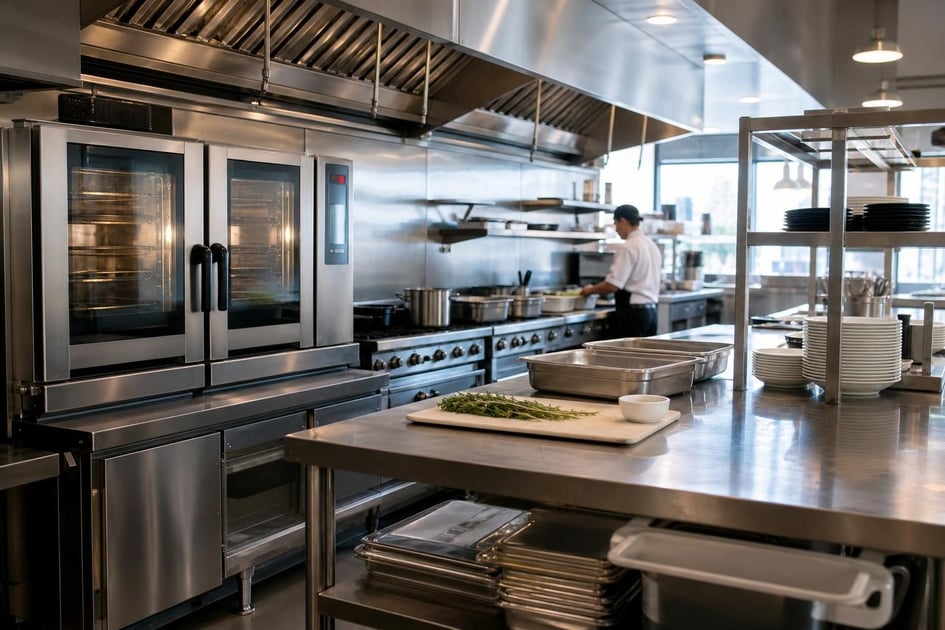
Almost every item in a commercial kitchen can be financed with no money down. Eligible equipment includes gas ranges, convection ovens, combi ovens, salamanders, walk-in refrigerators and freezers, reach-in coolers, ice machines, dishwashers, exhaust hoods with fire suppression systems, stainless steel prep tables, slicers, mixers, grinders, and point-of-sale systems. Front-of-house items such as espresso machines, draft systems, and beverage dispensers also qualify. Even large-format equipment like dough sheeters, blast chillers, and tandoor ovens routinely clear underwriting.
Used equipment is eligible if it is in working order and the vendor can provide a clean bill of sale. Financing used equipment is common in restaurant openings because it cuts startup costs without forcing you into obsolete models. The age and condition of the unit will affect the structure of the deal, since rates vary by credit profile, equipment age and term. A recently manufactured convection oven will typically command stronger terms than an older steamer, but both can be financed if the collateral value is there.
Financing can also cover soft costs that are bundled into the equipment purchase. If your vendor charges for freight, crating, or baseline installation, those line items can sometimes be included in the financed amount as long as they appear on the same invoice. You cannot typically finance routine maintenance contracts or extended warranties that are sold separately, but a packaged install cost is usually acceptable.
If you are unsure whether a specific piece of kitchen equipment qualifies, review our Food Service Equipment financing page for a detailed breakdown of covered assets.
Financing Structure and Payment Mechanics
Restaurant equipment financing is usually structured as an equipment financing agreement or a capital lease. In both cases, you make regular payments and gain equity in the equipment as you pay. Because the equipment secures the transaction, the down payment requirement drops away for many borrowers. Your rates vary by credit profile, equipment age and term. A strong credit history combined with new equipment and a shorter repayment schedule will generally produce the most favorable payment. Older equipment or a longer time frame may increase the monthly cost, but the deal can still fund if the collateral supports it.
Same-day approvals are possible when you submit a complete package that includes a vendor invoice, your business information, and any requested financials. The faster you provide documentation, the faster the underwriter can verify collateral value and issue a decision. Once approved, funds are sent directly to the equipment vendor or private party seller, and you schedule delivery. You should never send your own cash to the seller first and hope for reimbursement. The lender pays the vendor directly, which protects both you and the secured interest.
Financing vs. Leasing: Which Fits Your Kitchen?
Not every restaurant needs to own a piece of equipment forever. A high-volume pizzeria might want to own its deck ovens for the long haul, while a ghost kitchen testing a new concept might prefer flexibility. The table below compares the two most common structures.
| Feature | Equipment Financing Agreement | Equipment Lease |
|---|---|---|
| Ownership | You own the equipment after the final payment | You may have a nominal buyout or fair-market-value option at lease end |
| Down payment | Typically none; equipment serves as collateral | Typically none; lessor retains title |
| Monthly payment | Fixed for the life of the agreement | Fixed or seasonal, depending on structure |
| Credit reporting | Shown as debt on your business credit report | May appear as an operating expense |
| Tax treatment | Deduct interest and depreciate the asset; ask your CPA | Deduct payments as an operating expense; ask your CPA |
| Best for | Core equipment you plan to keep long term | Technology or equipment you may upgrade frequently |
Neither structure requires a large cash outlay upfront if the deal is approved on a collateral-only basis. The right choice depends on your bookkeeping preferences, your long-term menu plans, and how quickly the equipment is likely to become obsolete. If you plan to run the same burger concept for a decade, an equipment financing agreement usually wins. If you are piloting a robotic fry station that might be replaced soon, a lease could make more sense.
2026 Tax Considerations
For tax year 2026, Section 179 expensing and bonus depreciation remain available for qualifying business equipment, subject to annual inflation-adjusted caps and phase-out thresholds set by the IRS. Because these limits change yearly and depend on your total equipment purchases and taxable income, speak with your CPA before counting on a specific deduction amount. Even if you finance the equipment instead of paying cash, you may still be eligible to take these deductions in the current tax year, which can offset the cost of borrowing. Your CPA can also tell you whether an equipment financing agreement or a lease produces the stronger write-off under the 2026 rules.
Who Qualifies and What Underwriters Want
Provide Capital serves construction, healthcare, dental, restaurant and food service, manufacturing, transportation, agriculture, HVAC and forestry businesses nationwide. Within food service, we work with full-service restaurants, quick-service concepts, caterers, ghost kitchens, cafeterias, and mobile food operations. If your business operates in any of these segments and the equipment is essential to revenue generation, it likely fits our Restaurant Food Service equipment financing program.
Underwriters review your credit history, time in business, and the equipment value. They are not looking for perfect credit. They are looking for a reasonable ability to pay and collateral that holds value. Startups can qualify if the owners have strong personal credit and the equipment is new or nearly new, but additional documentation such as a business plan or projected cash flow may be required. No approval is guaranteed, and every application is evaluated on its own merits. If your restaurant has been open for years and you are adding another location, your existing cash flow will carry weight. If you are opening your initial unit, the strength of the equipment and your personal financials become more important.
Credit challenges from past events do not automatically end the conversation. Underwriters care more about your recent payment patterns and the cash flow of the restaurant than about an isolated late payment from years ago. If your business has consistent daily sales and the equipment you are buying will directly support that revenue, the deal has a path forward.
Mobile and Niche Operations
Not every food service business operates out of a brick-and-mortar dining room. Food trucks, coffee carts, concession trailers, and self-service kiosk operators all need equipment, and all can be financed using the equipment as collateral. If you are building out a mobile kitchen, the financing can cover cooking equipment, refrigeration, generator systems, and point-of-sale hardware. Review our Food Truck financing page to see how the structure works for mobile kitchens. Self-service kiosks and automated ordering systems can also be financed, letting you reduce labor costs without a massive technology outlay.
Mobile operations face unique challenges. Equipment must survive road vibration, temperature swings, and compact layouts. Lenders understand this and will finance properly spec'd kitchen gear as long as the collateral value is verifiable. You will need a detailed quote from the builder or equipment supplier so the underwriter can match the loan amount to the actual cost of the install.
Seasonal Timing and Vendor Negotiations
Restaurant equipment purchases often cluster around predictable calendar windows. Many operators buy in late winter after holiday cash flows settle, or in early spring before patio season ramps up. Ordering during these windows can improve vendor availability and give you time to train staff before peak volume hits. Because same-day approvals are possible, you can respond quickly when a used piece of equipment becomes available on the secondary market. You do not need to wait for a budget cycle if the collateral and your credit profile support the deal.
When you negotiate with vendors, ask whether they offer invoice financing or if they prefer direct lender payment. Most equipment dealers are familiar with third-party financing and will hold the unit once they receive a letter of intent from the lender. Private sellers may want a deposit, but the lender can often wire funds directly to them upon delivery and signed bill of sale, keeping your cash untouched.
Frequently Asked Questions
Can I finance used restaurant equipment with no money down?
Yes. Used stoves, coolers, and prep equipment are eligible as long as the unit is in working condition and the seller can provide clear title. The equipment age will factor into the approval and rate.
Does a low credit score automatically disqualify me?
No. Because the equipment serves as collateral, lenders can approve deals across a broader credit spectrum than unsecured lending. Your rates vary by credit profile, equipment age and term. Stronger credit improves the offer, but a lower score does not guarantee a denial.
Can I include soft costs like delivery and installation?
In many cases, yes. If the vendor invoice includes delivery, installation, or initial training, those costs can sometimes be rolled into the financed amount. Ask your financing manager to review the quote before you sign the vendor agreement.
Is the equipment really the only collateral?
On many deals, yes. The lender secures the transaction with a purchase-money security interest in the equipment itself. In some cases, especially with very high-risk profiles or startups, a personal guarantee may also be required, but the equipment remains the primary security.
What happens if I want to pay off the financing early?
Most equipment financing agreements allow early payoff, but the exact prepayment terms depend on the contract structure. Some agreements include a fixed prepayment schedule, while others may charge a nominal fee. Read the specific language in your term sheet before accepting the offer.
How does the 2026 tax code affect my financed equipment?
For tax year 2026, you may be able to deduct interest and depreciation on financed equipment, or deduct lease payments if you choose a lease structure. The exact benefit depends on the current IRS limits for Section 179 and bonus depreciation. Speak with your CPA to model the impact before you file.
Your Next Step
Gather your equipment quote or vendor invoice and submit it with your business information. We can review the collateral value and credit profile to determine whether a no-money-down structure is available for your deal. Same-day approvals are possible, and once approved, you can schedule delivery and keep your cash where it belongs: running your restaurant.
Disclaimer: The information provided in this article is for general educational purposes only and is not financial, legal, or tax advice. Funding terms, qualifications, and product availability may vary and are subject to change without notice. Provide Capital does not guarantee approval, rates, or specific outcomes. For personalized information about your business funding options, contact our team directly.