
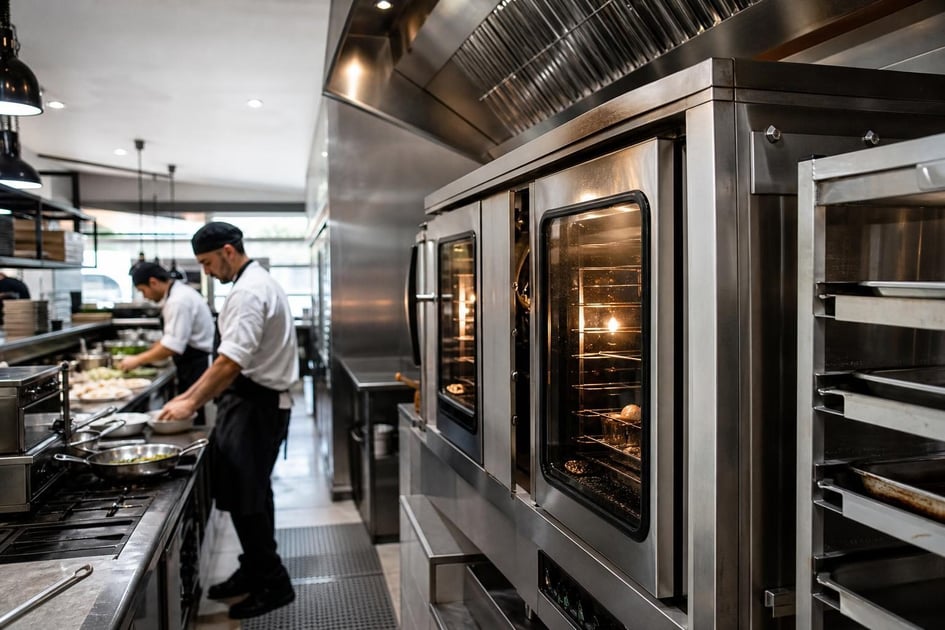
Commercial oven financing lets you buy or lease the cooking equipment your business needs without draining the cash reserves that keep daily operations running. Whether you are opening a second location, replacing a failing deck oven, or adding a combi unit to expand your menu, equipment financing spreads the cost over time and uses the oven itself as collateral. Rates vary by credit profile, equipment age and term. With the right documentation, same-day approvals are possible, and loan amounts range from $5,000 up to $5 million.
What Commercial Oven Financing Actually Covers
Financing is not limited to the oven box alone. A complete Commercial Ovens financing package can include the unit, delivery, installation, ventilation hoods, fire-suppression systems, and initial maintenance agreements. Lenders understand that a convection oven sitting in a parking lot generates no revenue, so many will finance the full project cost as long as the total stays within your approval limit.
Types of Ovens You Can Finance
Convection ovens circulate heated air for faster, even baking and are common in bakeries, cafes, and hotel kitchens. Deck ovens use stone or ceramic hearths for bread and pizza operations that need bottom heat. Combi ovens combine steam and convection in one unit, letting a single kitchen handle roasting, baking, and steaming without separate appliances. Conveyor ovens move product through a heated chamber on a belt, standard in high-volume pizza and sandwich chains. Rack ovens hold entire wheeled racks of product, making them popular in wholesale bakeries and central commissaries.
Each type carries a different price point and useful life. A standard half-size convection oven might run $3,000 to $8,000, while a full-size combi oven can start near $15,000 and climb past $40,000 depending on features and brand. Conveyor systems for high-throughput operations often land in the $20,000 to $50,000 range before installation.
Soft Costs Matter
Business owners sometimes budget for the invoice price and forget the soft costs. Hood installation, gas-line upgrades, electrical work, and floor reinforcements can add thousands. If you are leasing space, your landlord may require a certificate of insurance or specific contractor licenses before work begins. Financing the full project, not just the equipment tag, prevents a $25,000 oven from becoming a $40,000 out-of-pocket surprise.
Key Insight: Many lenders will finance up to 115 percent of equipment cost for established borrowers, covering freight, installation, and a first-year maintenance contract. Ask your financing contact whether soft-cost inclusion is available on your specific transaction, because not every program allows it.
Get a fast decision on your equipment
Applying takes just a few minutes, and decisions can come as soon as the same day.
Start Your ApplicationHow Equipment Financing Works for Ovens
Equipment financing is a secured transaction. The oven serves as collateral, which reduces the lender's risk and typically produces more competitive terms than an unsecured working-capital loan. Because the lender has a security interest in a tangible asset, they can offer longer terms and larger amounts—up to $5 million for qualified borrowers financing multiple units or an entire kitchen build-out.
The Collateral Advantage
Unlike a general business term loan that may require a blanket lien on all business assets or a personal real-estate pledge, equipment financing ties the obligation to the specific machine. If you finance a $35,000 combi oven over five years, the lender files a UCC-1 lien only on that oven. Your other assets remain unencumbered, and the fixed monthly payment is predictable. Rates vary by credit profile, equipment age and term, so a borrower with strong credit and two years of tax returns will see different pricing than a newer operation with a thinner file.
Lease vs. Loan: Which Fits Your Kitchen?
Choosing between a lease and a loan depends on how long you plan to keep the oven, your tax strategy, and your monthly cash-flow needs. A loan builds equity; a lease preserves flexibility.
| Feature | Equipment Loan | Equipment Lease |
|---|---|---|
| Ownership | You own the oven outright after the final payment | You return or purchase the oven at lease end |
| Down payment | Often zero to 10 percent | Usually one or two advance payments |
| Term length | Two to seven years, matching useful life | Two to five years, sometimes with renewal |
| Tax treatment | Interest deduction, depreciation, and possible Section 179 for tax year 2026 | Lease payments typically fully deductible as operating expense |
| Credit reporting | Installment debt on business credit | May or may not appear as debt, depending on structure |
| Best for | Ovens you plan to run for seven-plus years | Test kitchens, pop-ups, or rapidly changing menus |
If you operate a permanent Restaurant Food Service equipment financing location and expect the oven to serve daily for a decade, a loan usually wins. If you run a seasonal bakery or a food-truck commissary where equipment needs change yearly, a lease keeps your options open.
If you are unsure which structure fits your cash flow, see what you qualify for and compare the amortization schedule against your projected sales.
Pro Tip: Match your financing term to the oven's expected useful life. Spreading a $12,000 convection oven over seven years leaves you paying for a machine that may need replacement in year five. A three- or four-year term costs more per month but frees you from a payment before maintenance bills start climbing.
Qualifying for Commercial Oven Financing
Approval hinges on three factors: credit history, business longevity, and documented revenue. Equipment lenders weigh these differently than banks offering unsecured credit lines, because the collateral reduces their downside.
Credit Profile
Lenders look at both personal and business credit. A personal FICO score above 650 opens more programs and better pricing, but borrowers in the 600 to 650 range can still secure approval with compensating factors—strong revenue, a larger down payment, or a co-signer. Recent bankruptcies, open tax liens, or accounts in collection will slow the process and may require additional collateral or a shorter term.
Time in Business
Most equipment-financing programs prefer six months to two years of operating history. If you have acquired an existing restaurant with tax returns and a POS sales history, lenders treat you as an established operation even if the entity was recently formed. If you have less than six months of operating history under the current ownership, expect a larger down payment or a shorter term.
Documentation You Will Need
Have these items ready before you apply:
- Three months of business bank statements
- Most recent two years of business tax returns, or personal returns if the business is new
- A written quote or invoice from the equipment vendor
- Driver's license or other government-issued ID
- Voided business check for ACH setup
Some lenders also request a business debt schedule or a year-to-date profit-and-loss statement. Having these ready prevents the back-and-forth that turns a same-day approval into a three-day wait.
By the Numbers: Provide Capital finances new and used business equipment from $5,000 to $5 million. A typical commercial oven transaction falls between $15,000 and $75,000 when installation and hood work are included. Roughly 60 percent of applicants who submit a complete file receive a decision within four business hours.
Tax Treatment and Section 179 for 2026
The tax code treats financed equipment favorably, but the exact benefit depends on whether you choose a loan or a lease, and on the current-year limits set by Congress and the IRS.
Section 179 Considerations
Under Section 179 of the Internal Revenue Code, businesses may elect to deduct the cost of qualifying equipment in the year it is placed in service, rather than recovering the cost gradually through depreciation. For tax year 2026, the maximum deduction amount and phase-out threshold are set by the IRS. Because these figures are adjusted annually for inflation and may be affected by legislation, you should confirm the exact 2026 limits with your CPA before making a purchase decision. The equipment must be used more than 50 percent for business, and the deduction cannot create a net operating loss.
Bonus Depreciation Status
Bonus depreciation has been phasing down from its peak levels. For tax year 2026, the percentage allowed may differ from prior years. Again, your CPA can model whether accelerating depreciation through Section 179, bonus depreciation, or standard MACRS recovery produces the best outcome for your specific tax bracket and business structure.
The SBA publishes general guidance on buying versus leasing assets that can help you frame questions for your accountant. SBA guidance on buying assets and equipment is a useful starting point before you meet with your tax preparer.
Find the right financing structure
Tell us about the equipment you need and we will show you the options that fit your business.
See Your OptionsNew vs. Used Commercial Ovens
Both new and used ovens qualify for financing. The choice affects your rate, term, and warranty coverage.
Cost Differences
A used deck oven that retails new for $22,000 might sell at auction for $8,000 to $12,000 depending on age and condition. Lenders typically finance used equipment at slightly shorter terms because the collateral value is lower and the expected useful life is shorter. Rates vary by credit profile, equipment age and term, so a three-year-old oven may carry a marginally higher rate than a new unit. Even so, the total interest paid on a smaller principal often keeps the lifetime cost lower than financing a new unit at the longest available term.
Warranty and Maintenance
New ovens arrive with manufacturer warranties ranging from one to five years and access to factory-trained technicians. Used ovens may carry only a 30-day dealer warranty or none at all. If you finance a used unit, budget for a service contract or set aside reserves for burner replacements, control-board repairs, and door-gasket maintenance. A $6,000 savings at purchase can evaporate quickly if the oven needs a $2,500 control board in month four.
If your project includes multiple cooking stations, you can also finance a Commercial Range financing package alongside your oven to keep the kitchen under a single note and one monthly payment.
Industry-Specific Use Cases
Different sectors stress ovens in different ways, and the right machine affects both menu capacity and energy bills.
Full-Service Restaurants
A casual-dining kitchen running lunch and dinner rushes seven days a week needs durable, high-recovery ovens. Gas deck ovens or heavy-duty convection units handle the load. Financing lets the owner preserve cash for payroll and inventory while still upgrading from a worn-out range to a dedicated baking station.
Bakeries and Cafes
Bakeries prioritize even heat and steam injection. A combi oven or a rack oven can replace three separate pieces of equipment, saving floor space and utility connections. Because these units cost more upfront, spreading the expense over three to five years prevents a cash crunch during slow winter months.
Hotels and Catering Halls
Hotel banquet kitchens need versatility. A single combi oven can roast prime rib for 200 guests, proof dinner rolls, and rethermalize frozen soups. Financing aligns the payment with event revenue instead of demanding a capital outlay during renovation season.
Schools and Institutional Kitchens
Institutional buyers often purchase through cooperative contracts, but the financing still works the same way. The lender pays the vendor or the cooperative, and the district or contractor makes monthly payments. Because institutional budgets are cyclical, equipment financing smooths capital expenditures across fiscal years.
Key Insight: Seasonal buying patterns affect both pricing and delivery timelines. Restaurant equipment dealers often run pre-holiday promotions in late summer, but lead times stretch in September and October as everyone rushes to open before the fourth quarter. Financing locks in your price at signing, so you are protected if the manufacturer raises rates while you wait for build-out permits.
Common Mistakes When Financing Kitchen Equipment
Avoid these errors that delay approval or inflate lifetime cost.
Underestimating installation and code compliance. A commercial oven needs a Type I or Type II hood, fire-suppression nozzles, and often a grease-duct run to the roof. City health departments and fire marshals inspect before you open. Financing only the oven and paying cash for the hood work fragments your capital. Bundle everything into one equipment-financing transaction when possible.
Ignoring utility requirements. Switching from electric to gas, or from standard convection to a high-BTU deck oven, may require a service upgrade from your utility. The oven quote does not include the utility trench, meter upgrade, or electrical-panel expansion. Ask your contractor for a total project estimate before you set the loan amount.
Mismatching term to equipment life. As noted earlier, a five-year term on a used oven with three years of remaining life leaves you paying for equipment you no longer use. Be realistic about how long the oven will meet your volume needs.
Not comparing total cost of ownership. A lower monthly payment over seven years looks attractive, but the total interest may exceed the value of the oven. Always review the amortization table and ask for the total finance charge before signing. In an environment where AP News reporting on restaurant and services inflation shows continued pressure on wages and supplies, every dollar of financing cost matters.
What Happens After You Apply
The application process for commercial oven financing is straightforward, and preparation determines speed.
Same-Day Decision Process
Once you submit your application, bank statements, and equipment quote, the underwriting team verifies your revenue, checks credit, and reviews the vendor invoice. For transactions under $150,000, automated decisioning and manual review can produce an answer within hours. Larger transactions or complex corporate structures may take one to two business days. Same-day approvals are possible when the file is complete and the equipment is clearly identified.
Funding Timeline
After approval, the lender issues a term sheet or finance agreement. You review, sign, and return it. The lender then pays the vendor directly or funds your business account if the equipment is already paid for and you are seeking reimbursement. Most vendors release the oven for delivery upon receiving payment or a purchase order from the lender. From signed docs to vendor payment typically takes 24 to 48 hours. If the oven is in stock, you could be baking within a week of application.
Ready to move? Get a same-day decision on your equipment and lock in your oven before the next price increase.
Ready to move forward?
More than 10,000 businesses have financed equipment with Provide Capital. See what you qualify for today.
Get StartedFrequently Asked Questions
Can I finance a used commercial oven?
Yes. Used equipment is eligible as long as it is being purchased from a dealer or auction house that can provide a verifiable invoice. Private-party sales are harder to finance because the lender cannot verify condition or clear title as easily. Expect a slightly shorter term on used equipment.
Will financing an oven hurt my credit?
The lender will perform a credit inquiry, which may produce a small, temporary dip. Once the account is open, on-time payments build your business credit profile. Missing payments damages it, just like any other obligation.
Do I need a down payment?
Not always. Many equipment-financing programs offer 100 percent financing for qualified borrowers. If your credit is below 625 or your business is newer than six months, a 10 to 20 percent down payment improves approval odds and may produce better pricing.
Can I include installation and ventilation in the loan?
Often yes. Many lenders allow soft costs—freight, installation, taxes, and even a first-year service contract—to be included in the financing amount up to a certain percentage of the equipment cost. Ask your financing specialist about soft-cost limits before you structure the deal.
What if I need more than one oven?
You can finance multiple units and even additional equipment under a single master agreement. If you are building out a full line, adding a Commercial Mixer financing package or reach-in refrigeration to the same note keeps paperwork simple and may improve your overall terms.
How does the lender value the collateral?
The lender relies on the vendor invoice or an independent appraisal for used equipment. They typically finance a percentage of the equipment's fair-market value or cost, whichever is lower. For new equipment, the invoice price is the standard benchmark.
Can I pay off the loan early?
Most equipment-financing agreements allow early payoff, but the savings vary. Some contracts use a simple-interest structure where you pay only the remaining principal and accrued interest. Others include a prepayment penalty or a minimum interest threshold. Review the prepayment language before you sign.
Is a commercial oven loan tax deductible?
If you use the oven more than 50 percent for business, the interest portion of your payments is deductible. You may also be able to deduct depreciation or take a Section 179 deduction for tax year 2026, depending on your business structure and taxable income. Speak with your CPA to confirm the exact benefit for your situation.
Next Steps
The restaurant and food service sector remains one of the largest components of the U.S. economy. Census Bureau accommodation and food services data illustrates the breadth of establishments that rely on commercial ovens daily, from full-service restaurants to institutional cafeterias.
Commercial oven financing turns a large capital outlay into a predictable monthly expense, letting you preserve cash for ingredients, labor, and marketing. Whether you need a single convection unit or a full bakery build-out, the process starts with a clear equipment quote and three months of bank statements.
Gather your quote, review your tax returns, and talk to a specialist about your specific machine. A financing decision could arrive the same day, putting your new oven on the production line within the week.
Disclaimer: The information provided in this article is for general educational purposes only and is not financial, legal, or tax advice. Funding terms, qualifications, and product availability may vary and are subject to change without notice. Provide Capital does not guarantee approval, rates, or specific outcomes. For personalized information about your business funding options, contact our team directly.