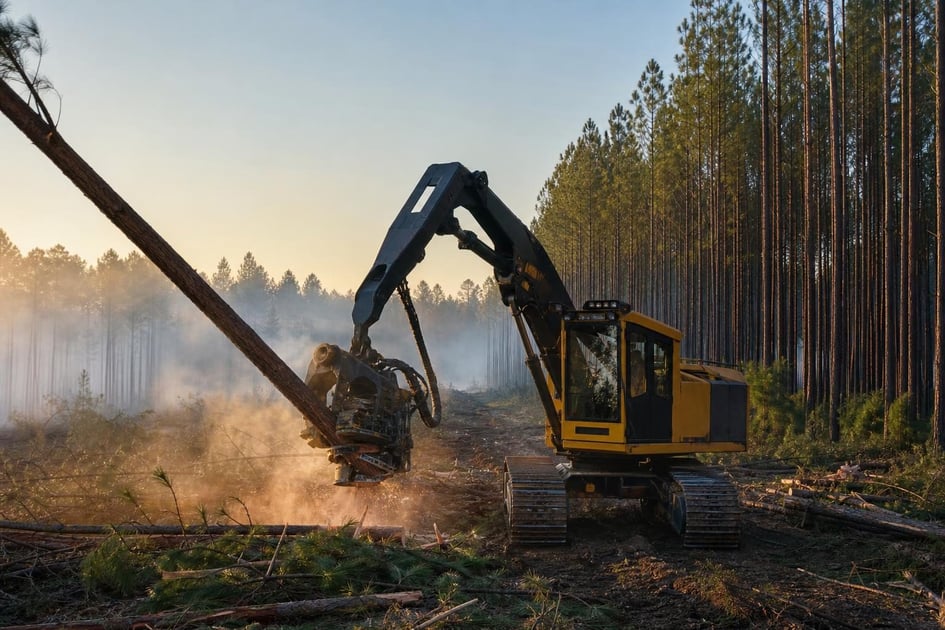
Forestry logging equipment financing works like any other business equipment loan: the machine you buy serves as the collateral, which keeps rates competitive and qualification straightforward. Provide Capital finances both new and used forestry and logging equipment from $5,000 up to $5 million, and same-day approvals are possible when your paperwork is complete. Whether you need a feller buncher for clear-cutting, a skidder for extraction, or a chipper for biomass work, the structure is the same—secure the machine, then pay it down over a term that matches its useful life.
Key Insight: Most independent logging contractors replace core machines on a five-to-seven-year cycle, but they keep support equipment such as chippers and loaders running for ten years or more. Lenders understand this split and will structure different terms for a primary harvester than for a secondary loader, so ask about term flexibility when you apply.
What Qualifies as Forestry and Logging Equipment
The category is broader than most owner-operators assume. Anything that fells, extracts, processes, or hauls timber can be financed, along with the support machinery that keeps a job site moving. Common qualifying equipment includes feller bunchers, harvesters, forwarders, skidders, delimbers, log loaders, knuckleboom loaders, chipper trucks, tub grinders, and whole-tree chippers. You can also finance the trucks that haul logs to the mill, including Dump Trucks financing for off-road site work and Wheel Loaders financing for yard management and sorting.
Used equipment qualifies just as readily as new. A three-year-old feller buncher with documented maintenance records and remaining factory warranty is often easier to finance than a brand-new machine from a defunct manufacturer, because residual value and parts availability matter to the lender. The same logic applies to Forestry Logging equipment financing across the full range of logging, land clearing, and wood-waste processing.
Already have a machine in mind?
Provide Capital finances new and used equipment from $5,000 to $5 million, with same-day decisions possible.
Apply NowFinancing Options for Logging Contractors
Most logging businesses choose between an equipment term loan and a capital lease. A term loan puts the title in your name immediately; you depreciate the asset and claim any available Section 179 expensing. A lease keeps the title with the lessor until the final buyout, which preserves capital but may limit first-year tax benefits depending on structure. Rates vary by credit profile, equipment age and term length, so the exact structure depends on your balance sheet and tax strategy.
| Feature | Equipment Term Loan | Capital Lease |
|---|---|---|
| Ownership | Title transfers at closing | Title transfers after final payment |
| Down payment | Usually 0% to 20% | Often one or two advance payments |
| Tax treatment | Depreciation and Section 179 eligible | May deduct lease payments as expense |
| Collateral | The equipment itself | The equipment itself |
| Best for | Established contractors building equity | Newer operations preserving cash flow |
Some contractors also explore SBA-backed programs for real estate or working capital, but for equipment acquisition, a direct equipment loan or lease is usually faster. The SBA's loan programs can be a useful reference point for understanding government-backed small-business financing, though equipment-specific lenders typically move faster than the SBA 7(a) timeline.
By the Numbers: A used wheeled feller buncher in good condition typically runs between $350,000 and $650,000 depending on hours and spec. A new tracked harvester with a processing head can exceed $800,000. Skidders range from $75,000 for older cable models to $300,000 for late-model grapple units. At Provide Capital, transactions start at $5,000 and can reach $5 million, so financing scales from a single chipper to a full fleet replacement.
What Lenders Look For in a Logging Business
Lenders evaluate three factors: credit profile, time in business, and equipment collateral. A personal credit score in the mid-600s or higher will open the most competitive terms, but scores below that do not automatically disqualify you—especially when the equipment has strong resale value and you can demonstrate consistent logging revenue. Most lenders prefer two or more years in business, though some will work with younger operations if the owner has prior industry experience.
Revenue documentation is straightforward for logging contractors: bank statements, tax returns, and equipment invoices. If you work on contract for timber investment management organizations or mill-owned land, recurring contracts strengthen your file. The equipment itself is the collateral, which means the lender secures its interest with a UCC-1 filing against the machine rather than placing a blanket lien on your real estate or other assets.
If you are unsure how your credit profile or business history will affect terms, you can talk to a specialist about your specific machine and get a straightforward assessment before you shop.
New vs. Used Forestry Equipment
The new-versus-used decision in logging is driven by utilization rates, terrain, and maintenance capacity. New machines carry manufacturer warranties, emission compliance, and telematics that reduce downtime. Used machines cost less upfront and depreciate more slowly, but they demand in-house mechanical capability or a strong dealer relationship.
When New Equipment Makes Sense
Buy new when you have multi-year contracts that guarantee utilization above 1,200 hours per year. New emission-compliant engines also matter if you work in states with strict air-quality rules, such as California or Oregon. Telematics packages now standard on most major brands let you monitor engine hours, hydraulic temperature, and fault codes remotely, which reduces surprise failures during peak season.
When Used Equipment Is the Smarter Buy
Used equipment fits contractors who run mixed fleets or need a specialty machine for a single contract. A $120,000 used grapple skidder with 4,000 hours can extract timber just as effectively as a new unit if your mechanic can service the hydraulics. The key is verifying chain-of-custody maintenance records and avoiding machines with outdated emissions that could face future restrictions.
Pro Tip: The used forestry market tightens in late winter. Many logging contractors sell excess equipment in December and January for tax reasons, which means February and March often deliver the best selection of late-model machines. If you finance during this window, get pre-approved before the auction so you can bid with confidence.
Tax Treatment and the 2026 Section 179 Deduction
For the 2026 tax year, businesses can elect to expense up to $2,560,000 of qualifying equipment under Section 179, with a dollar-for-dollar phase-out beginning once total qualifying purchases exceed $4,090,000. The deduction is fully eliminated once total purchases exceed the phase-out threshold by the full amount of the maximum deduction. These limits are indexed annually for inflation under current law. Qualifying property includes both new and used equipment, provided it is new to your business and used more than 50% for business purposes.
Bonus depreciation is also available at 100% for qualified property acquired and placed in service after January 19, 2025, which means many logging contractors can write off the full cost of a machine in year one by combining Section 179 and bonus depreciation. The exact sequencing—Section 179 first, then bonus depreciation on remaining basis—depends on your taxable income and overall purchase volume. Because timber operations are capital-intensive, the interaction between these provisions can significantly affect cash flow. Consult a CPA who understands logging depreciation schedules before you file.
Find the right financing structure
Tell us about the equipment you need and we will show you the options that fit your business.
See Your OptionsIndustry-Specific Use Cases
Timber harvesting contractors need feller bunchers, skidders, and loaders configured for the species and terrain they work. Pine plantations in the Southeast favor high-speed wheeled harvesters, while steep-slope operations in the Pacific Northwest require tracked machines with winch assists. Land-clearing contractors working for developers or utilities need mulchers and Skid Steers financing for right-of-way work. Biomass and salvage-logging operations after wildfire seasons often rely on chipper trucks and tub grinders to process material that cannot be milled into lumber.
Wildfire mitigation has become a growing revenue stream. Federal and state agencies contract with logging operators to thin overstocked forests and remove hazardous fuel loads. These contracts often specify equipment capabilities—minimum horsepower, grapple dimensions, or chipper discharge heights—so financing a machine that meets the spec opens doors to public-sector work. The logging industry is classified under NAICS code 113310 by the U.S. Census Bureau, which helps lenders understand the risk profile of timber operations when evaluating applications.
Market conditions also shape equipment demand. The pulpwood market downturn in the South has pushed some contractors to diversify into sawtimber, biomass, or land-clearing work, each requiring different machine configurations. Financing flexibility matters when you are retooling for a shifting market.
Key Insight: Insurance costs for logging equipment have risen sharply in regions with high wildfire exposure. Some carriers now require telematics monitoring or limit coverage for machines older than ten years. When you finance, ask your lender whether they require specific insurance minimums, because a $1 million liability policy with a $5,000 deductible looks very different from a $2 million umbrella policy on a fleet of six machines.
Common Mistakes Contractors Make When Financing
The most common error is financing a machine without verifying parts availability. A discontinued harvester head or an engine platform that the manufacturer no longer supports can turn a productive asset into an expensive anchor. Always confirm that your local dealer stocks critical components and has a certified technician within a reasonable service radius.
Another mistake is mismatching the term to the equipment's expected life. A seven-year loan on a high-hour used skidder that you plan to trade in three years leaves you underwater on the balance. Match the term to your realistic replacement cycle, and build in equity if you intend to trade early.
Finally, some contractors mix personal and business credit by putting equipment on a personal auto loan or credit card. This strips away the tax benefits of business depreciation and can expose personal assets to liability. Keep the financing in the business name, even if you personally guarantee the loan.
What Documentation You Need
A complete application typically includes the last three months of business bank statements, the prior two years of business tax returns, a current equipment quote or invoice, and a driver's license. If you are buying used equipment from a private seller, you will also need the serial number, year, make, model, and proof that the seller has clear title. For transactions above $250,000, some lenders request an equipment appraisal or a site inspection.
If your logging operation is structured as an LLC or S-corporation, have your articles of organization, operating agreement, and beneficial ownership documentation ready. Lenders use this to verify signatory authority and to comply with federal Know Your Business requirements.
What Happens After Approval
Once approved, the lender issues a funding letter or purchase order to the equipment dealer or private seller. You review and sign the closing documents, which include the UCC-1 financing statement, the promissory note or lease agreement, and any personal guarantee. Funding usually occurs within 24 to 48 hours of signed documents, at which point you take delivery and place the machine in service.
After funding, your first payment is typically due 30 to 45 days later. Most lenders offer automatic ACH withdrawal to avoid missed payments during busy seasons. If you want to pay off the balance early, review the prepayment terms before you sign—some loans carry a declining prepayment penalty in the first two years, while others allow full payoff with no fee.
Ready to move forward?
More than 10,000 businesses have financed equipment with Provide Capital. See what you qualify for today.
Get StartedFrequently Asked Questions
Can I finance used logging equipment?
Yes. Both new and used equipment qualify. Lenders focus on the machine's condition, remaining useful life, and resale value. A used machine with documented maintenance and strong dealer support often finances on the same terms as a new unit.
How long does approval take?
Many equipment lenders can issue a decision within one business day, and same-day approvals are possible when your documentation is complete. Complex transactions or large fleet purchases may take two to three business days.
Do I need perfect credit to qualify?
No. While stronger credit opens more competitive terms, many lenders work with credit scores in the low-to-mid 600s when the equipment collateral is strong and the business shows stable revenue. The equipment itself secures the loan, which reduces the lender's reliance on credit score alone.
What is the typical down payment for forestry equipment?
Down payments vary by credit profile, equipment age and term length. Well-qualified buyers can often finance 100% of the purchase price, including soft costs such as delivery and initial attachments. Used equipment or lower credit scores may require 10% to 20% down.
Can I finance equipment from a private seller?
Yes. Private-party sales are common in the logging industry. The lender will verify clear title, conduct a lien search, and may require an equipment inspection or appraisal before funding.
Does the equipment need to be new to qualify for Section 179?
No. For the 2026 tax year, both new and used equipment qualify for Section 179 expensing, as long as the equipment is new to your business and used more than 50% for business. Confirm your specific situation with a CPA before claiming the deduction.
Can I finance multiple machines at once?
Yes. Fleet transactions are common for growing logging operations. Lenders will evaluate your overall debt service coverage and the combined collateral value of the machines. Transactions can range from $5,000 to $5 million.
What happens if I need to sell the equipment before the loan is paid off?
You can sell at any time, but the loan balance must be paid in full from the sale proceeds. The lender holds the title or a perfected security interest until the final payment clears. Some loans include prepayment provisions, so review those terms before you sign.
Next Steps
If you have a machine picked out or just want to know what your monthly payment range looks like, the next step is a short application. You can get a same-day decision on your equipment in minutes, with no obligation. A specialist will review your equipment quote and business financials, then present options matched to your credit profile and the specific machine you are buying. If everything lines up, you can take delivery before your next contract starts.
Disclaimer: The information provided in this article is for general educational purposes only and is not financial, legal, or tax advice. Funding terms, qualifications, and product availability may vary and are subject to change without notice. Provide Capital does not guarantee approval, rates, or specific outcomes. For personalized information about your business funding options, contact our team directly.