Commercial Ovens Financing in Texas: What Owner-Operators Need to Know
Yes, you can finance a commercial oven in Texas without tapping your operating line or putting up real estate as collateral. Provide Capital finances new and used business equipment from $5,000 to $5 million, with the oven itself serving as the collateral. That structure keeps rates competitive and lets you preserve cash for payroll, inventory, and the higher energy bills that come with running a kitchen in the Texas heat. Whether you are opening a second location in Houston, replacing a failed deck oven in Dallas, or adding a conveyor oven ahead of the State Fair of Texas, financing spreads the cost over the useful life of the equipment while you generate revenue with it.
Why Texas Restaurants Time Their Oven Purchases Strategically
Texas food service does not follow a single rhythm. In Dallas-Fort Worth, corporate catering and hospitality spending tracks the convention calendar. In Austin, the South by Southwest season and university football weekends create sharp spikes in kitchen output. Houston’s year-round international traffic means steady volume, while San Antonio’s tourism economy surges around spring break and the holiday River Walk season. Because of this, smart owner-operators plan oven upgrades during the late summer lull so installation and staff training finish before September demand kicks in.
The physical climate matters too. Ambient kitchen temperatures in Central and South Texas regularly push past 90 degrees for months at a time. Older ovens lose efficiency under that load, and the added strain on HVAC systems can force a kitchen upgrade earlier than planned. Texas has added more restaurant and food service establishments than any other state over the past 5 years, according to U.S. Census Bureau data. Financing lets you pull the trigger when the equipment fails or when opportunity strikes, rather than waiting for a cash reserve to rebuild.
Key Insight: The Texas restaurant supply chain is heavily concentrated along the I-35 and I-10 corridors. A bakery in Waco and a barbecue joint in San Antonio often source ovens from the same Dallas-based dealers. When your lender already has existing vendor relationships in those corridors, the verification and funding process moves faster because the collateral description and invoice details are standardized.
What Types of Commercial Ovens Can Be Financed
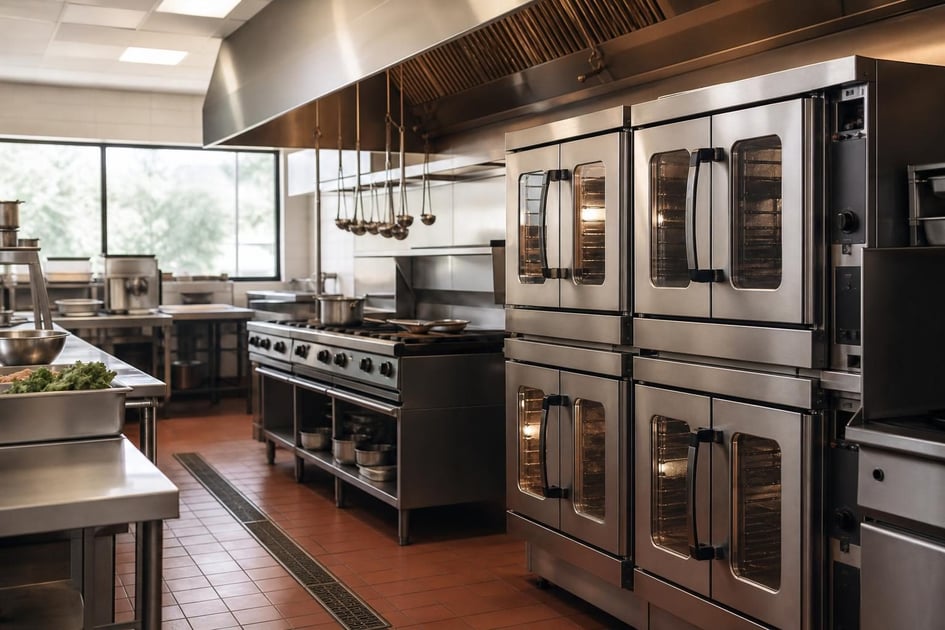
Nearly every category of commercial oven is eligible for equipment financing. Convection ovens remain the workhorse for cafés and bakeries because the forced-air circulation reduces cooking times and energy use. Deck ovens, essential for Neapolitan and New York-style pizzerias, hold value well on the used market and are often financed over 48 to 60 months. Conveyor ovens dominate high-volume pizza chains and central commissaries, with price tags that can run well into the mid-five figures. Combination ovens, or combis, let a single piece of equipment replace multiple units, which is critical when square footage in Austin or Houston costs premium rent.
Financing is not limited to the oven itself. Many lenders will roll related costs into the same agreement if they are invoiced with the equipment. That can include stands, casters, exhaust hood interfaces, and initial freight from the dealer to your dock. If you are also upgrading the cooking line, you can explore Commercial Range financing or Commercial Mixer financing through the same application. The core requirement is that the financed item is tangible business equipment with a serial number and a fair market value. For a deeper look at oven-specific structures, see our Commercial Ovens financing page.
New vs. Used: Which Route Makes Sense for Your Kitchen
New ovens come with manufacturer warranties, lower maintenance risk, and longer useful lives, which usually translates to a lower monthly payment over a longer term. Used ovens cost less upfront and depreciate slower, but they can carry higher interest rates and shorter maximum terms because the residual value is harder to predict. In Texas, the used oven market is robust in Houston and Dallas, where restaurant turnover creates regular auction inventory. However, a used unit from a shuttered buffet may have 10 years of daily grease accumulation, while a 2-year-old oven from a corporate test kitchen could be a steal.
| Factor | New Oven | Used Oven |
|---|---|---|
| Typical financing term | 36 to 84 months | 24 to 60 months |
| Warranty coverage | Full manufacturer warranty | Limited or expired |
| Rate impact | Rates vary by credit profile, equipment age and term | Rates vary by credit profile, equipment age and term; often slightly higher |
| Down payment | Often 0% to 10% | Often 10% to 20% |
| Best for | Long-term mainline cooking | Short-term projects, backup units, or cash-tight expansions |
The right choice depends on your hold period. If you plan to operate the same location for 7 years or more, new usually wins on total cost of ownership. If you are testing a ghost kitchen concept with a 6-month lease, used keeps your exit costs low.
Pro Tip: Before financing a used convection oven in Texas, verify that the unit carries an NSF certification sticker and matches your city's gas pressure specifications. Houston and Dallas have different municipal gas pressure standards, and an oven configured for one market may require a regulator and re-certification bill before your health inspector will sign off.
How Equipment Financing Works for Texas Food Service
Equipment financing is a secured transaction. The oven is the collateral. If your Texas restaurant defaults, the lender recovers the equipment. Because the loan is backed by a hard asset rather than an unsecured promise, the underwriting focuses on the equipment value, your business cash flow, and your credit history rather than on real estate or personal guarantees beyond the standard guarantee required of most private companies. The SBA guidance on equipment financing recommends matching the loan term to the equipment's useful life to avoid owing money on an oven that has already been replaced.
The process starts with an equipment quote or invoice. You submit a single-page application, and the lender reviews your business bank statements, tax returns, and the equipment specifications. For requests under $150,000, many deals can be approved with just an application and 3 months of bank statements. Larger requests, especially those approaching $500,000 or more for a full commissary line, may require 2 years of tax returns and a personal financial statement. Same-day approvals are possible when the file is clean and the equipment is standard.
Once approved, the lender pays the vendor directly or reimburses you if you have already purchased the oven. A UCC-1 filing is recorded against the equipment in Texas, and you take possession immediately. You make fixed monthly payments until the term ends, at which point you own the oven outright. There are no balloon payments at the end of a standard finance agreement.
If you are ready to move, get a same-day decision on your equipment before the quoted price expires or the used unit sells to another buyer.
Lease vs. Loan for Commercial Ovens
Equipment financing generally takes one of two forms: a finance lease (capital lease) or an equipment loan (installment purchase). In a loan, you are the owner for tax purposes from day one, and you claim depreciation and interest. In a true lease, the lessor owns the equipment and you deduct lease payments as an operating expense. At the end of a lease, you may have a fair-market-value buyout, a fixed buyout, or simply return the oven.
| Structure | Ownership | Tax treatment | End of term | Best fit |
|---|---|---|---|---|
| Equipment loan | You own; lender holds security interest | Depreciation + interest deduction | Title released after final payment | Permanent locations, long-term equipment |
| FMV lease | Lessor owns | Deduct lease payments as expense | Return, renew, or buy at fair market value | Equipment that obsoletes quickly |
| $1 buyout lease | Lessor owns until final $1 payment | Similar to loan for tax purposes | Ownership transfers for $1 | When you want ownership but lower payments upfront |
For most Texas restaurants, a loan or $1 buyout lease makes more sense because commercial ovens have long useful lives and do not obsolete as quickly as software or electronics. However, if you are running a pilot concept and want the flexibility to return a combi oven after 36 months, an FMV lease preserves exit optionality.
Not sure which structure matches your cash flow? Talk to a specialist about your specific machine and term options.
Tax Treatment for Tax Year 2026
For tax year 2026, Section 179 allows businesses to deduct the full purchase price of qualifying equipment, subject to an annual limit set by the IRS. The deduction begins to phase out once total equipment purchases exceed a specified threshold. Because these limits adjust with inflation and may be affected by mid-year legislation, consult a CPA for the exact 2026 figures before you file. Both new and used commercial ovens qualify if they are placed in service during 2026 and used more than 50% for business purposes.
Bonus depreciation continues to phase down from its peak levels in tax year 2026. You may be able to deduct a portion of the equipment cost in the first year while spreading the remainder according to MACRS schedules. The exact percentage depends on current federal law, so confirm the rate with your accountant before modeling your tax savings. A CPA can also help you decide whether to pair Section 179 with bonus depreciation or to spread deductions across future years if your taxable income is lower in 2026.
Texas does not impose a state income tax on businesses or individuals, but you should still factor in the state's franchise tax responsibilities and local property tax assessments on your equipment. Your CPA can model the total state and federal impact.
Qualification Criteria in Detail
Provide Capital serves businesses nationwide, including the Texas construction, healthcare, dental, restaurant and food service, manufacturing, transportation, agriculture, HVAC, and forestry sectors. Approval depends on several variables.
Credit profile. A FICO score in the mid-600s or higher generally opens the most competitive structures, but we review the full file rather than relying on a single number. Recent bankruptcies, active tax liens, or judgments can complicate approval. If your credit is bruised, a larger down payment or a shorter term may still get the deal done.
Time in business. 2 or more years under the same ownership is the sweet spot. Startups face higher scrutiny, but if you have a strong personal credit profile and relevant industry experience, financing is still possible. The equipment age and cost matter more for younger businesses.
Equipment age and condition. New equipment up to $5 million is eligible. Used equipment is judged on remaining useful life. A 10-year-old oven may still finance if it is a high-end brand with available parts, but the term will likely cap at 24 to 36 months.
Down payment. Zero-down deals exist for strong credits and new equipment. Used equipment or challenged credit often requires 10% to 20% down. The down payment is applied directly to the equipment cost, not kept as a fee.
Documentation. Expect to provide a driver’s license, a voided business check, the equipment invoice or quote, and recent bank statements. Deals over a certain size may require tax returns and interim financials. Rates vary by credit profile, equipment age and term.
By the Numbers: A single-deck gas pizza oven typically falls in the $6,000 to $14,000 range, while a double-stack convection pair often runs $12,000 to $28,000. High-volume conveyor ovens for central commissaries regularly reach $35,000 to $90,000. On a 60-month equipment finance agreement, that translates to roughly $130 to $1,850 per month depending on credit profile, equipment age and term.
Industry-Specific Use Cases Across Texas
Different kitchen concepts demand different ovens, and financing structures adapt accordingly.
Independent pizzerias. A Dallas or Houston operator opening a fast-casual slice shop might finance a double-deck gas oven and a dough prep line. The monthly payment aligns with the per-ticket average of a $12 pizza. Because these ovens last 15 to 20 years with proper maintenance, a 60-month term is common.
Bakeries and cafés. Convection and rack ovens dominate here. A Waco or Georgetown bakery financing a rotating rack oven often pairs it with a Commercial Mixer financing package to handle peak kolache and holiday bread demand. Lenders view established bakeries favorably because they have predictable morning rushes and strong local followings.
Barbecue joints and smokehouses. While smokers get the glory, these operations need holding ovens, finishing ovens, and reheating cabinets to manage the variable timing of brisket. Financing these secondary ovens preserves the cash needed for wood, labor, and the high-grade beef that Texas barbecue customers expect.
Ghost kitchens and commissaries. Austin and Houston have seen rapid growth in delivery-only kitchens. These operators often need multiple ovens in a small footprint. A commissary financing 3 combi ovens and 2 conveyor units can easily reach $150,000. Lenders will want to see the commissary lease and any platform agreements with delivery services to confirm revenue stability. You can learn more about restaurant-specific structures on our Restaurant Food Service equipment financing page.
Pro Tip: Texas ghost kitchen operators should confirm that their commissary lease runs at least 6 months past the final payment date of any equipment finance agreement. Lenders need assurance that the kitchen address will not change before the UCC filing is released, and a short-term sublease can trigger a collateral location review mid-term.
Common Mistakes Texas Operators Make
Even experienced owners miscalculate kitchen equipment purchases. Forbes reporting on commercial kitchen supply chains notes that lead times for imported oven components can stretch 12 to 16 weeks, making advance planning critical.
Buying undersized for growth. A 30-seat restaurant in Austin that plans to double its catering output in 18 months should not finance a single convection oven sized for the current dining room. It is cheaper to finance the right oven once than to trade up and pay two sets of installation and financing fees.
Ignoring installation and electrical costs. A conveyor oven may require a 3-phase power upgrade, a new exhaust hood, or a reinforced floor. These costs can add thousands to the project. Ask your dealer for a turnkey quote that includes freight, rigging, and gas connection before you apply for financing.
Waiting too long to line up financing. The best used equipment moves fast at Texas restaurant auctions. If you wait until after you win the bid to apply, you may lose the unit while the file is under review. Get pre-qualified so you can bid with confidence.
What Happens After Approval
Once you sign the finance documents, the lender issues payment to the vendor. In most cases, funds move within 24 to 48 hours. You schedule delivery, install the oven, and begin making monthly payments 30 to 45 days later. The lender files a UCC-1 in Texas to perfect its security interest in the oven. When the final payment clears, the lender releases the UCC filing and you hold clear title.
Same-day approvals are possible when the application is complete and the equipment is standard. The fastest path to a decision is to submit your quote, 3 months of bank statements, and a completed application before noon Central Time.
Ready to install before the holiday rush? See what you qualify for and lock in terms before your dealer's floor stock sells out.
Frequently Asked Questions
Can I finance a used commercial oven in Texas?
Yes. Used ovens are common collateral. The lender will review the age, brand, condition, and remaining useful life. Expect a slightly higher down payment or shorter term than you would see on new equipment.
Will the lender install the oven?
No. Financing covers the purchase of the equipment. You are responsible for delivery, rigging, gas or electrical hookup, and exhaust ventilation. Some dealers offer turnkey installation, and you can often finance the equipment portion while paying the installer separately.
How fast can I get approved?
Same-day approvals are possible for well-documented applications financing standard equipment. Larger requests or specialized ovens may take 24 to 48 hours. Submitting a complete file with your equipment quote speeds the process.
Does my credit score disqualify me?
There is no hard cutoff. Strong credit opens the best terms, but we review the full financial picture. Solid cash flow, a reasonable down payment, or high-quality collateral can offset credit challenges.
Can I finance the installation and ventilation?
Generally, only the equipment itself and directly related freight or accessories can be included on the finance agreement. Installation labor and construction are usually paid out of pocket or through a separate construction line. Ask your specialist what the specific invoice structure allows.
What happens if I want to pay off early?
Most equipment finance agreements allow early payoff. Depending on your specific contract, you may save on future interest or owe a prepayment penalty. Review the terms before signing so you understand the exact cost to close early.
Do I need a down payment?
Not always. Strong credits and new equipment can qualify for 0% down. Used equipment or challenged credit typically requires 10% to 20% down. The down payment reduces the financed amount and your monthly obligation.
Is a convection oven different from a deck oven for financing purposes?
The equipment type does not change the financing structure, but it can affect the term. A deck oven with a 20-year lifespan may qualify for a longer term than a light-duty convection unit. The lender bases the term on the expected useful life and residual value of the specific machine.
Disclaimer: The information provided in this article is for general educational purposes only and is not financial, legal, or tax advice. Funding terms, qualifications, and product availability may vary and are subject to change without notice. Provide Capital does not guarantee approval, rates, or specific outcomes. For personalized information about your business funding options, contact our team directly.