Indiana businesses can finance new and used equipment from $5,000 to $5 million through equipment-backed lending. The equipment itself serves as collateral, which keeps rates competitive and opens the door to same-day approvals for qualified buyers. Rates vary by credit profile, equipment age and term, so the rate you receive depends on your specific situation rather than a posted number. Whether you run a construction crew in Indianapolis, a farm outside Lafayette or a manufacturing shop in Elkhart, financing lets you put the machine to work now while paying for it over time.
Why Indiana's Economy Runs on Equipment
Indiana is not a one-industry state. The manufacturing corridor stretches from the RV plants in Elkhart through the automotive suppliers around Kokomo and down to the steel mills of Northwest Indiana. Federal Census Bureau manufacturing data shows Indiana maintains one of the highest concentrations of manufacturing employment in the country, and that density of production creates constant demand for CNC machines, presses, forklifts and material-handling equipment.
Agriculture adds another layer. Indiana ranks among the top states for corn, soybeans and pork production. A grain operation near Muncie or a livestock farm outside Evansville cannot afford to miss planting season or farrowing windows because a tractor or feed system is down. Spring buying patterns here are predictable: equipment orders spike between February and April as operators prepare for planting.
Construction follows a similar rhythm. Groundbreaking in Indiana is heavily concentrated between late March and October. A paving contractor in Fort Wayne or a utility crew in South Bend that waits until May to finance a paver or excavator may find dealer inventory thin and delivery timelines stretched. The same logic applies to HVAC contractors, who see demand spikes during summer cooling season and again when heating calls jump in late fall.
Logistics also matters. Indiana calls itself the Crossroads of America for a reason. Warehousing and transportation businesses along the I-65 and I-70 corridors need trailers, box trucks and material-handling equipment to keep freight moving. When one of those assets fails, replacement speed often matters more than brand preference.
Key Insight: Indiana dealers typically hold their largest used-equipment auctions in February and October, timed to farmers and construction crews trading up before peak season. Buyers who arrange financing ahead of those auctions often negotiate harder because they can close the deal on the spot rather than asking the dealer to hold inventory.
What Indiana Businesses Finance
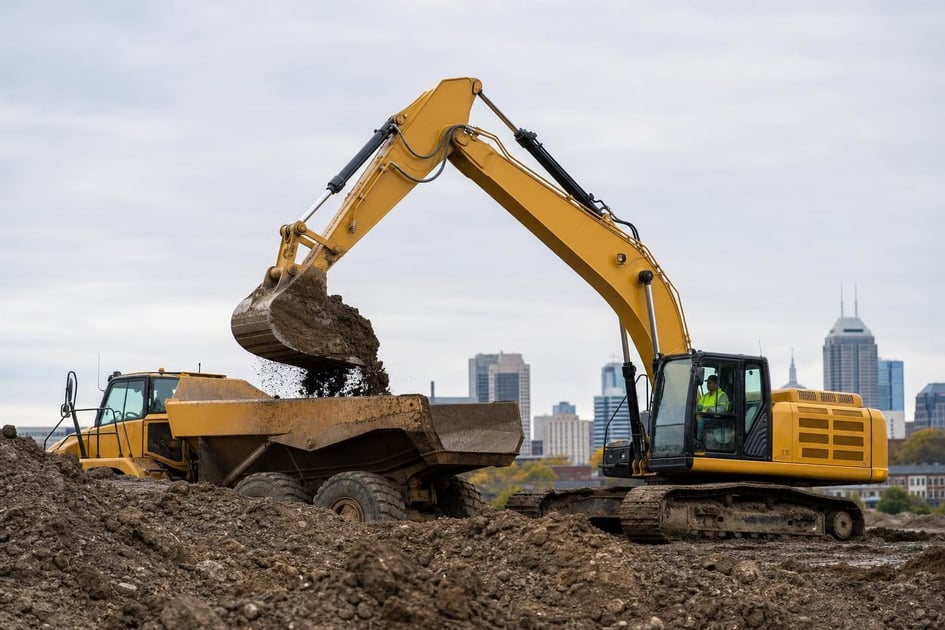
Construction equipment dominates the central and northern parts of the state. Contractors financing Skid Steers financing for residential site prep or Dump Trucks financing for roadwork represent a large share of applications. Bucket trucks and excavators follow close behind, especially for utility and excavation contractors working on the infrastructure projects that run through Indianapolis, Gary and the suburban corridors.
Agricultural equipment remains the lifeblood of rural Indiana. Combines, tractors, planters and grain dryers carry price tags that can easily reach six figures. Because harvest windows are narrow, a farmer who loses a combine in September cannot wait weeks for a lengthy approval process. Equipment financing that uses the machine as collateral can move faster because the lender's security is visible and verifiable.
Manufacturing and fabrication shops across the state finance lathes, milling machines, welding equipment and automated systems. The tooling required to supply Tier 1 and Tier 2 automotive contracts is precise and expensive. A shop that lands a new production run may need to add a CNC center quickly to meet contract deadlines.
Food service and hospitality businesses in Indianapolis, Bloomington and the tourist areas around the Indiana Dunes finance Commercial Ovens financing, walk-in coolers, prep tables and exhaust systems. Restaurant margins are thin, so preserving cash flow by spreading the cost of a kitchen build-out over several years is often the difference between opening on schedule and delaying launch.
Healthcare and dental practices finance imaging equipment, chairs, sterilization units and practice-management technology. A dental office upgrading to digital radiography or a physical therapy clinic adding electrotherapy devices can finance the full installation, including software and training.
HVAC and mechanical contractors finance commercial heating and cooling systems, duct fabrication equipment and service vehicles. The seasonal nature of the work means that a contractor who wins a large commercial replacement job in July may need to mobilize equipment immediately, even if the customer's payment terms stretch 30 or 60 days.
Forestry and logging operations in the southern hill country rely on skidders, feller bunchers and log loaders. Forestry Logging equipment financing helps these operators replace aging equipment or add capacity when timber contracts come available.
New vs. Used Equipment in the Indiana Market
The choice between new and used equipment depends on availability, warranty coverage and how hard you plan to run the machine. Indiana has a robust used-equipment market because of the state's manufacturing and agricultural density. Dealer trade-ins, lease returns and farm auctions create steady inventory.
When Used Equipment Makes Sense
Used equipment typically carries a lower total cost and may require a smaller down payment. For a construction company adding a second dump truck to handle a six-month project, a low-hour used unit can generate revenue immediately without the depreciation hit of a new vehicle. Agricultural buyers who need a backup tractor or a grain cart often find better value on the used lot, especially at auction.
The risk is condition. Indiana's winters are hard on equipment. Salt exposure on road-going units and freeze-thaw cycles on construction machines can hide corrosion or hydraulic issues. A buyer who finances used equipment should request maintenance records and, when possible, have a mechanic inspect the machine before the lender funds the deal.
When New Is the Better Choice
New equipment makes sense when uptime is critical, technology reduces operating costs or warranty coverage matters. A manufacturing shop buying a CNC machine with automated tool changing may recoup the premium through faster cycle times and less scrap. An HVAC contractor buying a new service van with upfit warranties avoids downtime that could cost service contracts.
New equipment also tends to finance more easily. Lenders can verify the invoice from an authorized dealer, and the residual value is easier to predict. That predictability can produce longer terms and lower monthly payments compared to an older machine with uncertain resale value.
| Factor | New Equipment | Used Equipment |
|---|---|---|
| Down payment | Often 0% to 10% | Often 10% to 20% |
| Financing term | Up to 84 months, depending on equipment type | Typically 36 to 60 months |
| Rate structure | Rates vary by credit profile, equipment age and term | Rates vary by credit profile, equipment age and term; older units may see slightly higher rates |
| Warranty | Full manufacturer warranty | Limited or expired; third-party coverage available |
| Best for | High-utilization, technology-dependent operations | Short-term projects, backup units, cost-sensitive buyers |
Pro Tip: Indiana buyers purchasing used equipment from out-of-state auctions should factor in transport costs, which can run $3 to $5 per mile for heavy machinery, and confirm that the lender will fund the purchase before the machine leaves the lot. Some lenders require a physical inspection or dealer invoice, which is harder to obtain after a remote auction closes.
How Qualification Works
Equipment financing qualification centers on three things: your credit history, your time in business and the equipment itself. Because the machine serves as collateral, lenders are often more flexible than they would be for an unsecured working-capital loan. That does not mean approval is automatic, but it does mean that a strong equipment choice can offset a shorter operating history or a credit event.
What Lenders Actually Review
Lenders typically request three to six months of business bank statements, a business tax return and a color copy of your driver's license. They want to see consistent cash flow that can cover the new payment. If your business generates seasonal spikes common in construction and agriculture be prepared to explain the cycle. A lender who sees $80,000 in revenue during summer paving season and $15,000 in January needs to understand that the annual average, not the winter dip, is what matters.
Time in business matters, but two years is a common benchmark rather than a hard wall. Businesses with strong personal credit and a detailed equipment invoice may still qualify, though often with a larger down payment or a shorter term. The equipment's age, hours and condition also factor into the decision. A 2024 skid steer with 200 hours from an Indiana dealer is easier to approve than a 2012 model with 4,000 hours from a private seller.
Common Reasons Applications Stall
Incomplete documentation is the most frequent delay. Missing pages from a tax return, a bank statement that does not show the full month or an equipment invoice without a serial number can all pause the file. Another common issue is mismatching the loan amount to the equipment value. Lenders generally will not finance 100% of a private-party sale without an independent appraisal, and they rarely fund equipment that is older than 10 to 15 years unless the borrower brings significant equity.
Tax liens, recent bankruptcies or unresolved judgments can also slow approval. Transparency is the best strategy. If there is a blemish on your record, disclosing it early with an explanation and evidence of resolution gives the underwriter confidence.
If you have been in business for at least a year and the equipment you want is priced between $5,000 and $5 million, see what you qualify for and get a same-day decision on your application.
Lease vs. Loan: Choosing the Right Structure
Equipment loans and leases both let you acquire machinery without paying the full purchase price upfront, but they treat ownership, payments and taxes differently. The right structure depends on whether you want to own the asset, how long you plan to keep it and how you want to claim deductions.
With an equipment loan, you own the equipment from day one. The lender files a UCC lien against the asset until the loan is paid off, but title is in your name. You make monthly principal and interest payments, and at the end of the term you own the equipment free and clear. This structure is common for construction equipment, manufacturing machinery and agricultural implements that owners plan to keep for a decade or more.
A capital lease, sometimes called a $1 buyout lease, functions similarly to a loan for tax purposes. You make monthly payments and typically own the equipment at the end for a nominal amount. An operating lease, or fair-market-value lease, is closer to a rental. You make lower monthly payments, return the equipment at the end of the term and claim the payments as an operating expense.
SBA guidance on buying business assets explains that equipment loans let you spread the purchase price over several years while maintaining ownership. Forbes analysis of business loan structures notes that equipment financing terms typically align with the useful life of the asset, which is why a truck that runs 10 years can be financed over a longer term than a computer that obsolesces in three.
| Feature | Equipment Loan | Capital Lease | Operating Lease |
|---|---|---|---|
| Ownership | You own the equipment; lender holds a lien | You own at end for nominal buyout | Lender owns; you return or purchase at FMV |
| Monthly payment | Higher than operating lease, lower than FMV lease with buyout | Similar to loan | Lowest monthly option |
| Tax treatment (2026) | Interest deductible; depreciation under Section 179/bonus depreciation rules for the 2026 tax year per IRS guidance—consult your CPA | Similar to loan; depreciation and interest deductions generally apply | Payments typically fully deductible as operating expense |
| Best for | Long-term use, building equity | Businesses wanting ownership with slightly lower monthly cost | Short-term use, technology that obsolesces quickly |
By the Numbers: A $75,000 excavator financed over 60 months might carry a monthly payment in the low four figures for a borrower with strong credit, while the same machine on a 36-month operating lease could run 30% to 40% less per month—but with no equity at the end. For a contractor running the machine 1,500 hours per year, the loan builds a $75,000 asset on the balance sheet; the lease builds none.
Tax Treatment for Indiana Buyers in 2026
The tax benefits of equipment financing can be significant, but the rules change and the details matter. For the 2026 tax year, Section 179 allows qualifying businesses to deduct the full purchase price of eligible equipment up to an annual limit set by the IRS. The exact dollar limit for 2026 is published in IRS guidance; because thresholds adjust with inflation and legislation, you should confirm the current-year figure with your CPA before making a purchase decision.
Bonus depreciation may also apply to new and used equipment in 2026, though the percentage has been phasing down from prior peaks. Again, the precise percentage for the 2026 tax year depends on current law, so consult your accountant to model whether Section 179, bonus depreciation or standard MACRS depreciation produces the best outcome for your situation.
Indiana conforms to federal depreciation rules for the most part, but state tax rates and filing deadlines differ. A business structured as an S-corporation or partnership should discuss how the deduction flows through to individual returns. If you are considering a large equipment purchase in the fourth quarter of 2026, remember that the equipment must be placed in service by December 31 to claim the deduction on that year's return, not just ordered or paid for.
Before finalizing any transaction for tax purposes, talk to a specialist about your specific machine and run the numbers with your CPA.
What Documentation You'll Need
Having your paperwork ready before you apply speeds up the process and improves your chances of same-day approval. Most lenders request:
- Three to six months of business bank statements
- One to two years of business tax returns
- A current equipment invoice or purchase agreement with the serial number and seller information
- A color copy of your driver's license
- A voided business check for ACH setup
- Occasionally, a year-to-date profit and loss statement if your most recent tax return is more than six months old
If you are buying from a private party rather than a dealer, the lender may also require an independent appraisal or an equipment inspection report. For transactions over $250,000, expect to provide a personal financial statement and a debt schedule. The key is completeness. A file that arrives with every document in order can be approved and funded in a single business day; a file that is missing the invoice or shows gaps in bank statements can sit for a week.
Common Mistakes Indiana Buyers Make
Waiting until peak season is the classic error. A farmer who waits until March to finance a planter may find that lenders are swamped, dealers have raised prices and the best used inventory is gone. The same applies to a roofing contractor who tries to finance a new dump truck after hail season starts.
Another mistake is ignoring transportation and rigging costs. Indiana buyers who shop nationally for used equipment often win the auction but lose the savings to freight. A $45,000 machine that costs $4,500 to ship from Texas to Indiana is effectively a $49,500 purchase, and lenders may not fund the freight portion on a private-party deal.
Buyers also sometimes overestimate the value of older equipment with high hours. A 2015 wheel loader with 8,000 hours may look like a bargain at $35,000, but if the hydraulic system needs $12,000 in repairs within the first year, the total cost of ownership exceeds a newer unit. Request maintenance records and calculate operating costs before you commit.
Pro Tip: Indiana construction contractors bidding on state or municipal infrastructure work should verify that financed equipment meets the spec requirements before signing the finance agreement. Some public contracts require equipment to be less than five years old or to carry specific emissions certifications. Financing a machine that disqualifies you from the job site is an expensive mistake.
What Happens After Approval
Once approved, the lender typically issues a check or wires funds directly to the equipment seller. For dealer purchases, this usually happens within 24 to 48 hours. For private-party sales, the lender may hold funds until a title search confirms no prior liens and a bill of sale is executed.
The lender files a UCC-1 financing statement to perfect its lien on the equipment. You receive the title or certificate of origin once the loan is paid in full. During the repayment term, you are responsible for insurance, maintenance and registration. Most lenders require proof of insurance listing them as loss payee.
If you want to pay off the loan early, ask about prepayment terms before you sign. Some equipment finance agreements apply a declining prepayment penalty in the first two years; others allow full payoff at any time with no penalty. Understanding this upfront protects your flexibility if cash flow improves or you decide to sell the equipment.
Frequently Asked Questions
Can I finance equipment if my business is less than two years old?
Yes, though terms may be tighter. Equipment-backed financing relies heavily on the collateral, so a newer business with strong personal credit and a verifiable equipment invoice can often qualify with a larger down payment or a shorter term.
Does the equipment have to be from an Indiana dealer?
No. You can finance equipment purchased from out-of-state dealers, private parties or national auction houses. The lender will need a clear invoice or bill of sale, and used equipment may require an appraisal.
How fast can I get funded?
Same-day approvals are possible when the application and documentation are complete. Funding usually follows within 24 to 48 hours for dealer transactions. Private-party sales may take slightly longer due to title verification.
Can I finance soft costs like installation and delivery?
Sometimes. Many lenders will bundle freight, installation and training into the finance amount if those costs appear on the equipment invoice from the dealer. Standalone soft costs without a hard asset attached are harder to finance.
What happens if I sell the equipment before the loan is paid off?
You must pay off the remaining balance to clear the lender's lien. The buyer cannot receive a clean title until the lien is satisfied. Some lenders allow assumption by a credit-qualified buyer, but this is not guaranteed.
Is a personal guarantee required?
For most small-business equipment financing, yes. The personal guarantee gives the lender recourse beyond the collateral if the business defaults. The strength of your personal credit and the value of the equipment both influence whether the guarantee is required and in what amount.
Can I finance multiple pieces of equipment under one agreement?
Yes. Bundling several purchases into a single finance agreement can simplify bookkeeping and may produce better terms than financing each item separately. This is common when a construction company outfits an entire crew or a restaurant builds a full kitchen.
Will applying hurt my credit?
Most equipment lenders perform a hard inquiry on your personal credit, which can have a minor, temporary impact. Some lenders offer prequalification tools that use a soft pull, but a firm credit offer typically requires a hard inquiry.
Next Steps
Equipment financing in Indiana works best when you match the right structure to your specific machine, timeline and tax situation. Start by gathering your financial documents and a firm equipment invoice. Decide whether you want to own the equipment outright, lease it or structure a capital lease with a buyout. Then apply with complete documentation so the underwriter can move quickly.
If you are ready to add a machine to your fleet, get a same-day decision on your equipment and move your Indiana operation forward.
Disclaimer: The information provided in this article is for general educational purposes only and is not financial, legal, or tax advice. Funding terms, qualifications, and product availability may vary and are subject to change without notice. Provide Capital does not guarantee approval, rates, or specific outcomes. For personalized information about your business funding options, contact our team directly.