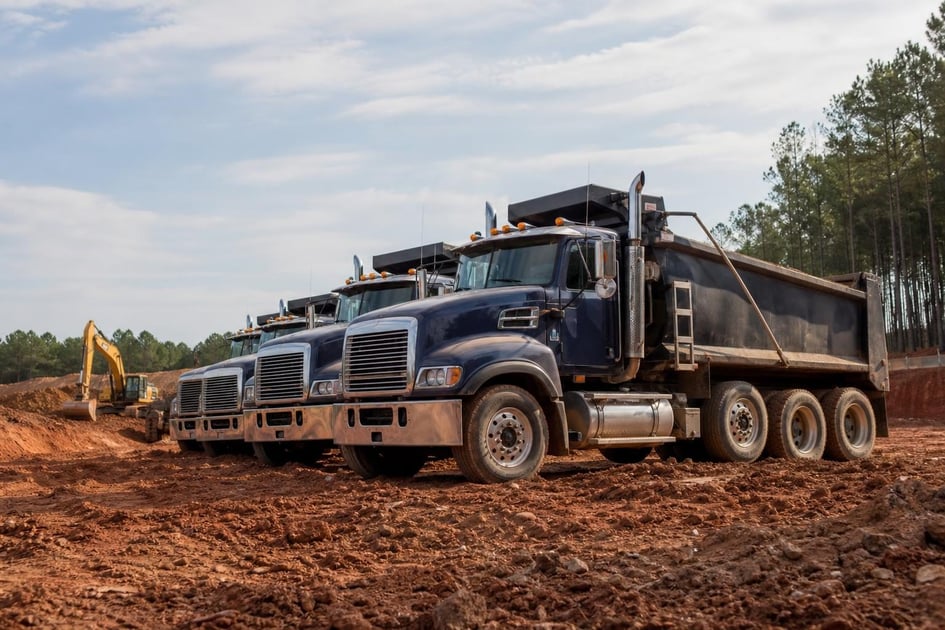
Financing a dump truck in North Carolina works best when the lender treats the equipment as the collateral. That setup keeps rates competitive and speeds up the decision, because the truck itself secures the deal rather than your home or a blanket lien on every business asset. Provide Capital finances new and used dump trucks from $5,000 to $5 million for North Carolina owner-operators, with same-day approvals possible when the file is complete. Whether you are hauling aggregate out of Wake County quarries, moving soil on Charlotte-area subdivisions, or running forest products in the Appalachians, the structure of the loan matters as much as the monthly payment.
Why North Carolina Demand Differs by Region and Season
North Carolina is not a single market. The Coastal Plain, the Piedmont, and the Mountain regions each run on different construction and agriculture calendars, and the dump trucks you see in Wilmington look different from the ones climbing grades in Buncombe County.
Coastal Plain and Piedmont Construction Cycles
In the Piedmont, Charlotte and the Research Triangle continue to absorb population growth that drives site development, road widening, and utility work. Dump trucks there move fill dirt, asphalt millings, and crushed stone across relatively flat terrain. Population growth in the Carolinas has kept residential and commercial construction active; U.S. Census Bureau construction data tracks the permits and starts that drive dump truck demand in these markets. The Coastal Plain adds hurricane-season demand: after tropical systems, debris removal and elevation projects create short windows where an extra truck pays for itself in weeks. Lenders who understand those spikes will structure seasonal payment schedules or skip periods that match your cash flow, rather than forcing a flat twelve-month schedule that ignores November-to-February slowdowns.
Mountain Logging and Agricultural Timing
West of the Piedmont, logging contractors and poultry litter haulers need trucks with shorter wheelbases, higher ground clearance, and often heavier suspension. Financing used trucks in this region is common, because the terrain punishes new iron as fast as it punishes three-year-old iron. The buying season also shifts: forestry crews often acquire equipment in late winter to be ready when mud season firms up in early spring. A lender with national reach but no regional awareness may not understand why you are buying a truck in February instead of June. We do.
Key Insight: In North Carolina, dump trucks financed for logging or mountain construction frequently carry lower mileage allowances but higher residual value clauses, because the odometer does not capture the wear that mountain grades and unpaved access roads place on the drivetrain.
Already have a machine in mind?
Provide Capital finances new and used equipment from $5,000 to $5 million, with same-day decisions possible.
Apply NowNew vs. Used Dump Trucks — Financing Considerations
New dump trucks offer warranty coverage, cleaner emissions profiles, and longer service life, but they also carry higher acquisition costs and steeper depreciation in the first two years. For a North Carolina contractor bidding on state Department of Transportation work, a newer truck may be required to meet bid specifications or corporate fleet rules. Used dump trucks cost less upfront, let you avoid the sharpest depreciation curve, and can often be cash-flow positive faster. The trade-off is maintenance exposure and shorter available terms.
When you finance through Provide Capital, the equipment itself is the collateral. That means a well-maintained used truck with documented service history can qualify on the same competitive terms as a new unit, provided the inspection and valuation come back clean. We finance both new and used business equipment across the $5,000 to $5 million range, so a single used tri-axle or a fleet of new tandem dumps are both within scope. The key is matching the equipment age and expected useful life to the term length. A seven-year-old truck with 400,000 miles rarely makes sense on a five-year note, but a three-year-old truck with 150,000 miles and a recent overhaul can be a strong candidate.
Lease or Loan? A Side-by-Side Look
Some North Carolina operators want to own the truck outright at the end of the term; others want the lowest possible monthly outlay and plan to refresh the fleet every four years. The right structure depends on your tax strategy, mileage expectations, and whether you want to carry the asset on your balance sheet.
| Feature | Equipment Loan | Equipment Lease |
|---|---|---|
| Ownership | You own the truck; lender holds lien | Lessor owns; you may have purchase option |
| Down payment | Often $0 to first payment upfront | First and last payment, or small deposit |
| Term length | Typically 36 to 72 months | Typically 24 to 60 months |
| Monthly cost | Higher than lease; builds equity | Lower monthly outlay |
| Tax treatment | Depreciation and interest deduction | Deduct payments as operating expense |
| Mileage limits | None | May apply on some structures |
| End-of-term | Title releases after final payment | Return, renew, or buy at FMV/$1 |
If you plan to put 80,000 miles a year on a dump truck running I-40 between Raleigh and Wilmington, a loan usually wins because mileage limits do not apply and you build equity. If the truck is a seasonal supplement for spring grading work only, a lease with a seasonal payment structure may preserve cash flow. Rates vary by credit profile, equipment age and term, so the only way to know the exact spread is to run the numbers on your specific deal.
The SBA guidance on buying business assets points out that leasing can require less cash upfront, while purchasing builds equity and lets you claim depreciation. Either path can make sense depending on how long you plan to keep the truck and how many miles you expect to run.
See what you qualify for based on the truck you are considering and your business financials.
What It Takes to Qualify
Equipment financing is collateral-driven, which means the dump truck secures the transaction. That does not mean credit and business history are ignored, but it does mean a strong equipment choice can offset a less-than-perfect credit profile.
Credit Profile and Business History
Most approved borrowers have a personal credit score in the mid-600s or higher and at least two years of business history. That said, a well-qualified piece of equipment—low hours, strong brand, good resale market—can carry an application that might otherwise be marginal. If your business is newer, expect to provide a larger down payment or a shorter term. If your credit has recent dings but the business cash flow is solid, bank statements showing consistent deposits can help.
The Equipment as Collateral
The lender will order an independent valuation or inspection on used trucks, checking for frame integrity, engine condition, and maintenance records. New trucks are financed based on the invoice or purchase agreement. Because the truck is the collateral, rates stay competitive compared to unsecured credit lines. Provide Capital serves construction, transportation, agriculture, and forestry operators nationwide, so a dump truck hauling soybeans in Pitt County is evaluated under the same standards as one moving rebar in Mecklenburg.
Pro Tip: If you are buying a used dump truck from a private seller in North Carolina, get the maintenance records and a current DOT inspection before submitting your application. A clean inspection report speeds underwriting by days and often improves the rate tier, because the lender knows the collateral is road-ready.
Tax Treatment for the 2026 Tax Year
For the 2026 tax year, Section 179 allows businesses to deduct the full purchase price of qualifying equipment in the year it is placed in service, subject to annual limits. Bonus depreciation may also apply, though the percentage has been phasing down in recent years. The exact dollar ceilings and phase-out thresholds for 2026 should be confirmed with your CPA before you sign, because tax legislation can shift late in the year. What does not change is the basic rule: if you take a loan, you can deduct depreciation and interest. If you lease, you typically deduct the lease payments as an operating expense. Either way, consult a tax professional before choosing a structure based on tax savings alone.
See what you qualify for
The equipment itself secures the financing, which keeps rates competitive. Checking your options takes minutes.
Check Your OptionsReal-World Cost Scenarios
Below are three realistic North Carolina deals, showing how term length and equipment age affect the monthly outlay. These are illustrative; rates vary by credit profile, equipment age and term.
- Scenario A: New single-axle dump truck, $95,000 purchase price, 60-month term. Estimated monthly payment in the mid-$1,800s.
- Scenario B: Used tri-axle dump truck, four years old, $68,000 purchase price, 48-month term. Estimated monthly payment in the mid-$1,600s.
- Scenario C: Heavy-duty articulated dump truck for quarry work, $210,000 purchase price, 72-month term. Estimated monthly payment in the low-$3,700s.
By the Numbers: A North Carolina grading contractor who adds a $75,000 dump truck on a 48-month note and keeps the truck working 45 weeks a year needs roughly $415 per week in gross margin to cover the payment. On a typical $95-per-hour haul rate, that is under five billable hours a week—a threshold most contractors clear in a single day during busy season.
Get a same-day decision on your equipment when you submit a complete file with the truck details and your business bank statements.
Industry-Specific Use Cases in NC
Site Development and Grading Contractors
Subdivision builders in Union and Johnston Counties run fleets of tandem and tri-axle dumps to move cut-and-fill material. These trucks work in soft clay that adds wear to frames and suspensions. Construction equipment financing for dump trucks in this segment usually favors loans over leases, because the trucks are kept for seven to ten years and the mileage is predictable. A used truck with a recently rebuilt transmission and new rubber can be financed on a four-year term and still have productive life left after the note is paid.
Agriculture and Forestry Operations
Eastern North Carolina poultry, sweet potato, and peanut operations use dump trucks for litter transport, vine disposal, and hauling grain to elevators. In the mountains, logging crews need trucks that can handle switchbacks and gravel landings. Dump Trucks financing for these roles often involves older chassis with newer beds, because the bed takes more abuse than the drivetrain. We can finance the truck and the body together as a single package if the seller invoices them jointly.
Transportation and Hauling Fleets
Independent haulers running under contract to aggregate quarries or asphalt plants need reliable iron and fast turnaround on approvals, because missed loads mean lost relationships. Transportation equipment financing through Provide Capital is designed for this: the equipment is the collateral, so you are not tying up real estate or signing personal guarantees beyond standard recourse. Same-day approvals are possible when the application and equipment details are complete, which matters when a good used truck appears on a dealer lot in Greensboro and will not last the weekend.
Common Mistakes to Avoid
First, do not shop for the truck before you know what payment range you can support. Pre-qualification lets you negotiate as a cash buyer. Second, do not ignore the total cost of the term. A low monthly payment stretched over seven years on a used truck can leave you underwater when the truck needs its first major overhaul. Third, do not assume every lender understands seasonal cash flow. A flat monthly payment in January when your logging or grading work is frozen can strain the business; structure the note to match when you actually get paid. Fourth, do not forget to budget for insurance, tags, and federal heavy vehicle use tax. Those are not financed in the equipment note, but they hit your account right after purchase.
Documentation You Will Need
Have these items ready to keep the process moving:
- Business tax returns for the last two years, or a year-to-date profit and loss statement if the most recent return is more than six months old
- Current business bank statements, usually the last three to four months
- A copy of the quote, invoice, or purchase agreement for the dump truck
- Proof of insurance meeting the lender’s requirements
- A current driver's license and, for larger trucks, a valid CDL
If you are buying from a private party rather than a dealer, also provide the VIN, mileage, and photos. The faster you assemble the file, the faster underwriting can move. Same-day approvals are possible, but only when the documentation is complete and the equipment valuation is straightforward.
From Application to Approval — What Happens Next
Once you submit the application and equipment details, the lender reviews your business cash flow, credit profile, and the collateral value. On used trucks, an inspection or valuation is ordered. If everything aligns, you receive a term sheet showing the down payment, monthly payment, and any fees. You sign and return it, the lender pays the seller or lienholder, and you take delivery. The entire cycle can close in 24 to 48 hours on clean files. On more complex deals—very high mileage, older chassis, or private-party sales with title issues—it may take three to five business days.
Some borrowers also research SBA 7(a) loans, which can be used for equipment purchases up to $5 million, though the approval timeline is often longer than collateral-based equipment financing.
Key Insight: North Carolina requires a valid title and, for trucks over 10,001 pounds, a current USDOT number and proper motor carrier registration before the truck can legally haul for hire. Lenders will verify that the truck is not encumbered by hidden liens, but they will not secure your operating authority. Handle your DOT and IRP filings before you schedule the first load.
Put the right equipment to work
From $5,000 to $5 million, new or used, Provide Capital helps businesses nationwide finance the equipment they need.
Apply TodayFrequently Asked Questions
Can I finance a dump truck with a 600 credit score?
It is possible, depending on the equipment value and your business cash flow. Strong collateral and documented revenue can offset a lower personal credit score, though the rate tier and down payment requirement will reflect the added risk. Rates vary by credit profile, equipment age and term.
How long can I finance a used dump truck?
Terms typically range from 24 to 72 months. Used trucks older than seven years or with very high mileage may be limited to 36 or 48 months, because the lender wants the note paid before the collateral depreciates too far.
Is a down payment always required?
Not always, but it helps. Zero-down options exist for well-qualified buyers and newer equipment. Older trucks, weaker credit, or first-time buyers usually see a down payment in the 5 to 15 percent range.
Can I finance the dump body and the chassis together?
Yes, if they are on a single invoice or bill of sale. If you already own the chassis and only need to finance a new body, that is usually treated as an add-on or separate transaction depending on the body cost.
Does the truck have to be purchased from a dealer?
No. Private-party sales, auctions, and dealer purchases are all eligible. Private-party deals require extra diligence on title status and lien payoff, but they are common and fully financeable.
Can I pay the note off early?
Most equipment loans allow prepayment. Some have a small prepayment schedule for the first year, and many have no penalty at all after month six or twelve. Ask for the specific prepayment language before you sign.
What happens if the truck needs major repairs while I still owe on it?
You are responsible for maintenance and repairs. Unlike a full-service lease, a loan or capital lease puts the operational risk on you. Budget for maintenance reserves, and carry physical damage and gap coverage until the loan is paid down.
Can I finance more than one dump truck at a time?
Yes. Fleet deals are common, and adding a second or third truck can sometimes improve the overall rate tier because the total collateral pool is larger. Provide Capital finances equipment from $5,000 to $5 million, so multi-unit deals are well within scope.
Ready to Add Capacity?
North Carolina’s construction, agriculture, and forestry markets do not wait on slow financing. If you have a dump truck picked out or you are still comparing units, the next step is to run the numbers on your specific deal. Talk to a specialist about your specific machine and see what terms are available for the 2026 season.
Disclaimer: The information provided in this article is for general educational purposes only and is not financial, legal, or tax advice. Funding terms, qualifications, and product availability may vary and are subject to change without notice. Provide Capital does not guarantee approval, rates, or specific outcomes. For personalized information about your business funding options, contact our team directly.