The Core Difference
Equipment financing is a term loan secured by the machine you are buying. A business line of credit is a revolving pool of cash you can draw from, repay, and draw again. If you are purchasing a specific piece of equipment you intend to own, equipment financing is usually the cheaper, cleaner tool. If you need ongoing access to cash for mixed expenses, a line of credit offers flexibility that a term loan cannot match.
Both products serve real needs, but they are not interchangeable. Using a line of credit to buy a $150,000 excavator ties up your working capital and exposes you to variable rates. Using equipment financing to cover payroll leaves you making payments long after the cash is gone. The decision starts with what you are buying and how long you will use it.
Key Insight: Equipment financing lenders underwrite the asset, not just the borrower. Because the machine serves as collateral, lenders can offer larger amounts and longer terms than an unsecured line of credit typically allows. This is why a specialized equipment lender can finance transactions from $5,000 up to $5 million, while many business lines of credit cap well below six figures.
Get a fast decision on your equipment
Applying takes just a few minutes, and decisions can come as soon as the same day.
Start Your ApplicationHow Equipment Financing Works
Equipment financing is a straightforward installment loan. You pick the machine, the lender pays the vendor or private seller, and you repay the balance in fixed monthly payments over a set term. The equipment itself is the collateral, which means you do not need to pledge real estate or other assets to secure the deal. Rates vary by credit profile, equipment age and term length.
SBA guidance on buying business assets explains that financing equipment through a term loan preserves working capital while spreading the cost over the asset's useful life.
Collateral Structure
Because the lender retains a security interest in the equipment, the loan is self-securing. If you finance a dump truck, the dump truck is the collateral. If you finance a CNC router, the CNC router is the collateral. This structure keeps the application focused on the asset's value and your ability to generate revenue with it, rather than on your total net worth. For borrowers who have strong cash flow but limited unencumbered real estate, this is a critical advantage.
Terms and Amounts
Provide Capital finances new and used business equipment from $5,000 to $5 million. Terms typically range from 24 to 84 months, depending on the expected useful life of the asset. New equipment often qualifies for longer terms and lower rates because the collateral retains value well. Used equipment can still be financed aggressively, especially if it is a known brand with a strong resale market. Same-day approvals are possible once the application and equipment details are submitted.
New vs. Used Considerations
New equipment carries full manufacturer warranties and the latest efficiency standards, but it also depreciates the moment it is delivered. Used equipment offers a lower acquisition cost and slower depreciation, though financing terms may be slightly shorter. The right choice depends on your utilization rate. A truck running 120,000 miles per year justifies a newer model with warranty coverage. A backup generator used for occasional job sites may be a smarter purchase as used equipment. Either way, the equipment itself secures the loan.
By the Numbers: A $75,000 used skid steer financed over 60 months might carry a monthly payment in the low four figures, while the same machine leased on an operating lease could run 20 to 30 percent less per month but leave you with no equity at the end. Equipment financing builds ownership; leasing builds access. The break-even usually falls between 36 and 48 months for assets held longer than five years.
How a Business Line of Credit Works
A business line of credit is a revolving facility. The lender approves you for a maximum limit, say $50,000 or $100,000. You draw what you need, pay interest only on the amount outstanding, and repay the principal on your own schedule or according to the agreement. Once repaid, the available credit replenishes. It functions like a business credit card with typically lower rates and higher limits.
A Forbes Advisor comparison of term loans and credit lines emphasizes that lines of credit address cash-flow timing, not large capital expenditures.
Revolving Structure
The flexibility is the selling point. You can draw $20,000 to buy computers in January, pay that down by March, then draw $15,000 for inventory in April. You do not reapply for each draw. However, most lines of credit carry variable interest rates tied to a benchmark, which means your cost can rise if rates increase. Many lines also require an annual review or renewal, and the lender can reduce your limit if your financials deteriorate.
When It Makes Sense
A line of credit excels at smoothing cash flow, not funding large capital purchases. If you need to bridge the gap between paying vendors and collecting receivables, or if you want to stock up on seasonal inventory, a line of credit is the right tool. It is less ideal for buying a $200,000 piece of manufacturing equipment because the line may not be large enough, the variable rate creates payment uncertainty, and tying up your revolving credit leaves you exposed when a real cash-flow crunch hits.
Side-by-Side Comparison
The table below lays out the structural differences that matter most when you are deciding between these two products.
| Feature | Equipment Financing | Business Line of Credit |
|---|---|---|
| Purpose | Specific equipment purchase | General working capital or mixed expenses |
| Structure | Term loan with fixed payments | Revolving; draw and repay as needed |
| Collateral | The equipment being purchased | Often unsecured or backed by general assets |
| Interest rate type | Usually fixed | Usually variable |
| Loan amount range | $5,000 to $5 million | Typically $10,000 to $250,000 |
| Term length | 24 to 84 months | 12 to 24 months, renewable |
| Ownership | You own the equipment after payoff | No ownership; purely a borrowing tool |
| Best for | Long-lived, high-value assets | Short-term cash-flow gaps |
As the table shows, the products solve different problems. Equipment financing matches the repayment schedule to the revenue the asset generates. A line of credit gives you a safety net, but it is not designed to carry a six-figure equipment purchase across five years.
Pro Tip: Some owners try to split a large equipment purchase across multiple credit cards and a line of credit to avoid a term loan. This fragments your debt, raises your effective rate, and usually violates the terms of the revolving facility. If the asset costs more than $25,000 and you plan to use it for more than three years, equipment financing is almost always the cleaner structure.
Cost and Tax Treatment
Tax treatment is one of the biggest differentiators between these two products, and it is often overlooked until year-end.
Equipment Financing and Depreciation
When you finance equipment, you own the asset from day one. That means you can claim depreciation on your tax return. For the 2026 tax year, Section 179 allows businesses to deduct the full purchase price of qualifying equipment up to a limit set by the IRS for 2026. The exact 2026 Section 179 limit should be verified with your CPA, as it adjusts annually. Bonus depreciation rules for 2026 may also allow additional first-year write-downs, though these provisions phase down over time. Consult a tax professional before claiming any deduction.
Line of Credit Interest
Interest paid on a business line of credit is generally tax-deductible as a business expense, but only if the funds are used for business purposes. If you draw $30,000 for a truck and $20,000 for personal use, only the interest on the $30,000 is deductible. You must keep detailed records of each draw. Unlike equipment financing, a line of credit does not give you depreciation because you do not own the underlying asset purchased with the funds.
Find the right financing structure
Tell us about the equipment you need and we will show you the options that fit your business.
See Your OptionsIndustry-Specific Use Cases
Your industry often determines which product fits best.
Census Bureau capital expenditure data shows that manufacturing, transportation, and utilities consistently rank among the largest equipment-spending sectors in the United States.
Construction and Forestry
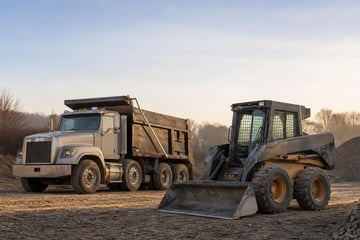
Contractors buying excavators, skid steers, or feller bunchers need long terms and large amounts. The machine is the revenue engine. Skid Steers financing is structured around the machine's hours and expected life. A line of credit would be exhausted by a single purchase and leave nothing for payroll or fuel. Equipment financing is the clear choice.
Transportation and Trucking
Owner-operators adding a sleeper cab or reefer trailer face similar math. The asset runs 100,000 miles per year or more. Transportation equipment financing matches the loan term to the truck's revenue cycle. A line of credit might cover a down payment or a repair, but it cannot carry a $180,000 tractor across a five-year term without choking the borrower's liquidity.
Restaurants and Food Service
A restaurant replacing ovens and walk-in coolers may be better served by equipment financing if the purchase exceeds $50,000. For smaller needs, like a single mixer or POS terminals under $10,000, a line of credit can make sense because the payback period is short and the items may need replacing again within a few years.
Healthcare and Dental
Medical equipment, from imaging machines to dental chairs, often costs six figures and lasts a decade. Equipment financing preserves your line of credit for payroll, malpractice insurance premiums, and supplies. It also gives you the depreciation benefits that help offset the high upfront cost of technology upgrades.
HVAC and Mechanical
Service vans and commercial HVAC system installations represent hybrid needs. The van itself is a long-lived asset ideal for equipment financing. Dump Trucks financing works the same way for landscapers and demolition crews. A line of credit can cover refrigerant stock or emergency parts, but the major equipment belongs on a term loan.
Key Insight: Seasonal businesses in agriculture and forestry often face a cash-flow trap. They need equipment in spring but do not generate revenue until fall. Equipment financing with a term that includes a seasonal skip-payment structure can bridge that gap without touching the line of credit reserved for harvest payroll and fuel. Ask your lender whether seasonal structures are available for your industry.
Common Mistakes Owners Make
Choosing the wrong product is expensive, but it is avoidable if you know where others stumble.
Buying Long-Lived Assets with Short-Term Credit
The most common error is purchasing a seven-year asset with a line of credit that must be renewed annually. You face rate risk, renewal risk, and the possibility that the lender reduces your limit right when you still owe most of the balance. If the asset outlives the credit facility, you have mismatched your debt and your collateral.
Ignoring Total Cost of Ownership
Owners sometimes fixate on the monthly payment and ignore maintenance, insurance, and downtime. A lower monthly payment on a used machine looks attractive until you factor in three weeks of lost revenue for major repairs. Calculate the total cost per operating hour, not just the finance payment.
Over-Leveraging the Balance Sheet
Taking out both a large equipment loan and maxing out a line of credit simultaneously leaves you with no cushion. Lenders call this being fully levered. If a customer pays late or a job gets rained out, you have no liquidity buffer. The safer approach is to finance the equipment and keep the line of credit at least 30 percent available for emergencies.
What You Need to Apply
The documentation requirements differ between the two products.
For equipment financing, you will typically need a one-page application, the equipment invoice or purchase agreement, and three months of business bank statements. Some transactions over $250,000 may require two years of tax returns and a current year-to-date financial statement. The underwriter focuses on the equipment value, your business cash flow, and your credit history. Approvals can come the same day for well-documented deals.
For a business line of credit, banks and online lenders usually want two years of tax returns, a current balance sheet, profit and loss statements, and personal financial statements from the owners. The underwriting is broader because the lender has no specific collateral to repossess if the business fails. Approval times range from a few days to several weeks.
What Happens After Approval
With equipment financing, the lender pays the vendor directly or funds your escrow for a private-party purchase. You take delivery, inspect the equipment, and sign the closing documents. Your first payment is typically due 30 to 45 days after funding. The lender files a UCC-1 lien on the equipment, which is released once you make the final payment.
With a line of credit, you receive access to the funds via a dedicated account or checks. You draw as needed. You will receive monthly statements showing your balance, interest accrued, and available credit. Some lenders require you to pay the balance to zero at least once per year to prove the line is not becoming a permanent term loan in disguise.
If you are ready to see how much you can finance for your next machine, get a same-day decision on your equipment. The process takes minutes and does not lock you into any obligation.
Ready to move forward?
More than 10,000 businesses have financed equipment with Provide Capital. See what you qualify for today.
Get StartedFrequently Asked Questions
Can I use a business line of credit to buy equipment?
Yes, but it is usually not the best tool. A line of credit is designed for short-term cash-flow needs, not long-term capital purchases. Buying a $75,000 machine with a line of credit ties up your liquidity and exposes you to variable rates. Equipment financing offers fixed payments, longer terms, and the equipment itself as collateral.
Is equipment financing easier to qualify for than a line of credit?
Often yes, because the equipment secures the loan. Lenders can be more flexible on credit profile and business history when they have a hard asset backing the transaction. A line of credit is usually unsecured, so underwriters scrutinize your overall financials more closely and may require higher credit scores or longer time in business.
Does equipment financing require a down payment?
Not always. Many transactions are financed at 100 percent of the equipment cost, including soft costs like delivery and installation. The exact down payment requirement varies by credit profile, equipment age and term length. Strong credit and new equipment often qualify for zero down.
What credit score do I need for equipment financing?
There is no universal cutoff. Borrowers with credit scores in the mid-600s and above often qualify for competitive terms, but scores below that do not automatically disqualify you. Lenders also weigh business revenue, time in operation, and the equipment's value. If your credit is challenged, a larger down payment or a shorter term may still get the deal done.
Can I pay off equipment financing early?
Most equipment loans allow early payoff, but the savings depend on how interest is calculated. Simple-interest loans save you the future interest you would have paid. Some leases and loans include a prepayment penalty or a minimum interest clause. Ask your lender for the exact prepayment language before you sign.
Will applying for equipment financing hurt my credit?
The initial prequalification usually involves a soft inquiry that does not affect your score. A full application may require a hard inquiry, which can cause a small, temporary dip. The impact is typically minor and fades within a few months. Multiple hard inquiries for the same type of financing within a short window are often treated as a single inquiry by credit scoring models.
Can I finance used equipment?
Yes. Provide Capital finances both new and used equipment. Used equipment is evaluated based on age, hours, condition, and resale value. A five-year-old excavator from a major manufacturer may qualify for the same term as a new one, while an obscure brand with no resale market may require a larger down payment or a shorter term.
Should I use both products together?
Many successful owners do. They use equipment financing for long-lived assets and keep a line of credit open for working capital. This preserves liquidity, keeps debt structured correctly, and ensures you have access to cash when opportunities or emergencies arise. The key is using each product for its intended purpose.
Which One Should You Choose?
If you are staring at a specific piece of equipment and calculating how many jobs it will take to pay for itself, equipment financing is almost certainly the right tool. It aligns the debt with the asset, fixes your payment, and preserves your revolving credit for everything else. If you need a safety net for payroll, inventory, or unexpected repairs, a line of credit belongs in your financial toolkit, but it should not be the primary funding source for a six-figure machine.
The best outcome is usually a deliberate split: finance the excavator, the truck, or the medical imaging suite on a term loan, and keep the line of credit untouched until you need to bridge a cash-flow gap. That structure keeps your balance sheet clean, your payments predictable, and your options open.
Ready to move forward? Talk to a specialist about your specific machine and find out what terms you qualify for. Whether you need $10,000 for a single piece of used equipment or $500,000 for a fleet expansion, the right financing structure starts with a conversation.
Disclaimer: The information provided in this article is for general educational purposes only and is not financial, legal, or tax advice. Funding terms, qualifications, and product availability may vary and are subject to change without notice. Provide Capital does not guarantee approval, rates, or specific outcomes. For personalized information about your business funding options, contact our team directly.