Can You Finance an Excavator with Bad Credit?
Yes. Equipment lenders regularly approve excavator financing for owners with credit scores below 620, recent late payments, or even past bankruptcies. The reason is simple: the excavator itself serves as collateral. Unlike an unsecured line of credit, the lender can recover the machine if payments stop. That collateral lowers the lender's risk and opens the door for borrowers who would not qualify for traditional bank term loans. Many contractors assume bad credit means paying cash or renting indefinitely, but equipment finance companies specialize in these exact situations.
Provide Capital finances new and used excavators from $5,000 to $5 million for businesses across construction, landscaping, utilities, agriculture and forestry nationwide. Because the equipment backs the transaction, rates stay competitive even when the borrower's credit history has blemishes. Same-day approvals are possible once the application and equipment details are submitted.
Already have a machine in mind?
Provide Capital finances new and used equipment from $5,000 to $5 million, with same-day decisions possible.
Apply NowHow Lenders Evaluate Bad-Credit Excavator Applications
What "bad credit" means for equipment finance
Most equipment lenders view FICO scores below 620 as subprime territory. Some will work with scores in the 500s if the business has stable revenue and the equipment holds strong resale value. A bankruptcy discharged two years ago is less of a barrier than one still open. Multiple recent late payments on existing obligations raise more red flags than an isolated medical collection from three years ago.
Why the equipment itself matters
The excavator is the collateral. Lenders order an appraisal or use wholesale guidebooks to verify value. A 2022 CAT 336 with 2,000 hours has a known resale market. A no-name import with sketchy maintenance records does not. The stronger the collateral, the more forgiving the lender can be on credit.
Time in business and revenue benchmarks
A contractor with two years of tax returns showing $400,000 in annual revenue and a 580 credit score often gets a better offer than a borrower with a 700 score but no financial history or equipment collateral. Lenders want evidence the business generates enough cash to cover the payment. Six months in business is sometimes enough for smaller transactions, but a year or more improves the odds substantially.
Key Insight: Lenders care more about the equipment's resale value and your monthly revenue than your exact credit score. A borrower with a 550 FICO but $30,000 in monthly bank deposits and a late-model excavator with under 3,000 hours can often secure financing, while a 650 FICO borrower trying to finance a high-hour, off-brand machine may face declines or larger down payments.
Equipment Loans vs. Leases for Excavators
An equipment loan for an excavator works like a vehicle loan. You make monthly payments, and once the term ends you own the machine outright. A lease, by contrast, is a longer-term rental. You pay for use of the excavator and typically return it at lease end, though some leases include a nominal buyout.
For bad-credit borrowers, loans are more common because the collateral is straightforward. Leases often require stronger credit or a longer track record, but a capital lease with a $1 buyout can still be an option if the down payment is sufficient.
| Feature | Equipment Loan | Operating Lease | Capital Lease |
|---|---|---|---|
| Ownership at end | Yes | No (return or renew) | Yes (with buyout) |
| Down payment | 10-20% typical | First/last payment | 10-20% typical |
| Credit flexibility | Higher | Lower | Moderate |
| Monthly payment | Higher than lease | Lower | Moderate |
| Tax treatment (2026) | Interest + depreciation | Full payment deductible | Depreciation |
| Best for | Long-term ownership | Short-term projects | Eventual ownership with lower initial cost |
The choice between a loan and a lease has significant tax and cash-flow implications; equipment leasing versus financing deserves a close look before you commit.
When a loan makes sense
If you plan to keep the excavator for five to seven years and put 1,500+ hours on it annually, a loan builds equity. You can still sell the machine if cash flow tightens, using the proceeds to pay off the balance.
When a lease makes sense
If you need a specialized attachment for an 18-month infrastructure project and the machine will sit idle afterward, an operating lease preserves capital. Just be aware that early termination fees can be steep.
New vs. Used Excavator Financing with Challenged Credit
Used equipment as a path to approval
Used equipment is often the smarter path for borrowers with credit challenges. A $45,000 used mini-excavator requires a smaller total commitment than a $180,000 new mid-size unit. The monthly payment difference can be $800 versus $2,800, which changes the debt-service coverage ratio in your favor.
Age and hour limits that lenders watch
Lenders do set limits. Most prefer used excavators no older than 10 to 15 model years. Hour caps vary by lender and machine class, but a common threshold is 8,000 to 12,000 hours for full-priced financing. Above that, expect a larger down payment or a shorter term. Maintenance records matter. A machine with 6,000 hours and complete dealer service history is viewed more favorably than a 4,000-hour unit with no documentation.
Brand and resale considerations
Caterpillar, John Deere, Komatsu, and Kubota dominate the used excavator market. Lenders recognize these brands and can value them quickly using auction data and dealer wholesale guides. An off-brand or grey-market import may cost less upfront, but finding a lender willing to finance it is harder. If you do find financing, the term may be shorter and the down payment larger. Stick to name brands unless you are paying cash.
By the Numbers: A used 12,000-pound mini-excavator purchased for $48,000 with a 15% down payment finances $40,800 over 60 months. At a rate appropriate for a subprime equipment borrower, the monthly payment typically falls between $925 and $1,150. The same machine leased under a capital structure might run $850 to $1,050 monthly with a 10% buyout at term end. Exact payments vary by credit profile, equipment age and term.
What Bad-Credit Excavator Financing Actually Costs
Rate ranges and term structures
Rates vary by credit profile, equipment age and term. A borrower with a 640 score financing a three-year-old excavator might see a lower rate than a 560-score borrower on a 10-year-old machine. Terms generally run 24 to 72 months. Stretching to 84 months is sometimes available for new or near-new units over $100,000, but it increases total interest paid.
Down payment expectations
Down payments for bad-credit excavator financing usually start at 10% and can reach 30% depending on risk factors. A 580 FICO with two years in business might put 15% down. A 520 FICO with six months in business and a high-hour machine might need 25%. The down payment reduces the lender's exposure and shows skin in the game.
Watch for documentation fees, UCC filing charges, and origination costs. These typically add $200 to $600 to the transaction. They should be disclosed before you sign, not sprung at closing.
If you have an excavator picked out, get a same-day decision on your equipment and see what down payment and term structure fit your situation.
Tax Treatment for Excavators in 2026
For the 2026 tax year, Section 179 allows businesses to deduct the full purchase price of qualifying equipment in the year it is placed in service, subject to an annual limit and a phase-out threshold. The specific dollar limits for 2026 are set by inflation-adjusted IRS figures. Because these limits change annually and your eligibility depends on taxable income, consult a CPA to confirm how much you can deduct before you file.
Bonus depreciation may also apply to new and used excavators in 2026, though the percentage has been stepping down under current law. Again, a CPA can model whether Section 179, bonus depreciation, or standard MACRS depreciation produces the best outcome for your 2026 return.
If you lease, the full lease payment is generally deductible as a business expense. If you finance with a loan, you deduct the interest portion plus depreciation. The difference can shift your 2026 tax liability by thousands of dollars, so run the math with your accountant before choosing. SBA loan programs also support equipment acquisitions, though approval timelines and paperwork often exceed those of direct equipment lenders.
Find the right financing structure
Tell us about the equipment you need and we will show you the options that fit your business.
See Your OptionsDocumentation You Will Need
Financial paperwork
Lenders typically ask for the last three to six months of business bank statements, a year-to-date profit and loss statement, and the most recent business tax return. If your revenue is seasonal, be ready to explain the cycles. A landscaping contractor with winter dips should show how summer contracts cover the annual payment load.
Some lenders also ask for a current debt schedule showing existing equipment payments, vehicle loans, and lines of credit. They want to see that your total monthly debt service stays within a reasonable percentage of gross revenue, often 40% to 60% depending on the lender's policy. If you are already at the ceiling, paying down a smaller obligation before applying can improve your chances.
Equipment specifics
You will need an equipment quote or invoice showing the serial number, year, make, model, and hours. Photos help, especially for private-party sales. If the machine has aftermarket attachments, list them separately; some lenders exclude attachments from the primary financing and require them to be paid out of pocket or on a separate schedule.
Common Mistakes Owners Make
Shopping for equipment before financing
It is tempting to bid on an auction excavator or negotiate a private sale before knowing your budget. But if the lender requires a 20% down payment and you only budgeted 10%, the deal stalls and you may lose the machine. Get prequalified first. Prequalification does not guarantee approval, but it gives you a realistic price range and down payment target.
Ignoring total cost of ownership
The monthly payment is only part of the equation. A $35,000 used excavator that needs $8,000 in undercarriage repairs in year one is more expensive than a $48,000 unit with fresh tracks. Fuel consumption, insurance, and transport costs also vary by size and brand. Run a three-year ownership cost estimate before you sign.
Overlooking the lender's collateral requirements
Some lenders file a UCC lien on the specific excavator. Others take a blanket lien on all business assets. A blanket lien can complicate future financing for trucks, attachments, or real estate. Read the security agreement carefully.
Pro Tip: If you are buying at auction, arrange financing before bidding. Auction houses often require payment within 24 to 72 hours. A lender that offers same-day approvals can issue a proof-of-funds letter or wire the deposit directly, but only if you have already submitted your financials and the lender has prequalified you for the equipment category.
Industry-Specific Use Cases
Excavators are not just for major earthmoving. In forestry, a 16,000-pound unit with a thumb attachment clears brush and loads logs. In agriculture, contractors use mini-excavators for drainage tile installation and pond maintenance. HVAC contractors trench for geothermal loops. Each use case affects the lender's view of revenue stability.
For Construction equipment financing, excavators are core revenue producers. A general contractor with a signed municipal contract and a pending pay app is a stronger candidate than one relying entirely on residential bid work. Lenders may ask to see the contract or the work-in-progress schedule. Steady demand for infrastructure and private development, reflected in Census Bureau construction spending data, means contractors with reliable equipment can bid on a consistent pipeline of work.
Landscaping businesses see seasonal cash flow. Financing a mini-excavator in March, before the rush, lets you book larger hardscaping jobs. Show the lender your signed contracts or recurring maintenance agreements to offset winter revenue dips.
Financing Excavators Alongside Other Equipment
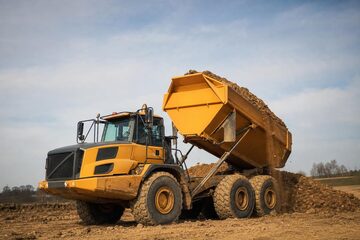
Many contractors do not need just an excavator. They need a Dump Trucks financing package to haul spoil, or Skid Steers financing for grading and loading. Bundling multiple machines into one financing agreement can simplify accounting and sometimes improve terms because the total collateral pool is larger.
However, be cautious about overextending. A $180,000 excavator bundled with a $90,000 dump truck and a $45,000 skid steer creates a $315,000 total obligation. Even with strong revenue, three simultaneous monthly payments strain cash flow. Consider financing the excavator now and the complementary equipment after six months of payment history, when your profile looks stronger to lenders.
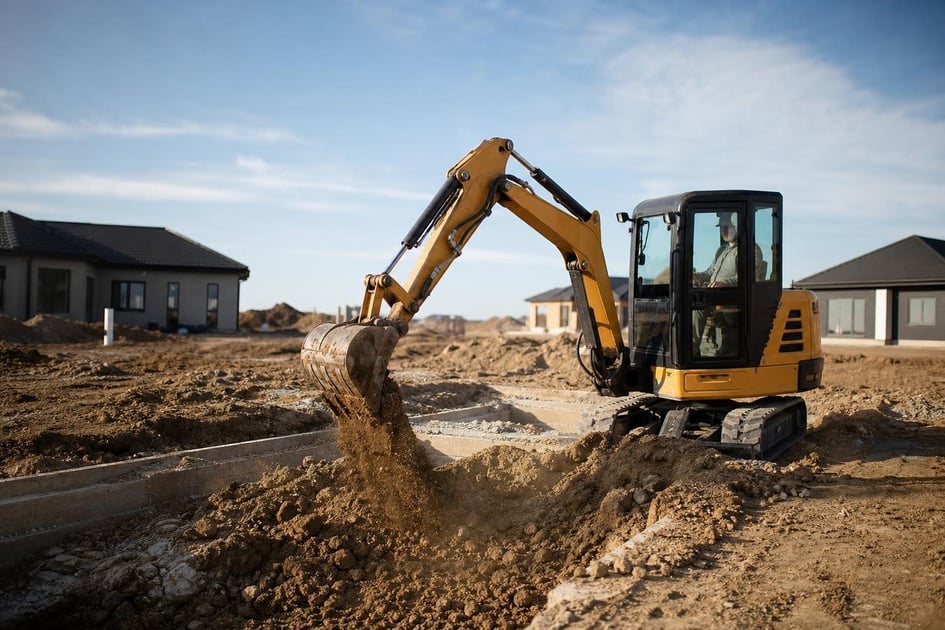
If you only need a compact unit, Mini Excavator financing often has more flexible credit requirements than full-size machines because the ticket size is smaller and the resale market is broader.
What Happens After You Apply
Once you submit your application and equipment details, the lender reviews credit, verifies equipment value, and calculates a payment structure. For straightforward transactions, this can happen the same day. Complex deals involving multiple machines, private sellers, or additional collateral may take 24 to 48 hours.
After approval, the lender issues a term sheet outlining the monthly payment, term, down payment, and any fees. Review it carefully. If you accept, the lender wires funds to the seller or dealership, or issues a check. You take delivery and the lender files a UCC lien on the excavator. Your first payment is typically due 30 to 45 days later.
If the lender declines or counters with different terms, ask why. Sometimes adding a co-signer, increasing the down payment by 5%, or switching to a newer machine converts a decline into an approval.
Put the right equipment to work
From $5,000 to $5 million, new or used, Provide Capital helps businesses nationwide finance the equipment they need.
Apply TodayFrequently Asked Questions
What credit score is needed to finance an excavator?
There is no universal minimum. Some lenders work with scores in the low 500s if the equipment and revenue are strong. Expect larger down payments and shorter terms as the score drops.
Can I finance an excavator with a recent bankruptcy?
Discharged bankruptcies are easier to work with than open cases. Most lenders want to see 12 to 24 months of re-established credit and consistent revenue after discharge.
How fast can I get approved for excavator financing?
Same-day approvals are possible when your financials and equipment details are complete. Private-party sales and complex deals may take 24 to 48 hours.
Is it better to finance a new or used excavator with bad credit?
Used equipment usually requires a smaller commitment, which improves approval odds. New equipment is financeable but often demands stronger compensating factors like higher revenue or a larger down payment.
What down payment will I need?
Expect 10% to 30% depending on credit, equipment age, and time in business. A stronger borrower puts down less; a riskier profile puts down more.
Can I finance an excavator from a private seller?
Yes, but the lender will verify the machine's value, condition, and title status. You may need to arrange an independent inspection. The seller must provide a clear title at closing.
Does the lender file a lien on the excavator?
Yes. The lender typically files a UCC-1 financing statement against the specific machine. Some also take a blanket lien on business assets. Ask before you sign.
Will financing an excavator help rebuild my credit?
If the lender reports to business credit bureaus, on-time payments can strengthen your business credit profile. Not all equipment lenders report, so ask if credit building is a priority.
Next Steps
Bad credit does not have to stop you from adding an excavator to your fleet. Start by gathering your last six months of bank statements, your most recent tax return, and a quote on the machine you want. Know your approximate credit score so there are no surprises. Then talk to a specialist about your specific machine and see what structure fits your cash flow.
Whether you need a 3,500-pound mini for residential utility work or a 40,000-pound unit for commercial site prep, Excavators financing options exist even when your credit history is imperfect. The key is matching the right equipment, the right down payment, and the right lender. Start the conversation today and put the machine to work tomorrow.
Disclaimer: The information provided in this article is for general educational purposes only and is not financial, legal, or tax advice. Funding terms, qualifications, and product availability may vary and are subject to change without notice. Provide Capital does not guarantee approval, rates, or specific outcomes. For personalized information about your business funding options, contact our team directly.