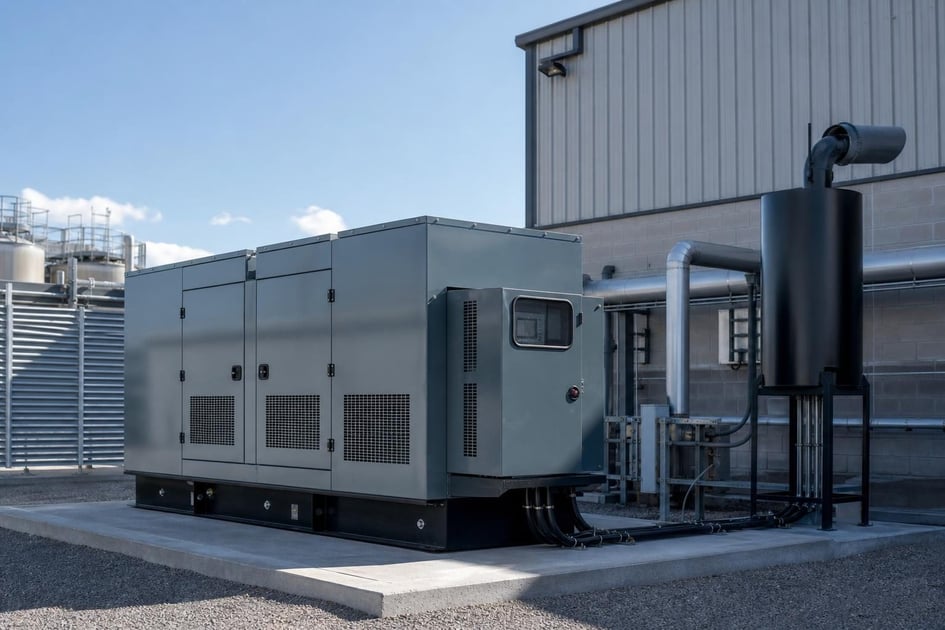
You can get generator set financing with bad credit. The equipment itself serves as collateral, which shifts the lender's focus from your credit score to the asset's resale value and your business's cash flow. Expect to document revenue, explain past credit issues, and possibly put down 10% to 20%. Rates vary by credit profile, equipment age and term. Same-day approvals are possible when your paperwork is organized, and deals from $5,000 to $5 million are common in this market.
How Bad Credit Affects Generator Set Financing
A credit score below 670 does not automatically disqualify you from Generator Set financing. Lenders who specialize in equipment financing weight your business fundamentals more heavily than your personal FICO. They want to see that the generator will generate revenue, and that your business has the cash flow to cover the monthly payment without strain.
What Lenders Actually Look At
Lenders review your bank statements, tax returns, and equipment quote. They look for consistent deposits, positive ending balances, and a clear business purpose for the generator. If your credit suffered because of a one-time event—a medical emergency, a lawsuit settlement, or a bad debt from a former customer—be ready to explain it in writing. Underwriters are humans; a coherent narrative that shows the problem was isolated and your business has recovered matters more than the number itself.
Equipment financing accounts for a significant share of small business capital investment. The U.S. Small Business Administration recognizes equipment loans as a primary vehicle for business growth, particularly for firms that do not qualify for traditional unsecured credit.
They also look at your debt-service coverage ratio, or DSCR. This is your net operating income divided by your total debt payments. Most equipment lenders want to see a DSCR of at least 1.25, meaning you have $1.25 in income for every $1.00 in debt obligations. If your credit is weak but your DSCR is strong, you still have a compelling file.
Credit Score Ranges and Their Impact
Borrowers with scores above 700 typically see the most favorable structures, but those in the 500s still close deals regularly. The difference shows up in down payment requirements, term length, and the need for additional collateral or a guarantor, not necessarily in approval versus denial. A score in the low 600s might mean 15% down instead of 10%, or a 48-month term instead of 60 months. Scores below 580 often require 20% down and may limit the lender to used equipment or shorter amortizations. Rates vary by credit profile, equipment age and term.
Key Insight: Most equipment finance companies pull your credit once and shop it across multiple funding sources internally. Ask whether the lender conducts a soft or hard inquiry initially; a soft pull lets you compare terms without adding another hard inquiry to your report. For borrowers rebuilding credit, this distinction can be worth 5 to 10 points.
Qualification Criteria Beyond Credit Score
Your credit score is one line on the application. The rest of the file tells the real story.
Time in Business
Most equipment lenders prefer two years in operation, but some programs accept six months if revenue is consistent. If you are newer, expect a larger down payment or a shorter term. The longer your track record, the more willing the lender is to stretch the amortization and the more likely they are to overlook an old credit blemish.
Equipment as Collateral
This is the core advantage of equipment financing. The generator set you are buying is the collateral. If you default, the lender repossesses and resells the unit. Because the loan is secured by a tangible asset with measurable resale value, lenders can offer more flexible terms than an unsecured business loan or line of credit. This is why Commercial Generator financing remains accessible even when traditional bank credit is not. The lender's risk is bounded by the liquidated value of the machine.
Revenue Documentation
Expect to provide three to six months of business bank statements. Some lenders also request one or two years of tax returns for deals above $150,000. If your revenue is seasonal—common in construction, agriculture, and forestry—show statements from your peak and trough months so the underwriter sees the full cycle. A contractor who shows $80,000 in deposits in July and $20,000 in January is not failing; they are seasonal. Context prevents misinterpretation.
Personal Guarantee Requirements
For deals under $500,000, most lenders require a personal guarantee from the business owner. This means you are personally liable if the business defaults. It sounds harsh, but it is standard in equipment finance. The good news is that making consistent payments builds both your business and personal credit profiles over time.
New vs. Used Generator Sets
The age and condition of the unit affect your financing structure as much as your credit does.
| Factor | New Generator Set | Used Generator Set |
|---|---|---|
| Purchase price | Higher upfront | 30% to 60% lower |
| Financing term | Up to 84 months | Typically 36 to 60 months |
| Down payment | Often 10% to 15% | Often 15% to 20% |
| Warranty | Full manufacturer coverage | Limited or expired |
| Interest structure | Rates vary by credit profile, equipment age and term | Rates vary by credit profile, equipment age and term |
| Resale value | Highest in first 3 years | Depreciation curve flattens |
| Best for | Long-term primary power | Backup or intermittent use |
When Used Makes Sense
If you need a backup unit for occasional outages, a low-hour used generator can cut your payment significantly. Just verify the hour meter, maintenance records, and whether parts are still available for that model. A 10-year-old generator with 2,000 hours and a clean service history is often a smarter buy than a new unit for a secondary application. Avoid units with incomplete service histories or signs of salt-air corrosion if you are near the coast.
When New Is Worth It
For primary power in a healthcare facility, data center, or critical manufacturing line, new equipment with a full warranty reduces operational risk. The higher price is offset by lower maintenance costs, longer useful life, and manufacturer support. New units also qualify more cleanly for Section 179 and bonus depreciation because the original invoice is unambiguous.
By the Numbers: A used 100 kW diesel generator might list for $18,000 to $25,000, while the same model new runs $35,000 to $45,000. On a 60-month term with 15% down, the used unit's monthly payment can be $200 to $300 lower, freeing cash for installation, transfer switches, and initial maintenance.
Lease vs. Loan for Generator Financing
You have two main structures: a capital lease (finance lease) and an equipment loan. Both let you deduct payments, but the mechanics and ownership timeline differ.
Equipment Lease Structure
In a capital lease, the lender buys the generator and leases it to you. You make monthly payments, and at the end of the term you own the equipment for a nominal buyout—often $1 or 10% of the original cost. The lease payment is generally fully deductible as a business expense. For tax year 2026, consult your CPA on how lease payments interact with your specific tax position, especially if you are near the Section 179 phase-out threshold.
Leases often have lower down payment requirements, which helps if you are preserving cash for a large project.
Equipment Loan Structure
With a loan, you take title immediately. You depreciate the asset and deduct interest. For 2026, Section 179 allows immediate expensing of qualifying equipment up to the annual limit set by the IRS. The exact 2026 Section 179 limit and phase-out threshold should be confirmed with your CPA or by checking current IRS guidance, as these figures adjust for inflation annually. Bonus depreciation for 2026 may also apply, though the percentage has been stepping down from prior years and is subject to legislative change.
Worked Cost Examples
Understanding the numbers helps you plan. These examples assume a borrower with challenged credit and a 15% down payment.
Example 1: Used 75 kW diesel generator, $22,000 purchase price. With $3,300 down, you finance $18,700 over 48 months. Rates vary by credit profile, equipment age and term, but the monthly payment typically falls in a range that leaves room for fuel and maintenance.
Example 2: New 150 kW natural gas generator, $52,000 purchase price. With $7,800 down, you finance $44,200 over 60 months. The longer term and newer equipment may qualify for a lower rate band than used equipment, but the total interest cost over the life of the deal will be higher due to the larger principal and longer amortization.
Example 3: Emergency backup system for a restaurant, $12,000 total. With $1,800 down, you finance $10,200 over 36 months. Shorter terms mean higher monthly payments but less total interest and faster ownership.
See what you qualify for based on your specific equipment quote and business financials.
Tax Treatment for 2026
Tax strategy is often the deciding factor in whether to finance a generator now or wait.
For tax year 2026, Section 179 lets businesses deduct the full purchase price of qualifying equipment in the year it is placed in service, subject to an annual limit and a total equipment purchase cap. If your business spends more than the phase-out threshold on equipment in 2026, the deduction begins to reduce dollar-for-dollar. Your CPA can calculate the exact benefit based on your taxable income and total asset purchases.
If you do not qualify for the full Section 179 deduction, you can still use MACRS depreciation over a five-year recovery period. Generators are not real property; they qualify as five-year MACRS assets, which front-loads the deductions into the early years of ownership through the double-declining balance method.
State and Local Incentives
Some states offer additional incentives for backup power, especially in areas prone to severe weather or grid instability. Check with your state's energy office or economic development authority. These are separate from federal tax treatment and can stack with Section 179.
Tax planning remains a top motivator for year-end equipment purchases. As Forbes has noted, the interaction between Section 179, bonus depreciation, and a company's taxable income creates complex timing decisions that reward advance planning with a CPA.
Pro Tip: If you are financing in Q4 2026, confirm delivery and installation dates before signing. The IRS requires the equipment to be "placed in service" by December 31 to claim the deduction on your 2026 return. A delay into January moves the tax benefit to 2027. Your CPA can confirm the documentation needed to prove placement in service.
Documentation You'll Need
Having your paperwork ready before you apply speeds the process and signals professionalism.
- Equipment quote or invoice from the seller
- Three to six months of business bank statements
- Most recent two years of business tax returns (for larger transactions)
- Voided business check for ACH setup
- Driver's license or other government-issued ID
- Business formation documents if requested
For transactions above $250,000, some lenders also request interim financial statements or an aging of accounts receivable. If you are buying from a private party rather than a dealer, add a bill of sale and proof of the seller's clear title.
What Happens After Approval
Once approved, the lender issues a purchase order or funds the invoice directly. You do not handle the cash; the money moves from lender to seller. This protects both parties and prevents misuse of funds.
The lender files a UCC-1 financing statement against the equipment. This is standard practice. It does not mean you do not own the generator; it simply publicizes the lender's security interest to other potential creditors. When you make the final payment, the lender releases the UCC filing, and you hold clear title.
Most lenders report your payment history to business credit bureaus. Making on-time payments on your generator financing can rebuild your business credit profile, making the next equipment purchase easier and potentially qualifying you for better terms.
Get a same-day decision on your equipment when you have your documentation ready.
Common Mistakes to Avoid
Buying too small. A generator running at 90% capacity wears out fast and risks overload. Size for 70% to 80% of peak load and leave room for growth. A unit that is adequate today but strained in two years is a false economy.
Ignoring installation costs. Transfer switches, fuel tanks, permitting, and electrical work can add $5,000 to $15,000 to the project. Some lenders will finance the total project cost including soft costs; others only finance the equipment itself. Ask upfront so you are not scrambling for cash after closing.
Overlooking fuel type. Diesel units cost more upfront but last longer and hold resale value. Natural gas units run cleaner and have lower fuel costs in some regions, but require utility gas lines. Propane offers storage flexibility and long shelf life. Match the fuel to your site constraints, local pricing, and emissions regulations.
Not checking the seller's reputation. A great financing deal on a lemon is still a bad deal. Verify the dealer services what they sell and stocks parts for the model you are buying. A financed generator that sits idle for three months waiting for a control board is expensive downtime.
Industry-Specific Use Cases
Generator sets cut across industries, but the financing context changes by field.
Construction
Construction crews run tools, lighting, and trailers off generators at sites without utility power. Peak season runs spring through fall, so many contractors buy in late winter to be ready for the surge. Construction equipment financing often accommodates seasonal payment structures that match cash flow to your billing cycle. A skip-payment structure lets you miss one or two winter payments without penalty.
Construction spending patterns tracked by the U.S. Census Bureau show seasonal volatility, which explains why many equipment lenders offer skip-payment structures for contractors.
Healthcare and Dental
Clinics and dental practices cannot afford downtime. A standby generator keeps imaging equipment, sterilizers, and patient management systems running during outages. Joint Commission and state health department regulations often mandate backup power, making the purchase effectively non-discretionary. Lenders view this as low-risk financing because the need is regulatory, not optional.
Manufacturing
A single power outage can cost a manufacturer tens of thousands in scrapped production runs and idle labor. Many factories finance backup generators as insurance against supply chain disruption. Because manufacturing facilities already have three-phase power infrastructure, installation costs are often lower per kilowatt than in other industries. Lenders like manufacturing deals because the collateral is typically housed in a secure facility.
Agriculture
Grain dryers, irrigation pumps, and livestock ventilation systems depend on reliable power. Farms in remote areas face longer utility restoration times, making on-site generation critical. Harvest season financing is common; lenders understand the annual revenue cycle and can structure payments to align with commodity sales.
Restaurants and Food Service
A walk-in freezer without power for four hours can destroy thousands of dollars of inventory. Restaurants in areas with aging grid infrastructure increasingly finance standby generators as a hedge against spoilage. Natural gas units are popular in this sector because the fuel source is already piped to the building.
Frequently Asked Questions
Can I finance a generator set with a credit score under 600?
Yes. Equipment financing is asset-backed, so lenders focus on the generator's value and your business cash flow. Expect a larger down payment, a shorter term, and possibly a higher monthly payment than a prime borrower.
How fast can I get approved?
Same-day approvals are possible when your application and documentation are complete. Complex deals, requests over $500,000, or private-party transactions may take 24 to 48 hours.
Will the lender check my personal credit?
Yes, almost always for transactions under $500,000. The lender needs to assess total risk. However, the equipment collateral and business revenue often outweigh personal credit issues, especially if the business itself is profitable.
Can I include installation and soft costs in the financing?
Some lenders allow you to roll delivery, installation, and transfer switch costs into the equipment financing. Others cap soft costs at 10% to 20% of the equipment price. Ask before you quote so you know your total out-of-pocket requirement.
What happens if I miss a payment?
Contact your lender immediately. Most equipment finance companies will work with you on a modification or deferral before pursuing repossession. The equipment is collateral, so default eventually risks repossession, but lenders prefer to restructure because repossession is costly.
Is leasing or buying better for tax purposes?
For tax year 2026, both structures offer deductions, but the timing differs. Loans typically let you take Section 179 and depreciation immediately. Lease payments are deducted as they are made. Your CPA can model which structure saves more tax for your specific situation and income level.
Do I need a down payment?
Most deals require 10% to 20% down for borrowers with challenged credit. Strong credit and long time in business can sometimes qualify for zero-down programs, but these are less common for sub-650 credit scores.
Can I finance a used generator from a private seller?
Yes, but the process is more involved. The lender will verify the seller's ownership, inspect the unit, and may require an independent appraisal. Private-party deals take longer than dealer transactions, so plan accordingly.
Next Steps
If your business needs reliable power and your credit is less than perfect, equipment financing is the most practical path forward. The generator itself secures the deal, which keeps the door open even when banks say no. Gather your bank statements, get a quote on the unit you want, and talk to a specialist about your specific machine. A same-day decision puts you closer to keeping the lights on—whatever the grid decides to do.
Disclaimer: The information provided in this article is for general educational purposes only and is not financial, legal, or tax advice. Funding terms, qualifications, and product availability may vary and are subject to change without notice. Provide Capital does not guarantee approval, rates, or specific outcomes. For personalized information about your business funding options, contact our team directly.