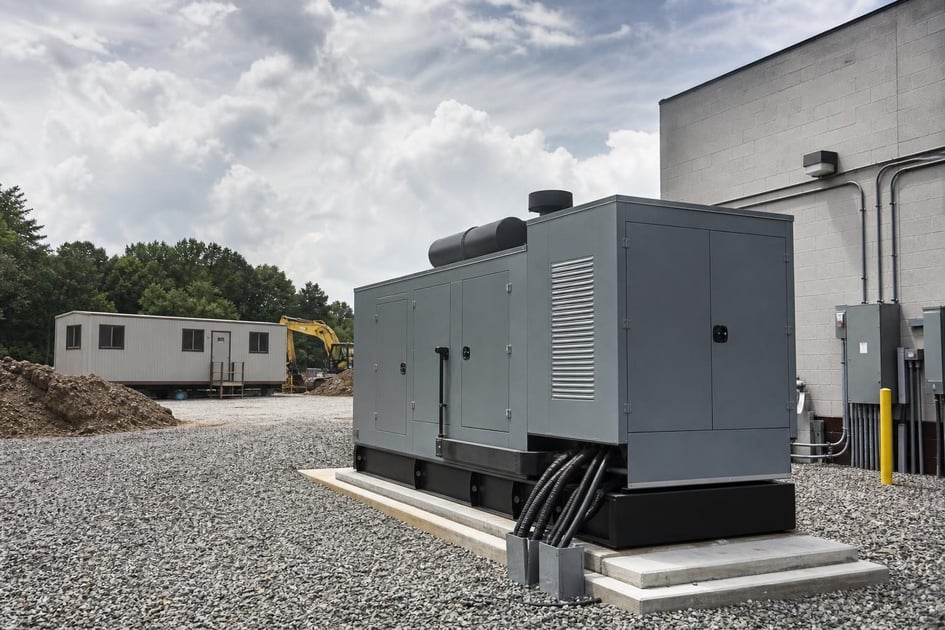
Yes, you can finance a generator set with no down payment. Lenders who specialize in equipment financing use the machine itself as collateral, which means qualified buyers can cover the full purchase price, delivery, and installation without tying up working capital. Rates vary by credit profile, equipment age, and term length, but the structure is straightforward: you make fixed monthly payments while the generator powers your operations.
What "No Down Payment" Actually Means for Generator Financing
100% financing does not mean you sign a document and pay nothing until the first monthly bill. Most equipment finance agreements still require a small documentation fee or filing fee at closing, usually a few hundred dollars. What it does mean is that the lender funds the entire cost of the generator set, including freight, rigging, and initial setup if those costs are rolled into the equipment invoice.
The collateral is the generator itself. Because the lender holds a security interest in a hard asset with measurable resale value, they do not need a cash down payment to reduce their risk the way an unsecured lender would. This is the central difference between equipment financing and a general business term loan. If your business has been operating for at least two years and your credit profile is solid, 100% financing is a standard offering, not a special promotion.
For used equipment, the lender will typically cap financing at the fair market value or the invoice price, whichever is lower. A $50,000 used generator with a questionable service history may still qualify for 100% financing, but only if the quoted price aligns with auction data for similar hours and year models.
Key Insight: Soft costs like delivery and installation can often be wrapped into the financing, but only if they appear on the same invoice as the generator from a vendor the lender recognizes. Separate invoices from a third-party rigger may need to be paid out of pocket or handled with a working capital line.
Get a fast decision on your equipment
Applying takes just a few minutes, and decisions can come as soon as the same day.
Start Your ApplicationHow Generator Set Financing Works
Equipment financing for generator sets functions as a fixed-term installment agreement. You select the machine, the lender pays the vendor, and you repay the balance over 24 to 72 months. The equipment serves as collateral for the full duration, which keeps rates competitive compared to unsecured borrowing. The Small Business Administration notes that equipment financing and leasing gives business owners the ability to increase revenues while spreading the cost over time.
Loan amounts range from $5,000 for a small portable unit up to $5 million for a large industrial installation. The term length usually matches the expected useful life of the equipment. A new diesel generator rated for 20,000 hours might qualify for a 60-month term, while a used unit with 8,000 hours already logged may be capped at 36 or 48 months.
Monthly payments are fixed. This matters for businesses budgeting around storm season or project timelines. You know exactly what the generator costs each month, and there is no balloon payment at the end if you choose a standard capital lease or equipment loan. At the end of the term, you own the generator outright.
Pro Tip: Ask your vendor to quote the generator, delivery, and startup commissioning on a single sales order. Lenders can fund soft costs more easily when they are bundled with the hard asset on one invoice, which keeps your out-of-pocket expense at closing close to zero.
New vs. Used Generator Sets: Financing Considerations
New generator sets carry full manufacturer warranties, typically 1 to 2 years on the entire unit and up to 5 years on the engine. Lenders like this predictability. A new unit usually qualifies for the longest terms and the most favorable rate tiers because the residual value is known and the risk of a major mechanical failure during the loan term is low.
Used generator sets can be financed, but the underwriter will look closely at age, runtime hours, and maintenance records. Units under 5 years old with documented service intervals from an authorized dealer are the easiest to approve. Once a generator passes 10 years or 15,000 runtime hours, the pool of willing lenders shrinks, and the terms shorten. You may still get 100% financing, but expect a 36-month cap and a rate that reflects the higher collateral risk.
The break-even math depends on your utilization. A used 250 kW diesel generator priced at $35,000 might make sense for a facility that only needs backup power a few times per year. A hospital or data center running a unit 2,000 hours annually should prioritize reliability and warranty coverage over the lower upfront cost of used equipment.
Generator Set financing covers both new and used units, but the documentation required for a used machine is heavier. Expect to provide photos, hour-meter readings, and recent service records.
Lease vs. Loan: Choosing the Right Structure
The choice between leasing and loaning a generator set comes down to ownership intent, tax strategy, and how long you plan to keep the unit. A loan puts the generator on your balance sheet immediately. A true lease, or operating lease, keeps it off your books and gives you the option to return, renew, or purchase at fair market value when the term ends.
| Feature | Equipment Loan | Capital Lease | Operating Lease |
|---|---|---|---|
| Ownership | You own from day one | You own at term end | Lessor owns throughout |
| Down Payment | 0% possible | 0% possible | 0% possible |
| Monthly Payment | Higher, building equity | Moderate | Lowest |
| Tax Treatment | Interest + depreciation | Depreciation | Full payment deduction |
| End of Term | Free and clear | $1 or 10% buyout | Return, renew, or FMV buyout |
| Best For | Long-term ownership | Eventual ownership with lower payments | Short-term or uncertain needs |
An equipment loan is usually the better fit for a generator because these machines have long service lives and no obsolescence curve like computers. A 20-year-old diesel generator still has value if it was maintained. If you are considering an operating lease, run the numbers against a loan. The lower monthly payment is appealing, but the total cost over 60 months is often higher once you account for the residual buyout.
By the Numbers: A $75,000 generator financed over 60 months might carry a monthly payment roughly one-third lower than a 36-month term, but the total interest paid over the life of the longer loan is significantly higher. If you plan to keep the unit for 15 years, the 60-month term preserves cash flow without forcing a refinance.
If you are evaluating options for your next machine, see what you qualify for and compare terms side by side.
Who Qualifies for Zero-Down Generator Financing
Lenders evaluate four main factors for 100% equipment financing. The first is time in business. Companies with two or more years of operating history and documented revenue receive the most favorable terms.
The second factor is credit profile. Both personal and business credit are reviewed. A strong credit history shows consistent payment behavior, which matters when the lender is advancing 100% of the asset cost. The third factor is the equipment itself. New Tier 4 final diesel generators from recognized manufacturers like Caterpillar, Cummins, or Generac are easier to finance than obscure brands with no dealer network.
The fourth factor is industry experience. A construction contractor who has owned and maintained generators for a decade is a lower risk than a restaurant owner buying their first standby unit. That does not mean newcomers cannot qualify, but experienced operators may see faster approvals and more flexible terms.
Rates vary by credit profile, equipment age, and term length. Same-day approvals are possible when the application is complete and the equipment quote is straightforward.
Construction equipment financing is one of the largest categories for generator funding, but the same underwriting criteria apply to healthcare, manufacturing, and agriculture.
See what you qualify for
The equipment itself secures the financing, which keeps rates competitive. Checking your options takes minutes.
Check Your OptionsTax Treatment for the 2026 Tax Year
Generator sets are tangible personal property used in a trade or business, which makes them eligible for depreciation. For the 2026 tax year, Section 179 allows businesses to deduct the full purchase price of qualifying equipment up to an annual limit set by the IRS. Bonus depreciation may also apply, though the percentage has been phasing down in recent years.
Because tax law changes frequently, you should consult a CPA to confirm the exact 2026 Section 179 limit and whether your generator purchase qualifies for bonus depreciation. The deductibility of lease payments versus depreciation on a loan also differs, so run the structure past your accountant before signing.
If you finance the generator, you generally deduct the interest portion of your payments and take depreciation on the equipment. If you operate lease it, the entire lease payment is usually deductible as a business expense. The optimal choice depends on your 2026 taxable income and whether you need the deduction upfront or spread across multiple years.
Industry-Specific Use Cases
Construction sites rely on mobile and towable generator sets to power tools, light towers, and temporary offices. A contractor working on a remote site without utility hookups may run a portable unit 10 hours a day, 6 days a week. Financing preserves the cash needed for payroll and materials while keeping the site powered. Reuters reports that rising grid constraints are pushing more businesses toward larger onsite generation systems to secure capacity for expansion. U.S. Census Bureau construction spending data shows continued investment in infrastructure and commercial building, which sustains demand for mobile power on job sites nationwide.
Healthcare facilities face life-safety requirements. A nursing home or outpatient clinic needs a standby generator that starts automatically during a grid failure. The Joint Commission and local fire codes often mandate specific runtimes and fuel storage. Financing allows a clinic to install a code-compliant unit without drawing down reserves that might be needed for staffing or medical supplies.
Restaurants and food service businesses lose inventory rapidly during outages. A standby generator keeps walk-in coolers, freezers, and point-of-sale systems online. For a restaurant with $15,000 in perishable inventory, a generator pays for itself during the first extended outage.
Manufacturing and agriculture use generators both for standby power and for primary power in remote barns or processing facilities. A dairy operation with automated milking equipment cannot afford downtime. A manufacturer running CNC machines needs clean, stable power that only a quality generator set can provide.
Commercial Generator financing serves these sectors nationwide, with terms adjusted for the equipment's expected utilization and the borrower's industry experience.
Common Mistakes When Financing Without a Down Payment
The most common error is financing more generator than you need. A 500 kW unit for a facility with a 100 kW load wastes capital and fuel. Size your generator to your actual load profile, including motor starting surges, but do not oversize by 200% because the lender is offering 100% financing.
Another mistake is ignoring the total cost of ownership. The monthly payment is only part of the equation. Diesel generators need oil changes every 250 to 500 hours, coolant exchanges, and eventual alternator rebuilds. Natural gas units have lower maintenance but higher fuel costs in some regions. Budget for service before you budget for the payment.
Buyers also fail to verify the vendor's reputation. A used generator sold at auction may have hidden hour-meter tampering or neglected maintenance. Work with a dealer who can provide load-bank test results and oil analysis. The lender may require this documentation anyway, but you should demand it for your own protection.
Key Insight: Hour meters on used generators can be replaced or rewound. A 2015 model showing 400 hours but missing five years of service records is a red flag. Always cross-check the engine serial number with the manufacturer to verify the original ship date and any dealer-reported service.
What Documentation You Will Need
For a zero-down generator finance application, gather the following before you start: the equipment quote or invoice from the vendor, your last three business bank statements, a copy of your driver's license, and a voided business check. Some lenders also request the most recent two years of business tax returns, especially for transactions above $150,000.
If the generator is used, add the maintenance history, hour-meter photograph, and any recent load-bank test results. For new equipment, the vendor's quote should list the model number, serial number if available, delivery date, and any accessories like remote monitoring panels or extended tanks.
The application itself takes 10 to 15 minutes. Most lenders use a single-page digital form. Decision times range from a few hours to one business day, depending on the transaction size and the completeness of your file.
What Happens After You Apply
Once approved, the lender issues a purchase order or funds the vendor directly. Same-day approvals are possible for transactions under $250,000 with clean credit and standard equipment. For larger transactions or specialized units, expect 24 to 48 hours.
The lender files a UCC-1 financing statement against the generator to perfect their security interest. This is standard and does not affect your ability to use the equipment. You take delivery, the vendor is paid, and your first payment is typically due 30 to 45 days later.
If you pay off the financing early, most equipment lenders do not charge a prepayment penalty, but they may use a rule of 78 interest calculation that front-loads interest. Ask for the prepayment policy in writing before you sign. Early payoff can make sense if you sell the business or receive a large contract payment.
Ready to move forward?
More than 10,000 businesses have financed equipment with Provide Capital. See what you qualify for today.
Get StartedFrequently Asked Questions
Can I really finance a generator with no money down?
Yes. Equipment financing is secured by the generator itself, which allows lenders to advance 100% of the purchase price for qualified buyers. You may still owe a small documentation fee at closing, but the equipment cost is fully funded.
What credit score do I need to finance a generator set?
There is no universal minimum. Lenders look at the full credit profile, time in business, and equipment quality. Strong credit and two or more years in business open the door to the best terms. Weaker credit does not automatically disqualify you, but it may result in a shorter term or a request for additional collateral.
Can I include installation and delivery in the financing?
Yes, if these costs are itemized on the same invoice as the generator. Lenders prefer to fund a single equipment invoice rather than coordinating multiple payments to different vendors. Ask your dealer to bundle freight and startup costs into the sales order.
Is it better to lease or buy a generator?
Buying through an equipment loan is usually better for generators because they hold value for decades and do not become obsolete. Leasing makes sense only if you need the unit for a specific short-term project or if your tax advisor recommends an operating lease for deduction purposes.
How long can I finance a generator for?
Terms typically range from 24 to 72 months. New units qualify for longer terms. Used units over 10 years old or with high hours may be limited to 36 or 48 months.
Can I finance a used generator set?
Yes, provided it has documented maintenance, reasonable hours, and a clear title. The lender will verify the serial number and may require a third-party inspection. Expect slightly shorter terms and higher rates than a new unit.
What happens if I need to pay off the financing early?
Most equipment lenders allow early payoff. Ask for the prepayment schedule before signing. Some contracts apply all remaining interest, while others calculate a discounted payoff. Get the policy in writing.
Does the lender file a lien on the generator?
Yes. The lender files a UCC-1 financing statement against the equipment. This is standard practice for secured equipment financing. Once you make the final payment, the lender releases the lien and you own the generator free and clear.
Next Steps
Financing a generator set with no down payment is a practical way to secure backup or primary power without draining your operating account. The process is straightforward: choose your equipment, submit your documentation, and receive a decision quickly. Whether you need a portable unit for a construction site or a permanent standby installation for a healthcare facility, the right financing structure keeps your cash working elsewhere in the business.
Talk to a specialist about your specific machine and get a same-day decision on your equipment to keep your project on schedule.
Disclaimer: The information provided in this article is for general educational purposes only and is not financial, legal, or tax advice. Funding terms, qualifications, and product availability may vary and are subject to change without notice. Provide Capital does not guarantee approval, rates, or specific outcomes. For personalized information about your business funding options, contact our team directly.