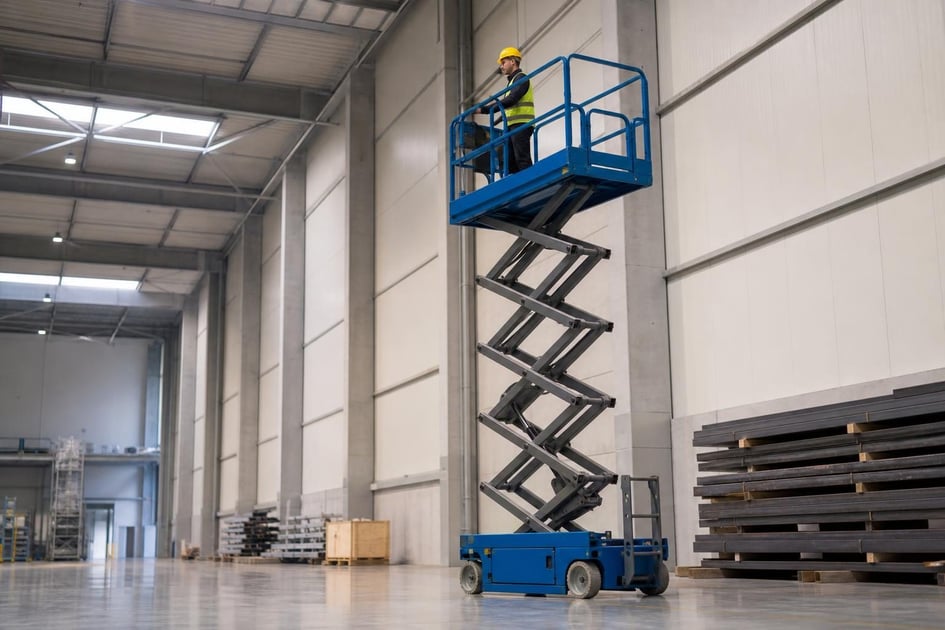
Financing a scissor lift means using the equipment itself as collateral, which keeps rates competitive and lets owner-operators preserve cash for payroll, materials, and growth. Most small businesses can finance new or used scissor lifts from $5,000 up to $5 million, with same-day approvals possible when your documentation is ready. Rates vary by credit profile, equipment age and term, so the exact monthly payment depends on your specific situation rather than a published sticker price.
Whether you run a construction crew, a facilities maintenance company, or a warehouse operation, a scissor lift is often essential rather than optional. If you are considering Scissor Lifts financing, the process is straightforward and designed to get you working quickly.
How Scissor Lift Financing Works
Scissor lift financing is a form of equipment financing. The lender secures the loan with the lift itself, which means you do not need to pledge real estate or other assets to close the deal. This structure is why small businesses with limited collateral can still access funding for machinery that would otherwise require a large capital outlay.
The process starts with an application that covers your business basics: time in operation, monthly or annual revenue, and the equipment you want to buy. Because the lift serves as collateral, lenders focus on the cash flow the equipment will help generate and the overall health of your business, rather than relying solely on personal credit scores. That said, your credit profile still matters. It influences the rate, the term options available, and the down payment requirement.
Once approved, the lender pays the vendor or private seller directly. You take delivery of the scissor lift and begin using it on jobs immediately. Payments are typically fixed monthly amounts spread over 24 to 60 months, though shorter and longer terms exist depending on the equipment cost and your preferences. At the end of the term, you own the lift outright, free and clear.
For businesses that need multiple lifts or plan to upgrade every few years, some lenders also offer equipment leasing structures. We will cover the lease-versus-loan decision in detail below, but the key point is that financing gives you options beyond writing a check. The U.S. Small Business Administration offers planning resources for owners evaluating major equipment purchases.
Already have a machine in mind?
Provide Capital finances new and used equipment from $5,000 to $5 million, with same-day decisions possible.
Apply NowWhat Determines Your Monthly Payment
No two financing agreements are identical because no two businesses are identical. Your monthly payment is a function of several variables that the underwriter weighs together.
Credit Profile
Your personal and business credit histories signal how reliably you have managed debt. A stronger profile unlocks longer terms and lower rates, while a weaker profile may require a larger down payment or a shorter term to offset risk. Even if your credit is not perfect, equipment financing is often more accessible than unsecured lending because the collateral reduces the lender's exposure.
Equipment Age and Condition
New scissor lifts command better financing terms than used ones because they have longer remaining useful life and stronger resale value. That does not mean used lifts are hard to finance. A well-maintained three-year-old lift from a reputable brand can still qualify for attractive terms. What underwriters watch for is excessive hours, poor maintenance records, or obscure brands with thin resale markets. If you are buying used, have the service history ready.
Term Length
Stretching the loan over 60 months lowers the monthly payment but increases total interest paid over the life of the loan. A 24-month term costs more per month but less overall. The right term depends on how quickly the lift will generate revenue and what your monthly cash flow can comfortably absorb. Most small businesses land in the 36-to-48-month range for lifts priced between $15,000 and $40,000.
By the Numbers: A $25,000 scissor lift financed over 36 months typically carries a monthly payment lower than the total rental cost for a comparable machine on a six-week job. If you use the lift more than eight weeks per year, ownership usually beats renting.
New vs. Used Scissor Lifts: A Financing Comparison
The new-versus-used decision is not just about purchase price. It affects your financing terms, maintenance budget, tax treatment, and how long the machine stays in your fleet. New lifts come with manufacturer warranties, zero operating hours, and the latest safety features. Used lifts cost less upfront and depreciate more slowly, but they may need repairs sooner.
From a financing perspective, new equipment often qualifies for lower rates and smaller down payments because the collateral value is predictable. Used equipment can still be financed aggressively, especially if it is a late-model unit from a major manufacturer like JLG, Genie, Skyjack, or Haulotte. Lenders know these brands hold value, so they are comfortable advancing a higher percentage of the purchase price.
| Factor | New Scissor Lift | Used Scissor Lift |
|---|---|---|
| Purchase price | $20,000 – $60,000+ | $8,000 – $35,000 |
| Typical down payment | 0% – 10% | 10% – 20% |
| Interest rate range | Lower end of range | Mid to upper range |
| Term availability | 24 – 60 months | 24 – 48 months |
| Warranty coverage | Full manufacturer warranty | Limited or expired |
| Tax depreciation | Full Section 179 eligible | Full Section 179 eligible |
The table above illustrates typical ranges, but your specific offer depends on the variables we discussed earlier. If you are comparing a new lift at $35,000 to a three-year-old lift at $22,000, run the numbers on total cost of ownership, not just monthly payment. A used lift that needs $4,000 in repairs during the first year may erase the upfront savings.
Pro Tip: When financing a used scissor lift, ask the seller for the hour meter reading, annual inspection records, and any recent service invoices. Lenders increasingly request this documentation for used equipment deals over $15,000, and having it ready can shave a day or two off approval time.
Lease vs. Loan: Which Structure Fits Your Business
An equipment loan ends with you owning the scissor lift. A lease gives you use of the lift for a set period, after which you return it, buy it out, or upgrade to a new model. The right choice depends on how long you plan to keep the equipment and how you want to treat it for tax purposes.
With a loan, you claim depreciation and potentially the Section 179 deduction because you are the owner. With a true lease, you typically deduct the lease payments as a business expense. Both can produce tax benefits, but the mechanics differ. Your CPA can model which structure saves more for your specific tax situation in 2026.
Leasing works well if you need the latest safety technology, operate in a high-wear environment where lifts age quickly, or want predictable replacement cycles. Loans work better if you plan to run the lift for seven to ten years, want to avoid mileage or usage restrictions, and prefer building equity in an asset you can eventually sell or trade. Industry coverage from Forbes regularly notes that the lease-versus-buy decision often hinges more on balance-sheet preference than on raw cost.
Rates vary by credit profile, equipment age and term for both products, so the spread between leasing and borrowing is not always wide. The more important distinction is ownership philosophy: do you want an asset on your balance sheet or an expense on your income statement?
Tax Treatment for 2026
For tax year 2026, the Section 179 deduction allows businesses to expense qualifying equipment purchases up to an inflation-adjusted annual limit. Scissor lifts used more than 50 percent for business purposes generally qualify. If your business purchases and places a lift in service during 2026, you may be able to deduct the full cost in the current tax year rather than depreciating it over several years.
Bonus depreciation may also apply in 2026, though the percentage has been phasing down from the peak levels seen in prior years. The exact bonus depreciation rate for 2026 depends on federal legislation and IRS guidance published for the tax year. Because these rules change and interact with state tax laws in complex ways, talk to your CPA before you structure a deal around a specific tax outcome.
One common misconception is that you must pay cash to claim Section 179. You do not. Financed equipment qualifies as long as you are in an ownership structure, such as a loan or capital lease, and you meet the business-use threshold. This is why many businesses finance the lift to preserve cash while still capturing the full deduction.
Key Insight: If you finance a $30,000 scissor lift in December 2026 but do not take delivery until January 2027, the deduction shifts to tax year 2027. The IRS bases the deduction on when the equipment is placed in service, not when the loan closes. Coordinate delivery timing with your tax advisor if you are near year-end.
See what you qualify for
The equipment itself secures the financing, which keeps rates competitive. Checking your options takes minutes.
Check Your OptionsQualification Criteria in Detail
Equipment financing is more flexible than bank term loans, but there are still thresholds you need to cross. Understanding them before you apply helps you present your business in the best light and avoids surprises.
Time in Business
Most equipment lenders prefer at least one to two years of operating history. That said, businesses with shorter track records can still qualify if revenue is strong and the buyer has relevant industry experience. If you have been in business for six months but already have signed contracts that require a lift, mention those contracts in your application. They demonstrate immediate revenue potential.
Revenue Requirements
Lenders want to see that your monthly revenue can cover the new payment. A common rule of thumb is that the equipment payment should not exceed a reasonable percentage of your monthly gross revenue, though the exact threshold varies by lender and industry. Having three to six months of bank statements ready speeds this part of the review.
Credit Range
There is no single cutoff score that guarantees approval or denial. Businesses with credit scores in the mid-600s and above generally see the most competitive terms. Those with scores below that range may still qualify, especially with a larger down payment or a shorter term. Because the lift collateralizes the deal, equipment financing is often available to borrowers who would not qualify for unsecured credit.
If you are financing a lift as part of a larger equipment package, the total deal size can also influence approval. Transactions from $5,000 to $5 million are possible, with documentation requirements increasing as the amount rises. A $12,000 lift might require only a one-page application and bank statements, while a $150,000 package with multiple lifts may need tax returns and a financial statement.
Documentation You'll Need
The faster you gather paperwork, the faster you close. For smaller deals under $50,000, most lenders ask for a driver’s license, a business bank statement, and an invoice or quote for the equipment. For larger transactions, add two years of business tax returns, a year-to-date profit and loss statement, and possibly a personal financial statement.
If you are buying from a private seller rather than a dealer, you will also need proof that the seller owns the lift free and clear, or a payoff letter if there is an existing lien. The lender will not fund a deal with title issues. For dealer purchases, the dealer usually handles title verification as part of the sale process.
Have the equipment specification sheet ready, including model year, serial number, hour reading, and any attachments. This lets the underwriter verify collateral value quickly and move straight to approval.
Industry-Specific Use Cases
Scissor lifts are not limited to one trade. In construction, they provide stable platforms for drywall, electrical, and finishing work at heights up to 50 feet or more. Construction equipment financing often includes scissor lifts alongside excavators and skid steers because general contractors need vertical access daily.
In facilities maintenance, property managers use electric scissor lifts to change lighting, repair HVAC systems, and maintain atriums. Warehouses and distribution centers rely on them for inventory management at height. In retail and hospitality, lifts handle signage installation and seasonal decoration changes. Even agriculture and forestry operations use rough-terrain scissor lifts for barn maintenance and equipment servicing. U.S. Census Bureau economic data consistently ranks construction, warehousing, and specialty trades among the most equipment-intensive small business sectors.
The use case affects which type of lift you need and therefore how much you finance. An indoor warehouse likely needs a compact electric model with non-marking tires, while an outdoor construction site needs a diesel rough-terrain unit with four-wheel drive. Match the machine to the environment, then finance the right specification rather than settling for a lift that does not fit your work.
Key Insight: Seasonal businesses often time scissor lift purchases for late winter or early spring to have equipment ready when construction and maintenance seasons begin. Financing lets you acquire the lift during the prep period and start generating revenue before the first payment is due, smoothing out seasonal cash flow gaps.
Common Mistakes When Financing Scissor Lifts
The biggest mistake is focusing only on the monthly payment and ignoring total cost of ownership. A lower monthly payment stretched over 60 months may cost more in interest than a slightly higher payment over 36 months. Run the full amortization before you sign.
Another mistake is buying the wrong lift for the application. A slab scissor lift with a 500-pound capacity and 19-foot platform height is inexpensive but useless if your crew needs to lift 1,000 pounds to 32 feet. Measure your typical job requirements, including outreach and terrain, before you shop.
Some buyers also forget to budget for insurance, maintenance, and operator training. Lenders require insurance naming them as loss payee, and OSHA-compliant training is mandatory. These are not deal-breaking costs, but they are real costs that affect your cash flow in the first year of ownership.
Finally, do not wait until you are desperate for the lift to apply for financing. Start the process two to three weeks before you need the machine. Same-day approvals are possible when files are complete, but complicated deals or private-party purchases can take longer. Planning ahead keeps you from paying premium rental rates while you wait for funding.
If you are ready to explore your options, see what you qualify for and get a same-day decision on your equipment.
What Happens After Approval
Once the lender issues an approval, you receive a term sheet outlining the monthly payment, term, down payment, and any fees. Review it carefully. If the terms match your expectations, you sign and return the documents. The lender then coordinates with the seller to fund the purchase.
For dealer transactions, funding usually happens within 24 to 48 hours of signed documents. For private-party sales, the timeline may stretch an extra day or two while title verification completes. As soon as the seller confirms receipt of funds, you arrange pickup or delivery.
After funding, your responsibility is simple: make the monthly payments and maintain the equipment. Most lenders do not impose usage restrictions, but they do require insurance and may ask for periodic proof of coverage. Stay current on both and the loan pays off on schedule, leaving you with a fully owned asset and no further obligations.
Expanding Your Fleet with Related Equipment
Many businesses that finance scissor lifts also need other vertical-access equipment. If your work requires maneuvering in tight spaces or over uneven ground, you may want to explore Spider Lifts financing as a complement to traditional scissor lifts. Spider lifts offer articulated booms and outriggers that fit through standard doorways yet reach heights comparable to larger lifts.
For automotive shops and collision centers, vehicle lifts use the same equipment-secured structure and can be bundled with scissor lifts if you run a multi-service operation. The key advantage of financing through a single lender is streamlined documentation: one application, one credit pull, and coordinated funding across multiple pieces of equipment.
Whether you need one lift or a full fleet, the process remains the same. Present your business financials, select the equipment, and let the collateral secure the deal. The flexibility to add machines as you win contracts is one reason equipment financing has become the standard funding path for owner-operators who want to grow without draining their operating accounts.
Put the right equipment to work
From $5,000 to $5 million, new or used, Provide Capital helps businesses nationwide finance the equipment they need.
Apply TodayFAQ
Can I finance a scissor lift with bad credit?
Yes, though the terms will reflect the added risk. Equipment financing uses the lift as collateral, which makes lenders more willing to work with lower credit profiles than unsecured lenders would be. Expect a larger down payment or a shorter term, and rates will vary by credit profile, equipment age and term. Providing strong revenue documentation can offset a weaker credit score.
How long does approval take?
Simple applications with complete documentation can receive same-day approvals. Larger transactions or deals requiring additional verification may take two to five business days. You can speed the process by having your bank statements, equipment quote, and tax returns ready before you apply.
Do I need a down payment?
Not always. New equipment deals for well-qualified buyers sometimes require zero down. Used equipment and lower credit profiles more commonly require 10 to 20 percent down. The down payment reduces the lender's risk and can improve your rate.
Can I finance a used scissor lift from a private seller?
Yes. Private-party sales are financeable as long as the seller can prove clear title. The lender will verify that no existing liens encumber the equipment before funding. This adds a day or two to the process compared with a dealer purchase.
What is the difference between a scissor lift and a boom lift?
A scissor lift raises workers straight up on a collapsing platform, making it ideal for vertical tasks over flat surfaces. A boom lift extends horizontally and vertically with an articulating or telescopic arm, offering outreach to reach over obstacles. Scissor lifts typically handle heavier platform loads, while boom lifts offer greater flexibility in positioning.
Does financing a scissor lift affect my ability to borrow for other equipment?
It can, but usually not dramatically. Equipment loans appear on your business credit report and affect your debt-service coverage ratio. However, because equipment financing is secured by the asset itself, lenders view it more favorably than unsecured debt. Many businesses carry multiple equipment loans simultaneously as they build their fleets.
What happens if I pay off the loan early?
Most equipment loans allow early payoff, though some include prepayment penalties during the first year or two. Ask your lender about prepayment terms before you sign. If you anticipate a large cash influx—such as a seasonal contract payout—structuring a loan without prepayment penalties can save you interest.
Are there tax benefits to financing a scissor lift in 2026?
For tax year 2026, Section 179 may allow you to deduct the full purchase price of a qualifying scissor lift in the year it is placed in service, subject to annual limits and business-use requirements. Bonus depreciation may also apply. Because tax law is complex and changes frequently, consult your CPA before making a purchase decision based on tax benefits.
Ready to move forward? Talk to a specialist about your specific machine and get a same-day decision on scissor lifts financing for small business.
Disclaimer: The information provided in this article is for general educational purposes only and is not financial, legal, or tax advice. Funding terms, qualifications, and product availability may vary and are subject to change without notice. Provide Capital does not guarantee approval, rates, or specific outcomes. For personalized information about your business funding options, contact our team directly.