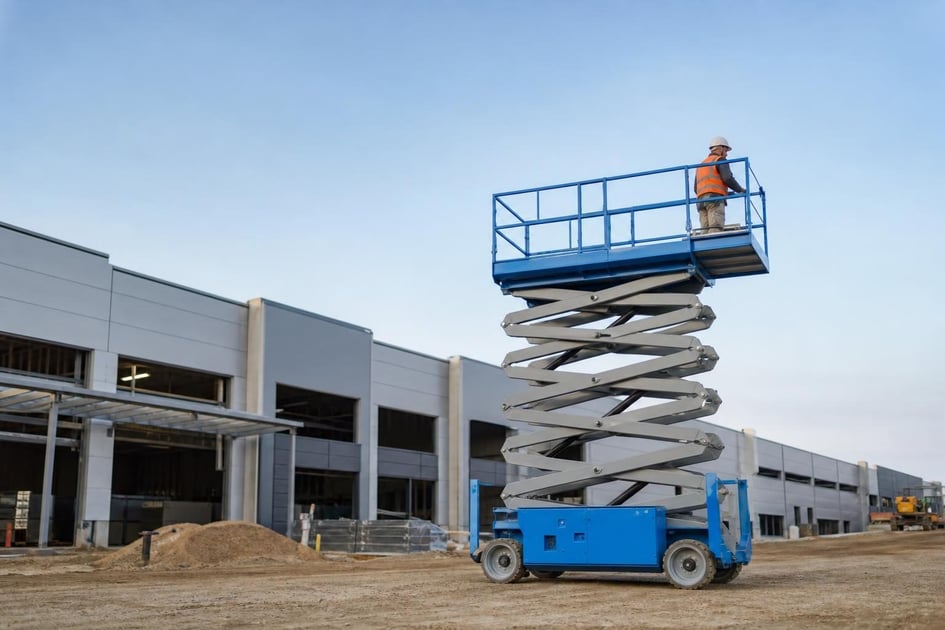
Yes, you can finance a scissor lift with no down payment. Because the equipment itself serves as collateral, lenders can fund the full invoice—including soft costs like delivery and installation—without requiring you to tie up working capital upfront. For owner-operators exploring Scissor Lifts financing for a 19-foot slab lift or a rough-terrain unit, the structure keeps cash in the business and moves the machine into revenue-generating service quickly.
How Zero-Down Scissor Lift Financing Works
When a lender uses the financed asset as security, the deal is called a secured equipment financing agreement. The serial number, make, model, and year of the scissor lift are recorded on a UCC-1 filing, which gives the lender a legal interest in the machine until the balance is satisfied. For the borrower, this means the advance rate can reach 100 percent of the invoice, including attachments and freight, provided the total fits within program guidelines. Programs typically start at $5,000 and can scale to $5 million for larger fleet acquisitions.
Because the collateral reduces the lender’s risk, rates vary by credit profile, equipment age and term rather than being pegged to unsecured benchmarks. A borrower with strong credit and a new Genie or JLG unit will see different pricing than a first-time buyer financing a 10-year-old off-brand lift, but both can secure funding without a capital outlay at closing.
This structure is especially useful for trades where margins are project-based. A roofing contractor bidding a three-month commercial job can add a scissor lift to the crew without draining the deposit account that covers payroll and materials. The machine arrives on site, the UCC filing is recorded, and payments begin after funding.
When the deal funds, the lender files a UCC-1 with the secretary of state in your jurisdiction. This public notice tells other creditors that the lender has a priority claim on the scissor lift. It does not prevent you from using the machine, selling it with lender permission, or adding it to your insurance policy. In fact, you will need a certificate of insurance listing the lender as loss payee and additional insured, which is standard practice. Once the final payment clears, the lender files a UCC-3 termination statement, and the lien disappears.
The SBA guidance on equipment loans explains that using the asset as collateral is standard practice for small business acquisitions. If you have an invoice in hand, see what you qualify for and learn what terms are available.
What You’ll Pay: Machine Costs and Deal Structure
Scissor lift prices span a wide band. Electric slab models used for interior maintenance and warehouse work typically cost less than rough-terrain diesel units built for unpaved construction sites. Used machines with higher operating hours trade at a discount, but they also carry shorter available terms and can trigger larger security deposits or administrative fees, even in zero-down programs.
Beyond the sticker price, a complete finance package can cover freight, installation, and training if those costs appear as line items on the dealer invoice. Some lenders allow up to a certain percentage of soft costs relative to the hard equipment cost, while others cap the total at 100 percent of the invoice. Rates vary by credit profile, equipment age and term, so financing $35,000 versus $40,000 changes the monthly obligation proportionally. Ask your specialist what ancillary costs can roll into the note.
New vs. Used Price Ranges and Why They Matter
A new lift carries a full manufacturer’s warranty, predictable maintenance schedules, and a known residual value. Lenders like these attributes, so they often extend longer terms—up to 60 months or more—on new units. Used machines, especially those between five and ten years old, may max out at 36 or 48 months. The shorter term raises the monthly payment, but the total out-of-pocket cost over the life of the deal is usually lower because the starting principal is smaller.
How Term Length Affects Monthly Cash Flow
Stretching the same principal over 60 months instead of 36 lowers the monthly obligation, which helps businesses that bill net-30 or net-60 on their contracts. The trade-off is that more payments mean more interest accrued over time. Rates vary by credit profile, equipment age and term, so the exact difference between a three-year and five-year deal changes with each application. The right fit depends on how many billable hours you expect the lift to generate each month.
| Factor | New Scissor Lift | Used Scissor Lift (Under 1,000 hrs) | Used Scissor Lift (Older/High Hours) |
|---|---|---|---|
| Typical financing term | 48–60 months | 36–48 months | 24–36 months |
| Collateral confidence | High (warranty + known value) | Moderate (depends on brand/hours) | Lower (may require stronger credit) |
| Monthly payment | Lower relative to value | Moderate | Higher relative to value |
| Best for | Long-term fleet standardization | Immediate capacity at lower total cost | Short-term projects or backup units |
By the Numbers: New slab scissor lifts in the 19- to 26-foot range typically carry invoice prices between $25,000 and $45,000, while comparable used models with under 1,000 hours often trade between $15,000 and $30,000. Rough-terrain lifts with diesel engines and four-wheel oscillating axles can run significantly higher. Fleet packages or multiple lifts can push totals toward the $5 million equipment-finance ceiling.
Qualifying for No-Down-Payment Approval
When a lender advertises no down payment, it does not mean automatic approval. The underwriter still evaluates the borrower and the asset. Understanding the criteria helps you present the strongest file.
Credit History and Business Track Record
Most equipment lenders want to see a personal credit score that demonstrates willingness to pay, but there is no universal cutoff. More important is the story: a borrower with a 680 score, two years in business, and six months of consistent bank deposits often looks better than a 720 score with erratic revenue and recent overdrafts. Time in business matters because it proves the company can generate revenue to cover the new obligation. If your business is younger, a strong co-signer or additional collateral elsewhere can compensate, though that starts to erode the zero-down advantage.
Equipment Age, Hours, and Resale Value
The underwriter will look up auction values and dealer wholesale pricing for the specific model year. A 2024 JLG 1930ES holds value differently than a 2012 off-brand import. Operating hours matter too: a five-year-old lift with 300 hours is a different risk than a five-year-old lift with 3,000 hours. If the machine is too old or has too many hours, the lender may still approve the deal but cap the term or require a small security deposit. In the no-down-payment tier, lenders prefer name-brand units—Genie, JLG, Skyjack, Haulotte—because replacement parts and buyer demand keep resale values predictable.
Vendor Documentation and Invoice Detail
Lenders fund equipment from legitimate vendors and dealers, not private-party sales in every case. An itemized invoice showing the base unit, battery, charger, freight, and any platform modifications gives the underwriter confidence that the collateral matches the loan amount. Vague invoices slow the process. If you are buying at auction, expect to provide the auction listing, condition report, and proof of payment before the lender releases funds.
Key Insight: Lenders collateralize the serial number and hour meter reading, not the brand name on the side. A well-maintained used lift with documented annual inspections and under 500 annual hours often secures better advance rates than a newer unit missing service records. Keep the maintenance file as complete as the title.
Before you shop, talk to a specialist about your specific machine to confirm advance rates and term availability.
Financing Structure: Loan vs. Lease
Not every zero-down deal is a loan. The structure changes who owns the asset, how the tax treatment works, and what happens when the last payment clears.
Equipment Finance Agreement (Loan)
With an equipment finance agreement, you own the scissor lift from day one. The lender files a UCC lien against it, but the title is in your business name. You claim depreciation and any applicable Section 179 deduction for tax year 2026, and you deduct the interest portion of each payment. At the end of the term, the lender releases the lien and you hold an unencumbered asset.
Fair Market Value Lease
An FMV lease is a rental agreement with a purchase option at the end. You do not own the lift during the lease; the lessor does. Monthly payments are often lower than a loan, but you must return the equipment or pay fair market value to keep it. This structure works well if you plan to upgrade to a newer model before the lease ends or if the lift is for a short-term contract.
$1 Buyout Lease
A $1 buyout lease is technically a lease for accounting purposes, but the $1 residual means you effectively own the machine after the final payment. It functions like a loan with a different name. Rates vary by credit profile, equipment age and term, but the structure lets you spread the cost without a down payment while locking in ownership.
| Feature | Equipment Finance Agreement (Loan) | FMV Lease | $1 Buyout Lease |
|---|---|---|---|
| Ownership | You own from day one | Lessor owns; you may buy at end | You own after final $1 payment |
| Monthly payment | Moderate | Lowest | Moderate to higher |
| Tax treatment (2026) | Interest + depreciation/Section 179 | Deduct payment as operating expense* | Interest + depreciation/Section 179 |
| End of term | UCC lien release | Return, renew, or buy at FMV | Automatic ownership transfer |
| Best for | Long-term asset retention | Short-term use or frequent upgrades | Ownership without upfront capital |
*Consult your CPA for tax year 2026 deductibility rules.
Tax Treatment for the 2026 Tax Year
Tax strategy is usually the second question after payment amount. For tax year 2026, the Internal Revenue Code offers several ways to write off equipment, but the exact limits and phase-out thresholds adjust annually for inflation. Because the specific dollar caps for 2026 change based on federal indexing, you should verify the current-year Section 179 limit and bonus depreciation percentage with your CPA before signing documents.
If you use an equipment finance agreement or a $1 buyout lease, you generally place the asset on your books and depreciate it. You may also be able to elect Section 179 for tax year 2026 to accelerate that deduction into the current year, subject to taxable income limitations. The interest component of each payment is separately deductible as a business expense.
Under a true FMV lease, you typically do not depreciate the asset because you do not own it. Instead, you deduct the lease payments as an operating expense, provided the lease qualifies under IRS guidelines. The deductibility depends on structure and use, so a CPA should review the contract.
State conformity adds another layer. Some states follow the federal Section 179 limit exactly for 2026, while others decouple and impose their own caps or disallow bonus depreciation entirely. If you operate in a high-tax state, the after-tax cost of ownership changes. Again, your CPA can model the difference between a loan and an FMV lease under your specific state rules for tax year 2026.
Industries That Rely on No-Down Scissor Lift Financing
Scissor lifts are not just for construction, though that is the most visible market. Commercial construction remains a major driver of equipment demand, and U.S. Census Bureau construction spending data tracks monthly activity that correlates directly with lift purchases. In 2026, warehouse operators also face continued demand for last-mile distribution space, driving interior maintenance and racking installation work. Electric slab lifts fit neatly into these facilities without venting exhaust.
HVAC contractors use scissor lifts to reach rooftop units on commercial buildings. A no-down-payment deal lets them match the equipment cost to the project schedule rather than carrying the asset year-round on the balance sheet.
Manufacturing plants need lifts for line maintenance, lighting retrofits, and mezzanine work. Because downtime is expensive, buying used through a fast equipment-finance agreement gets the machine into the plant faster than a lengthy capital expenditure approval process.
Facilities managers at hospitals and universities run preventive maintenance programs that require periodic aerial access. For these buyers, Construction equipment financing structures apply even when the end user is not a traditional contractor, provided the lift is used for business purposes.
Where job sites are tight—historic renovations, atriums, or narrow warehouse aisles—buyers sometimes pair a scissor lift with a more compact unit. If your work requires overhead reach in constrained footprints, Spider Lifts financing offers a complementary zero-down path for articulated boom platforms that scissor lifts cannot access.
In the roofing trade, demand peaks in late spring and early fall. Contractors who wait until the busy season to buy often face dealer stock shortages. Financing in late winter, with no down payment, lets you reserve the unit and lock in pre-season pricing while spreading the cost over 60 months. Similarly, landscaping companies adding tree-trimming divisions in early spring use scissor lifts to reach ornamentals, funding the machine before the first maintenance contract starts.
For owner-operators watching margins, Forbes coverage of small business capital trends notes that preserving cash flow through zero-down equipment deals helps contractors manage seasonal revenue swings.
Common Mistakes Buyers Make
Avoiding these errors saves time and money.
Underbuying Platform Height or Weight Capacity
A 19-foot platform height sounds adequate until you account for worker height and tool weight. Buyers who finance the cheapest unit often find themselves renting a larger lift for half their jobs. Finance the right spec the first time. It is easier to add a higher-capacity machine to the approval than to refinance a second purchase six months later.
Forgetting Delivery, Taxes, and Attachments in the Financed Amount
Scissor lifts do not drive themselves to your yard. Delivery fees, state sales tax, and essential accessories like pipe racks or panel cradles can add thousands to the true cost. If your finance request covers only the base unit, you pay those extras out of pocket. Ask the dealer for an out-the-door quote and finance the full amount.
Matching the Wrong Product to the Tax Strategy
A contractor who wants Section 179 acceleration in 2026 but signs an FMV lease will be disappointed at tax time. Conversely, a business that wants off-balance-sheet treatment but chooses a $1 buyout lease has created the opposite effect. Align the financing structure with your CPA’s advice before you sign.
Pro Tip: Request that your vendor itemize the invoice into the base machine, battery, charger, delivery, and any platform modifications. Lenders typically collateralize line-item equipment, not lump-sum “miscellaneous” charges. If accessories are not separated, you may pay for them out of pocket even when the lift itself is fully financed.
The Documentation Checklist
Same-day approvals are possible when the file is clean. Gather these items before applying:
- Equipment quote or invoice from a verified dealer
- Completed application with business and personal details
- Last three months of business bank statements
- Voided business check for ACH setup
- Driver’s license or other government ID
- Business tax returns (typically required for requests above a certain threshold, though specific revenue requirements vary by lender)
If the lift is used, include photos, hour-meter readings, and maintenance records. The underwriter may also request proof of insurance naming the lender as loss payee before funding.
From Application to Delivery: The Timeline
Same-day approvals are possible when the file is complete. Here is how the timeline typically breaks down:
- Hour 0: You submit the application, invoice, and bank statements.
- Hour 1–2: The underwriter reviews credit, verifies the dealer, and checks collateral value.
- Hour 2–4: If approved, you receive a term sheet or verbal approval outlining the payment, term, and any conditions.
- Day 1–2: You sign documents and provide proof of insurance.
- Day 2–3: The lender funds the dealer directly via ACH or wire.
- Day 3–5: The dealer releases the lift for delivery or pickup.
Delays usually come from incomplete invoices, insurance hiccups, or title issues on used equipment. Get ahead of them by preparing the full file upfront.
Frequently Asked Questions
Can I really get scissor lift financing with no down payment?
Yes. Because the lift itself collateralizes the deal, lenders can advance 100 percent of the invoice for qualified buyers. Your credit profile, equipment age, and term will shape the rate and structure.
Does no down payment mean no collateral or no credit check?
No. The lender still underwrites your credit and business history. The equipment serves as the collateral. There is no program that skips underwriting entirely.
How fast can I get approved?
Same-day approvals are possible when your application, equipment quote, and bank statements are complete. Incomplete files take longer.
Can I finance a used scissor lift with no money down?
Yes, provided the unit is not too old and has verifiable hours and maintenance records. Used machines may carry shorter maximum terms than new ones.
What happens if I want to pay off the loan early?
Most equipment finance agreements allow early payoff, but the exact prepayment terms—whether interest is rebated or a fee applies—vary by contract. Ask your specialist before signing.
Can I finance the delivery and tax too?
Often yes, if those costs are itemized on the dealer invoice. Lenders collateralize the entire package up to the approved amount, soft costs included.
Do I own the lift at the end of the term?
With a loan or $1 buyout lease, yes. With an FMV lease, you must exercise the purchase option at fair market value or return the equipment.
Is the interest tax-deductible in 2026?
Generally, yes. Interest paid on business equipment financing is a deductible expense for tax year 2026. Depreciation and Section 179 treatment depend on whether you structure the deal as a loan or a true lease. Consult your CPA.
Next Steps
You do not need to drain your operating account to put a scissor lift to work. Whether you are adding one electric slab unit or building a fleet of rough-terrain machines, zero-down equipment financing matches the cost to the revenue the lift generates. Start by gathering your invoice and bank statements, then get a same-day decision on your equipment to lock in terms and delivery. Getting the facts takes less time than a service call, and it puts the machine on your job site while your cash stays where it belongs—in the business.
Disclaimer: The information provided in this article is for general educational purposes only and is not financial, legal, or tax advice. Funding terms, qualifications, and product availability may vary and are subject to change without notice. Provide Capital does not guarantee approval, rates, or specific outcomes. For personalized information about your business funding options, contact our team directly.