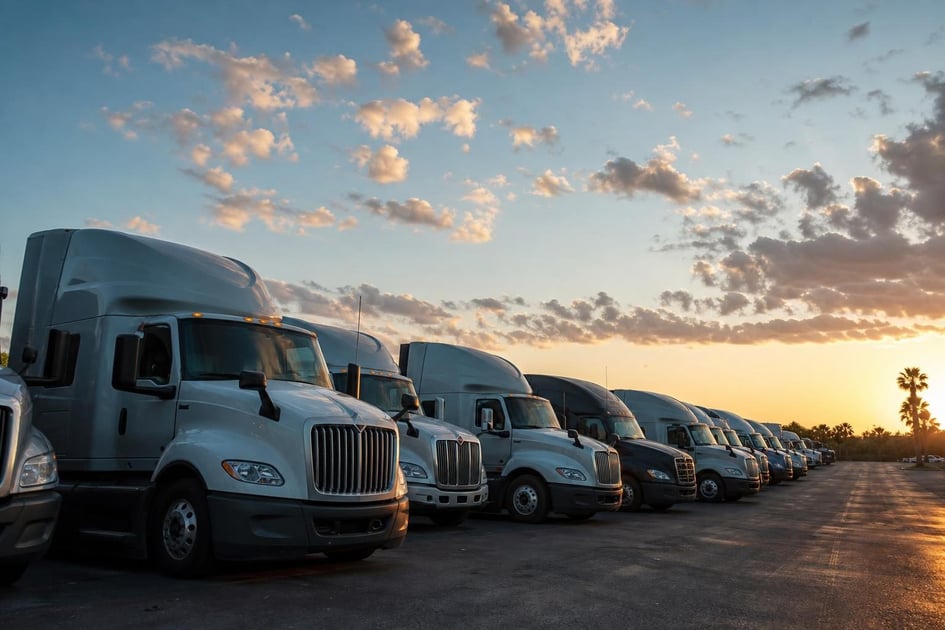
If you are buying a semi truck in Florida, financing is available from $5,000 to $5 million with the equipment itself serving as collateral. Rates vary by credit profile, equipment age and term. Same-day approvals are possible, which matters in a state where freight volumes swing with produce season, tourism cycles and hurricane rebuilding. Whether you are running reefer loads out of central Florida or flatbeds down the interstate corridors, understanding how Semi Trucks financing works in this market will help you structure a deal that fits your cash flow.
Key Insight: Florida's produce season runs roughly from October through May, creating a predictable surge in reefer freight rates that owner-operators can use to offset slower summer months. Lenders familiar with the state often see stronger winter cash flows from agricultural haulers and may structure payments accordingly.
Why Florida's Freight Market Rewards the Right Truck
Florida is not a generic trucking state. It is a peninsula with heavy inbound freight and strong seasonal outbound surges. Winter vegetables, strawberries, peppers and citrus move north from central and southwest Florida for much of the year. The summer hurricane season triggers sudden demand for building materials, generators and relief supplies. Year-round, tourism in central Florida and along both coasts requires constant restocking of hotels, restaurants and retail. That means an owner-operator who owns the right equipment can stay loaded more months of the year than in many other states.
The state's highway network reflects this demand. Interstate 95 runs the entire east coast, Interstate 75 cuts north-south through the western half, and Interstate 10 provides an east-west corridor across the Panhandle. The Interstate 4 corridor between Tampa and Orlando is one of the busiest freight routes in the Southeast. For truckers based near Jacksonville, Port Everglades or PortMiami, drayage and intermodal work adds another revenue stream. U.S. Census Bureau commodity flow surveys consistently show Florida among the top states for truck-moved freight by value, driven by agriculture, imports through deepwater ports and consumption by a large residential population.
All of this means that lenders active in Florida understand the cyclical nature of the market and structure Transportation equipment financing accordingly. They know a reefer tractor working the strawberry harvest in March is a different risk profile than a dry van running dedicated retail routes in Orlando. That regional knowledge can lead to faster approvals and more flexible terms.
Already have a machine in mind?
Provide Capital finances new and used equipment from $5,000 to $5 million, with same-day decisions possible.
Apply NowWhat Semi Truck Financing Covers
New vs. Used Equipment
New Class 8 day cabs typically run between $130,000 and $180,000 depending on specification, while sleeper cabs can push past $200,000 when equipped with aerodynamic packages and integrated sleeper quarters. Used trucks three to five years old often fall in the $75,000 to $125,000 range, though mileage and engine history matter more than calendar age. Because the equipment itself is the collateral, lenders weight the asset value heavily in the approval decision.
Financing terms generally stretch from 48 to 84 months for new trucks. Used equipment usually qualifies for 48 to 72 months, with the maximum term shrinking as the truck ages. A truck with 600,000 miles and ten years on the road may still be financeable, but expect a shorter term and a larger down payment requirement. Most lenders cap the advance at the appraised value or the purchase price, whichever is lower.
Soft Costs and Add-Ons
Many borrowers roll sales tax, title fees and an extended warranty into the financing. This is practical in Florida because the sales tax rate varies by county and can add several thousand dollars to the transaction. Rolling these costs preserves working capital for fuel, insurance and permits. Not every lender allows full soft-cost financing, so ask upfront if you want the total project cost wrapped into one payment.
By the Numbers: A buyer in Hillsborough County paying sales tax on a $120,000 used sleeper cab could see roughly $7,200 in tax plus title and registration fees. Rolling that into the financing instead of paying cash preserves liquidity for fuel deposits and the first month of insurance premiums.
Who Qualifies for Semi Truck Financing
Lenders look at three primary factors: time in business, credit profile and cash flow. Two or more years in business is the standard threshold, though some programs accept one year with a strong credit score and documented revenue. Credit scores in the 600s are often the minimum, while scores in the 700s unlock better terms and lower down payment requirements. Monthly revenue should generally support the proposed payment, with most lenders looking for the equipment payment to consume no more than a set percentage of gross monthly receipts.
The equipment itself is the collateral, which keeps rates competitive compared with unsecured borrowing. That also means the lender will care about the truck's make, model, year and maintenance history. A well-maintained Freightliner or Peterbilt from a reputable dealership will command better terms than a high-mileage unit from a private seller with incomplete records. If you are buying from a private party, expect additional documentation requests and possibly a third-party inspection.
The U.S. Small Business Administration publishes guidance showing that equipment loans are one of the most common funding tools for small transportation businesses, precisely because the collateral reduces lender risk and allows borrowers to preserve working capital. That dynamic holds true for Florida owner-operators running single trucks or small fleets.
Lease vs. Loan: Which Fits Your Operation
Owner-operators often debate whether to take out an equipment loan or enter a lease. The right choice depends on how long you plan to keep the truck, how many miles you run annually and your tax situation for 2026.
| Factor | Equipment Loan | Fair Market Value Lease | $1 Buyout Lease |
|---|---|---|---|
| Ownership | You hold title after final payment | Option to purchase at fair market value | You own after final payment |
| Down payment | Typically 0% to 20% | Often first and last payment upfront | Often first and last payment upfront |
| Monthly payment | Higher than FMV lease | Lower than loan | Similar to loan |
| Mileage restrictions | None | Usually annual limits apply | None |
| Tax treatment (2026) | Interest deductible; depreciation via Section 179 and bonus depreciation subject to annual limits | Lease payments generally fully deductible as operating expense | Treated similarly to a loan for tax purposes; consult your CPA |
| Best for | High-mileage owner-operators planning to run the truck 7 to 10 years | Fleet operators who refresh equipment every 3 to 4 years | Borrowers who want ownership certainty with lower upfront cash |
Florida-based operators running produce or refrigerated freight often put high annual miles on a truck. For them, an equipment loan usually wins because there are no mileage penalties. If you are testing a new lane or running seasonal hurricane-relief contracts, a fair market value lease might make sense because you can return the equipment when demand drops.
Pro Tip: If you are considering a used truck, ask the seller for maintenance records going back at least two years. Lenders increasingly require documentation of major services such as after-treatment system work, transmission servicing and engine overhead adjustments. A file with complete records can speed approval by several days and sometimes improve your rate by reducing the lender's collateral risk.
Tax Treatment for Tax Year 2026
For tax year 2026, Section 179 allows businesses to deduct the cost of qualifying equipment, subject to annual inflation-adjusted limits. The exact dollar cap changes each year, and the total amount you can deduct depends on your total equipment purchases and taxable income. Because these limits adjust annually, verify the current threshold with your CPA before making a purchase decision.
Bonus depreciation continues its scheduled phase-down from the elevated percentages available in prior years. For 2026, the remaining percentage is lower than in 2025, but it may still apply to qualifying new and used equipment. The interaction between Section 179, bonus depreciation and regular depreciation is complex, and the optimal strategy depends on your taxable income, other deductions and the month you place the truck in service. Work with a CPA who understands both federal tax rules and Florida's tax environment to build a strategy that maximizes your 2026 deductions without creating a net operating loss you cannot use.
Lease payments are generally treated as operating expenses and deducted as paid, which simplifies recordkeeping but may provide a smaller total deduction over the life of the deal compared with ownership. Again, your CPA can model both scenarios using the 2026 tax rules.
Real-World Cost Examples
Here is how financing breaks down for typical Florida buyers at different price points. These are illustrative; your actual rate and term will vary by credit profile, equipment age and term.
Used day cab, $85,000 purchase price. With a 10% down payment of $8,500, you finance $76,500 over 60 months. Depending on credit and equipment age, the monthly payment could fall in a range that leaves room for fuel, insurance and maintenance while preserving operating cash flow.
New sleeper cab, $175,000 purchase price. With 15% down, or $26,250, you finance $148,750 over 72 months. The longer term keeps the monthly obligation manageable, though you pay more in total interest over the life of the loan. This structure works well for an owner-operator running long-haul lanes out of Jacksonville or Miami who plans to keep the truck for a full decade.
Private-party used truck, $60,000 purchase price. Because private sales carry more documentation risk, some lenders require 20% down, or $12,000, and a shorter 48-month term. The higher equity position protects the lender and often offsets the lack of dealer warranty with a stronger collateral buffer.
Ready to add capacity before produce season peaks? Talk to a specialist about your specific machine and terms that match your credit profile.
Find the right financing structure
Tell us about the equipment you need and we will show you the options that fit your business.
See Your OptionsFlorida-Specific Industry Use Cases
Trucking in Florida is not monolithic. The best financing structure depends on what you haul and where you run.
Agriculture and produce. From October through May, Florida supplies the eastern United States with tomatoes, strawberries, peppers and citrus. Reefer owner-operators running out of central and southwest Florida need reliable equipment with strong refrigeration units. Financing a reefer unit often means bundling the tractor and trailer into one package or using separate programs for each asset. Lenders familiar with produce season understand that cash flow peaks in winter and may structure seasonal payments.
Construction and hurricane recovery. When storms hit, demand for lumber, roofing, generators and building materials surges across the peninsula. Dump Trucks financing and flatbed tractors see increased demand during rebuild cycles. Owner-operators who serve this market often need versatile equipment that can handle both daily construction runs and occasional overweight permits.
Tourism and hospitality supply. Central Florida's tourism corridor requires constant delivery of food, beverages, linens and retail goods. Local route drivers running day cabs typically work shorter hauls but make multiple stops. These operators often prioritize maneuverability and fuel efficiency over sleeper amenities, which changes the price point and the optimal loan term.
Port and intermodal drayage. Jacksonville, Port Everglades, PortMiami and Tampa handle substantial container volume. Drayage tractors usually log fewer highway miles but endure more stop-and-go wear. Used day cabs with well-documented maintenance histories are common in this segment, and lenders comfortable with port logistics understand the revenue cycle tied to shipping schedules.
Key Insight: Florida's hurricane season creates sudden demand spikes that last well beyond the storm itself. Owner-operators with flatbed or dump configurations often see six to twelve months of elevated construction freight as rebuilding progresses. Financing equipment in late spring positions you to capture that cycle when it arrives.
Common Mistakes Florida Buyers Make
One frequent error is buying a truck without verifying financing approval first. Owner-operators find a deal at a dealership or auction, put down a deposit, then discover the truck does not meet lender age or mileage requirements. Get pre-qualified before you shop so you know your price range and the lender's collateral rules.
Another mistake is ignoring the total cost of ownership. Florida's fuel prices, insurance rates and tolls on the Turnpike and certain expressways add up. A low monthly payment on an older truck can evaporate if the engine needs an in-frame rebuild or the transmission fails. Budget for maintenance reserves alongside your finance payment.
Some buyers also fail to account for seasonal cash flow. If your revenue drops by a significant margin in the summer produce off-season, a fixed monthly payment that felt comfortable in February may strain your account in July. Structure your term and down payment to survive the slow months, not just the busy ones. Reuters industry analysis has documented how produce price volatility directly affects owner-operator margins in agricultural states, making conservative leverage a smart strategy.
Finally, do not assume all lenders understand Florida's unique market. A national call-center operation may not recognize the value of a reefer unit during strawberry season or the revenue potential of hurricane-relief flatbed work. Working with a lender that finances transportation equipment nationwide and understands regional freight patterns can lead to a faster, more favorable decision.
Documentation You Will Need
Having your paperwork ready speeds the approval process. Most lenders request the following:
- Recent business tax returns
- Current profit and loss statement
- Recent business bank statements
- Current driver's license and medical card
- Quote or purchase agreement for the specific truck
- Proof of insurance, or a quote showing you can insure the equipment
If you are buying from a private party, add a bill of sale, the seller's title and possibly a third-party inspection report. For new trucks, the dealer invoice and build sheet will satisfy the collateral documentation. The cleaner your records, the faster the underwriter can move. Same-day approvals are possible when the file is complete on the first submission.
What Happens After Approval
Once approved, the lender issues a commitment letter outlining the rate, term, payment and any conditions. Review this carefully. Conditions might include proof of down payment funds, specific insurance coverage limits or a satisfactory inspection. After you accept, the lender wires funds directly to the seller or issues a draft payable to the dealership. You take delivery, register the truck in Florida and provide the lender with the title showing their lien.
Most lenders do not hold the title indefinitely. Once you pay the balance, they release the lien electronically or by mail, and the title becomes yours free and clear. If you finance through a lease, the process differs slightly at end-of-term, with either a purchase option or return inspection. Read your documents at closing so there are no surprises in month 60 or 72.
If you have a truck picked out and want to see what you qualify for, start an application and get a same-day decision on your equipment.
Put the right equipment to work
From $5,000 to $5 million, new or used, Provide Capital helps businesses nationwide finance the equipment they need.
Apply TodayFrequently Asked Questions
Can I finance a semi truck with a credit score below 650?
Yes, though terms will vary by credit profile, equipment age and term. Borrowers in the 600 to 649 range can often still qualify, especially with a larger down payment or a strong revenue history. Below 600, options narrow, but the equipment itself as collateral gives lenders more flexibility than unsecured credit.
How much down payment is required?
Down payments typically range from 0% to 20%, depending on your credit profile, the equipment's age and the lender's program. New trucks for well-qualified buyers sometimes require no money down. Used trucks from private sellers or borrowers with shorter time in business more often require 10% to 20%.
Can I finance a truck I buy from a private seller?
Yes, but expect additional documentation. The lender will need a clear title history, a bill of sale and often a third-party inspection. Private-party transactions carry more fraud risk, so underwriters scrutinize them more closely than dealer sales. The truck may also need to meet stricter age and mileage criteria.
Can I include sales tax, title and warranty in the financing?
Many lenders allow you to roll soft costs into the total project amount, up to a percentage of the equipment value or a specific dollar cap. This preserves working capital. Ask upfront whether the lender structures the deal around the equipment cost only or the total project cost.
How long does the approval process take?
Same-day approvals are possible when your documentation is complete and the collateral meets the lender's guidelines. More complex files, such as private-party purchases or borrowers with limited time in business, may take 24 to 48 hours. Submitting a complete file on the first try is the single best way to speed things up.
Can I buy a truck in another state and register it in Florida?
Yes. Interstate transactions are common. The lender will wire funds to the out-of-state seller, and you will handle Florida registration and title transfer at your local county tax collector's office. Make sure the seller provides a properly assigned title and a bill of sale that matches the lender's payoff amount.
Is there a penalty for paying off the financing early?
Some equipment loans carry a prepayment penalty, especially in the first 12 to 24 months. Others allow payoff at any time with no penalty. Read your loan agreement before signing. If early payoff is important to you, ask your financing specialist to structure the deal with a lender that does not charge prepayment fees.
What types of semi trucks can be financed?
Lenders finance day cabs, sleeper cabs, heavy haul tractors and specialty configurations. The truck must generally be used for business purposes. Personal-use or recreational vehicles do not qualify for business equipment financing. If you need a specific body type, such as a dump configuration or reefer unit, mention it early in the application.
Ready to Finance Your Next Truck?
Florida's freight market rewards owner-operators who move fast and own reliable equipment. Whether you are adding capacity for produce season, replacing an aging tractor or expanding into port drayage, the right financing structure keeps your cash flow intact and your truck on the road. Rates vary by credit profile, equipment age and term, and the equipment itself is the collateral, which keeps borrowing costs competitive compared with unsecured options.
If you are ready to see what you qualify for, get a same-day decision on your equipment. If you are still comparing models or sorting out your tax strategy for 2026, talk to a specialist about your specific machine and terms that match your credit profile.
Disclaimer: The information provided in this article is for general educational purposes only and is not financial, legal, or tax advice. Funding terms, qualifications, and product availability may vary and are subject to change without notice. Provide Capital does not guarantee approval, rates, or specific outcomes. For personalized information about your business funding options, contact our team directly.