What to Expect From Skid Steers Financing for a Startup Business
If you are launching a company in construction, landscaping, or agriculture and need a loader, skid steers financing startup business options are more accessible than you might think. Because the equipment itself secures the transaction, lenders can work with companies that have limited operating history. At Provide Capital, we finance new and used business equipment from $5,000 to $5 million nationwide, using the machine as collateral to keep rates competitive. That structure means same-day approvals are possible when your documentation is complete.
Still, a startup application is underwritten differently than one from an established contractor. You should expect to prove personal creditworthiness, provide a clear use of funds, and possibly sign a personal guarantee. Understanding how the process works before you shop for a machine will save you time and keep your monthly payments aligned with your early cash flow.
How Lenders View a Startup Application
A startup in equipment finance usually means any business operating for less than two years, and in some cases a company still in its first six months. Without lengthy financials, the lender shifts weight to the owner’s personal credit, the quality of the equipment, and the size of the down payment. The skid steer’s resale value matters because it is the collateral.
Personal Credit and Guarantees
Most startup equipment deals require a personal guarantee from the majority owner. Your personal FICO score is heavily weighted because the business has not yet built its own credit profile. Strong personal credit improves the likelihood of approval and can reduce the required down payment. If your credit has recent blemishes, expect a larger initial investment or a shorter term. We look at the full picture—time since derogatory events, current revolving balances, and whether you have existing commercial relationships—but the personal score is the starting point.
Time in Business and Revenue Documentation
If you have been operating for even three to six months, bank statements showing deposits can strengthen the file. For pre-revenue startups, a detailed business plan and a signed equipment quote from a dealer may suffice. The lender wants evidence that the machine will generate revenue that covers the payment. A startup bidding on its first municipal contract or landscaping route can use the purchase order or contract letter as supporting documentation.
Industry Experience and Vendor Relationships
Prior experience in your industry counts even if the legal entity is new. An owner who spent five years as a foreman before forming a limited liability company presents lower operational risk than someone entering construction cold. If you have relationships with established dealers, mention them. Reputable vendors provide clean titles, warranty support, and accurate hour meters, all of which reduce collateral risk for the lender.
Down Payment Expectations
Startups should plan on putting money down. While zero-down promotions exist in consumer markets, equipment finance for a new company typically requires an investment. The exact percentage depends on credit tier, equipment age, and term length, but planning for a down payment will keep your application moving. Because the equipment is the collateral, the lender wants to see equity in the deal from day one.
If you are ready to see how your profile translates to terms, talk to a specialist about your specific machine and learn what documentation you need to gather.
How Collateral Value Drives the Approval
Lenders treat the skid steer as the primary security. That means the underwriter cares about year, make, model, operating hours, and market demand. A popular brand with readily available parts and a strong resale history commands a higher advance rate than an obscure import with limited dealer support. Hours matter more than age in many cases. A five-year-old machine with eight hundred hours may be viewed more favorably than a three-year-old unit with three thousand hours. If you are buying used, obtain the maintenance records and a recent inspection. The lender may not require a third-party appraisal for machines under a certain price point, but they will verify the serial number against industry databases to check for existing liens, theft reports, or total-loss history.
Hours, Brands, and Model Years
Compact track loaders and wheeled skid steers depreciate differently. Track machines often hold value longer in wet climates, while wheeled units are cheaper to maintain in dry regions. Model years within the last decade generally qualify for standard terms, but once a machine crosses a decade in age or exceeds four thousand hours, the lender may narrow the term or require a larger equity injection. Sticking with manufacturers that have broad dealer networks makes resale value easier to verify, which speeds underwriting.
New vs. Used Skid Steers: What Changes in Financing
The age and hours on a skid steer directly affect the term, down payment, and rate range. New machines qualify for longer terms and sometimes lower down payments because the collateral value is predictable. Used equipment can be financed just as readily, but the lender will cap the term to match the machine’s remaining useful life.
| Factor | New Skid Steer | Used Skid Steer (Under 5 Years) | Used Skid Steer (5+ Years or High Hours) |
|---|---|---|---|
| Typical term range | 36–60 months | 36–48 months | 24–36 months |
| Down payment | Often lower | Moderate | Higher |
| Collateral confidence | High (warranty, known value) | Moderate | Dependent on inspection |
| Rate outlook | Most competitive range | Competitive | Rates vary by credit profile, equipment age and term |
A new loader from a major brand may hold value well enough to support a five-year note. A ten-year-old unit with four thousand hours may still get financed, but the term could be limited to two or three years to prevent the loan from outliving the machine’s productive life. If you are weighing a new purchase against a used bargain, remember that a shorter term on a cheaper machine can still produce a higher monthly payment than a longer term on a newer unit.
Attachment Bundling and Soft Costs
Many startups need more than the machine itself. Buckets, augers, grapples, and trenchers can often be bundled into the same finance contract if they are quoted on the same invoice. Delivery fees and initial warranty extensions may also be rolled in. This keeps your monthly accounting simple and avoids the need for separate credit pulls. Tell your lender upfront if you want attachments or soft costs included so the approval amount covers the full package.
For more details on how we structure deals for earth-moving equipment, review our Skid Steers financing options or explore Dump Trucks financing if you are building a mixed fleet.
Lease vs. Loan: Which Structure Fits a Startup?
Equipment loans and equipment leases are both available to startups, but the structure changes who owns the asset, how the balance sheet looks, and what happens at the end of the term.
An equipment finance agreement or loan puts the title in your business name once the down payment clears and the lien is recorded. You claim depreciation and interest, and when the final payment posts, the lien releases automatically. A lease, on the other hand, is often structured as a fair-market-value agreement where the lessor holds title. You make payments for the use of the equipment and may have the option to purchase, return, or renew at the end.
| Consideration | Equipment Loan | Fair Market Value Lease |
|---|---|---|
| Ownership | You own; lender holds lien | Lessor owns |
| Monthly payment | Typically higher | Typically lower |
| End of term | Free and clear | Purchase, return, or renew |
| Tax treatment (general) | Depreciation plus interest deduction | Payment may be deductible as expense; confirm with CPA |
| Best for startups that... | Want equity and long-term fleet assets | Need lower payments or plan to upgrade often |
Startups with uncertain growth paths sometimes prefer a loan because every payment builds equity. Others choose a lease to preserve cash in the first critical year. There is no universal right answer, but the decision should be driven by your expected utilization, tax strategy, and whether you want to own the machine at month forty-eight.
Balance Sheet Impact for Startups
A loan appears as both an asset and a liability on your balance sheet, which can improve your debt-to-asset ratio as you pay down the principal. An operating lease may keep the liability off the balance sheet entirely, depending on the structure and your accounting method. For a startup seeking additional credit lines later in the year, the lease-versus-loan choice can affect how vendors and banks view your leverage. Discuss the presentation with your accountant before you commit.
Tax Treatment for the 2026 Tax Year
Under the tax rules for 2026, Section 179 may allow you to deduct the cost of qualifying equipment in the year you place it in service, subject to annual limits and taxable-income thresholds that adjust for inflation. Because the specific dollar ceilings and phase-out ranges for the 2026 tax year depend on inflation-adjusted figures, you should confirm the exact limit with your CPA before you file.
Bonus depreciation is also a factor for the 2026 tax year, though it continues to phase down from prior-year levels. Your accountant can model whether Section 179 expensing, bonus depreciation, or regular MACRS depreciation produces the best outcome for your startup’s first tax return. If you finance the skid steer, you still own the equipment for tax purposes under a loan, which preserves your ability to claim these deductions. Lease structures may treat payments as operating expenses, but the details depend on whether the lease is classified as a true tax lease or a finance lease. Review the structure with your CPA before you sign.
For additional background on depreciation rules, see IRS Publication 946 on depreciation. If you are still drafting your business plan, SBA guidance on writing a business plan can help you organize the revenue projections lenders want to see.
Worked Cost Examples for Startup Buyers
Numbers help ground the conversation. Below are two realistic scenarios for startup owner-operators. These examples do not include an interest rate because rates vary by credit profile, equipment age and term. Instead, they show how down payment and term length affect the financed amount and monthly obligation structure.
Scenario A: Entry-Level Used Machine
A new excavation and grading startup finds a two-year-old skid steer with two hundred operating hours listed at $28,000. The lender requires a down payment at the higher end of the startup range due to limited time in business. The borrower puts down $5,000, leaving $23,000 to finance. Because the machine is relatively young, the lender approves a forty-eight-month term. The shorter term builds equity quickly but keeps the total interest cost lower than a sixty-month note. The owner also bundles a bucket and pallet forks for $3,000, bringing the total financed to $26,000. By keeping the equipment under its original warranty period, the lender views the collateral favorably, which helps offset the startup risk.
Scenario B: New Loader for a Landscaping Fleet
A landscaping company in its first year of operation needs a new skid steer to handle a multi-year commercial contract. The machine retails at $62,000 with a high-flow hydraulic package and brush cutter attachment. The total invoice comes to $68,000. The owner finances the package over sixty months with a down payment of roughly fifteen percent. The financed amount falls well below the five million dollar maximum, and the equipment collateral allows the lender to stretch the term to keep payments manageable against the predictable contract revenue. Because the machine is new, the lender does not require an independent appraisal, which speeds the closing timeline.
These scenarios illustrate why the equipment itself matters as much as the borrower. A strong machine with documented hours and a recognized brand can carry a deal even when the business is young.
Industry Use Cases That Justify the Purchase
Skid steers are not universal machines, but they are central to several industries where startup activity is high. Lenders like to see a clear connection between the equipment and revenue.
Construction and Demolition
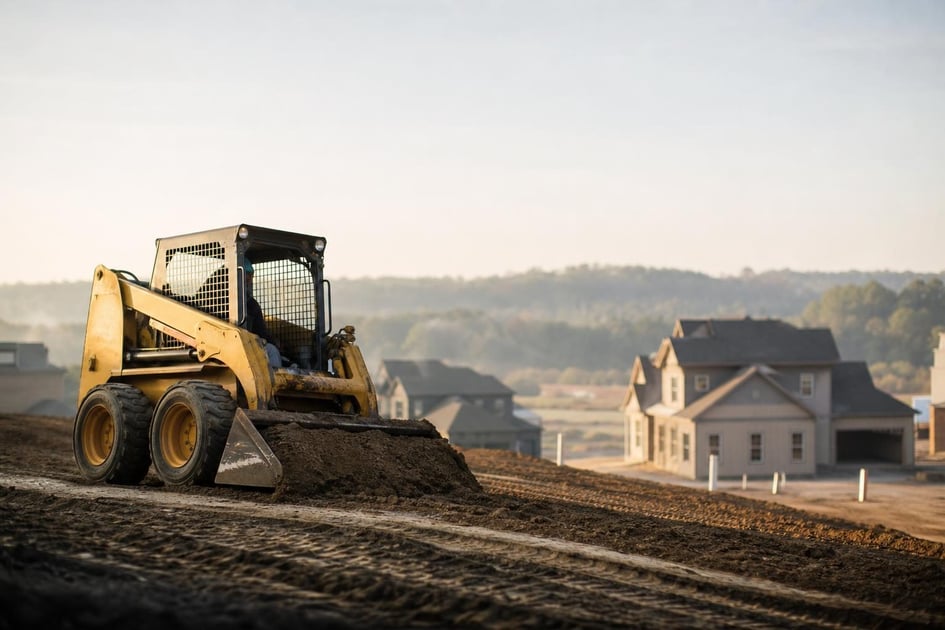
General contractors and site prep startups use skid steers for grading, material handling, and debris removal. A single machine can replace multiple pieces of equipment on small-to-mid residential jobs. If you are entering this space, pairing a skid steer with Construction equipment financing for complementary machines like excavators or dump trailers can create an efficient fleet.
Agriculture and Forestry
Farm startups and land-clearing operations use skid steers for moving feed, handling brush, and loading logs. The compact footprint allows work in barns and tight woodlots where larger loaders cannot operate. High-flow hydraulics enable brush-mulching attachments that turn the machine into a year-round revenue tool. Forestry startups in particular benefit from the maneuverability when working on uneven terrain.
Property Maintenance and Snow Removal
In northern climates, a skid steer with a snow pusher or blower can generate winter revenue that offsets the monthly payment during off-peak landscaping months. Startups that plan seasonal diversification should mention this in their application. Lenders view seasonal income positively when it is documented through contracts or historical invoices from related businesses.
Documentation You Need Before Applying
Gathering paperwork before you submit speeds the approval process and can move you into the same-day decision window.
For Pre-Revenue or Brand-New Startups
- Personal financial statement for each guarantor
- Two years of personal tax returns
- Business plan with equipment use case and revenue projections
- Signed equipment quote or dealer invoice
- Proof of business formation (articles of incorporation or LLC operating agreement)
- Bank statements showing startup capital reserves
For Startups with Operating History
- Last three to six months of business bank statements
- Year-to-date profit and loss statement, even if internally prepared
- Existing contracts or customer agreements tied to the equipment need
- Current debt schedule, if any
- Insurance quote for the machine (most lenders require physical damage coverage naming them as loss payee)
Why Bank Statements Matter
Underwriters read bank statements for cash flow patterns, not just balances. Regular deposits from customers, even if the business is only three months old, show that the company is already transacting. Large unexplained withdrawals or overdrafts raise questions. Keep your business and personal accounts separate before you apply. Commingled funds make it harder for the underwriter to verify true business revenue.
Insurance and UCC Requirements
Physical damage insurance is non-negotiable. The policy must cover the replacement value of the skid steer and name the lender as loss payee and additional insured. General liability coverage is also required by most lenders because it protects against jobsite accidents that could render the machine unusable. If you store the equipment at a home residence rather than a commercial yard, disclose this upfront. Some carriers charge differently for residential storage, and the lender needs to know the asset location for their own risk assessment.
After funding, the lender will file a UCC-1 financing statement in the state where the equipment is located. This public filing puts other creditors on notice that the machine is encumbered. Once you make the final payment, the lender releases the UCC filing. Until then, you cannot sell the skid steer without paying off the loan because the title is effectively restricted by the lien.
Common Mistakes Startup Borrowers Make
Avoid these pitfalls when you are new to equipment finance.
Shopping without a quote. Walking into a dealership without pre-approval gives you no leverage and no certainty that the machine fits your budget. Get a conditional approval based on a price range before you test-drive units.
Ignoring hours and maintenance records. On used equipment, lenders care about documented service history. A machine with ambiguous hours or missing maintenance logs may trigger a lower advance rate or a shorter term.
Choosing the longest term by default. A seventy-two-month term lowers the monthly payment but can leave you underwater if the machine depreciates faster than the balance declines. Match the term to the expected useful life of the equipment.
Neglecting insurance early. You cannot fund without proof of coverage. Start the insurance conversation as soon as the lender issues approval. If you wait until the day before delivery, you risk delaying funding.
Overlooking seasonal cash flow gaps. Startups in snow removal or landscaping often earn most of their revenue in specific quarters. If your payments are structured evenly across twelve months but your income is not, you may face crunch periods. Ask your lender about payment schedules that align with your seasonality, or build a cash reserve during peak months to cover winter or summer obligations.
Mixing personal and business credit without a plan. Some startup owners put a down payment on a personal credit card out of convenience. Large recent balances on personal revolving accounts can alter your credit picture and trigger re-underwriting. Keep the down payment source transparent and in your business account if possible.
What Happens After Approval
Once the lender issues an approval, the process moves quickly.
Verification and Funding
You will receive a term sheet outlining the payment structure, term, collateral description, and any conditions. Review it for accuracy. After you sign and return the documents, the lender verifies the collateral details directly with the dealer or seller. For new equipment, this is usually a quick invoice confirmation. For used machines, it may include a serial number check and lien search.
When verification clears, the lender sends funds via wire or draft to the seller. You take delivery and begin using the machine. The entire cycle from signed docs to dealer payment can be as short as one to three business days. In some cases, when the file is complete early in the day, same-day approvals and funding are possible.
Title and Lien Perfection
If the seller holds title, the lender will not release funds until they receive evidence that any existing lien has been satisfied. In private-party transactions, this often means the seller must provide a payoff letter from their current lender. Once the old lien clears, the new lender’s interest is perfected through the UCC filing. You receive a copy of the filing for your records. Keep it with your insurance binder and original purchase invoice.
Post-Funding Obligations
Keep the machine insured with the lender listed as loss payee. Some lenders require annual insurance renewals to be submitted within a window. If you sell or trade the skid steer before the note matures, you must pay off the remaining balance. Because the equipment is the collateral, there is no prepayment penalty on most simple interest loans, but verify the specific language in your agreement.
Ready to move forward? Get a same-day decision on your equipment by submitting your application and dealer quote today.
Frequently Asked Questions
Can a brand-new LLC with no revenue get skid steer financing?
Yes, but expect to rely heavily on personal credit and a personal guarantee. Pre-revenue startups should have a detailed business plan, a signed equipment quote, and personal financials ready. The equipment collateral is what makes the approval possible.
Does the lender need to see my business credit score?
If your business is under two years old, it likely does not have a robust business credit profile yet. Lenders will focus on your personal FICO score and the quality of the collateral. As your company matures, business credit will play a larger role.
Can I finance a private-party sale, or only dealer purchases?
Many lenders, including Provide Capital, finance private-party sales as well as dealer transactions. The collateral still needs to meet age and condition guidelines, and a lien check is required to ensure the seller has clear title. The process adds a day or two for title verification.
What term length should a startup choose?
Choose a term that keeps the monthly payment safely inside your projected cash flow without stretching beyond the machine’s useful life. For a new skid steer, that is often forty-eight to sixty months. For a used machine over five years old, twenty-four to thirty-six months is more common.
Is a down payment always required for a startup?
Nearly always. The equipment secures the loan, but a startup without established cash flow represents higher risk. A down payment provides equity in the collateral and reduces the lender’s exposure. The exact amount depends on credit, equipment age, and term.
Can I deduct the full cost of the skid steer in 2026?
For the 2026 tax year, Section 179 may allow a first-year deduction up to an inflation-adjusted limit, subject to taxable income constraints. Bonus depreciation may also apply at a reduced rate compared with prior years. Because these figures change annually, ask your CPA to calculate the optimal deduction strategy for your specific return.
Will financing a skid steer help my business build credit?
Yes. Making consistent payments on a commercial equipment note helps establish your business credit profile. Be sure the lender reports to commercial credit bureaus, and always pay from your business bank account.
Can I refinance or upgrade before the term ends?
Many startups outgrow their first machine. You can trade in or sell the skid steer and pay off the remaining balance, or in some cases refinance into a larger package. The key is maintaining positive equity or bringing cash to the table if the payoff exceeds the trade value.
Need clarity on your specific situation? See what you qualify for and let us review your equipment quote and business plan.
Disclaimer: The information provided in this article is for general educational purposes only and is not financial, legal, or tax advice. Funding terms, qualifications, and product availability may vary and are subject to change without notice. Provide Capital does not guarantee approval, rates, or specific outcomes. For personalized information about your business funding options, contact our team directly.