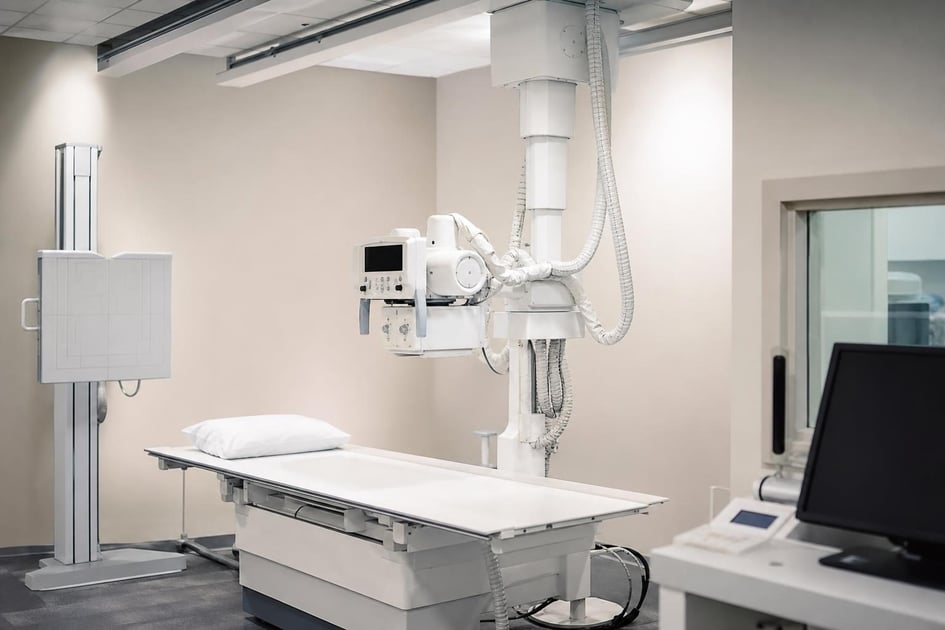
You can finance an X-ray machine with no money down, but the phrase covers several different structures. At Provide Capital, zero-down financing generally means 100 percent of the equipment invoice is financed. That leaves your cash in the business for payroll, inventory, or facility improvements. It does not always mean every associated cost is covered. Shipping, crating, installation, lead shielding updates, and staff training are sometimes classified as soft costs. Some programs roll soft costs into the total note; others cap them at a percentage of the hard equipment price or require you to pay them upfront. Before you commit, ask for a line-item breakdown of what the loan covers and what you must pay separately.
The equipment itself serves as collateral. Because the lender secures the financing against the machine, you do not need to pledge real estate or additional business assets to avoid a down payment. That structure keeps the application moving fast and preserves liquidity. It also means the lender cares deeply about the equipment's resale value, brand reputation, and remaining useful life. A digital system from a major manufacturer with a ten-year tube will collateralize more easily than an off-brand analog unit with obsolete software.
Key Insight: A "no money down" approval usually covers the invoice price of the machine, not the full project cost. If your digital X-ray installation requires electrical upgrades or PACS integration, budget for those separately unless your loan officer explicitly confirms they are included.
How X-Ray Machine Financing Works
We write equipment loans from $5,000 to $5 million. That range covers everything from a single chiropractic digital radiography panel to a complete hospital-grade fixed room with multiple tubes and detectors. Rates vary by credit profile, equipment age and term. A practice with strong credit financing a new digital system over five years will see different numbers than a buyer with a shorter track record seeking a used portable unit on a three-year term.
The process starts with a real equipment quote. You do not need to have purchased the machine yet, but underwriting needs a signed invoice or vendor quote to collateralize the exact asset. Once we have that, we review your business bank statements, credit history, and the equipment specifications. For straightforward files, same-day approvals are possible. Larger suites or complex credit histories may take 24 to 48 hours while we verify income and run lien checks.
Because the equipment acts as collateral, the approval speed depends heavily on how quickly we can confirm the asset's value. New systems from dealers with established list prices move fastest. Used systems require more documentation, but they still collateralize well if the make and model have an active resale market. You can explore X Ray Machine financing for general radiography rooms, Digital X Ray Machine financing for computed radiography or direct radiography panels, or Portable X Ray Machine financing for mobile units used in veterinary, chiropractic, or home-health settings. Each asset class has its own resale market, which affects term length and rate.
Already have a machine in mind?
Provide Capital finances new and used equipment from $5,000 to $5 million, with same-day decisions possible.
Apply NowNew vs. Used X-Ray Equipment
New digital X-ray systems carry higher price tags but longer useful lives and stronger collateral value. A new fixed-room system with a DR detector and four-way float table can run from $90,000 to $150,000 or more, depending on features and manufacturer. A used or refurbished unit with similar specs might cost 40 to 60 percent less. The trade-off is warranty coverage, software support, and detector life. New systems arrive with manufacturer warranties, the latest dose-reduction algorithms, and direct integration into modern PACS and EMR platforms.
Used systems can be smart purchases if you verify three things: remaining tube life, detector crystal integrity, and software license transferability. A detector with depleted cesium iodide crystals or a cracked TFT layer will cost tens of thousands to replace, erasing your upfront savings. Software is another hidden cost. Some manufacturers charge a new license fee when the system changes ownership, especially if the software is tied to a service contract. Ask the vendor for the service history, the tube shot count, and a written confirmation that the software license transfers without penalty.
We finance both new and used equipment, but the age of the machine affects the term. New systems often qualify for terms up to 84 months. Used systems older than five years may be capped at 36 or 48 months. The logic is simple: the loan should not outlast the collateral's reliable working life. Major brands like GE, Siemens, Philips, and Canon maintain stronger residual values, which means they often qualify for better advance rates than obscure or discontinued lines.
Pro Tip: Request the tube log and detector hours before you make an offer on a used system. Underwriters review these numbers too, and a machine with a fresh tube installed last quarter will collateralize better than one approaching its rated life limit.
Digital X Ray System financing works best for practices that want to depreciate a capital asset and own it free and clear. Portable units appeal to mobile imaging providers, house-call veterinarians, and sports-medicine contractors who need to move between locations.
Lease vs. Loan: Which Saves More?
Choosing between an equipment loan and a lease affects your monthly cash flow, tax timing, and end-of-term flexibility. The table below summarizes the practical differences for a practice acquiring a $75,000 digital X-ray system.
| Feature | Equipment Loan | $1 Buyout Lease | FMV Lease |
|---|---|---|---|
| Ownership | You own it after final payment | You own it for $1 at end | Return or buy at fair market value |
| Down payment | 0% possible for qualified buyers | 0% possible for qualified buyers | 0% possible for qualified buyers |
| Typical term | 24–84 months | 24–60 months | 12–48 months |
| Monthly payment | Moderate; lower total cost than leasing | Moderate; slightly higher total cost | Lowest monthly option |
| Tax treatment | Depreciation and Section 179 for 2026; interest deductible | Deduct full payment as lease expense | Deduct full payment as lease expense |
| Best for | Long-term ownership and practices wanting the asset on the books | Practices that want eventual ownership with fixed payments | Short-term needs or technology that may obsolete quickly |
If you plan to keep the equipment for seven to ten years and want to build equity, a loan usually wins on total cost. If you expect to upgrade to a newer detector technology in three years, an FMV lease preserves flexibility. A $1 buyout lease splits the difference: you own it at the end, but you pay a little more in total cost than a loan in exchange for simpler qualification and fixed payments. According to the U.S. Small Business Administration, understanding total cost of capital is one of the most important steps before signing any equipment financing agreement.
Who Qualifies for Zero-Down X-Ray Financing?
Underwriting looks at three factors: personal and business credit, time in business, and the equipment itself. A practice operating for two or more years with consistent revenue and a credit score above 650 typically qualifies for the strongest terms, including 100 percent financing with no down payment. Newer businesses can still qualify, but they may need to show stronger recent bank balances or accept a shorter term to offset the limited history.
Credit matters because medical imaging equipment is specialized collateral. If a default occurs, the lender must resell an X-ray system into a narrower market than a backhoe or delivery van. That resale risk shows up in the rate and advance rate. A credit profile with recent late payments, charge-offs, or high utilization signals higher risk, which can trigger a down-payment requirement or a shorter term. Strong credit offsets that risk and unlocks zero-down approval.
Time in business is measured by your first deposited revenue, not your articles of incorporation. If you bought an existing practice and kept the same tax ID and bank accounts, we can count that revenue history. If you started a fresh entity, the clock resets to your first deposit, even if you personally have decades of industry experience.
The equipment itself also plays a role. New systems from established manufacturers collateralize at higher advance rates than used systems from defunct brands. A digital system with a current FDA 510(k) and active software support is easier to underwrite than an analog system that requires obsolete parts. Personal guarantees are common for smaller practices, especially when the loan amount exceeds the business's annual revenue.
Find the right financing structure
Tell us about the equipment you need and we will show you the options that fit your business.
See Your OptionsTax Treatment and Section 179 in 2026
For tax year 2026, Section 179 allows businesses to deduct the full purchase price of qualifying equipment up to an inflation-adjusted annual limit. Bonus depreciation may also apply, though the percentage has been phasing down in recent years. Because Congress adjusts these thresholds annually and your state may have its own depreciation rules, consult your CPA to confirm the exact 2026 limits before you file.
If you lease instead of buy, you generally deduct the monthly lease payment as an operating expense. The tax difference between leasing and buying is usually a timing question, not a permanent savings question. A CPA can model which approach gives your practice the better outcome for 2026 based on your current tax bracket, expected income, and whether you have other capital expenditures planned. U.S. Census Bureau data shows that healthcare practices remain among the most active small-business equipment purchasers, making tax planning a high-value exercise.
By the Numbers: A $75,000 digital X-ray system financed over 60 months with no money down might carry a monthly payment in the low thousands for a strong-credit borrower, while the same file on a 36-month term would show a higher monthly outlay but lower total cost of capital. Rates vary by credit profile, equipment age and term, so treat any example as directional rather than a quote.
Real Cost Examples
Consider a chiropractic practice purchasing a digital X-ray system with a 17x17 detector and four-way float table. The equipment invoice is $95,000. With no money down and a 60-month term, a strong-credit borrower might see a monthly payment in the range of $1,800 to $2,200. Shorten the term to 36 months, and the monthly payment rises toward $2,900 to $3,400, but the total interest paid drops significantly. Over the life of either loan, the difference in total cash outlay can be tens of thousands of dollars depending on the rate.
Now consider a mobile veterinary clinic buying a portable unit for $22,000. Financed over 48 months with no down payment, the monthly payment could fall in the $500 to $700 range for a qualified buyer. Because the ticket size is smaller, the total interest cost is modest even if the rate is slightly higher than a large-suite loan. The practice preserves roughly $22,000 in working capital that can instead cover vehicle wrap, insurance, and initial marketing.
A dental practice adding a second panorex and ceph unit for $45,000 might choose a 72-month term to keep the monthly payment below $900. That stretches the obligation longer, but it matches the equipment's useful life and keeps monthly cash flow predictable. The key is aligning the term with how long you realistically plan to use the machine. Forbes has reported that medical practices increasingly favor equipment financing over cash purchases to preserve liquidity for technology upgrades.
Common Mistakes When Financing Medical Imaging
One of the most expensive mistakes is fixating on the monthly payment and ignoring total cost. A seven-year term on technology that becomes clinically obsolete in five years leaves you writing checks on equipment you have already replaced. Another error is failing to budget for installation and IT integration. Cabling, network switches, PACS connectivity, lead shielding verification, and staff training can add 10 to 20 percent to the total project cost.
Buyers also forget to verify software licensing. A used digital system may require a new license fee to activate the viewing software on your network, and that fee is often due at installation. If the software is tied to a manufacturer service agreement, confirm whether the agreement transfers or whether you must pay a reactivation fee. Finally, do not assume every lender understands medical equipment. A generalist lender may not know how to value a DR detector versus an analog film processor, which can lead to weaker terms or unnecessary down-payment demands.
Documentation You'll Need
To move from application to approval, gather the following: your last three months of business bank statements, a current equipment quote or invoice from the vendor, your business tax returns for the past one to two years, and a copy of your driver's license. If you are buying used equipment, we may also need a recent appraisal, the service history, or the tube log.
For requests above certain thresholds, we may request a year-to-date profit and loss statement and a brief narrative explaining how the equipment will generate revenue or reduce costs. The faster you return these items, the faster underwriting can issue a decision. Keep your bank statements clean and unmarked; underwriters look for NSF episodes, large unexplained deposits, and declining balances as warning signs.
What Happens After You Apply
Once you submit the application and supporting documents, underwriting reviews credit, cash flow, and collateral value. For smaller requests with complete files, same-day approvals are possible. For larger digital suites or complex ownership structures, the review may take 24 to 48 hours while we verify equipment specs, vendor reputation, and lien searches.
After approval, we issue a term sheet. You review the payment amount, term length, prepayment language, and any personal guarantee requirement. If you accept, we prepare the closing documents and pay the vendor directly upon delivery confirmation. You start using the equipment immediately while making monthly payments. If your quote is ready and you want to move forward, get a same-day decision on your equipment by starting the application now.
Industries and Equipment Types
Provide Capital serves construction, healthcare, dental, restaurant and food service, manufacturing, transportation, agriculture, HVAC, and forestry nationwide. While this post focuses on medical imaging, our underwriting approach is consistent across sectors. We also offer Forestry Logging equipment financing for businesses investing in skidders, feller bunchers, and harvesters, using the same collateral-based structure that keeps rates competitive for qualified buyers.
Put the right equipment to work
From $5,000 to $5 million, new or used, Provide Capital helps businesses nationwide finance the equipment they need.
Apply TodayFAQ
Can I really get an X-ray machine with no money down?
Yes, if your credit and business financials meet program requirements. The equipment acts as collateral, which reduces the lender's risk and allows 100 percent financing for qualified buyers. You still need to show stable cash flow and acceptable credit.
Does no money down mean no payments for 90 days?
Not necessarily. No money down means you do not bring cash to closing. Deferred first payments are a separate feature that some lenders offer seasonally or for qualified borrowers. Ask your financing specialist whether a deferred first payment is available on your specific deal.
What credit score do I need for zero-down X-ray financing?
Most programs prefer a personal credit score above 650, but we review the full file. Strong cash flow, low existing debt, and clean bank history can offset a lower score. Conversely, a high score with recent NSF episodes or declining revenue may still trigger a down-payment request.
Can I finance a used or refurbished X-ray machine?
Yes. We finance both new and used equipment. The age, brand, and condition of the unit will affect the maximum term and rate. Expect older units to qualify for shorter terms.
How long are the terms?
Typically 24 to 84 months for loans, depending on equipment cost, age, and useful life. Portable units may qualify for shorter terms than full room systems. Leases usually run 12 to 60 months.
Is the interest tax deductible?
For loans, the interest portion is generally deductible as a business expense. For leases, the entire payment is usually deductible as an operating expense. Consult your CPA for the exact rules that apply to your practice for tax year 2026.
What if I want to pay off the loan early?
Most equipment loans allow early payoff, but some include a prepayment schedule or minimum interest clause. Review your term sheet carefully before signing so you understand whether you will save interest by paying ahead of schedule.
Can I finance soft costs like installation and training?
Sometimes. Many lenders cap soft-cost coverage at a percentage of the equipment price, often 10 to 20 percent. If your project has heavy installation, electrical work, or IT integration costs, ask whether they can be wrapped into the note or must be paid separately.
Next Steps
Buying an X-ray machine is a capital decision that affects your practice's cash flow for years. No-money-down financing preserves your liquidity, but the structure of the deal matters more than the absence of a down payment. Compare total cost, term length, and end-of-term options before you commit. Make sure you understand whether soft costs are included, what the prepayment terms are, and how the tax treatment fits your 2026 planning. When you have your equipment quote ready, talk to a specialist about your specific machine and see what terms are available for your practice.
Disclaimer: The information provided in this article is for general educational purposes only and is not financial, legal, or tax advice. Funding terms, qualifications, and product availability may vary and are subject to change without notice. Provide Capital does not guarantee approval, rates, or specific outcomes. For personalized information about your business funding options, contact our team directly.