Bad credit does not disqualify you from financing a backhoe. Because the machine itself serves as collateral, equipment lenders weigh the asset's value and your operating history more heavily than a personal credit score alone. If you generate consistent revenue and the backhoe fits the work you already have lined up, approval is realistic even with a sub-650 credit profile.
Key Insight: Many equipment lenders use a collateral-first underwriting model for backhoes. A 2021 model with 1,200 hours and a strong auction value can offset a weaker credit profile more effectively than a 15-year-old unit with uncertain resale demand. The lender's loss-given-default drops when the asset is easy to resell, which directly improves your approval odds.
How Backhoe Financing Works When Your Credit Is Bruised
Traditional unsecured business loans rely almost entirely on creditworthiness and cash-flow coverage. Equipment financing operates on a different logic. The lender secures a lien against the backhoe. If cash flow becomes strained, the lender can recover the machine and sell it into a liquid secondary market. That security interest means borrowers with past credit events—late payments, collections, even a prior bankruptcy—can still access capital if the deal structure makes sense.
At Provide Capital, financing ranges from $5,000 to $5 million. A backhoe typically falls in the $30,000 to $150,000 range for used units and $100,000 to $250,000 for new models, depending on size and attachments. Because the equipment itself is the collateral, rates vary by credit profile, equipment age and term rather than following a single published grid.
Why the Equipment Itself Changes the Risk Equation
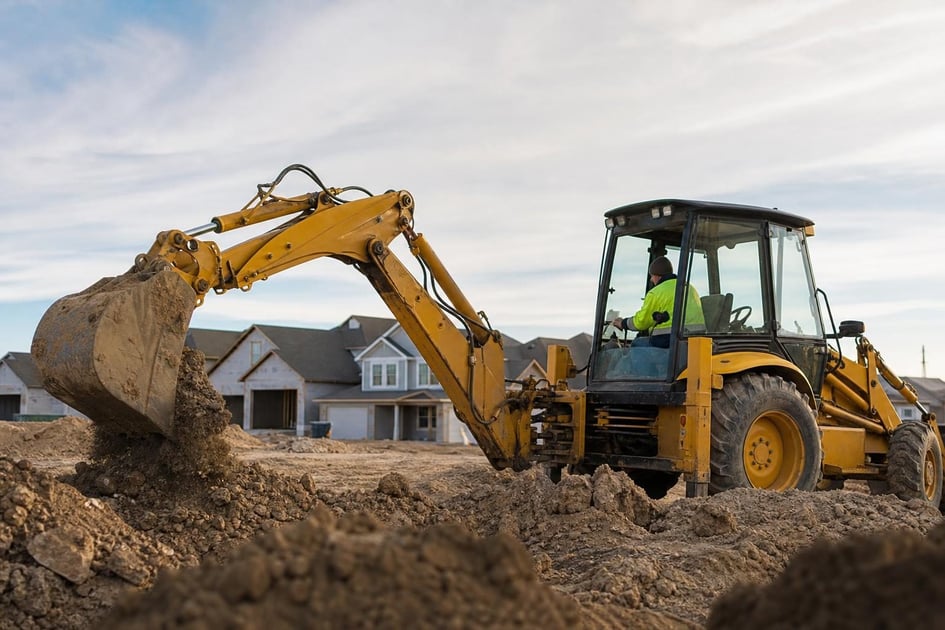
A backhoe is a standardized, high-demand asset. Construction, utility work, landscaping, and agriculture all use them. That broad end-user base creates a robust resale market. Lenders know that a 4x4 extendahoe with low hours will retain value for years. When your credit is bruised, offering a newer, well-maintained unit as collateral strengthens the application because the lender's exposure is limited.
What "Bad Credit" Actually Means in This Context
In equipment financing, "bad credit" is not a binary label. A score in the low 600s with a recent bankruptcy discharge is different from a score in the high 500s with active tax liens. Lenders look at the story: Is revenue trending up? Is the credit damage isolated to a past event, or is it ongoing? A borrower with a 620 score, two years in business, and $25,000 monthly deposits will often see better terms than a 680-score applicant with declining revenue and recent charge-offs.
Get a fast decision on your equipment
Applying takes just a few minutes, and decisions can come as soon as the same day.
Start Your ApplicationWhat Lenders Evaluate Beyond Your Credit Score
When you apply for Backhoes financing with challenged credit, underwriters shift attention to operational metrics. Here is what matters most.
Time in Business and Revenue Consistency
Lenders prefer at least one year in operation, though some programs accept six months with strong deposits. Consistency matters more than top-line growth. A contractor depositing $18,000 every month for 12 months looks safer than one with volatile $40,000 months followed by $5,000 months. Bank statements are the primary evidence here. Expect to provide the last three to six months.
Equipment Age and Condition
Financing a backhoe that is less than 10 years old with under 5,000 hours is far easier than financing a 20-year-old unit with unknown maintenance history. For bad-credit borrowers, sticking to equipment no older than 7 to 10 years usually produces better terms and a lower down payment requirement.
Down Payment and Collateral Strength
With strong credit, some lenders offer 100% financing. With bruised credit, plan for 10% to 20% down. On a $75,000 used backhoe, that means $7,500 to $15,000 out of pocket. The down payment reduces the lender's loan-to-value ratio and signals your commitment to the asset.
By the Numbers: A borrower putting 15% down on a $90,000 backhoe finances $76,500. On a 60-month term, that $13,500 equity stake can be the difference between a declined application and an approval with a standard monthly schedule. Lenders often view the down payment as a proxy for skin in the game when credit history is thin or damaged.
New vs. Used Backhoes: Financing Considerations
The new versus used decision affects approval odds, monthly payment, and total cost of ownership. Bad-credit borrowers should understand the trade-offs before shopping.
| Factor | New Backhoe | Used Backhoe (5–10 Years) |
|---|---|---|
| Purchase price | $100,000–$250,000 | $35,000–$90,000 |
| Down payment (bad credit) | 15%–20% | 10%–15% |
| Depreciation hit | Steepest in first 24 months | Slower, more predictable |
| Maintenance risk | Low, often under warranty | Higher, inspect hydraulics and pins |
| Approval difficulty | Higher monthly burden | Easier to cash-flow, better for bruised credit |
| Resale value for lender | Strong | Moderate to strong if under 5,000 hours |
For borrowers rebuilding credit, a used unit in the $50,000 to $80,000 range often makes more sense than stretching for a new machine. The lower monthly obligation improves your debt-service coverage, which reduces default risk for both you and the lender.
Lease vs. Loan: Which Structure Fits Your Situation?
Both equipment loans and leases can work for backhoes. The right choice depends on your tax strategy, how long you plan to keep the machine, and whether you want to own the asset at the end.
| Feature | Equipment Loan | Finance Lease ($1 Buyout) |
|---|---|---|
| Ownership | You own the backhoe; lender holds lien | You own after final payment |
| Monthly payment | Higher, but builds equity | Lower or comparable |
| Tax treatment | Interest deductible; depreciate asset | Payments may be fully deductible |
| End of term | Free and clear | $1 buyout, then free and clear |
| Better for bad credit? | Yes, if you have 10%–15% down | Yes, if cash flow is tight and you need lower payments |
With bruised credit, a finance lease can be easier to approve because the lessor retains title and the residual risk is structured differently. However, a traditional equipment loan through a program like Construction equipment financing often offers more flexibility if you plan to trade the backhoe in after four or five years.
Pro Tip: If your credit score is under 620, ask your dealer for a lease-to-own quote alongside a loan quote. Some captive finance companies push loans because they earn more on interest, but a lease structure may approve when a loan will not. Compare the total outlay over 60 months, not just the monthly payment.
Tax Treatment for Backhoe Purchases in 2026
The tax advantages of equipment acquisition remain substantial in 2026, but the exact limits adjust annually for inflation. Section 179 allows eligible businesses to deduct the full purchase price of qualifying equipment in the year it is placed in service, subject to an annual dollar cap and a phase-out threshold. For tax year 2026, consult a CPA for the precise limit because it changes each year based on inflation indexing.
Bonus depreciation may also apply to new and used backhoes placed in service during 2026, though the percentage has been stepping down from prior years. Again, the exact rate for 2026 depends on legislative schedules and inflation adjustments. Your CPA can confirm whether your purchase qualifies and how to coordinate Section 179 with bonus depreciation for maximum benefit.
Lease payments, by contrast, are typically treated as operating expenses and deducted as paid. This simplifies bookkeeping but does not deliver the front-loaded deduction of a purchase. If you are comparing a loan to a lease purely on tax grounds, a purchased backhoe usually generates larger first-year write-offs, though the specifics depend on your taxable income and entity structure. Always confirm with a tax professional before filing.
Qualifying for Backhoe Financing with Challenged Credit
Approval criteria vary by lender, but most equipment finance companies evaluate a common set of factors. Understanding them lets you prepare before applying.
Credit score minimums. Many programs advertise no minimum, but in practice, scores below 580 require significant compensating factors: larger down payment, newer equipment, or a co-signer. Scores from 580 to 640 are the typical bad credit band where approvals happen regularly with 10% to 20% down. Scores above 640 generally see better rates and lower down payment requirements.
Monthly revenue. Lenders want to see that the equipment payment fits your cash flow. A common rule of thumb is that the new equipment payment should not push your total debt service above 50% of monthly revenue. If you generate $30,000 per month and existing debt claims $10,000, a backhoe payment up to $5,000 is within most guidelines.
Equipment specs. Hours, year, make, and model all matter. A Caterpillar 420F2 with 2,000 hours is easier to finance than an obscure import brand with 8,000 hours. Stick to name brands—Caterpillar, John Deere, Case, JCB, Kubota—when possible. Their parts availability and auction liquidity reassure underwriters.
Vendor or private party. Buying from a licensed dealer usually simplifies financing because the dealer provides inspections, warranties, and clear title. Private-party purchases are financeable, but expect more documentation: title search, equipment inspection, and proof of the seller's ownership.
See what you qualify for
The equipment itself secures the financing, which keeps rates competitive. Checking your options takes minutes.
Check Your OptionsDocumentation You'll Need to Apply
Having paperwork ready speeds up the process. Same-day approvals are possible when the file is complete. According to SBA guidance on equipment financing options, organized documentation is one of the strongest predictors of fast approval.
- Last three to six months of business bank statements
- Current driver's license or passport
- Equipment invoice or purchase agreement
- Proof of business registration (articles of incorporation, LLC operating agreement, or DBA certificate)
- Voided business check for ACH setup
- Recent tax return (some programs require one year; others do not)
- Equipment insurance binder naming the lender as loss payee
For borrowers with credit challenges, some lenders also request a brief written explanation of derogatory marks. A one-paragraph note explaining a 2023 medical collection or a chapter discharged in 2022 can help an underwriter view the credit damage as historical rather than ongoing.
Common Mistakes Owners Make When Financing a Backhoe
Avoid these pitfalls to keep your application strong and your total cost reasonable.
Shopping for the machine before the financing. If you find a great deal on a 2015 backhoe at auction but your lender will not finance equipment over 10 years old, you have wasted time and potentially lost the bid. Get pre-qualified for an equipment range before you shop.
Ignoring total cost of ownership. A cheap backhoe with a $45,000 price tag becomes expensive if it needs $8,000 in hydraulic repairs in the first six months. Budget 5% to 10% of purchase price annually for maintenance on used units.
Stretching the term too long. A 72-month term lowers the monthly payment but increases total interest paid and extends the period during which you owe more than the machine is worth. For used backhoes, 48 to 60 months is usually the sweet spot.
Neglecting insurance. Lenders require physical damage insurance. If your current policy does not cover equipment over a certain value, secure a binder before closing. Delays here can push same-day approvals into next-week fundings.
Key Insight: Some borrowers try to improve their application by inflating revenue estimates. Underwriters verify deposits against bank statements. A discrepancy of even 10% can trigger a decline or a request for additional documentation that adds days to the process. Report actual deposits; let the equipment's cash-flow potential speak for itself.
What Happens After You Apply
Once you submit a complete application, the timeline moves quickly. Most equipment lenders issue a credit decision within 24 hours. If approved, you receive a term sheet outlining the monthly payment, term length, down payment, and any documentation conditions.
After you accept the term sheet, the lender orders a UCC lien search and verifies equipment title. You arrange insurance, sign the closing documents, and the lender pays the seller or dealer directly. In many cases, funds disperse within one to three business days of final approval. For straightforward deals with dealer invoices, same-day approvals are possible.
If the lender issues a conditional approval, read the conditions carefully. Common stipulations include a larger down payment, a shorter term, or a co-signer. Evaluate whether the revised structure still cash-flows for your business before accepting.
At this point in the process, you have a clear picture of what financing a backhoe with bruised credit looks like. The next step is to see what you qualify for with your specific credit profile and equipment choice.
Industry Use Cases and Sizing the Machine to the Work
Backhoes serve multiple industries, and the right size affects both productivity and financing terms. U.S. Census Bureau construction spending reports consistently show that demand for earth-moving equipment tracks closely with residential and infrastructure investment, which means lenders remain active in this collateral class even during tighter credit cycles.
Construction and excavation. A full-size 4x4 backhoe with an extendahoe attachment handles trenching, grading, and material loading on residential and light commercial sites. These machines typically cost $75,000 to $150,000 used and represent the core of Construction equipment financing volume.
Landscaping and hardscaping. A compact backhoe or a tractor-loader-backhoe (TLB) works well for retaining walls, drainage, and pool excavation. Units in the $35,000 to $65,000 range fit this segment. Because the revenue per job is lower than commercial construction, lenders pay close attention to job pipeline and seasonality.
Utilities and municipal work. Backhoes with pilot controls, four-wheel steering, and auxiliary hydraulics command premium prices. These are often new or low-hour units financed on 48-month terms. Bad-credit borrowers in this space may need a larger down payment because the specialized attachments reduce resale liquidity.
Agriculture. Farmers use backhoes for barn construction, fence line maintenance, and drainage ditches. A used 4x4 unit with a quick-attach bucket system is versatile enough to work across seasons. Because farm revenue is seasonal, lenders may structure payments to match cash flow: higher in harvest months, lower in winter.
If your work also requires smaller loaders, consider pairing your backhoe with Skid Steers financing to round out your fleet. Many contractors bundle equipment to negotiate better fleet pricing and consolidate financing under a single schedule.
Worked Cost Example: Breaking Down a Monthly Payment
Understanding how the numbers fit together helps you shop with confidence. Here is a realistic scenario for a borrower with a credit score in the low 600s.
A contractor selects a 2019 Case 580SN with 3,200 hours. The dealer asks $82,000. With bruised credit, the lender requires 15% down, or $12,300. The financed amount is $69,700. Rates vary by credit profile, equipment age and term, but a 60-month structure on this deal might produce a monthly payment in the $1,450 to $1,650 range. Over five years, the contractor builds equity in a machine that still holds $35,000 to $45,000 in resale value if maintained.
Compare that to leasing the same unit. A 60-month finance lease with a $1 buyout might run $1,350 to $1,550 monthly with a smaller upfront cost. The total outlay is similar, but the lease preserves cash at closing. The contractor should run both scenarios with a CPA to determine which structure maximizes after-tax cash flow in 2026.
If the same borrower chose a newer 2023 model at $130,000 with 20% down ($26,000), the financed amount is $104,000. Monthly payments on a 60-month term might fall between $2,100 and $2,400. The newer machine carries lower maintenance risk and stronger collateral value, but the higher monthly burden requires consistent revenue to support. Reuters economic outlook data suggests construction equipment demand remains steady, which supports resale values for borrowers weighing the new versus used decision.
Ready to move forward?
More than 10,000 businesses have financed equipment with Provide Capital. See what you qualify for today.
Get StartedFrequently Asked Questions
Can I finance a backhoe with a credit score under 600?
Yes, but expect to put 15% to 20% down and choose equipment that is no more than 7 to 10 years old. Revenue consistency and time in business become even more important when your score is below 600.
Does the lender pull my personal credit or business credit?
Most equipment lenders pull both. For businesses under two years old, personal credit usually weighs more heavily because there is limited business credit history to evaluate.
How fast can I get funded?
With a complete file, many lenders issue decisions within 24 hours. Same-day approvals are possible for straightforward applications with dealer invoices and clear title. Funding typically occurs one to three business days after final approval.
Can I buy from a private seller?
Yes, but expect extra steps: a title search, equipment inspection, and proof of the seller's ownership. Dealer purchases are simpler because the dealership handles much of this paperwork.
What happens if I miss a payment?
Contact your lender immediately. Equipment lenders prefer workout arrangements to repossession because used backhoes require remarketing effort. Early communication usually opens options: a short-term deferment, a term extension, or a seasonal restructure.
Should I choose a loan or a lease?
Choose a loan if you want to build equity and depreciate the asset. Choose a lease if you need lower monthly payments and prefer to treat the expense as an operating cost. With bad credit, leases sometimes approve more easily because the lessor retains title.
Do I need a down payment?
With strong credit, 0% to 10% down is common. With bad credit, plan for 10% to 20%. The down payment reduces the lender's risk and shows commitment to the equipment.
Can I finance attachments and warranties?
Yes, soft costs like buckets, hammers, thumb attachments, and extended warranties can often be rolled into the financing amount. Some lenders cap soft costs at 10% to 20% of the equipment value, so confirm the limit before adding options.
Next Steps: Get a Same-Day Decision on Your Equipment
Financing a backhoe with bad credit is not about finding a loophole. It is about matching the right equipment, the right structure, and the right documentation to a lender that understands collateral-based underwriting. Gather your bank statements, identify the machine you want, and know your down payment capacity.
Provide Capital finances new and used business equipment from $5,000 to $5 million nationwide. Whether you are in construction, landscaping, agriculture, or utilities, we structure deals around the asset and the cash flow it generates. Get a same-day decision on your equipment and move your project timeline forward.
Disclaimer: The information provided in this article is for general educational purposes only and is not financial, legal, or tax advice. Funding terms, qualifications, and product availability may vary and are subject to change without notice. Provide Capital does not guarantee approval, rates, or specific outcomes. For personalized information about your business funding options, contact our team directly.