Yes, You Can Finance a Backhoe Without a Down Payment
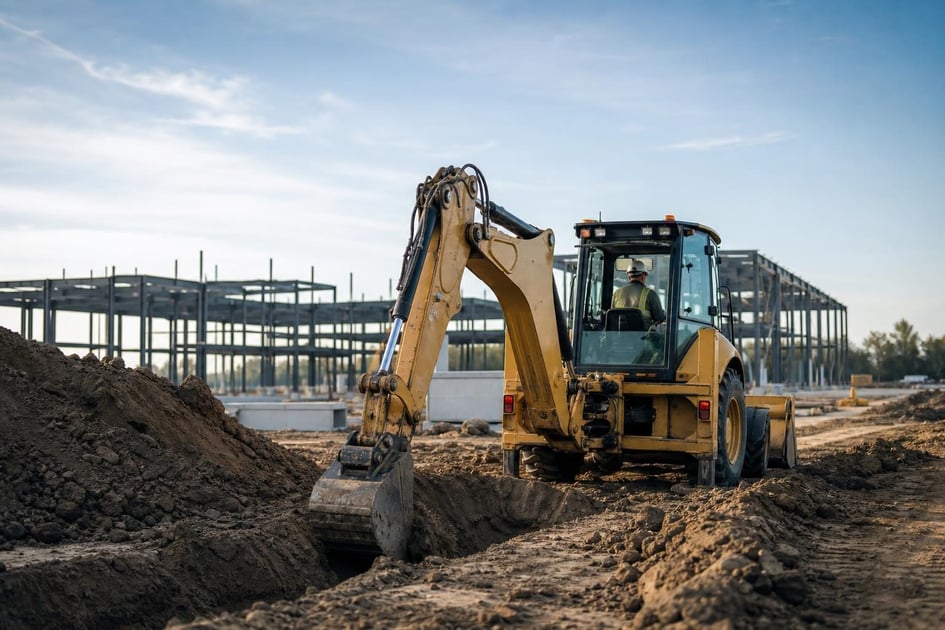
If you need a backhoe for your business and want to preserve cash, no-down-payment equipment financing is available. Lenders structure these deals so the machine itself serves as collateral, which keeps your upfront cost at or near zero. At Provide Capital, we finance new and used business equipment from $5,000 to $5 million, including backhoes for construction, utility, and agricultural work. Same-day approvals are possible once your documentation is complete.
That does not mean everyone qualifies automatically. Rates vary by credit profile, equipment age and term. A newer machine and a stronger credit file will generally produce more favorable terms than a high-hour used backhoe paired with limited financial history. The key is understanding what lenders weigh before you apply.
Key Insight: Lenders rarely ask for a down payment on backhoes when the loan-to-value ratio stays below the equipment's forced-liquidation value. If the backhoe's wholesale value is $55,000 and you are borrowing $50,000, the deal can close with zero out of pocket. If you need to borrow $65,000 for the same machine, you may need to cover the gap.
Already have a machine in mind?
Provide Capital finances new and used equipment from $5,000 to $5 million, with same-day decisions possible.
Apply NowHow No-Down-Payment Backhoe Financing Works
The structure is straightforward. You identify the backhoe you want to buy, the lender evaluates the equipment and your business, and if approved, the lender pays the seller directly. You take delivery and make fixed monthly payments until the balance is satisfied. At the end of the term, you own the backhoe outright.
Because the equipment secures the loan, lenders are often willing to advance 100 percent of the purchase price plus soft costs like freight, warranties, or attachments. This is different from an unsecured business loan, which would require strong cash flow and likely a larger down payment or personal guarantee. With Backhoes financing, the collateral is literally the machine in your yard.
The process typically runs like this. You submit an application and any required documents. An underwriter reviews your business bank statements, credit history, and the equipment specs. If the deal fits the lender's parameters, you receive a term sheet. You sign, the lender funds the seller, and you take delivery. For straightforward deals, this can happen in one business day.
Pro Tip: Shop for your backhoe in late fall and winter. Construction equipment demand softens between November and February in most regions, which gives you more negotiating room on price. A lower purchase price reduces your monthly payment and improves your chances of securing no-down-payment terms.
What Lenders Actually Review
Lenders look at three things: the borrower, the business, and the equipment. Each piece affects whether you can finance with nothing down.
Time in Business and Revenue
Most equipment lenders prefer to see at least two years of operating history. That gives them enough bank statements to verify consistent revenue. If your business is younger, you may still qualify, but the lender will likely scrutinize personal credit more heavily or ask for a shorter term. Monthly revenue should comfortably cover the proposed payment. A common rule of thumb is that your existing equipment debt payments plus the new backhoe payment should not exceed 20 to 25 percent of your monthly gross revenue.
Credit Profile
Personal credit scores in the mid-600s and above generally open the door to 100 percent financing. Scores below that do not automatically disqualify you, but the lender may offset risk with a shorter term, a nominal down payment, or additional collateral. Business credit matters too, especially if you have prior equipment loans paid satisfactorily. A history of on-time payments on previous Construction equipment financing improves your profile significantly.
Equipment Age and Condition
The backhoe itself is the security. A 2024 or 2025 model with low hours and a clean maintenance record is easier to finance at full value than a 2012 machine with 8,000 hours. Lenders assign a liquidation value based on auction data and manufacturer resale trends. If the loan amount exceeds that value, they will ask you to cover the difference. This is why shopping for machines with strong residual value—brands like Caterpillar, John Deere, and JCB—can help you avoid a down payment.
By the Numbers: A new 4x4 backhoe loader in the 14- to 17-foot digging-depth range typically costs between $45,000 and $120,000 depending on brand, attachments, and dealer location. A three- to five-year-old model with under 2,000 hours usually trades between $35,000 and $75,000. Financing the lower end of that range at 100 percent is routine for established contractors.
New Backhoes vs. Used Backhoes
New machines carry full manufacturer warranties, the latest emissions compliance, and lower maintenance risk for the first few years. That predictability makes them attractive to lenders, and you will often see longer terms—up to 60 or 72 months—on new units. The trade-off is a higher monthly payment because the purchase price is larger.
Used backhoes cost less upfront, which lowers your total interest outlay, but lenders may cap the term at 36 to 48 months depending on age. A 2019 backhoe might qualify for a four-year term, while a 2012 model may be limited to three years. The shorter term raises the monthly payment, even though the principal is lower. You also need to budget for maintenance and possible component replacement sooner.
From a financing perspective, the decision hinges on utilization. If you plan to run the machine 1,500 hours per year, a new backhoe may be worth the premium. If you need it for 400 hours annually to handle occasional trenching and grading, a low-hour used model financed over three years could be the smarter cash-flow move.
Equipment Loan vs. Equipment Lease
Both structures let you acquire a backhoe without a large initial outlay, but they work differently. An equipment loan ends with you owning the asset. A lease gives you use of the machine for a fixed period, after which you either return it, buy it out, or upgrade. The right choice depends on how long you plan to keep the backhoe and how you want to treat it for tax purposes.
| Feature | Equipment Loan | Equipment Lease |
|---|---|---|
| Ownership | You own the backhoe after the final payment | Lessor owns the equipment; you may have a buyout option |
| Down Payment | Often $0 on qualified deals | Usually one or two payments upfront |
| Term Length | 24 to 72 months, depending on equipment age | 12 to 60 months |
| Monthly Payment | Higher than a lease because you are paying off principal | Lower because you are paying for use, not full value |
| Tax Treatment for 2026 | Section 179 deduction and bonus depreciation may apply; confirm with your CPA | Payments typically deductible as operating expense; confirm with your CPA |
| End of Term | Free and clear ownership | Return, renew, or purchase at fair market value or a fixed amount |
For contractors who plan to keep a backhoe for seven to ten years, a loan usually wins. You build equity, you can modify the machine as needed, and there are no mileage or usage restrictions. If you prefer to upgrade every three years to avoid maintenance risk, a lease keeps you in newer iron with a predictable monthly cost. Talk to a specialist about your specific machine to model both scenarios.
Tax Treatment for the 2026 Tax Year
For the 2026 tax year, the Internal Revenue Code allows businesses to deduct qualifying equipment purchases under Section 179 up to an annual dollar limit set by the IRS. The exact ceiling adjusts yearly, so verify the 2026 limit with your CPA before you file. Bonus depreciation may also apply to new and used equipment, though the percentage has been stepping down in recent years. Your accountant can tell you whether your backhoe qualifies for first-year expensing or whether straight-line depreciation over five years is more advantageous for your situation.
With a loan, you generally deduct the interest portion of your payments and claim depreciation on the asset. With a lease, the full payment is often treated as an operating expense. The better structure depends on your taxable income, other capital purchases this year, and whether you are trying to accelerate deductions or smooth them. Do not guess. U.S. Small Business Administration funding resources outline general financing principles, but tax strategy requires personalized advice.
Key Insight: If you finance a backhoe in December 2026, you may be able to take the Section 179 deduction for the full 2026 tax year even though you have only made one monthly payment. This timing can significantly improve your year-end tax position, but only if your CPA confirms you have enough taxable income to absorb the deduction without creating a net operating loss you do not want.
Find the right financing structure
Tell us about the equipment you need and we will show you the options that fit your business.
See Your OptionsReal-World Cost Examples
These examples illustrate how no-down-payment financing plays out for different buyers. Rates vary by credit profile, equipment age and term, so treat these as directional only.
Example 1: New compact backhoe. A contractor buys a new 74-horsepower backhoe loader for $92,000, financed over 60 months with no money down. Assuming a strong credit profile, the monthly payment might fall in the range of $1,650 to $1,850. Total cost over the term depends on the rate assigned, but the business preserves roughly $92,000 in working capital.
Example 2: Used mid-size backhoe. A utility company purchases a 2021 model with 1,200 hours for $58,000, financed over 48 months. With good credit, the monthly payment could land between $1,250 and $1,450. Because the term is shorter than the new-machine example, the business owns the backhoe free and clear after four years.
Example 3: Budget-friendly older unit. A landscaping company acquires a 2016 backhoe for $38,000, financed over 36 months. The payment might run $1,100 to $1,300 per month. The shorter term reflects the lender's desire to match the loan duration to the machine's remaining useful life.
In every case, the borrower keeps cash on hand for payroll, materials, and unexpected expenses. That liquidity is often more valuable than the interest cost, especially when work is seasonal.
Who Uses No-Down-Payment Backhoe Financing
General excavation contractors are the most obvious fit, but the user base is broader. Utility installers need backhoes for trenching water and sewer lines. Landscape companies use them for grading and retaining-wall prep. Agricultural operations employ backhoes for ditching and barn-site work. Municipalities and county road departments finance them for maintenance crews. Even forestry contractors pair backhoes with Skid Steers financing to create a versatile fleet without a six-figure capital outlay.
U.S. Census Bureau construction data shows sustained infrastructure spending across most regions, which supports healthy resale values for earth-moving equipment. That sustained demand, combined with strong dealer activity reported in Reuters reporting on Caterpillar's 2026 construction outlook, makes lenders more comfortable advancing 100 percent of purchase price on backhoes and loaders.
Common Mistakes to Avoid
The biggest error is shopping for the machine before you know what you can borrow. Sellers want a quick decision, and if you have not been pre-qualified, you may lose a good deal while scrambling for funds. Get a financing decision in principle first, then negotiate from a position of certainty.
Another mistake is ignoring the total cost of ownership. Financing with no down payment frees up cash, but you still need to insure the backhoe, maintain it, and fuel it. A $1,500 monthly payment is only part of the equation. Budget another $200 to $400 per month for insurance, preventive maintenance, and repairs depending on age and usage.
Some buyers also overextend on term length. Stretching a used backhoe to 72 months lowers the payment but may leave you owing money on a machine that is nearly worn out. Match the term to the equipment's realistic service life. For most used backhoes, 36 to 48 months is the sweet spot. For new machines, 60 months is standard, and 72 months is available for premium credit profiles.
Finally, do not forget to verify the seller's title. A backhoe with an undisclosed lien or a missing serial-number plate can derail closing. Reputable dealers handle this cleanly, but private-party sales require extra diligence. Ask for a title search or use an escrow service if anything feels off.
The Documentation You Will Need
Lenders move fast when you give them complete paperwork upfront. Expect to provide the following:
- One-page application with business and owner information
- Last three to four months of business bank statements
- Current year financials or tax returns, if available
- Invoice or equipment listing with serial number, year, make, model, and hours
- Proof of insurance once approved
For loans above $150,000, some lenders ask for two years of tax returns and a current balance sheet. If you are buying from a private party rather than a dealer, you may also need a bill of sale and a title verification. The cleaner your documentation, the faster the approval. Same-day decisions are possible when the file is complete and the equipment is easy to value.
What Happens After Approval
Once you accept the terms, the lender issues a purchase order or funds the invoice directly. You coordinate delivery or pickup with the seller. The lender files a UCC-1 lien on the backhoe, which is standard for equipment loans and protects their interest until you pay in full. You receive a payment schedule, usually with a first payment due 30 to 45 days after funding.
During the term, keep the backhoe insured with the lender listed as loss payee. If you sell the machine before the loan is paid off, you must satisfy the balance first. Most lenders allow early payoff with no penalty or a nominal fee, but confirm this before you sign. Once the final payment clears, the lender releases the lien and you receive a clear title.
If your business grows and you need additional machines, that same payment history makes the next approval easier. Many contractors start with one backhoe, add a Dump Trucks financing package six months later, and continue building a fleet one piece at a time.
Put the right equipment to work
From $5,000 to $5 million, new or used, Provide Capital helps businesses nationwide finance the equipment they need.
Apply TodayFrequently Asked Questions
Can I really get 100 percent financing with nothing out of pocket?
Yes, on qualified deals. If the backhoe's value supports the loan amount and your credit and revenue meet the lender's guidelines, the deal can fund with no down payment. Soft costs like freight and warranty may also be rolled in.
Does no down payment mean higher rates?
Not necessarily. Rates vary by credit profile, equipment age and term. A well-qualified buyer financing a newer machine can secure competitive rates with zero down. A riskier profile or older equipment may see a modest rate adjustment, but the spread is usually narrow.
Can I finance a backhoe from a private seller?
Yes. Lenders finance private-party sales as long as the title is clear and the equipment can be verified. You may need a third-party inspection or a title search, which adds a few days to the process.
How long does approval take?
For straightforward applications with complete documentation, same-day approvals are possible. Larger requests or complex ownership structures may take 24 to 48 hours.
What if I have bad credit?
Credit challenges do not automatically disqualify you. Lenders may ask for a shorter term, additional collateral, or a nominal down payment. The equipment itself is the primary collateral, which offsets some credit risk.
Is a personal guarantee required?
Most equipment loans under $500,000 require a personal guarantee from the business owner. This is standard practice and does not necessarily reflect poorly on your business. As the loan amount grows and the business establishes its own credit, some lenders will waive the personal guarantee.
Can I pay the loan off early?
Most equipment lenders allow early payoff. Some charge a small fee; others do not. Ask for the specific prepayment language before you sign the term sheet.
What happens if the backhoe needs major repairs?
You are responsible for maintenance and repairs. The lender holds a lien on the machine but does not maintain it. Budget for preventive maintenance and consider a warranty if you are buying used. Missing payments because of repair bills is a fast path to default.
Ready to Finance Your Backhoe?
No-down-payment backhoe financing lets you put revenue-generating equipment to work immediately while preserving the cash you need for payroll, materials, and growth. The process is straightforward: pick your machine, submit your paperwork, and get a decision—often the same day. Rates vary by credit profile, equipment age and term, so the best way to know your numbers is to apply.
If you have a backhoe picked out or just want to know what you can borrow, get a same-day decision on your equipment. A specialist will review your situation, run the numbers on new and used options, and structure terms that match your cash flow. You do not need perfect credit or a massive bank balance. You need a solid business, the right machine, and a lender who understands equipment.
Disclaimer: The information provided in this article is for general educational purposes only and is not financial, legal, or tax advice. Funding terms, qualifications, and product availability may vary and are subject to change without notice. Provide Capital does not guarantee approval, rates, or specific outcomes. For personalized information about your business funding options, contact our team directly.