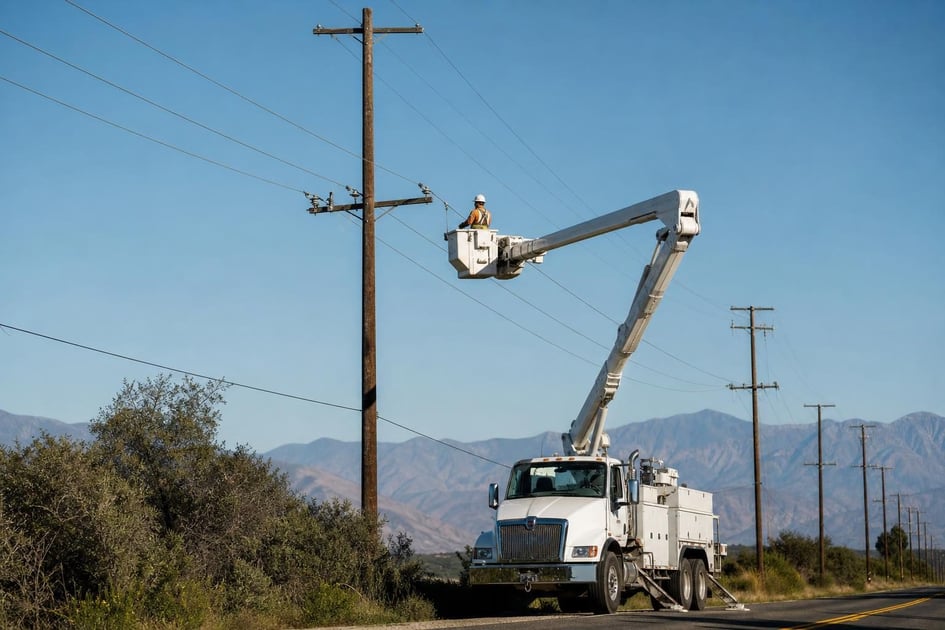
Bucket truck financing in California works like any other equipment financing agreement: the vehicle serves as collateral, which keeps rates competitive even if your credit is less than perfect. For arborists, electrical contractors, telecom crews and sign companies working from San Diego to Redding, that means preserving working capital while putting a revenue-generating lift in the yard. Provide Capital finances new and used bucket trucks from $5,000 to $5 million, with same-day approvals possible once the application and equipment details are in hand.
California's economy runs on infrastructure that lives above ground. The state's three largest investor-owned utilities maintain hundreds of thousands of miles of overhead line. Municipalities from Los Angeles to Sacramento manage urban forests under state mandates. Wireless carriers are still densifying 5G networks along highways and in downtown cores. All of that work happens at height, and much of it requires a bucket truck.
The demand is not uniform across the year. Crews in the northern part of the state often front-load purchases in late winter so trucks are ready before the spring tree-growth season and the summer wildfire mitigation push. Southern California buyers tend to shop in early fall, ahead of the Santa Ana wind season when deadwood removal and line clearance spike. If you are timing a purchase, financing lets you take delivery during the seasonal window without draining the cash reserves you will need for payroll and materials.
Why California Contractors Turn to Bucket Trucks
California's utility and telecom markets create steady demand for aerial lifts. According to Census Bureau construction spending data, electrical contractors and utility-support trades remain among the fastest-growing employer categories in the state. That growth translates into long-term contracts for line-clearance tree services and electrical construction firms, which in turn justifies the monthly payment on a financed bucket truck.
The Utility and Telecom Market
Reuters coverage of state infrastructure budgets indicates that California utilities continue to increase vegetation management spending, which underpins long-term demand for bucket trucks. For contractors bidding on utility line-clearance or telecom fiber-hang contracts, owning a truck is often a prerequisite to even submitting a proposal. Rental units are expensive on a long-term basis, and availability tightens during storm-response periods. Financing converts a large capital outlay into a fixed monthly cost that aligns with contract revenue.
Tree Care and Municipal Work
California's urban tree canopy programs continue to expand. Cities are required to maintain clearance between vegetation and power lines under state law, and many outsource that work to private arborists. A 60-foot aerial lift mounted on a Class 7 chassis is not an optional tool in that line of work; it is the price of admission. Financing spreads that admission price over a term that matches the revenue the truck generates.
By the Numbers: A new Class 7 bucket truck with a 60-foot platform height can run $185,000 to $240,000 depending on chassis spec and body builder. A comparable used unit, five to seven years old with documented service history, typically trades between $95,000 and $145,000. Both ends of that range are financeable.
Get a fast decision on your equipment
Applying takes just a few minutes, and decisions can come as soon as the same day.
Start Your ApplicationWhat a Bucket Truck Actually Costs to Finance
The amount you borrow depends on the truck, not just your credit file. A 40-foot insulated aerial device on a single-axle chassis costs far less than an 80-foot material handler on a tandem-axle Freightliner. Rates vary by credit profile, equipment age and term, but because the equipment itself is the collateral, lenders can offer more aggressive structures than an unsecured line of credit. The Small Business Administration recognizes equipment financing as a standard method for contractors to acquire revenue-producing assets without exhausting cash reserves.
Most California borrowers choose terms between 36 and 72 months. Shorter terms mean less total interest and faster equity buildup; longer terms keep the monthly obligation low during seasonal slowdowns. A $150,000 truck on a 60-month term might carry a monthly payment in the low-to-mid thousands, though your specific rate and payment will depend on underwriting. See what you qualify for with a short application that does not commit you to anything.
New vs. Used Bucket Trucks: A Side-by-Side Comparison
New trucks come with manufacturer warranties, the latest safety systems and the exact upfit you specify. Used trucks get you into revenue faster and with less total cash outlay. The right choice depends on your annual hours of use, the availability of local service and how quickly you need to put the unit to work.
| Factor | New Bucket Truck | Used Bucket Truck |
|---|---|---|
| Purchase price range | $160,000 – $260,000 | $75,000 – $150,000 |
| Typical finance term | 48 – 72 months | 36 – 60 months |
| Warranty coverage | Full chassis + aerial device | Limited or none; inspect carefully |
| Availability | 3 – 9 months build time | Immediate to 30 days |
| Depreciation benefit | Higher first-year Section 179 base | Lower acquisition cost, faster breakeven |
| Best for | High-hour fleets, long-term ownership | First-time buyers, seasonal crews |
Used trucks dominate the California market for independent arborists and one-truck electrical contractors. New trucks tend to go to municipals, investor-owned utilities and large tree-care fleets that can absorb the longer lead time and higher upfront cost.
Lease vs. Loan: Which Structure Fits Your Business?
Equipment financing agreements and true leases both let you use the truck while making monthly payments, but the tax treatment, end-of-term options and balance-sheet impact differ. Most California contractors who plan to keep a bucket truck for its full useful life choose a financing agreement, which effectively acts as a loan with a $1 buyout. If you expect to upgrade every five years or you need the lowest possible monthly payment, a fair-market-value lease may make more sense.
Under a financing agreement, you own the truck for tax purposes from day one, which means you can claim depreciation and, if eligible, the Section 179 deduction for the 2026 tax year. With a true lease, the lessor typically claims the depreciation while you deduct the lease payments as an operating expense. Talk to your CPA about which structure lines up with your 2026 tax strategy.
Key Insight: California's Air Resources Board (CARB) regulations can limit where older diesel chassis can operate. If you are financing a used truck, verify that the engine meets current CARB requirements for the counties where you work. A truck barred from operating in the Bay Area or South Coast air basin is not revenue-generating equipment; it is an expensive lawn ornament.
Qualification Criteria for California Buyers
Borrowers are approved based on a combination of credit history, time in business and revenue stability. You do not need a 720 credit score, but you should expect the best rate tiers if your personal credit is above 680 and your business shows two or more years of profitable tax returns.
For loans under $150,000, most lenders focus on the application, a recent bank statement and the equipment quote. For transactions between $150,000 and $500,000, expect to provide two years of business tax returns, a personal financial statement and a debt schedule. Above $500,000, the underwriter will also want interim financials, a business debt schedule and possibly an equipment appraisal.
Businesses with less than one year of operating history face tighter requirements. Provide Capital generally requires two years in business for bucket truck transactions because the collateral is specialized and the resale market is narrower than it is for a standard box truck. If you have strong compensating factors—significant industry experience, a large down payment or a co-signer with established credit—exceptions are possible.
Documentation Checklist
- Driver's license and voided business check
- Last three months of business bank statements
- Two most recent years of business tax returns (for requests above $150,000)
- Equipment quote or invoice from a dealer or private seller
- Proof of insurance binding once approved
See what you qualify for
The equipment itself secures the financing, which keeps rates competitive. Checking your options takes minutes.
Check Your OptionsCalifornia-Specific Regulations and Costs
Financing the truck is only part of the cost. California imposes several state-level expenses that buyers in Texas or Florida do not face. The California Highway Patrol requires a commercial vehicle inspection before first registration. Diesel trucks must comply with CARB's Truck and Bus Regulation, which phases out older engines based on model year. As of 2026, any diesel-fueled bucket truck with a gross vehicle weight rating above 14,000 pounds needs an engine that meets 2010-model-year emission standards or newer to operate statewide without restriction.
Registration fees are based on unloaded weight and can exceed $2,000 annually for heavy Class 7 and Class 8 chassis. If you operate across state lines, you will also need an International Registration Plan apportionment. These costs do not come out of the financing proceeds; they are out-of-pocket expenses you should budget for before taking delivery.
Seasonal Cash Flow Realities
California contractors in the Sierra foothills and northern mountains often see work slow in January and February when snow limits aerial access. Coastal and Central Valley crews may face the opposite problem: winter storms generate emergency tree work but also delay scheduled maintenance contracts. Structure your payment schedule to match your revenue curve. Many lenders offer skip-payment options or seasonal structures that reduce or defer payments during known slow months.
Pro Tip: If you are buying from a dealer in the Central Valley or Inland Empire, ask whether they have a current California Air Resources Board executive order for the chassis. Without it, you cannot register the truck at the DMV. Reputable dealers will have the EO number on file; private sellers may not even know what it is. Verify before you sign the financing docs.
Section 179 and Bonus Depreciation for the 2026 Tax Year
The tax treatment of a financed bucket truck can meaningfully reduce the net cost of acquisition. For the 2026 tax year, the Internal Revenue Service allows businesses to deduct the full purchase price of qualifying equipment up to an annual limit under Section 179, subject to phase-outs once total equipment purchases exceed a threshold. Bonus depreciation may also apply, though the percentage has been stepping down from the peak levels of prior years.
Because the exact 2026 Section 179 limit and bonus depreciation percentage are subject to inflation adjustments and legislative changes, you should confirm the current-year figures with your CPA before making a purchase decision. What matters for financing is that you do not need to pay cash to get the deduction; financed equipment generally qualifies as long as you place it in service during the 2026 tax year and begin making payments.
The deduction is taken on the business return, not the financing agreement. If your business shows a profit, the tax savings can offset a significant portion of the first-year payments. If you are in a loss position, consult your accountant about whether to accelerate the deduction or spread it over the depreciation schedule.
Common Mistakes California Buyers Make
First-time bucket truck buyers often over-spec the aerial device. An 80-foot platform height sounds impressive, but if 90 percent of your work is residential line clearance at 40 feet, you are paying for capacity you do not use, burning extra fuel and struggling to park in tight neighborhoods. Buy the reach you need plus 10 percent, not the reach that wins a bar bet.
Another mistake is ignoring the total cost of ownership. The monthly payment is only one line item. Insurance on a titled commercial vehicle with an aerial device runs higher than a standard work truck. Hydraulic maintenance, annual dielectric testing for insulated booms and CARB compliance upgrades all add up. Run a five-year total-cost estimate before you decide how much to finance.
Finally, do not assume every equipment lender is comfortable with bucket trucks. Some lenders cap vehicle loans at $100,000 or refuse to finance anything with a boom over 35 feet. Work with a lender that understands the collateral. Provide Capital finances Bucket Trucks financing across the full size and price spectrum, including specialized units for sign companies and telecom splicers.
What Happens After You Apply
Most applications take five to ten minutes online. You will need the equipment details—year, make, model, mileage, seller information—and basic business financials. If the transaction is under $150,000 and your credit and bank statements are clean, a same-day approval is possible. Larger transactions or more complex credits may take 24 to 48 hours while the underwriter reviews tax returns and verifies the equipment value.
Once approved, the lender issues a term sheet or finance agreement. Review it for prepayment penalties, personal guarantee requirements and any stipulations about insurance coverage. After you sign, the lender pays the seller directly or, in a private-party transaction, sends funds to an escrow service. You take delivery, insure the truck and begin the term.
If the truck is used, the lender may require a third-party inspection to confirm condition, hours and that the boom operates through its full range. The cost is usually a few hundred dollars and is the buyer's responsibility. Schedule it promptly; delays in inspection delay funding.
Industries That Rely on Bucket Trucks in California
Bucket trucks are not a one-industry tool. In California, the heaviest users include:
- Electrical contractors: Service work, new construction and utility subcontracting all require safe access to overhead lines.
- Tree care and arborists: Municipal line-clearance contracts, residential pruning and post-storm emergency response.
- Telecom and cable: Fiber optic splicing, coax repair and 5G small-cell installation.
- Sign and lighting: Installation and maintenance of highway signage, parking lot lighting and building-mounted displays.
- Solar: Elevated access for commercial rooftop panel installation and maintenance.
Each industry has different payload, reach and insulation requirements. A sign company needs a short wheelbase and tight turning radius. A transmission-line contractor needs an 80-foot non-insulated boom and heavy outriggers. Match the truck to the work, then finance the match. Provide Capital also offers Transportation equipment financing for fleets that need multiple vehicle types, including Dump Trucks financing for site-development crews.
Put the right equipment to work
From $5,000 to $5 million, new or used, Provide Capital helps businesses nationwide finance the equipment they need.
Apply TodayFrequently Asked Questions
Can I finance a bucket truck with bad credit?
Yes, but the structure changes. Borrowers with credit scores below 640 should expect a larger down payment—often 10 to 20 percent—and a shorter term. The equipment itself is the collateral, which gives the lender security beyond your credit file. Rates will be higher than they are for prime borrowers, but financing is still usually available if the truck is priced fairly and you have consistent revenue.
How long does approval take?
For transactions under $150,000 with complete documentation, same-day approval is possible. Larger requests or deals requiring tax-return review typically take one to two business days. Private-party sales may add another day or two compared with a dealer sale, but it opens up the full used-truck market.
Do I need a commercial driver's license?
It depends on the gross vehicle weight rating. Most single-axle bucket trucks fall under Class 6 or 7 and can be driven with a standard Class C California license if the GVWR is under 26,000 pounds. Heavier tandem-axle units require a Class B commercial license. Your insurance carrier may also have its own driver requirements regardless of the state DMV rules.
Can I finance a private-party sale?
Yes. Provide Capital finances dealer and private-party transactions. The lender will verify the seller's ownership, check for liens and usually require a third-party inspection before funding. The process adds a day or two compared with a dealer sale, but it opens up the full used-truck market.
What is the oldest bucket truck I can finance?
Most lenders prefer trucks that are no more than 10 to 15 years old at the end of the term. If you want a 60-month term, the truck should generally be a 2011 model or newer. Older trucks with low hours and documented maintenance may still qualify with a larger down payment or shorter term.
Does the truck have to be registered in California?
If your business is based in California and the truck will operate there, yes. If you are an out-of-state contractor working California jobs temporarily, you may be able to register in your home state. The financing agreement is not contingent on California registration, but your insurance and compliance obligations are.
Can I include upfits and tooling in the financing?
Often, yes. If you are buying a chassis and having a body builder install the aerial device, the lender can sometimes finance the total project cost, including the upfit labor. Tooling, spare buckets and safety gear are usually not financeable unless they are part of the original invoice from the equipment seller.
Is there a prepayment penalty?
Most equipment financing agreements do not carry a prepayment penalty, but some do. Read the term sheet carefully. If you plan to pay the truck off early—perhaps after a large contract closes—make sure your lender structures the deal without a penalty or with a declining penalty that disappears after the first year.
Your Next Step
Bucket truck financing in California is straightforward if you work with a lender that understands the equipment, the local regulations and the seasonal nature of the work. Gather your equipment quote, your last three bank statements and your two most recent tax returns if the transaction is over $150,000. Then get a same-day decision on your equipment and take delivery before your next contract starts.
Disclaimer: The information provided in this article is for general educational purposes only and is not financial, legal, or tax advice. Funding terms, qualifications, and product availability may vary and are subject to change without notice. Provide Capital does not guarantee approval, rates, or specific outcomes. For personalized information about your business funding options, contact our team directly.