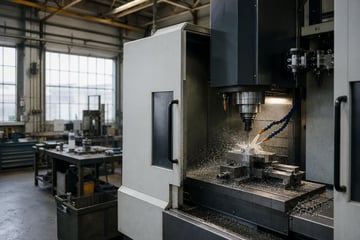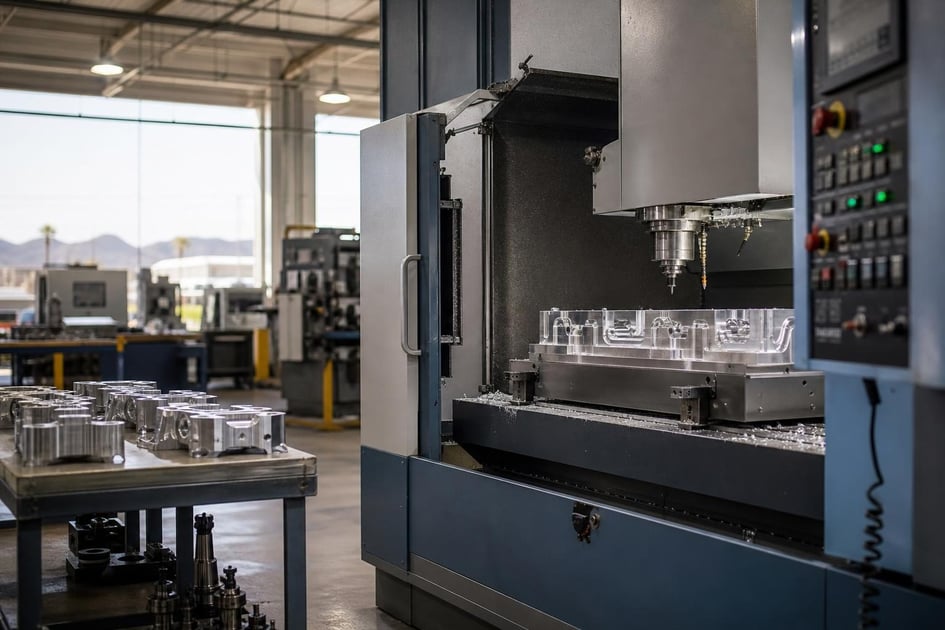
CNC machines financing in Arizona works like any other equipment-backed loan: the machine itself serves as collateral, which lets lenders offer competitive rates even when a machine shop's credit file is thin. Whether you are buying a used Haas VF-2 in Mesa or a new 5-axis Okuma for aerospace work in Tempe, loans generally run from $5,000 up to $5 million, with same-day approvals possible once the right documentation is in hand. If you are pricing a machine right now, you can see what financing you qualify for on that CNC without committing to a hard quote first.
Arizona's manufacturing base is heavier than its desert reputation suggests. According to Census Bureau data on state manufacturing activity, the state ranks among the top U.S. locations for semiconductor packaging, aerospace machining, and precision metal fabrication. That industrial mix creates steady demand for mills, lathes, and multi-axis machining centers. Because many of those shops are owner-operated or mid-sized contract manufacturers, they finance equipment to preserve working capital for raw material and payroll rather than tying up cash in a single capital purchase.
Why the Equipment Itself Makes the Loan Work
Equipment finance differs from an unsecured line of credit because the lender files a security interest in the CNC machine. If the borrower defaults, the lender repossesses and resells the asset to recover its exposure. That security lowers the lender's risk, which in turn means the borrower does not need to pledge real estate or exhaust an existing bank line to acquire the machine.
For Arizona buyers, this structure matters because CNC machines hold resale value well when they are name-brand, well-maintained, and under power. A 2019 Mazak vertical machining center with documented maintenance history is far easier to finance than an obscure import with no service record. Lenders evaluate the collateral's liquidity almost as carefully as they evaluate the borrower's cash flow. If you are unsure whether a particular used machine will clear a lender's collateral test, get a decision on your equipment, possibly the same day, by submitting the machine details and your basic financials.
Key Insight: Lenders generally require the CNC machine to have a recognized control—Fanuc, Haas, Mazak, or Siemens—because off-brand controls shrink the resale pool and extend liquidation timelines by 30 to 90 days.
Get a fast decision on your equipment
Applying takes just a few minutes, and decisions can come as soon as the same day.
Start Your ApplicationNew vs. Used CNC Machines — What Arizona Buyers Should Know
The decision between new and used equipment is not only about sticker price. It affects rate, term length, down-payment expectation, and whether the lender will finance the full amount or cap the loan at a percentage of auction value.
New CNC Machines
New machines qualify for the longest terms—often five to seven years—and the lowest down payments. They also carry manufacturer warranties, which reduce the risk of an unplanned repair draining the cash reserves that service the debt. For Arizona shops doing tight-tolerance aerospace or medical work, new equipment may be necessary simply because the contract specifies current-model calibration and traceability.
Used CNC Machines
Used machines finance readily if they are less than ten to fifteen years old and have verifiable hours. The rate may edge up slightly compared with new, and the term may shorten to match the machine's remaining useful life. The upside is that a used machine depreciates more slowly and can be placed into revenue generation immediately if the prior owner was running production. Arizona's used market is active; shops in Phoenix, Tucson, and Chandler upgrade frequently, which creates opportunities for buyers willing to move quickly.
| Factor | New CNC Machine | Used CNC Machine |
|---|---|---|
| Typical term | 5–7 years | 3–5 years |
| Down payment | Often minimal | 10–20% common |
| Rate posture | Most competitive | Slightly higher |
| Warranty | Full manufacturer coverage | Variable or none |
| Ideal buyer | High-tolerance, long-run contracts | Job shops, first-time buyers |
Pro Tip: Before committing to a used machine, request the maintenance log and a current spindle drawbar force test. A $30,000 mill with a failing spindle becomes a $45,000 mill fast, and most lenders will not advance extra funds for repairs discovered after closing.
Loan or Lease? Choosing the Right Structure
CNC buyers in Arizona usually choose between a $1 buyout lease, a fair-market-value lease, or a standard equipment term loan. The right structure depends on tax strategy, expected holding period, and whether the shop wants to own the asset outright at the end.
A $1 buyout lease functions like a loan for accounting and tax purposes: the shop claims depreciation and the Section 179 deduction, and it owns the machine after the final payment. A fair-market-value lease keeps the monthly payment lower but hands the machine back to the lessor at term end unless the shop pays residual. Term loans are straightforward debt: fixed payments, UCC filing on the machine, and title in the borrower's name from day one.
| Structure | Ownership | Tax Treatment | Best For |
|---|---|---|---|
| Equipment term loan | Borrower owns immediately | Depreciation + Section 179 | Shops planning to keep the machine 7+ years |
| $1 buyout lease | Borrower owns after final payment | Depreciation + Section 179 | Buyers who want ownership with level payments |
| Fair-market-value lease | Lessor owns; option to buy at end | Lease payments deducted as expense | Shops that upgrade every 3–4 years |
By the Numbers: A $250,000 CNC machining center financed over five years at a competitive equipment-loan rate can carry a monthly payment roughly between $4,500 and $5,500, depending on credit profile, equipment age, and term length. That same machine on a fair-market-value lease might run $3,800 to $4,600 monthly, but the shop faces a residual balloon if it wants to keep the asset.
Qualifying for CNC Machine Financing
Provide Capital finances new and used business equipment from $5,000 to $5 million. For CNC machines, the approval decision weighs three factors: the borrower's credit history, the business's cash flow, and the machine's collateral value. No single factor is dispositive.
Credit profile matters because it predicts payment behavior. A score above 650 generally opens competitive tiers, but lower scores do not automatically disqualify an applicant if the business shows strong deposits and the machine is desirable collateral. Time in business helps; two or more years of filed tax returns make underwriting faster, though younger shops can still qualify with a solid down payment or a co-signer. Revenue requirements vary by transaction size, but the core test is whether the new monthly payment fits inside existing cash flow after payroll, rent, and materials.
Documentation You Will Need
- One to two years of business tax returns
- Recent bank statements (usually the last three to four months)
- A quote or invoice for the CNC machine, including year, make, model, and serial number
- Proof of business registration and applicable Arizona transaction privilege tax license
For transactions above $250,000, underwriters may also request an interim financial statement and a brief narrative explaining how the machine increases revenue or reduces per-part cost. The cleaner the documentation, the faster the file moves. If you are unfamiliar with how lenders evaluate equipment collateral, Small Business Administration guidance on business financing offers a useful overview of secured lending standards.
Pro Tip: If you are buying from a private seller rather than a dealer, have the seller provide a detailed bill of sale and a lien search before you apply. Lenders will not fund until they are certain no prior security interest clouds the title, and clearing a UCC lapse in Arizona can add five to ten business days.
Find the right financing structure
Tell us about the equipment you need and we will show you the options that fit your business.
See Your OptionsArizona's CNC-Heavy Industries and Buying Patterns
Arizona's manufacturing economy concentrates in four corridors: Phoenix-Mesa-Scottsdale, Tucson, Prescott, and Flagstaff. The Phoenix metro alone accounts for the majority of the state's machining capacity, driven by aerospace supply chains, semiconductor capital equipment support, and medical device contract work. Reuters reporting on domestic manufacturing investment has tracked continued capital flows into states with strong aerospace and semiconductor ecosystems, a trend that benefits Arizona machine shops seeking to finance growth. Manufacturing equipment financing is especially active in Maricopa County, where shops often expand capacity in Q1 to align with aerospace production ramps.
Seasonal patterns in Arizona differ from the Midwest. Because the state does not face deep winter shutdowns, machine purchasing stays relatively steady year-round, but two peaks stand out. January through March sees elevated activity as shops deploy capital budgets refreshed by year-end contract closings. September through October picks up as aerospace and defense subcontractors order capacity ahead of federal fiscal-year spending deadlines. Summer months slow slightly—not because of weather, but because many owner-operators delay major decisions until they return from August vacations.
Beyond CNC machines, Arizona contractors and fabricators finance support equipment that keeps the shop productive. If your operation also needs material handling or fleet assets, Skid Steers financing and Scissor Lifts financing are common companion transactions for machine shops that handle their own site prep and heavy loading.
Section 179 and 2026 Tax Treatment
For tax year 2026, Section 179 allows qualifying businesses to deduct the full purchase price of eligible equipment in the year it is placed into service, subject to an annual limit that adjusts for inflation. The precise dollar cap for 2026 is set by the IRS based on inflation indexing; consult your CPA for the current-year limit before you sign a purchase agreement. Bonus depreciation may also apply, though its phase-down schedule means the 2026 percentage is lower than in prior years. Again, a tax professional can model whether Section 179, bonus depreciation, or standard MACRS yields the best outcome for your Arizona shop's 2026 return.
One detail Arizona buyers sometimes miss: the deduction is claimed in the year the machine is placed in service, not the year it is ordered. If you finance a CNC lathe in December 2026 but cannot get it wired and cutting chips until January 2027, the deduction shifts to tax year 2027. Plan your delivery and installation timeline with your CPA so you do not miss the window you expected.
What Happens After Approval
Once approved, the process moves quickly. The lender issues a term sheet or finance agreement spelling out payment, term, and collateral requirements. The borrower reviews, signs, and returns it with any final stipulations—often just proof of insurance naming the lender as loss payee. The lender then pays the seller or dealer directly. In dealer transactions, funds sometimes wire the same day the insurance certificate clears. Private-party transactions take slightly longer because title verification is manual.
After funding, the borrower makes monthly payments while retaining full use and title of the machine. There is no ongoing covenant package or quarterly reporting requirement for standard equipment loans under $1 million. The UCC filing is released automatically once the final payment clears.
Common Mistakes Arizona Buyers Make
First, underestimating rigging and installation. A CNC vertical machining center weighing 12,000 pounds does not roll through a standard dock door without a rigger, a forklift, and sometimes a crane. Those costs—plus power drops, coolant systems, and foundation pads—rarely finance inside the equipment loan itself. Budget $5,000 to $15,000 above the machine price for a mid-size VMC install.
Second, mismatching term to useful life. Financing a 1998 manual lathe over five years is risky because the machine may need replacement before the loan matures, leaving the shop with debt and no collateral value. Match the term to the machine's realistic productive lifespan.
Third, ignoring preventive maintenance reserves. A financed machine must stay insured and operational. Shops that run every spare dollar into the monthly payment without reserving for tooling, maintenance, and repair eventually face downtime that jeopardizes the revenue stream servicing the debt.
Put the right equipment to work
From $5,000 to $5 million, new or used, Provide Capital helps businesses nationwide finance the equipment they need.
Apply TodayFrequently Asked Questions
Can I finance a CNC machine if I have only been in business for one year?
Yes. Established credit and a healthy bank balance can offset limited operating history. Expect a slightly higher down payment or a shorter term than a ten-year shop would receive, but start-ups with strong personal credit and verifiable contracts regularly qualify.
Does the lender need to approve the specific machine before I buy it?
Most equipment lenders review the machine's make, model, year, and asking price before issuing a final approval. This step protects both parties: it confirms the collateral value supports the loan amount and prevents the borrower from overpaying for an asset with limited resale demand.
Can I include tooling, software, and installation in the financing?
Tooling and software sometimes finance as a bundled line item if they are part of the seller's invoice, but rigging and electrical installation usually pay out of pocket. Ask your lender what percentage of the total invoice can be soft costs; caps vary by program and transaction size.
Will financing a CNC machine hurt my ability to borrow for other needs?
Generally no. Because the loan is secured by the machine and does not consume unsecured credit capacity, it often leaves bank lines and credit cards untouched. The new monthly payment does appear in debt-service calculations, so factor it into any future borrowing plans.
Is it better to buy from a dealer or a private seller?
Dealers offer speed and title certainty. Private sellers may offer lower prices, but the lender will scrutinize the chain of title and may require a lien search. If the discount is modest, the convenience of a dealer often wins; if the discount is substantial, the extra paperwork can still be worth it.
How fast can I get funded?
Same-day approvals are possible on well-documented applications, especially for transactions under $250,000. Funding itself usually follows within one to three business days once insurance and title conditions are satisfied. Larger transactions or private-party sales may take five to seven business days.
What credit score do I need to finance a CNC machine?
There is no fixed cutoff. Scores above 650 tend to receive the most competitive structures, but approvals extend well below that when collateral is strong and cash flow is documented. The lender looks at the whole file, not a single number.
Can I pay off the loan early?
Most equipment finance agreements allow early payoff, though some include a prepayment schedule or a nominal fee in the first year. Read the term sheet carefully before signing, and ask your funding manager to highlight the prepayment language if cash-flow timing is uncertain.
Ready to Add CNC Capacity?
Arizona's manufacturing sector rewards shops that invest in precise, reliable equipment. Whether you are expanding a turning department or adding your first vertical machining center, the right financing structure keeps cash on the balance sheet while the machine generates revenue. Start an application in a few minutes to see what terms are available for the CNC machine you have quoted, and get back to cutting chips instead of cutting checks.
Disclaimer: The information provided in this article is for general educational purposes only and is not financial, legal, or tax advice. Funding terms, qualifications, and product availability may vary and are subject to change without notice. Provide Capital does not guarantee approval, rates, or specific outcomes. For personalized information about your business funding options, contact our team directly.