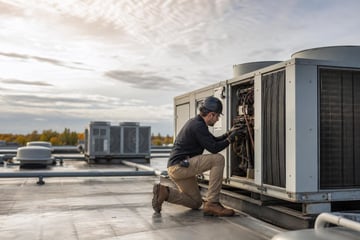
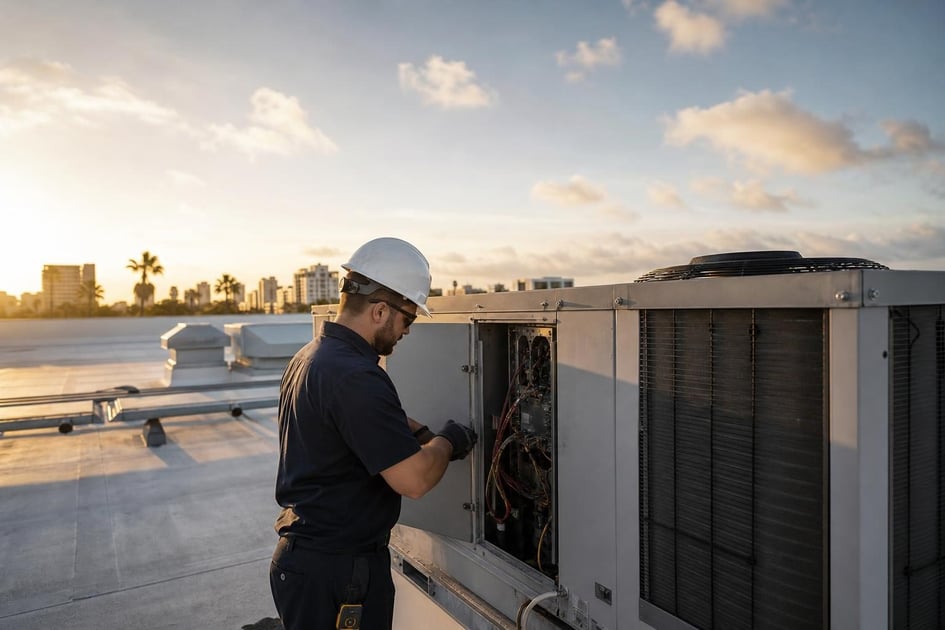
Commercial HVAC system financing in Florida lets business owners acquire heating, ventilation, and air conditioning equipment without draining operating cash. Because the equipment itself serves as collateral, lenders can offer competitive rates that vary by credit profile, equipment age and term length. Same-day approvals are possible, which matters in a state where a failed rooftop unit in July can shut down revenue within hours. Provide Capital finances new and used commercial HVAC systems from $5,000 to $5 million for Florida businesses in construction, hospitality, healthcare, agriculture, manufacturing and other equipment-intensive industries.
Why Florida's Climate Drives HVAC Costs Higher
Heat, Humidity, and Salt Air
Florida's subtropical climate means commercial HVAC units run harder and longer than equipment in most other states. The combination of 90-degree-plus temperatures and humidity levels regularly exceeding 70 percent forces compressors and condensers to operate at peak load for months at a time, a reality that has drawn national attention as record-breaking heat waves scorch the Southeast. Coastal businesses face an additional challenge: salt-laden air accelerates corrosion on outdoor condenser coils and electrical connections, shortening equipment life and increasing maintenance frequency. Inland cities like Orlando and Lakeland see extreme heat indexes that push systems designed for moderate climates beyond their rated capacity. The result is that Florida business owners often replace commercial HVAC systems every 10 to 12 years, compared with 15 to 20 years in drier, cooler regions.
Seasonal Buying Patterns
Timing a replacement or upgrade matters for both cost and availability. Florida sees a sharp spike in HVAC demand from March through May, as business owners prepare for summer cooling loads. Manufacturers and distributors often run pre-season promotions during these months, but lead times can stretch when demand peaks. Hurricane season, running June through November, creates secondary demand surges when power fluctuations and storm damage force emergency replacements. Smart buyers who finance equipment during the late fall and winter months often secure better installer availability and can negotiate stronger pricing before the spring rush begins.
Key Insight: Coastal Florida businesses within five miles of the Atlantic or Gulf should specify marine-grade coatings and epoxy-coated coils on replacement units. Standard commercial HVAC equipment rated for inland use can fail two to three years earlier in corrosive salt-air environments, turning a 10-year asset into an 8-year liability.
Get a fast decision on your equipment
Applying takes just a few minutes, and decisions can come as soon as the same day.
Start Your ApplicationWhat Financing Covers for Florida Commercial HVAC
Equipment Types
Commercial HVAC financing covers the full spectrum of cooling and climate-control equipment used in Florida businesses. Rooftop units (RTUs) remain the most common choice for retail, restaurant and light manufacturing buildings because they free up interior floor space and simplify maintenance access. Split systems work well for smaller offices and professional practices where ductwork already exists. Variable refrigerant flow (VRF) systems are gaining traction in hotels and multi-tenant buildings across Miami, Tampa and Orlando because they allow zoned temperature control and operate efficiently at partial loads. Chillers and cooling towers serve larger facilities such as hospitals, data centers and regional distribution centers. Heat pumps, including air-source and geothermal configurations, qualify for financing and offer dual heating and cooling capability for the handful of winter weeks when Florida temperatures drop below 50 degrees.
New vs. Used Equipment
New equipment carries full manufacturer warranties, meets current energy-efficiency standards and often qualifies for utility rebate programs offered by Florida Power & Light, Duke Energy and Tampa Electric. Used or refurbished equipment can cut upfront costs by 30 to 50 percent, which appeals to cash-conscious owners or those outfitting secondary locations. The trade-off is shorter remaining warranty life and potentially higher energy consumption. Lenders evaluate used equipment based on age, condition and resale value. Provide Capital finances both new and used commercial HVAC systems, with terms that adjust based on the equipment's expected useful life. Commercial Hvac System financing covers everything from single split systems to multi-unit rooftop installations.
By the Numbers: A 10-ton commercial rooftop unit for a mid-sized retail space in Tampa typically runs $8,000 to $12,000 for the equipment alone. Add $3,000 to $7,000 for crane rental, rigging, electrical and duct modifications, and the total installed cost lands between $11,000 and $19,000. Over a 60-month financing term, that translates to monthly payments that vary by credit profile, equipment age and term length.
Equipment Financing vs. Leasing: A Side-by-Side Comparison
Florida business owners often ask whether to finance a commercial HVAC system with a loan or lease it through an operating or capital lease. The right structure depends on your tax strategy, balance sheet preferences and how long you plan to keep the building.
| Factor | Equipment Loan / Capital Lease | Operating Lease |
|---|---|---|
| Ownership | You own the equipment at the end | Lessor retains ownership |
| Monthly Payment | Typically higher; builds equity | Typically lower; treated as expense |
| Tax Treatment | Interest and depreciation deductions; Section 179 may apply | Full payment usually deductible as operating expense |
| Balance Sheet | Asset and liability recorded | Often off-balance-sheet |
| Best For | Long-term owner-occupiers, tax-advantaged buyers | Short-term needs, rapid technology turnover |
| End of Term | You own it outright | Return, renew or purchase at fair market value |
A loan or capital lease makes sense for Florida business owners who plan to hold a property for seven years or more and want to capture depreciation and Section 179 deductions on their 2026 tax return. An operating lease works better for tenants with shorter lease terms or businesses that anticipate moving locations and do not want to transport a 5-ton rooftop unit. If you are evaluating whether a loan or lease fits your cash flow, talk to a specialist about your specific machine and building situation.
How to Qualify for HVAC Equipment Financing
Credit, Time in Business, and Revenue
Equipment lenders underwrite differently than banks offering unsecured term loans. Because the HVAC equipment itself is the collateral, lenders place significant weight on the asset's value and resale market rather than relying solely on your credit score. That said, your credit profile still matters. Strong personal and business credit histories unlock longer terms and more competitive rates. Most lenders prefer to see at least two years in business, though some programs accept startup-adjacent situations if the owner has deep industry experience. Monthly revenue should comfortably cover the proposed payment, with many lenders looking for a debt-service coverage ratio above 1.25. If your business generates strong seasonal cash flow—common in Florida tourism and agriculture—mention this upfront. Some lenders can structure skip payments or seasonal schedules that align with your revenue peaks.
Documentation Needed
The application process is lighter than a traditional bank loan but still requires real paperwork. Expect to provide business bank statements for the last three to six months, a current profit and loss statement, a personal financial statement or tax returns for the business owner, the equipment quote or invoice from the vendor or contractor, business formation documents and EIN verification, and proof of property ownership or a long-term lease if the unit is being permanently installed. Having these documents ready before you apply can shorten the approval timeline from days to hours. The Small Business Administration offers guidance on preparing for equipment financing, which aligns with what most specialized lenders request.
Pro Tip: Request a detailed equipment quote that breaks out the unit, freight, crane rental, duct modification and electrical work separately. Lenders often finance the entire installed cost, but they need to see itemization to verify the equipment value against soft costs like labor. A lump-sum invoice can trigger a lower advance rate or a request for additional documentation.
Find the right financing structure
Tell us about the equipment you need and we will show you the options that fit your business.
See Your OptionsTax Treatment for the 2026 Tax Year
For the 2026 tax year, business owners who purchase or finance commercial HVAC equipment may be eligible for Section 179 expensing and bonus depreciation. Section 179 allows qualifying businesses to deduct the full purchase price of eligible equipment in the year it is placed in service, subject to annual limits that adjust for inflation. Bonus depreciation permits additional first-year depreciation on qualified property, though the percentage has been phasing down in recent years. Because tax law changes frequently and the exact 2026 limits depend on your business structure and total equipment purchases, consult a CPA to confirm how much you can deduct this year. Do not assume your accountant will automatically apply the optimal strategy; ask specifically about Section 179, bonus depreciation and the alternative minimum tax implications for your situation.
Industry-Specific HVAC Financing Needs in Florida
Hospitality and Tourism
Florida's hospitality sector depends on guest comfort. A failed chiller at a 150-room hotel in Fort Lauderdale or a rooftop unit at a beachfront restaurant in Destin can trigger negative reviews and immediate revenue loss. Hotels often finance multiple units simultaneously under a single facility to standardize replacement schedules and lock in pricing. Restaurants with open kitchens need makeup air units and exhaust hoods integrated with the cooling system, which raises total project costs but is essential for code compliance and staff comfort.
Agriculture and Food Processing
Greenhouse operators in the Plant City area and poultry producers across the Panhandle rely on climate control to maintain yield and livestock health. These businesses often need specialized equipment such as evaporative cooling systems, ventilation fans and humidity controls that go beyond standard commercial air conditioning. Financing allows agricultural operators to expand climate-controlled square footage during planting or breeding seasons without waiting for harvest revenue.
Healthcare and Senior Living
Medical practices, outpatient surgery centers and assisted living facilities face strict indoor air quality and temperature requirements. Florida's heat makes redundancy critical: a single failed unit in a surgery suite or medication storage room can trigger regulatory scrutiny. Healthcare borrowers often prioritize new equipment with advanced filtration and precise temperature controls, which commands higher upfront costs but reduces liability.
Manufacturing and Warehousing
With hundreds of thousands of employer establishments statewide according to U.S. Census Bureau data, Florida's manufacturing base stretches from aerospace suppliers on the Space Coast to food processors in Miami-Dade. These businesses need heavy-duty climate control to protect inventory and maintain production tolerances. High-bay warehouses in Central Florida face unique challenges because heat stratifies at the ceiling, forcing oversized units or supplemental destratification fans. Financing these systems preserves working capital for raw materials and payroll. Hvac equipment financing through Provide Capital supports these capital-intensive upgrades.
Common Mistakes Florida Business Owners Make
Waiting until failure is the most expensive error. Emergency replacements during July or August eliminate your ability to compare quotes or negotiate terms. Another mistake is sizing a replacement unit based on the existing unit's tonnage without updating for building modifications, added insulation or changed occupancy. An oversized unit cycles on and off too frequently, wasting energy and failing to dehumidify properly—a critical problem in Florida. Some owners also forget to factor in the cost of crane rental, which can add $1,500 to $4,000 for a standard rooftop installation in a multi-story building. Finally, choosing a lender that does not understand equipment collateral can lead to slow approvals or requests for unnecessary personal guarantees. Working with a lender that specializes in equipment financing streamlines the process because the underwriter understands the resale value of a 5-year-old Trane or Carrier unit.
Key Insight: Florida building codes in many counties now require impact-rated or wind-resistant HVAC installations in designated wind-borne debris regions. If your property lies within one of these zones—common in coastal counties from Monroe through Volusia—your contractor must pull permits using wind-rated mounting curbs and straps. Financing the upgrade to a code-compliant unit now avoids a forced replacement after the next storm season.
What Happens After You Apply
Once you submit an application with your equipment quote and financial documents, the lender reviews your credit profile, time in business and the equipment details. For transactions under $150,000, many equipment lenders can issue a same-day approval based on a streamlined application. Larger transactions or more complex credit profiles may take 24 to 48 hours. After approval, the lender issues a term sheet or finance agreement outlining the payment schedule, end-of-term options and any prepayment penalties. You review and sign, and the lender pays the vendor or contractor directly. Installation proceeds on your timeline, and your first payment is typically due 30 to 45 days after funding. If a failing unit is threatening your operations, see what you qualify for today and get a same-day decision on your equipment.
Ready to move forward?
More than 10,000 businesses have financed equipment with Provide Capital. See what you qualify for today.
Get StartedFrequently Asked Questions
What credit score do I need to finance a commercial HVAC system?
Most equipment lenders prefer a personal credit score above 650, though programs exist for scores in the low 600s. Because the equipment is the collateral, lenders may be more flexible than banks offering unsecured loans. Rates vary by credit profile, equipment age and term length.
Can I finance used HVAC equipment in Florida?
Yes. Provide Capital finances both new and used commercial HVAC systems. Used equipment must pass a condition inspection and have sufficient remaining useful life to support the financing term. Expect slightly shorter terms and higher rates for older units. Industrial Hvac System financing is also available for heavy-duty applications.
How long are the financing terms?
Terms typically range from 24 to 84 months, depending on the equipment cost and expected useful life. A new $25,000 rooftop unit might qualify for a 60- or 72-month term, while a used split system may be limited to 36 or 48 months.
Does the lender pay my contractor directly?
In most cases, yes. The lender issues payment directly to the equipment vendor or HVAC contractor upon installation verification and your acceptance of the equipment. This protects both parties and ensures the funds are used for the stated purpose.
Can I deduct the payments on my 2026 taxes?
If you structure the financing as a loan or capital lease and take ownership of the equipment, you may be eligible for Section 179 expensing and depreciation deductions for the 2026 tax year. Operating lease payments are typically treated as operating expenses. Consult your CPA for advice specific to your situation.
What types of businesses qualify?
Florida businesses in construction, healthcare, dental, restaurant and food service, manufacturing, transportation, agriculture, HVAC contracting and forestry all qualify. The business must be a legal operating entity with verifiable revenue and a clear need for the equipment.
Is a personal guarantee required?
Many equipment finance agreements include a personal guarantee, especially for transactions under $250,000 or for businesses with limited operating history. The strength of your credit profile and the equity in the equipment both influence this requirement.
How quickly can I get approved?
Same-day approvals are possible for qualifying transactions. Having your equipment quote, bank statements and business documentation ready before you apply is the single biggest factor in speeding up the process.
Get a Same-Day Decision on Your Florida HVAC Project
Commercial HVAC system financing in Florida is not about borrowing money for the sake of it. It is about keeping your business cool, compliant and cash-flow positive when the heat index climbs past 100 degrees. Whether you are replacing a corroded coastal unit, upgrading a hotel chiller or adding climate control to a new warehouse, financing the equipment lets you preserve liquidity for payroll, inventory and growth. Provide Capital finances new and used commercial HVAC systems from $5,000 to $5 million nationwide, with same-day approvals possible for qualifying transactions. Review your equipment quote, gather your financials and take the next step. Get a same-day decision on your equipment and keep your business running through the Florida heat.
Disclaimer: The information provided in this article is for general educational purposes only and is not financial, legal, or tax advice. Funding terms, qualifications, and product availability may vary and are subject to change without notice. Provide Capital does not guarantee approval, rates, or specific outcomes. For personalized information about your business funding options, contact our team directly.