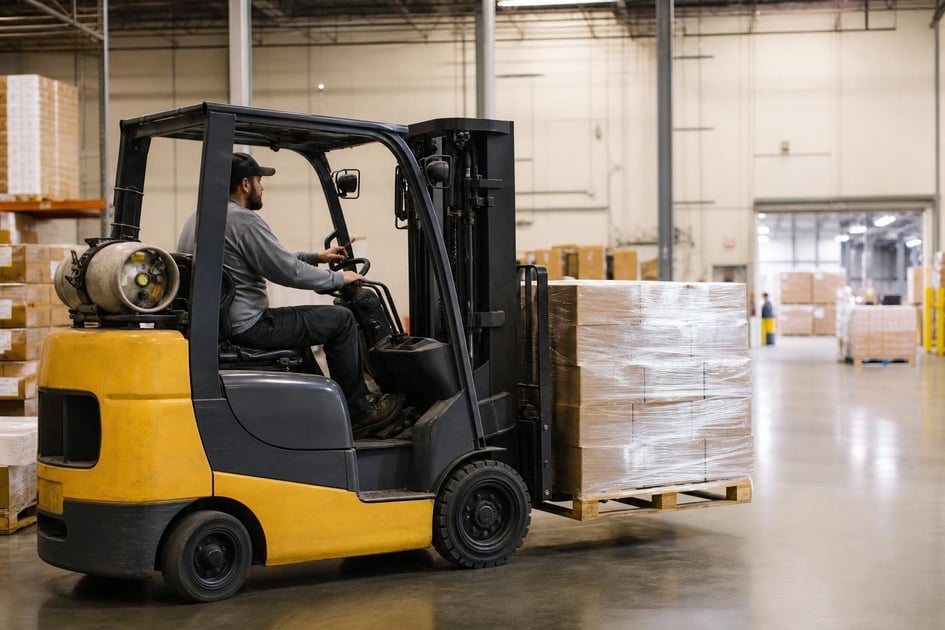
Yes, you can finance a forklift with bad credit. The equipment itself serves as collateral, which means lenders can approve deals that unsecured lenders would decline. What changes is the structure: you may face a larger down payment, a shorter term, or a more frequent payment schedule. Rates vary by credit profile, equipment age and term.
At Provide Capital, we finance new and used business equipment from $5,000 to $5 million, with same-day approvals possible when the file is complete. If you need a forklift to move inventory, load trucks, or keep a job site running, a challenged credit profile does not have to stop the purchase.
How Credit Affects Forklift Financing
Most equipment lenders divide applications into credit tiers. A score below 620 typically lands in the subprime or "story credit" bucket. Below 580, the lender will look harder at your business bank deposits, time in business, and the equipment's resale value. Bankruptcy, recent liens, or judgments add additional conditions but rarely an automatic denial.
Instead of a decline, you usually receive a structured offer. The lender might ask for two to three months of advance payments upfront, or they might cap the term at 36 months instead of 60. The key is that the forklift secures the deal. If the lender can verify the collateral value through an auction guide or dealer invoice, they have a path to recover capital even if the credit history is spotty.
Key Insight: Lenders care more about the equipment's liquidation value than your personal score once the deal drops below prime. A $25,000 forklift from a major brand with a strong secondary market often clears underwriting faster than a $100,000 specialized machine, even when the borrower's credit is identical.
Already have a machine in mind?
Provide Capital finances new and used equipment from $5,000 to $5 million, with same-day decisions possible.
Apply NowWhat Forklifts Cost and Why It Helps
Forklift prices vary by capacity, fuel type, and mast height. A new warehouse electric forklift typically runs between $20,000 and $45,000. Internal combustion models with higher lifting capacity can exceed $50,000. Used forklifts in good operating condition usually range from $8,000 to $25,000 depending on hours, age, and brand.
Businesses nationwide replace and expand material-handling fleets every year. According to U.S. Census Bureau capital spending data, equipment investment remains a major share of annual business expenditure. Because many forklifts fall into the $15,000 to $35,000 range, the monthly payment stays manageable even with a shorter term. A lower financed amount also reduces the lender's exposure, which is why owner-operators with credit challenges often get approved for single-unit forklift deals faster than for multi-vehicle fleet packages.
By the Numbers: A $22,000 used forklift financed over 36 months with a 15% down payment leaves a balance near $18,700. Even at a higher cost of capital, the monthly payment often falls between $600 and $900. That is less than the cost of hiring a third-party logistics service for daily dock work.
Qualifying for Forklift Financing With Bad Credit
Credit score is only one factor. Lenders also weigh time in business, monthly revenue, and the equipment's source. Here is what matters most when your credit is bruised.
Time in Business
Two or more years in operation opens the most competitive programs. If you have been in business for at least six months and can show consistent revenue, some lenders will still consider the deal, but they usually require a larger down payment or a shorter term. New businesses with no operating history are difficult to place, so if you recently acquired an existing company, be ready to show the asset purchase agreement and trailing financials.
Revenue and Bank Deposits
Most equipment lenders want to see at least $100,000 in annual revenue, though some programs go lower if the monthly payment is small relative to deposits. Expect to provide three to six months of business bank statements. Lenders look for positive ending balances, regular deposits, and no recent overdrafts. They may also calculate a debt-service coverage ratio to confirm the new payment will not absorb too much cash flow. The SBA loan programs page outlines how the government supports equipment purchases, though direct equipment financing from a specialty lender often moves faster than an SBA-backed process.
Down Payment and Collateral
With strong credit, some forklift deals approve with zero down. With bad credit, plan on 10% to 20% down. The down payment serves two purposes: it lowers the lender's loan-to-value ratio and it proves you have skin in the game. If you can put 20% down on a $20,000 machine, the lender is only financing $16,000. That gap absorbs much of the risk.
If you know the forklift you need and have a dealer quote in hand, see what you qualify for. Same-day decisions are possible once the application and equipment details are submitted.
New vs. Used Forklifts
New equipment carries a full manufacturer's warranty, zero hours, and the latest safety features. Used equipment costs less upfront and depreciates more slowly, but financing terms may be slightly shorter because the collateral ages faster. The right choice depends on your operating hours, maintenance budget, and how long you plan to keep the machine.
| Factor | New Forklift | Used Forklift |
|---|---|---|
| Purchase price | $20,000 – $50,000+ | $8,000 – $25,000 |
| Financing term | 36 – 60 months | 24 – 48 months |
| Down payment (bad credit) | 10% – 20% | 10% – 20% |
| Warranty | Full manufacturer coverage | Limited or none |
| Collateral confidence | Higher resale predictability | Depends on hours and brand |
| Best for | High-hour, multi-shift operations | Seasonal or light-duty use |
Used forklifts can be excellent collateral if you buy from a reputable dealer who provides an inspection report. Lenders may request photos, a serial number verification, and proof that the machine has passed a recent safety inspection. Private-party sales are harder to finance because the lender cannot verify condition as easily.
Pro Tip: If you are buying used, stick with brands that hold resale value and have authorized dealers nationwide. A lesser-known import may save money at purchase, but lenders discount the collateral value heavily if they cannot find comparable sales at auction.
Lease vs. Loan: Which Works With Bad Credit?
Equipment financing agreements and leases both let you acquire a forklift without paying the full price upfront, but the structures differ in ownership, tax treatment, and end-of-term obligations. If you are unsure which structure fits your balance sheet, equipment leasing versus financing comparisons can help you model the trade-offs before you apply.
Fair Market Value Lease
An FMV lease works like a rental. You make monthly payments and return the forklift at the end of the term. Monthly payments are usually lower than a loan, but you do not own the equipment unless you exercise a purchase option. FMV leases can be harder to secure with bad credit because the lender takes residual risk on the back end. If you choose this route, expect a shorter term and a personal guarantee.
$1 Buyout Lease
A $1 buyout lease is essentially a loan in lease clothing. You make payments and own the forklift for one dollar at the end. This structure works well for borrowers who want to claim depreciation and Section 179 deductions. Because the lender knows you intend to own the asset, credit requirements may be slightly more flexible than with an FMV lease, though still tighter than an equipment financing agreement for prime borrowers.
Equipment Financing Agreement
An EFA is the most common structure for forklift purchases. You own the equipment from day one, and the lender files a UCC lien against it until the final payment. For bad-credit borrowers, EFAs are often the easiest to secure because the collateral is straightforward, the term is fixed, and there is no residual guesswork. At Provide Capital, we structure EFAs from $5,000 to $5 million, with terms that match the useful life of the asset.
See what you qualify for
The equipment itself secures the financing, which keeps rates competitive. Checking your options takes minutes.
Check Your OptionsTax Treatment for the 2026 Tax Year
For the 2026 tax year, Section 179 allows businesses to deduct the cost of qualifying equipment, subject to an annual dollar limit and a phase-out threshold that begins at a set level of total equipment purchases. Because these limits adjust with inflation and legislative changes, you should consult a CPA to confirm the exact numbers that apply to your return.
Bonus depreciation continues to phase down in 2026, which means the immediate first-year write-off percentage is lower than it was in prior years. Depending on your taxable income and equipment spending for the year, your CPA may recommend pairing Section 179 with bonus depreciation, or using straight-line depreciation over the asset's recovery period. The right strategy depends on whether you need to offset income now or spread deductions across future years.
Interest paid on an equipment financing agreement is generally deductible as a business expense. Lease payments are typically deductible in full as an operating expense, though the exact treatment varies by lease structure. Again, a CPA who knows your books can model the outcome before you sign.
Industry-Specific Forklift Use Cases
Forklifts are not just for warehouses. They appear in dozens of industries, and the financing logic changes slightly depending on how you use the machine.
Construction
On construction sites, rough-terrain forklifts and telehandlers move lumber, roofing, and block across uneven ground. These machines work seasonally in many regions, so contractors often prefer used equipment or shorter-term leases that match the construction cycle. If you are adding a forklift to a construction fleet, Construction equipment financing can bundle the unit with other collateral such as Dump Trucks financing or Scissor Lifts financing.
Manufacturing and Warehousing
Manufacturers run forklifts multiple shifts per day. In this environment, uptime is everything. A new electric forklift with a warranty often justifies the higher payment because downtime costs more than the monthly note. Financing the forklift alongside a Forklift Battery Charger financing package keeps the charging infrastructure on the same term.
Agriculture and Forestry
Farmers use forklifts to load seed, move palletized produce, and stack hay. Because agricultural income is seasonal, lenders may ask for annual tax returns in addition to bank statements to see the full revenue cycle. A used forklift with low hours often makes sense here because the workload is lighter than in a distribution center.
Common Mistakes to Avoid
First-time forklift buyers sometimes overbuy capacity. A 5,000-pound lift truck is standard for most warehouses; stepping up to a 15,000-pound capacity nearly doubles the price and can trigger stricter underwriting. Match the machine to the job.
Another mistake is skipping the maintenance history on a used unit. A forklift with 8,000 hours and no service records is riskier collateral than one with 12,000 hours and documented PM intervals. Lenders notice this, and so should you.
Finally, do not wait until you have exhausted your cash reserves to apply. Lenders view low bank balances as a stress signal, even if revenue is strong. Apply while your accounts still show healthy average daily balances.
Documentation You Will Need
A complete file moves faster. Gather the following before you apply:
- A signed equipment quote or invoice from a dealer or private seller
- Three to six months of business bank statements
- Most recent business tax return
- Driver's license and voided business check
- Proof of insurance once approved
If the forklift is used, add recent inspection photos and a serial number. The lender may also request an independent appraisal for units over a certain age or price point.
What Happens After Approval
Once approved, the lender issues a term sheet or direct deposit instructions. If you are buying from a dealer, the lender usually pays the dealer directly. If it is a private party, the process may involve a title or UCC lien search to confirm no prior liens exist on the machine.
Funding typically occurs within one to three business days after you sign and return the closing package. Your first payment is usually due 30 to 45 days later, though some programs require an advance payment that covers the first and last months. The lender files a UCC-1 against the forklift, which is removed after the final payment clears.
Key Insight: Dealer-direct payment is the standard for financed equipment because it eliminates the risk that you will use the loan proceeds for another purpose. Bring your dealer's contact information and W-9 to the application to avoid delays.
Ready to move forward?
More than 10,000 businesses have financed equipment with Provide Capital. See what you qualify for today.
Get StartedFrequently Asked Questions
Can I finance a forklift with a credit score below 600?
Yes. Scores in the 500s are not automatic disqualifications for equipment financing. The lender will offset the credit risk with a larger down payment, a shorter term, or more frequent payments. The equipment collateral is what makes the approval possible.
How much of a down payment will I need?
With challenged credit, expect 10% to 20% of the equipment cost. Stronger credit profiles sometimes qualify with zero down, but subprime deals rarely do. The down payment is usually paid directly to the seller, and the lender finances the balance.
How long does approval take?
Many equipment lenders can issue a decision the same day if the application and equipment details are complete. Delays usually happen when bank statements are missing or the seller is slow to provide an invoice. Have your paperwork ready before you apply.
Can I finance a used forklift?
Yes. Used forklifts are common collateral. The lender will verify the serial number, hours, and condition. Financing terms may be slightly shorter than for new equipment, and the rate may reflect the higher collateral risk.
What is the shortest term available?
Terms as short as 24 months are common for used equipment or subprime borrowers. Shorter terms mean higher monthly payments but less total interest. If cash flow is tight, some lenders offer seasonal or skip-payment structures for agriculture and construction clients.
Does the lender inspect the equipment before funding?
Sometimes. For new equipment bought from an authorized dealer, inspection is usually unnecessary. For used equipment, especially units more than five years old or with high hours, the lender may require photos or an independent appraisal.
Can I pay off the financing early?
Most equipment financing agreements allow early payoff, but the structure varies. Some charge a fixed prepayment penalty during the first year or two. Others apply a declining balance formula. Read the term sheet carefully and ask your funding manager to model the payoff before you sign.
Will financing a forklift help rebuild my credit?
It can, if the lender reports to the business credit bureaus. On-time payments over 24 to 48 months establish a positive trade line. Before you apply, ask whether the lender reports to Dun & Bradstreet, Experian Business, or Equifax Business.
At Provide Capital, we finance Forklifts financing and other business equipment nationwide for construction, manufacturing, agriculture, and more. If you are ready to move forward, get a same-day decision on your equipment and keep your operations running without the wait.
Disclaimer: The information provided in this article is for general educational purposes only and is not financial, legal, or tax advice. Funding terms, qualifications, and product availability may vary and are subject to change without notice. Provide Capital does not guarantee approval, rates, or specific outcomes. For personalized information about your business funding options, contact our team directly.