Can You Finance HVAC Equipment With No Down Payment?
Yes. Equipment financing lets you acquire heating, ventilation and air conditioning units without draining your operating account for a large upfront payment. Because the equipment itself serves as collateral, lenders can structure deals with little or no money down, keeping your cash free for payroll, materials and job-site expenses. Same-day approvals are possible, and financing amounts range from $5,000 to $5 million depending on the equipment cost and your business profile.
At Provide Capital, we finance both new and used HVAC systems for contractors, facility managers and business owners nationwide. Whether you need a single rooftop unit for a retail build-out or a full chiller plant for a manufacturing floor, the structure works the same: you pick the equipment, we pay the vendor, and you repay over time while the system starts earning revenue immediately.
If you are staring at a quote for a replacement furnace or a commercial install and do not want to tie up tens of thousands in cash, see what you qualify for and keep your liquidity intact.
Already have a machine in mind?
Provide Capital finances new and used equipment from $5,000 to $5 million, with same-day decisions possible.
Apply NowWhat Qualifies as HVAC Equipment for Financing
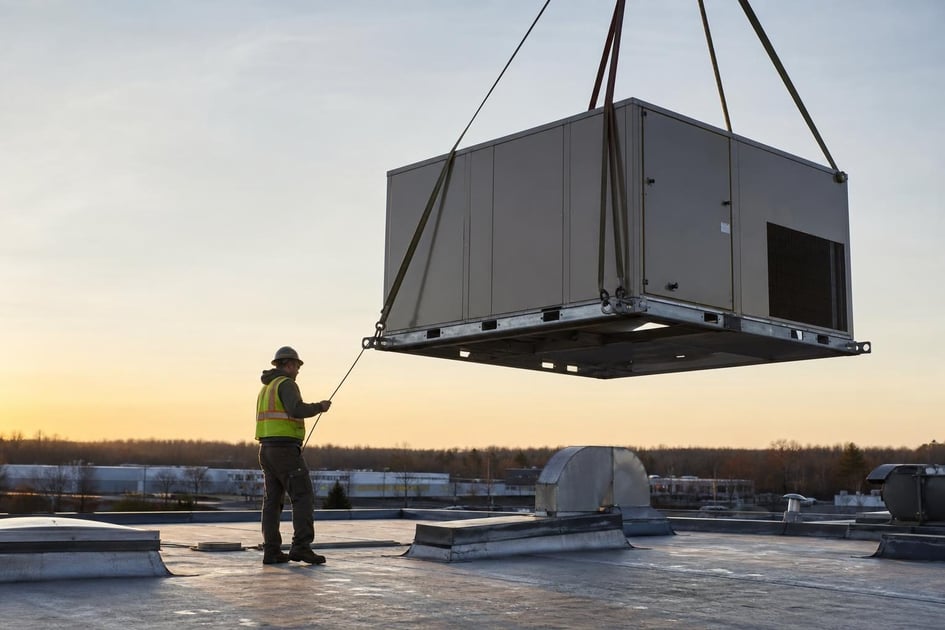
Almost every component of a climate-control system can be financed as long as it is used for business purposes. Eligible equipment includes split-system heat pumps, packaged rooftop units (RTUs), chillers, boilers, furnaces, air handlers, ductless mini-splits, ventilation fans, exhaust hoods, make-up air units, refrigerant piping runs, ductwork and digital building-automation controls. We also finance tools that support HVAC work, such as refrigerant recovery machines, sheet-metal brakes and duct-lifting equipment.
The key distinction is business use. A residential furnace installed in an owner’s home does not qualify. The same furnace installed in a rental property, office building or job-site trailer does. Lenders verify this through the equipment invoice and, in some cases, a site inspection or business-license check.
Used equipment is eligible too. A three-year-old RTU with documented maintenance records can be financed just like a new unit, though the term and rate may reflect the shorter remaining useful life. If you are unsure whether a specific unit qualifies, send us the spec sheet and we will tell you within hours.
The Census Bureau classifies central air-conditioning and major heating system replacements as construction spending, reflecting how integral these systems are to commercial buildings. That classification underscores why lenders treat HVAC as a core business asset rather than an afterthought.
How No-Down-Payment HVAC Financing Works
An equipment loan or lease is secured by the asset itself. That collateral reduces the lender’s risk, which in turn reduces the borrower's need for a large down payment. Instead of writing a check for 20 or 30 percent of the equipment cost, you may be able to finance the full amount—sometimes including soft costs such as delivery, installation and sales tax—then repay over a term that matches the equipment’s revenue-generating life.
Rates vary by credit profile, equipment age and term length. A business with strong cash flow financing a new system over a shorter term will see different terms than a company financing a used unit over a longer period. The application reviews your business bank statements, tax returns and the equipment quote. Decisions often come back the same day, and funds are typically sent directly to the equipment vendor so you never have to float the cost.
For businesses comparing options, SBA 7(a) loans can also fund equipment purchases up to $5 million, though they typically involve more paperwork and a longer timeline than direct equipment financing. When speed and minimal documentation matter, an equipment-specific lender usually closes faster.
According to industry analysis, the equipment itself serves as collateral in most deals, which lowers the lender's risk and can speed approval compared with unsecured lending. That collateral-based structure is why same-day decisions are possible even for sizable transactions.
Key Insight: Because the HVAC unit itself collateralizes the deal, lenders care as much about the equipment’s resale value and condition as they do about your credit score. A well-maintained unit from a reputable dealer strengthens your file even if your business credit is still building.
Equipment Loan vs. Lease
Choosing between a loan and a lease depends on how long you plan to keep the equipment and how you want to treat it for accounting purposes.
| Feature | Equipment Loan | Equipment Lease |
|---|---|---|
| Ownership | You own the unit from day one; lender holds a lien | Lessor owns the unit; you rent it for the term |
| Down payment | Often $0; equipment is collateral | Often $0; first and last payment may be required |
| Monthly payment | Higher than a lease; you build equity | Lower; purely an operating expense |
| Tax treatment | Depreciation and interest deductions; Section 179 may apply | Payments typically fully deductible as operating expense |
| End of term | UCC lien released; you own the asset free and clear | Return, renew or purchase at fair market value |
| Best for | Long-life equipment you plan to keep 10+ years | Technology that updates frequently or short-term projects |
If you intend to run the same RTU for fifteen years, a loan usually makes more sense. If you need temporary cooling for a twelve-month construction phase, a lease keeps your balance sheet lighter.
Who Qualifies for HVAC Equipment Financing
We work with established businesses across the industries we serve: construction, healthcare, dental, restaurant and food service, manufacturing, transportation, agriculture and forestry. You do not need a perfect credit score, but you do need to show operating history, consistent revenue and the ability to service the new payment.
Lenders look at several factors beyond the credit score. They want to see that your business has been generating revenue long enough to absorb a new monthly obligation. Bank statements showing regular deposits, a current business license and a clean equipment quote from a legitimate vendor all help. If your business has seasonal cash flow—common in construction and agriculture—we can sometimes structure payments that step up or down to match your busy months.
The equipment itself matters. Financing a new, name-brand heat pump with a ten-year warranty is a different risk profile than financing a twenty-year-old boiler with no service history. The newer and better documented the asset, the more competitive the terms.
Ready to find out where you stand? Get a same-day decision on your equipment without affecting your credit for an initial quote.
New vs. Used HVAC Equipment
New equipment carries the full manufacturer’s warranty, the latest efficiency ratings and the longest possible useful life. That predictability makes it easier to match the financing term to the asset’s revenue stream. A new variable-refrigerant-flow system installed in a medical office can be expected to run reliably for fifteen years, giving you ample time to amortize the cost.
Used equipment costs less upfront and can still deliver strong returns if it has been well maintained. The critical detail is documentation. Ask the seller for service records, compressor run hours and any remaining factory warranty. If the unit is six years old but was serviced twice a year by a licensed technician, it can be a sound buy. If the seller has no paperwork, proceed with caution; lenders may require an independent inspection before funding.
Pro Tip: Match your financing term to the remaining warranty period whenever possible. If you finance a five-year-old unit with five years of warranty left, aim for a term no longer than those five years. That way, if a major component fails, you are still covered while you owe money on the machine.
Recent shifts in trade policy have also affected capital equipment pricing. Tariffs on some imported farm and construction machinery were adjusted in 2026, which can influence replacement timelines for businesses that rely on imported components in their HVAC systems.
Tax Treatment for 2026
HVAC equipment placed in service during tax year 2026 may qualify for favorable deductions, but the exact numbers depend on IRS rules that adjust periodically. Section 179 allows businesses to deduct the full purchase price of qualifying equipment up to an annual limit in the year it is placed in service. Because that limit changes yearly, confirm the exact 2026 ceiling with your CPA before you file. Your CPA can also tell you whether bonus depreciation applies to your specific purchase and at what rate, because scheduled phase-down rules continue to shift the percentage.
If you lease the equipment, your monthly payments are generally treated as operating expenses and deducted as paid. If you take out a loan, you typically deduct depreciation on the asset and the interest portion of your payments. The difference can be meaningful for a six-figure chiller installation, so run the scenarios with a tax professional before you choose loan or lease.
One constant: the deduction only applies to business use. If you install a mini-split in a mixed-use building, your CPA will need to allocate the deduction between business and personal square footage. Keep your invoice, delivery receipt and installation photos organized from day one to make that allocation straightforward at filing time.
Find the right financing structure
Tell us about the equipment you need and we will show you the options that fit your business.
See Your OptionsIndustry-Specific HVAC Use Cases
Different industries impose different demands on climate control, and the right financing structure follows those demands.
Healthcare and dental. Medical offices and dental practices need precise temperature and humidity control to protect imaging equipment, maintain sterile environments and keep patients comfortable. A failed chiller during a summer heat wave can force appointment cancellations and lost revenue. Financing a backup cooling unit with no down payment lets you keep a redundant system on standby without tying up capital that could go into patient chairs or digital X-ray systems.
Restaurants and food service. Exhaust hoods, make-up air units and walk-in cooler compressors run hard twelve hours a day. When a kitchen’s ventilation system ages out, the health inspector does not wait for your cash flow to improve. Replacing a grease-duct fan or rooftop exhaust unit through equipment financing keeps the kitchen open and the hood code-compliant.
Manufacturing. Process cooling, dust-collection ventilation and climate-controlled assembly areas all rely on industrial HVAC. A manufacturing plant replacing an old boiler with a high-efficiency model may see utility rebates that partially offset the financed cost. We can structure the term so that the monthly payment is lower than the energy savings, making the upgrade cash-flow positive from month one.
Agriculture. Dairy barns, poultry houses and greenhouse operations depend on ventilation to control moisture, ammonia and temperature. A financed circulation fan or evaporative cooling system can improve yield and livestock health while preserving the working capital needed for feed and seed.
Construction. General contractors and HVAC subcontractors need sheet-metal fabrication tools, refrigerant recovery machines and portable climate-control units for job-site trailers. Financing these assets lets crews stay productive through seasonal swings without liquidating cash reserves.
By the Numbers: Provide Capital finances business equipment from $5,000 to $5 million. A $28,000 rooftop unit for a small retail strip, a $140,000 chiller for a medical campus and a $680,000 full-building automation package have all moved through the same approval pipeline. The equipment itself is the collateral, which is why deals across that range can close with no down payment for qualified borrowers.
Common Mistakes to Avoid
Even experienced buyers can misstep when they finance HVAC equipment. Avoid these pitfalls:
- Extending the term beyond the equipment’s useful life. A used residential furnace financed over seven years may need replacement before the loan is paid off. Match the term to the asset’s remaining life.
- Ignoring soft costs. Delivery, crane rental, duct modifications and electrical upgrades can add thousands to the project. Ask whether these can be wrapped into the financing so you do not face a second cash call after the unit arrives.
- Choosing the wrong payment structure. A flat monthly payment works for a dental office with steady patient flow. A landscaping contractor with winter downtime may need seasonal skip payments. Pick the structure that mirrors your cash cycle.
- Skipping maintenance because the unit is financed. The lender holds a security interest in a functioning asset. Deferred maintenance reduces resale value and can violate some loan covenants. Follow the manufacturer’s service schedule.
- Overlooking end-of-term obligations on leases. If you lease, read the residual clause. A fair-market-value buyout at the end of five years can be expensive if the equipment has held its value better than expected.
Key Insight: Many borrowers assume installation labor cannot be financed. In reality, soft costs including freight, rigging and initial startup are often rolled into the equipment finance agreement up to a threshold. Ask your specialist to quote the total project cost, not just the unit price, so you bring zero cash to the table.
What Documentation You Need
The paperwork is lighter than a traditional bank loan because the equipment itself secures the deal. Most applicants provide:
- Three to six months of business bank statements
- One or two years of business tax returns
- A quote or invoice from the equipment vendor
- A current business license or registration
- A voided business check for ACH setup
If the transaction exceeds a certain size, the lender may also request a current profit-and-loss statement or a brief description of how the equipment will be used. The goal is not to bury you in paper; it is to confirm that the monthly payment fits comfortably inside your cash flow. For smaller requests, a one-page application and the vendor quote may be enough.
What Happens After Approval
Once approved, the process moves quickly. The lender issues an approval letter or term sheet outlining the payment amount, term and any conditions. You review and sign. Funds are typically sent directly to the equipment vendor or dealer, not to your account, which streamlines the transaction and satisfies the lender’s collateral requirements.
The vendor delivers and installs the equipment. You put it to work immediately. A UCC filing is recorded against the serial number or unit to secure the lender’s interest. Your first payment is usually due thirty days after funding. If your business has seasonal cash flow, confirm whether your first payment can align with your strongest revenue month.
At the end of the term, the UCC lien is released and you own the equipment outright. If you leased, you return the unit, renew the lease or exercise your purchase option. Either way, the system has already paid for itself through the revenue it enabled.
Want to move fast on a quote that expires Friday? Talk to a specialist about your specific machine and we will get the vendor paid so you stay on schedule.
Ready to move forward?
More than 10,000 businesses have financed equipment with Provide Capital. See what you qualify for today.
Get StartedFrequently Asked Questions
Can I really finance HVAC equipment with no down payment?
Yes. Equipment financing is secured by the HVAC unit itself, which reduces the lender’s risk and removes the need for a large upfront cash payment. Many qualified borrowers finance the full equipment cost plus eligible soft costs.
Does my credit score have to be perfect?
No. While a stronger credit profile improves your rate and term, equipment financing places significant weight on the asset’s value and your business cash flow. Businesses with challenged credit can still qualify, though rates vary by credit profile, equipment age and term.
Can I finance used HVAC units?
Yes. Both new and used equipment are eligible. Used units should come with maintenance records and a clean inspection. The financing terms may reflect the shorter remaining useful life.
What is the typical term length for HVAC financing?
Terms typically align with the equipment’s useful life and range from two to seven years depending on whether the unit is new or used, its expected lifespan and your credit profile. A new commercial RTU may qualify for a longer term than a ten-year-old boiler.
Can I include installation and delivery costs in the financing?
Often yes. Freight, rigging, duct modifications and initial startup costs can sometimes be rolled into the equipment finance agreement. Ask your specialist to quote the total project cost upfront.
Is leasing or buying better for HVAC equipment?
It depends on your holding period and tax strategy. Buying through an equipment loan builds equity and may offer Section 179 deductions for tax year 2026. Leasing preserves capital and turns the payment into a predictable operating expense. Your CPA can model which structure saves more on taxes.
How fast can I get approved?
Same-day approvals are possible for well-documented applications. Once approved, funds are usually sent directly to the vendor within one to three business days, letting you schedule installation immediately.
What happens if I want to pay off the financing early?
Most equipment loans allow early payoff, though some include a prepayment schedule or a nominal processing fee. Leases are generally less flexible. Review the prepayment language in your term sheet before you sign.
Next Steps
Financing HVAC equipment with no down payment is straightforward when the deal is structured around the asset itself. Gather your vendor quote, your recent bank statements and your business tax returns, then submit an application. A specialist will review your file, confirm the equipment details and issue a decision—often the same day. Once approved, the vendor gets paid, the equipment gets installed and you keep your cash where it belongs: working in your business.
Whether you need Hvac System financing for a single replacement unit or Commercial Hvac System financing for a full-building install, the process is built for business owners who have better things to do than wait on bank committees. Contractors in construction, growers in agriculture and shop owners in manufacturing all use Hvac equipment financing to stay current and competitive without writing a six-figure check. Start your application now and put the equipment to work tomorrow.
Disclaimer: The information provided in this article is for general educational purposes only and is not financial, legal, or tax advice. Funding terms, qualifications, and product availability may vary and are subject to change without notice. Provide Capital does not guarantee approval, rates, or specific outcomes. For personalized information about your business funding options, contact our team directly.