Can You Finance Manufacturing Equipment with Bad Credit?
Yes. A lower credit score does not automatically disqualify you from financing the machines your shop needs. In equipment finance, the asset itself serves as collateral. That changes how lenders evaluate risk. At Provide Capital, we finance new and used business equipment from $5,000 up to $5 million for manufacturers nationwide, and we regularly approve deals for owners whose credit histories include blemishes, late payments, or even past bankruptcies. The equipment secures the transaction, which keeps rates competitive and opens the door for borrowers who would not qualify for an unsecured bank line.
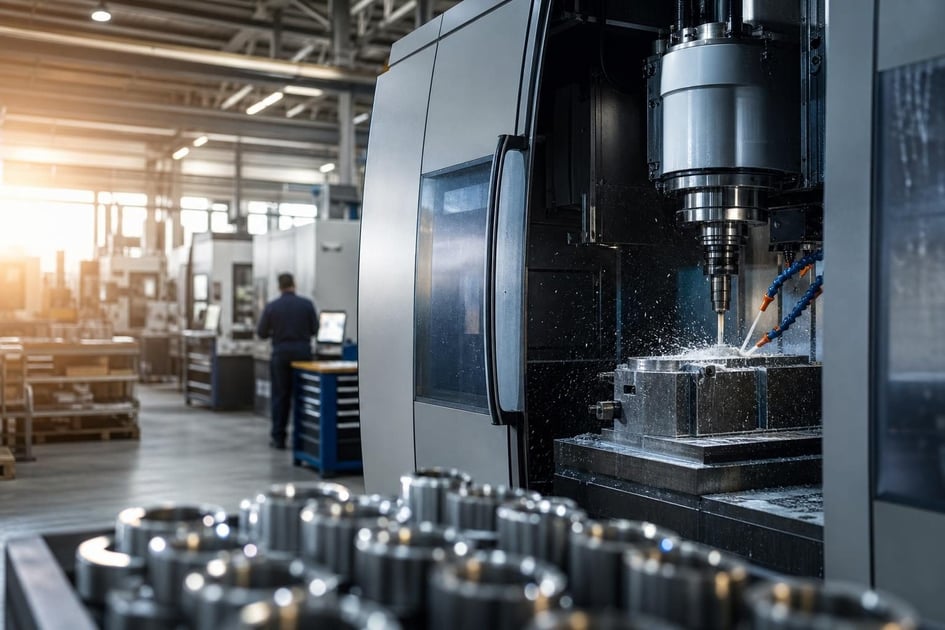
Manufacturing is equipment-heavy by nature. A CNC machining center, hydraulic press, or automated conveyor system is not a luxury. It is the mechanism that turns raw material into revenue. When that machine is also the collateral backing the loan, the lender's focus shifts from your past credit mishaps to the equipment's resale value and the revenue it will generate on your floor. That is why manufacturing equipment financing bad credit options exist in the first place. The structure is built around the asset, not just the applicant.
Key Insight: Most equipment finance underwriters weight the equipment's liquidation value at 40 to 60 percent of their risk assessment. A CNC lathe from a name-brand OEM with a strong secondary market can offset a credit score that would kill an unsecured term loan application.
If you are mid-purchase and worried about approval, the practical move is to see what you qualify for. Same-day approvals are possible once you have an equipment quote in hand.
Get a fast decision on your equipment
Applying takes just a few minutes, and decisions can come as soon as the same day.
Start Your ApplicationHow Equipment-Backed Financing Works for Manufacturers
Traditional unsecured lending relies almost entirely on personal credit and business cash flow. Equipment financing is structured as a secured transaction. The lender files a UCC-1 lien on the machine while you operate it. If you finance a $250,000 vertical machining center, that specific center secures the note. Because the lender has a tangible asset to recover, they can accept credit profiles that banks routinely decline.
Why Collateral Changes the Equation for Manufacturers
This matters for manufacturers because shop owners often reinvest every available dollar into materials and payroll. Credit scores suffer not because the business is failing, but because cash cycles are tight. Equipment lenders understand this dynamic. They look at time in business, monthly revenue deposits, and the equipment's useful life. A shop generating $75,000 in monthly revenue with two years of operation history can often secure financing for a critical machine even if the owner's personal score sits in the low 500s.
Loan terms typically stretch from 24 to 84 months depending on the equipment's expected lifespan and the borrower's overall profile. Rates vary by credit profile, equipment age and term. Because the equipment is collateral, you generally do not need to pledge real estate or additional assets. That preserves your working capital and keeps your personal property outside the deal.
According to SBA loan programs, secured equipment loans often carry lower down-payment requirements than unsecured alternatives because the collateral reduces the lender's exposure. Equipment finance companies apply the same principle, though they move faster than the typical SBA timeline.
What Credit Profile Actually Means for Your Approval
"Bad credit" is not a single category. In equipment finance, underwriters look at the full picture. They will pull your personal credit, but they also review business bank statements, tax returns, and the equipment's specs. A score below 580 raises flags, yet it is only one variable. Consistent revenue, a reasonable down payment, and hard-asset collateral can combine to produce an approval where a bank would decline.
Time in Business and Revenue Consistency
Time in business matters more than most owners realize. A manufacturing shop with three years of tax returns showing steady growth is a fundamentally different applicant than a two-month-old venture, even if both owners have similar credit scores. Most equipment lenders prefer at least two years in operation, though exceptions exist for strong revenue and collateral.
Revenue consistency is the next filter. Underwriters usually review the last three to six months of business bank statements. They want to see that your current equipment is running and that the new machine will add capacity, not replace a failed line. If your deposits show seasonal dips, be ready to explain them. Manufacturing often slows in January after holiday production cycles; that is normal, but documentation helps.
By the Numbers: A typical manufacturing equipment finance application with challenged credit involves reviewing 90 to 180 days of bank statements, a soft credit pull that does not affect your score, and an equipment appraisal or invoice that confirms the asset's fair market value. Approval decisions on deals under $500,000 can arrive the same day.
New vs. Used Manufacturing Equipment: Financing Differences
Manufacturers often assume new equipment is easier to finance. That is not always true. Used equipment with a documented maintenance history and a liquid secondary market can actually be more attractive to lenders financing lower-credit applicants. Why? Depreciation is slower, the purchase price is lower, and the monthly payment drops.
New equipment carries steeper first-year depreciation. A $400,000 new CNC mill might lose $120,000 in value the moment it ships. If the borrower defaults, the lender recovers less. A three-year-old machine bought for $220,000 has already absorbed that initial depreciation hit. The loan-to-value ratio is lower, which reduces the lender's exposure.
However, new equipment often comes with manufacturer warranties and longer useful lives, which can support longer terms. For a borrower with bad credit, putting 10 to 20 percent down on a used machine and taking a 36-month term is sometimes the fastest path to approval. The lender's risk drops, the monthly obligation stays manageable, and the shop gets the capacity it needs.
Be specific about condition when you apply. A "good condition" label means nothing. Have the serial number, year, make, model, hours, and maintenance records ready. If you are buying from a dealer, request a formal inspection report. Private-party purchases require extra scrutiny, but they are financeable if the asset checks out.
Lease vs. Loan: Which Structure Fits Your Shop?
Manufacturers with credit challenges sometimes assume leasing is their only option. In reality, both leases and loans are available, and the best choice depends on your tax strategy, cash position, and how long you plan to keep the machine.
An equipment finance agreement (EFA) functions like a loan. You own the equipment, build equity, and claim depreciation. A true lease, or operating lease, is essentially a rental with a purchase option. You do not own the asset during the term, which can keep debt off your balance sheet, but you may pay more over time.
Here is how the two structures compare for a manufacturing shop with challenged credit:
| Factor | Equipment Finance Agreement (Loan) | True Lease / Operating Lease |
|---|---|---|
| Ownership | You own the equipment from day one | Lessor owns the equipment during term |
| Equity | You build equity with each payment | No equity unless you exercise purchase option |
| Monthly Payment | Typically lower total cost of ownership | Often slightly higher over full term |
| Tax Treatment | Interest deductible; claim depreciation and Section 179 (2026 tax year — consult your CPA) | Lease payments fully deductible as operating expense |
| Credit Impact | Appears as installment debt | May appear as operating obligation |
| End of Term | You own the machine outright | Return, renew, or buy at FMV or $1 |
| Best For | Long-term holds, building asset base | Short-term needs, frequent technology upgrades |
For bad-credit applicants, the EFA is often easier to obtain because the collateral is straightforward. The lender has a clear lien on a tangible asset. True leases involve residual risk for the lessor, who must estimate the machine's value at term end. That uncertainty makes lessors more selective.
Pro Tip: If you are financing a specialized machine with limited resale demand—say, a custom-built fabrication press—lean toward an EFA rather than a lease. Lessors hate residual risk on oddball assets, but a secured lender will focus on the equipment's value to your specific revenue stream.
See what you qualify for
The equipment itself secures the financing, which keeps rates competitive. Checking your options takes minutes.
Check Your OptionsTax Treatment for Manufacturing Equipment in 2026
Tax strategy is where equipment financing pays for itself. For the 2026 tax year, manufacturers may be able to deduct the full cost of qualifying equipment in the year it is placed in service under Section 179, subject to annual limits set by Congress. The exact dollar cap for 2026 should be confirmed with your CPA, as inflation adjustments and legislative changes can shift the figure from prior years.
Bonus depreciation is another consideration. As of the 2026 tax year, bonus depreciation percentages and eligibility rules continue to evolve. Rather than quote a specific percentage that may be outdated, the safe approach is to ask your accountant whether your planned purchase qualifies for immediate expensing, standard MACRS depreciation, or a hybrid approach. The structure of your finance agreement—loan versus lease—affects who claims the deduction, so coordinate with your CPA before you sign.
What does not change is the deductibility of interest on an equipment loan. If you choose an EFA, the interest portion of your payments is a legitimate business expense. Lease payments are also deductible, but as an operating expense rather than depreciation. Either way, the tax treatment improves your net cash flow.
Industries and Equipment That Qualify
Manufacturing is a broad category. At Provide Capital, we finance equipment across the sector, from precision machining and metal fabrication to plastics, woodworking, and food processing. Eligible equipment includes CNC machines, lathes, mills, press brakes, injection molding machines, conveyor systems, packaging lines, and material handling equipment like forklifts and pallet jacks.
The key is that the equipment must be used for business purposes. A machine installed in a production facility qualifies. The same machine bought for a personal hobby shop does not. If your operation crosses into other sectors—say, you run a manufacturing firm that also maintains a fleet of delivery vehicles—those vehicles may qualify under different equipment categories.
You can explore our dedicated Manufacturing equipment financing page to see how we structure deals for your specific sector. For individual asset types, we also offer Wheel Loaders financing and Skid Steers financing for manufacturers who handle raw materials and site work in-house.
The manufacturing sector remains a cornerstone of the U.S. economy. Census Bureau manufacturing data shows that capital expenditure on machinery continues to drive employment and output across the Midwest and Southeast, where many of our manufacturing clients operate.
Qualification Criteria Explained
Understanding what underwriters actually evaluate removes the mystery from the process. Here is what matters, in rough order of importance:
- Equipment collateral: The make, model, year, condition, and serial number. Hard assets with liquid resale markets are easiest to approve.
- Revenue and bank deposits: Consistent monthly revenue demonstrated over three to six months. Manufacturing shops with seasonal spikes should provide a full year if possible.
- Time in business: Two years is the unofficial standard, though strong revenue and collateral can compensate.
- Credit history: Personal credit is reviewed, but it is not the sole determinant. Recent bankruptcies, unresolved tax liens, or open judgments will require explanation.
- Down payment: Zero-down deals exist for strong applicants, but borrowers with credit challenges should plan on 5 to 20 percent down. That equity reduces the lender's risk and often secures a better term.
- Equipment age: Hard caps vary, but many lenders prefer equipment no older than 10 to 15 years. Older machines can still be financed if the down payment is sufficient.
If you are unsure where you stand, the fastest path is to talk to a specialist about your specific machine. An underwriter can review your file informally and tell you what combination of down payment and term gets the deal done.
Documentation You'll Need
Gathering paperwork upfront speeds the process dramatically. Most applications require:
- A completed one-page application (business and personal information)
- Last three to six months of business bank statements
- Current equipment quote or invoice from the seller
- Business tax returns for the last one to two years (for larger transactions)
- Proof of business ownership and time in operation
For transactions over $250,000, expect to provide a full financial package including tax returns and possibly interim financial statements. For deals under $100,000, bank statements and an equipment quote are often sufficient. The cleaner your documentation, the faster the approval.
Common Mistakes When Applying with Challenged Credit
Manufacturers with bad credit often sabotage their own deals through avoidable errors. Here are the most common:
Shopping too many lenders simultaneously. Every hard credit pull leaves a trace. If five lenders pull your bureau in two weeks, the sixth sees a desperate applicant. Start with one or two specialized equipment lenders who understand manufacturing.
Applying without equipment selected. An equipment lender cannot price risk without knowing the collateral. Have a specific machine, quote, or serial number before you apply. "I need around $200,000 for shop upgrades" is not an equipment finance application. It is an unsecured loan request.
Overestimating cash flow. Be honest about seasonal slowdowns. If your bank statements show $40,000 months in summer and $18,000 months in winter, do not claim steady $35,000 months. Underwriters will spot the discrepancy and question your credibility.
Ignoring the total cost of ownership. Financing gets the machine in the door, but electricity, maintenance, tooling, and floor space add up. Make sure the new equipment generates enough marginal revenue to cover the payment plus its operating costs.
What Happens After You Apply
Once you submit a complete package, the timeline moves quickly. For transactions under $500,000 with standard equipment, same-day approvals are possible. The underwriter verifies your bank deposits, runs credit, and checks the equipment's wholesale value against an industry guide.
If approved, you receive a term sheet outlining the monthly payment, term length, down payment required, and any documentation conditions. Review it carefully. Ask about prepayment penalties, late fees, and what happens if you want to upgrade the machine mid-term.
After you accept, the lender coordinates with the seller. In most cases, the lender pays the seller directly. You do not handle the lump sum. Once the seller confirms receipt, you take delivery and the term begins. The entire process, from application to funding, commonly takes 24 to 72 hours for straightforward deals. Complex transactions or specialized equipment may take a week.
Manufacturing investment patterns tracked by Reuters business coverage consistently show that shops which upgrade equipment on compressed timelines tend to capture market share from slower competitors. Speed matters, both in financing and in production.
Put the right equipment to work
From $5,000 to $5 million, new or used, Provide Capital helps businesses nationwide finance the equipment they need.
Apply TodayFrequently Asked Questions
Can I get manufacturing equipment financing with a credit score under 600?
Yes. Equipment financing is collateral-based. A score below 600 means you may need a larger down payment or a shorter term, but approval is absolutely possible if the equipment holds value and your revenue supports the payment.
Does the lender need to inspect the equipment before funding?
For used equipment, yes. Most lenders require an appraisal, inspection report, or at minimum a condition disclosure from a reputable dealer. New equipment typically requires only the invoice and proof of delivery.
How much of a down payment will I need with bad credit?
Plan for 10 to 20 percent. Strong-credit borrowers sometimes secure zero-down terms, but challenged credit increases the lender's risk. Your down payment is equity that protects both parties.
Will applying hurt my credit?
Most equipment lenders start with a soft credit pull for prequalification. A hard inquiry happens only when you move to formal approval. Ask your representative which type of pull they use at each stage.
Can I finance older used equipment?
Yes, within reason. Most lenders cap equipment age at 10 to 15 years, though exceptions exist for well-maintained machines with strong resale markets. Older assets usually require larger down payments.
Is a lease better than a loan if I have bad credit?
Not necessarily. Loans often have clearer collateral structures, which can make them easier to approve for borrowers with credit challenges. Leases may offer lower monthly payments but can be harder to obtain and may cost more over time.
What types of manufacturing equipment can I finance?
Virtually any production equipment qualifies: CNC machines, presses, lathes, mills, injection molders, conveyors, packaging equipment, and material handling machinery. The equipment must be used for business purposes.
How fast can I get funded?
With complete documentation, funding can occur within 24 to 72 hours. Same-day approvals are possible for smaller transactions with clean paperwork and standard equipment.
Closing
Bad credit is a hurdle, not a wall. Manufacturing equipment financing is built around the machine, not just the borrower's credit file. If your shop generates revenue and the equipment you want has solid value, there is almost always a path to approval. The key is working with a lender who understands manufacturing collateral and can structure terms around your real-world cash flow.
Ready to add capacity? Get a same-day decision on your equipment and keep your production line moving.
Disclaimer: The information provided in this article is for general educational purposes only and is not financial, legal, or tax advice. Funding terms, qualifications, and product availability may vary and are subject to change without notice. Provide Capital does not guarantee approval, rates, or specific outcomes. For personalized information about your business funding options, contact our team directly.