Restaurant equipment financing rates vary by credit profile, equipment age and term. For an established owner-operator buying new or used kitchen equipment, the equipment itself serves as collateral, which keeps financing accessible across a broad credit spectrum. Provide Capital finances restaurant and food service equipment from $5,000 to $5 million, with terms typically ranging from 24 to 84 months depending on the asset and your business history.
Whether you are replacing a single reach-in freezer, financing a full cookline buildout, or adding a second food truck, the monthly payment depends on four factors: your credit and cash flow, the equipment's age and expected useful life, the length of the term, and how much equity you put down. Same-day approvals are possible when your documentation is complete, and because the equipment secures the deal, you typically do not need additional real estate or outside collateral.
U.S. Census Bureau data show more than 600,000 restaurant and food service establishments operate nationwide, employing millions of workers and generating substantial annual revenue. In an environment where commercial refrigeration, exhaust hoods, and cooking lines represent five-figure capital outlays, financing preserves working capital for payroll, inventory, and the unexpected repairs that come with daily service. Census retail sales data track monthly performance across food services and drinking places, giving lenders and owners a read on industry health.
What Determines Your Restaurant Equipment Financing Rate
Credit profile and time in business
Lenders look at your personal credit score, business credit history, and the length of time you have operated. A restaurant with two or more years under the same ownership, consistent revenue, and clean bank statements will see more flexible terms than a newer file with seasonal swings or recent overdrafts. That does not mean a single missed payment disqualifies you; it means the rate and structure adjust to reflect the file. Provide Capital looks at the full picture, including cash flow and the quality of the equipment, not just a score.
Equipment age and category
New equipment generally commands longer terms and lower rates because the collateral retains value. A new combi oven or walk-in cooler with a 10- to 15-year lifespan supports a 60- or 72-month term more comfortably than a 10-year-old fryer with limited remaining utility. Soft assets such as tables, chairs, and smallwares carry shorter terms than hard assets such as refrigeration, cooking equipment, and exhaust systems. If you are financing used equipment, expect the term to align with the remaining useful life rather than the original manufacturer warranty.
Loan term and down payment structure
Terms for restaurant equipment typically run from 24 to 84 months. A shorter term raises the monthly payment but lowers the total cost of ownership. A longer term improves monthly cash flow but extends the obligation. Down payments range from 0% to 20% depending on the transaction size and credit profile. Transactions under $50,000 often move with minimal money down, while larger buildouts may require 10% to 20% to align the equity position.
Key Insight: A lender values restaurant equipment collateral differently depending on the secondary market. Reach-in refrigerators, gas convection ovens, and stainless-steel prep tables retain resale value because they are standard across concepts. Custom-fabricated hoods or concept-specific décor have limited resale channels, which can shorten the available term even if the equipment is new.
Get a fast decision on your equipment
Applying takes just a few minutes, and decisions can come as soon as the same day.
Start Your ApplicationNew vs. Used Restaurant Equipment Financing
Restaurant owners often assume new equipment is the only financeable option. That is not the case. Used equipment makes up a significant share of financed transactions, especially in independent restaurants, catering operations, and food trucks where margin matters.
New equipment offers manufacturer warranties, longer useful life, and typically longer financing terms. The downside is upfront cost and depreciation the moment it is installed. Used equipment offers lower acquisition cost and faster payoff, but may carry higher maintenance reserves and shorter available terms.
| Factor | New Equipment | Used Equipment |
|---|---|---|
| Term range | 36–84 months | 24–60 months |
| Down payment | 0%–15% | 0%–20% |
| Warranty | Manufacturer included | Limited or third-party |
| Ideal for | Long-term operators, high-volume kitchens | Budget-conscious expansions, backup units, second locations |
| Resale value | Highest in years 1–3 | Steady if maintained |
Used equipment financing works best when the asset has been inspected, has verifiable maintenance records, and comes from a reputable dealer or broker. Provide Capital finances both new and used Food Service Equipment financing as long as the collateral meets standard condition and title requirements.
Pro Tip: When buying used, request the serial number and maintenance history before you apply. Lenders verify the equipment's age through serial records, and a documented service history can extend your approved term by 12 to 24 months on refrigeration and cooking assets.
Lease vs. Loan for Restaurant Equipment
Equipment loans and leases both let you put equipment to work without paying the full cash price upfront, but the structure, ownership path, and tax treatment differ.
With an equipment loan, you own the asset from day one and build equity with every payment. The equipment secures the note, and at the end of the term you hold clear title. Loans suit owners who plan to keep the equipment for its full useful life and want to claim depreciation or Section 179 deductions.
With a fair-market-value lease, you make monthly payments for a fixed term—typically 24 to 60 months—and at the end you have the option to purchase the equipment at fair market value, return it, or extend the lease. Leases often carry lower monthly payments than loans for the same equipment cost, which improves short-term cash flow. They work well for equipment that may need replacement within three to five years, such as technology-driven appliances or front-of-house furnishings.
A $10-out or capital lease structure blurs the line: you make payments as in a lease, but the intent is ownership at the end for a nominal buyout. For accounting and tax purposes, a $10-out lease is generally treated as a loan.
| Feature | Equipment Loan | Fair Market Value Lease |
|---|---|---|
| Ownership | You own immediately | Option to own at term end |
| Monthly payment | Higher | Lower |
| Tax deduction | Depreciation / Section 179 | Lease payments as expense |
| Best for | Long-life assets: hoods, walk-ins, ranges | Short-cycle assets: POS, kiosks, furniture |
| End of term | Free and clear title | Purchase, return, or extend |
If you are unsure which structure fits your operation, talk to a specialist about your specific kitchen setup and see what you qualify for. The right structure depends on how long you plan to keep the equipment, your current tax position, and whether you want to carry the asset on your balance sheet.
How Restaurant Owners Use Equipment Financing
Full-service and casual dining
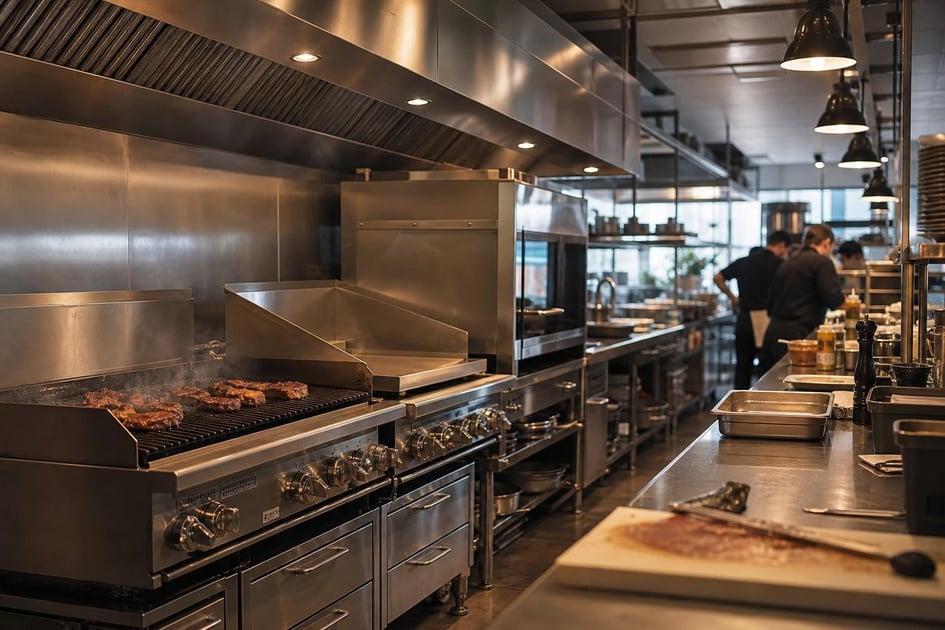
Full-service restaurants finance cooklines, exhaust hoods, fire-suppression systems, and walk-in refrigeration. A typical mid-size kitchen buildout runs $40,000 to $80,000 for cooking and refrigeration equipment alone, before installation and hood work. Financing spreads that cost over the productive life of the assets so that a $60,000 kitchen package might carry a monthly payment that fits within one or two weeks of revenue rather than demanding a six-figure cash draw.
QSR and fast casual
Quick-service concepts prioritize speed and consistency. They finance conveyor ovens, rapid-cook ovens, automated fryers, and drive-thru equipment. Because QSR equipment cycles faster—often 5 to 7 years—owners frequently match shorter loan terms to the equipment life to avoid owing money on an asset that no longer meets menu needs.
Food trucks and mobile kitchens
Food trucks represent a unique financing category. The equipment is affixed to a vehicle, which changes the collateral structure. Provide Capital offers Food Truck financing that treats the mobile kitchen as a single collateral package. Terms typically run 36 to 72 months, and because the truck and equipment are bundled, the down payment and rate reflect both the vehicle condition and the kitchen buildout quality.
Catering and commissary kitchens
Catering operations often need off-site prep equipment, transport coolers, and serving gear. Financing lets them scale for large events without liquidating cash reserves. Commissary kitchens—shared facilities used by multiple operators—also require individual tenants to own their own cooking and refrigeration equipment, making financing a practical entry path.
By the Numbers: Provide Capital finances transactions from $5,000 to $5 million. A $25,000 used fryer and griddle package might run 36 to 48 months with minimal down payment, while a $150,000 full kitchen buildout including hood and refrigeration could extend to 72 or 84 months. The equipment secures the transaction, which means the rate reflects collateral value as much as credit score.
Across every segment, Restaurant Food Service equipment financing is structured around the equipment's revenue-generating ability. According to U.S. Small Business Administration guidance, 7(a) loans can be used for machinery and equipment purchases, but specialized equipment lenders often move faster on standard collateral with streamlined documentation.
See what you qualify for
The equipment itself secures the financing, which keeps rates competitive. Checking your options takes minutes.
Check Your OptionsTax Treatment for the 2026 Tax Year
Equipment financing interacts with your tax return in ways that can lower the after-tax cost of the purchase. For the 2026 tax year, there are three mechanisms to understand: Section 179 expensing, bonus depreciation, and standard depreciation. Because tax limits adjust annually for inflation and your personal tax situation matters, confirm any strategy with a CPA before you file.
Section 179 allows qualifying business owners to deduct the full purchase price of eligible equipment in the year it is placed in service, subject to an annual limit that adjusts yearly for inflation. The deduction begins to phase out once total qualifying property placed in service exceeds a separate threshold, also indexed to inflation. For the 2026 tax year, the exact dollar limits should be verified with your CPA or by reviewing current IRS guidance on Section 179.
Bonus depreciation applies to new and used qualifying equipment and allows an additional first-year deduction beyond Section 179. The applicable percentage for the 2026 tax year depends on current federal schedules, which have been stepping down in recent years. Again, a CPA can model whether Section 179, bonus depreciation, or a combination delivers the larger 2026 benefit for your bracket.
If you lease equipment under a true lease structure, you generally deduct the lease payments as a business expense over the lease term rather than depreciating the asset. This simplifies bookkeeping but does not deliver the front-loaded deduction of a purchase.
The key is to match the financing structure to your tax timeline. If you have a high 2026 tax liability and need an immediate deduction, a loan or capital lease with Section 179 treatment may make sense. If you prefer steady, predictable write-offs and lower monthly payments, a true lease may fit better. Either way, never make a financing decision based on tax benefit alone; the equipment must first generate enough margin to cover the payment.
Documentation You Need to Apply
Restaurant equipment financing moves faster when you gather paperwork before you apply. Most transactions require a completed application with business and personal information, three to six months of recent business bank statements, a current year-to-date profit and loss statement, an equipment quote or invoice from the vendor, and your driver's license or other government-issued ID.
For transactions over $100,000, lenders may also request two years of tax returns and a current balance sheet. If you are buying used equipment, include the serial number, photos, and any available maintenance records.
Same-day approvals are possible when the file is complete and the equipment is standard. Custom deals—such as a food truck buildout with multiple vendors or a kitchen package requiring installation holdbacks—may take 24 to 48 hours while the collateral and contracts are reviewed.
Pro Tip: Request a formal equipment quote with line-item pricing before you submit. Lenders verify the collateral value against the invoice, and a detailed quote prevents delays caused by appraisals or vendor callbacks. If installation is part of the project, ask the vendor to separate equipment costs from labor so the lender can clearly identify the financeable amount.
Common Mistakes Restaurant Owners Make
One common mistake is overextending on front-of-house furnishings before the back-of-house is cash-flow positive. Dining room tables and décor do not generate revenue if the kitchen cannot execute the menu. Finance the revenue-producing assets first.
Another mistake is ignoring the total cost of ownership. A lower monthly payment stretched over 84 months may look attractive, but if the equipment is obsolete or worn out in year five, you will be making payments on an asset that no longer performs. Match the term to the useful life.
Some owners also fail to account for delivery and installation costs. A $50,000 cookline can become a $65,000 project after hood work, electrical, and plumbing. If your financing only covers the equipment invoice, you will need cash for the balance. Ask your lender whether soft costs can be included in the financing package.
Finally, do not wait until your only fryer fails during Friday dinner service to arrange financing. Emergency replacements force rushed decisions and limited vendor selection. Line up financing before the critical failure so you can choose the right equipment at the right price.
What Happens After Approval
Once approved, you receive a term sheet outlining the monthly payment, term length, down payment, and any documentation required to close. Review it carefully. The term sheet is not a commitment to borrow; it is the lender's offer based on the information provided.
After you accept, the lender coordinates with your equipment vendor to verify the collateral and arrange payment. On new equipment, funds are typically sent directly to the vendor upon proof of order or delivery. On used equipment, the lender may require a title search or UCC filing to perfect the security interest.
Your first payment is usually due 30 to 45 days after funding. Many restaurant owners align the due date with their high-revenue days to ensure cash is available. If you generate most of your sales on weekends, a Monday or Tuesday due date often works better than a Friday.
If your kitchen is ready and you have your vendor selected, get a fast decision on your equipment and move from quote to kitchen in days rather than weeks.
Put the right equipment to work
From $5,000 to $5 million, new or used, Provide Capital helps businesses nationwide finance the equipment they need.
Apply TodayFrequently Asked Questions
What credit score do I need to finance restaurant equipment?
There is no universal minimum. Provide Capital reviews the full file, including cash flow, time in business, and equipment quality. Owners across the credit spectrum qualify; the rate and structure adjust to reflect risk.
Can I finance used restaurant equipment?
Yes. Used cooking lines, refrigeration, prep tables, and food trucks are all financeable. The term aligns with remaining useful life, and documentation such as serial numbers and maintenance records strengthens the application.
How long are restaurant equipment financing terms?
Terms typically range from 24 to 84 months. New hard assets such as walk-ins and hoods support longer terms, while soft assets and used equipment trend toward 24 to 60 months.
Is a down payment always required?
Not always. Transactions under $50,000 often close with 0% down. Larger transactions or files with more risk layers may require 10% to 20% equity to improve the rate and secure approval.
Can I finance installation and soft costs?
Sometimes. Many lenders prefer to finance the equipment itself, but some transactions allow installation, freight, and related costs to be bundled up to a certain percentage of the equipment cost. Ask your specialist what is possible on your specific deal.
Will financing restaurant equipment hurt my credit?
A single inquiry for equipment financing has a minimal impact. If you shop multiple lenders within a short window, credit scoring models generally treat the inquiries as one event. Making payments on time builds your business credit profile.
Can I pay off the loan early?
Most equipment loans allow early payoff, but the structure varies. Some use a simple-interest model where you owe only the remaining principal and accrued interest. Others may include a prepayment schedule for the first 12 to 24 months. Review the term sheet before you sign.
Do you finance food trucks?
Yes. Food Truck financing bundles the vehicle and kitchen equipment into a single package. Terms depend on the truck age, mileage, and kitchen buildout value.
Closing
Restaurant equipment financing rates vary by credit profile, equipment age and term. The right structure balances your monthly cash flow, the equipment's productive life, and your tax position for the 2026 tax year. Whether you are upgrading a single piece or building out an entire kitchen, the equipment itself is the collateral, which keeps the process straightforward and the rates competitive.
Operating costs have risen across the board, and Forbes reporting on hidden fees and cost pressures notes that many operators are managing higher input costs while keeping menu prices competitive. Financing your equipment rather than draining cash helps preserve liquidity for those pressures.
Before you sign at the dealership or cut a check for used equipment, compare a loan against a lease, verify your tax strategy with a CPA, and gather your documentation. When you are ready, apply now to lock in financing for your next piece of equipment and get back to what matters: running your restaurant.
Disclaimer: The information provided in this article is for general educational purposes only and is not financial, legal, or tax advice. Funding terms, qualifications, and product availability may vary and are subject to change without notice. Provide Capital does not guarantee approval, rates, or specific outcomes. For personalized information about your business funding options, contact our team directly.