
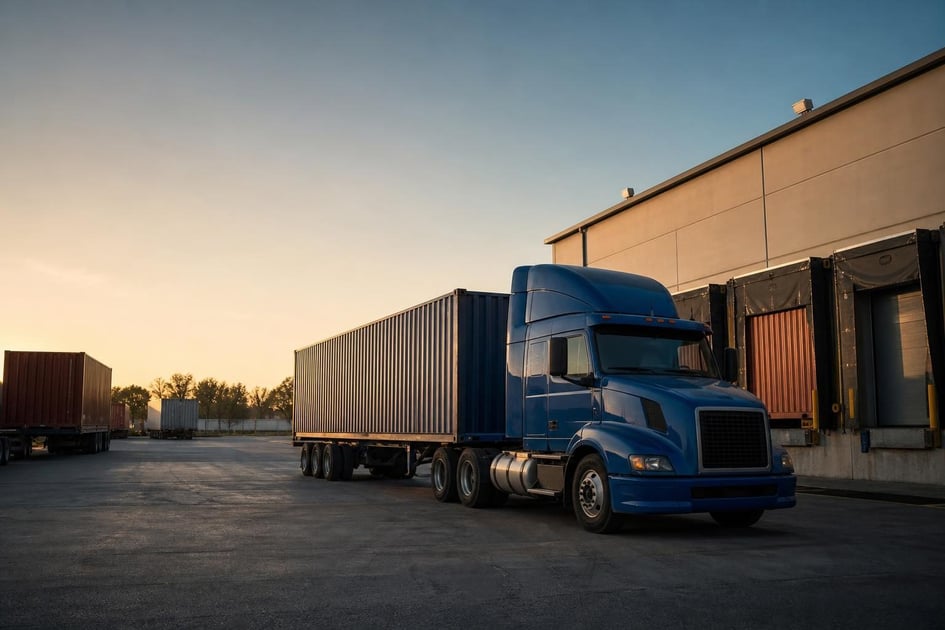
Bad credit does not disqualify you from financing a box truck, semi-trailer, or delivery van. Provide Capital finances new and used business equipment from $5,000 to $5 million, using the equipment itself as collateral to keep rates competitive. That collateral reduces the lender's risk, which means borrowers with credit challenges can still secure approval if the business generates steady revenue and the equipment holds resale value. Same-day approvals are possible when documentation is complete.
How Bad Credit Affects Transportation Equipment Financing
A FICO score below 620 is generally considered subprime in the equipment financing market. With damaged credit, you should expect to put down a larger initial payment—often 10% to 20% instead of the 0% to 5% offered to borrowers with stronger profiles. Rates vary by credit profile, equipment age and term. A borrower with a 550 score financing a 2018 sleeper cab over five years will pay more over the life of the agreement than a borrower with a 720 score financing the same unit, but the deal can still pencil out if the truck generates revenue immediately.
Lenders also tighten term lengths for riskier credits. Where a prime borrower might stretch a loan to 72 or 84 months, a subprime transportation borrower may be capped at 48 or 60 months. The shorter term raises the monthly payment, but it also builds equity faster and reduces the lender's exposure.
Some red flags matter more than the score itself. Recent bankruptcies, open tax liens, or multiple equipment repossessions within the past two years can stall an application even if the FICO number is technically acceptable. Lenders view transportation as a cyclical industry with thin margins, so they scrutinize cash flow closely when credit history is rocky. Freight demand and fuel costs shift quarterly, trends you can follow through Reuters business coverage.
Key Insight: Most transportation lenders weight the equipment's auction value more heavily than the borrower's credit score. A low-mileage Class 8 truck with a clean title and strong demand at auction is easier to finance with bad credit than a high-mileage specialized unit with limited resale data, even for a borrower with a higher FICO.
Get a fast decision on your equipment
Applying takes just a few minutes, and decisions can come as soon as the same day.
Start Your ApplicationWhat Lenders Review When Credit Is Damaged
Credit score thresholds
There is no universal cutoff, but scores below 580 typically trigger manual review. Below 550, expect a larger down payment or a shorter amortization. Lenders may also require a co-signer or personal guarantee. The personal guarantee means the lender can pursue personal assets if the business defaults, which lowers the lender's risk enough to approve a marginal file.
Time in business and revenue requirements
Startups or new businesses are not eligible for this program, so the underwriting focus falls on existing operations. Most lenders want to see at least two years in business and monthly bank deposits that cover the proposed payment by a factor of 1.25x to 1.5x. For a $1,200 monthly truck payment, the business should show $1,500 to $1,800 in free cash flow after operating expenses.
Bank statements are the primary proof. Underwriters look for NSF incidents, negative ending balances, and deposit consistency. A transportation company with seasonal spikes—common in agriculture or construction-related hauling—should explain the cycle in a cover letter. Consistent revenue over six months counts more than a single strong month.
Existing operations seeking Transportation equipment financing should understand that lenders follow criteria similar to those outlined in U.S. Small Business Administration guidance, emphasizing cash flow and collateral over credit score alone.
If your revenue covers the payment and the equipment is road-ready, see what you qualify for without hurting your credit score with a hard pull.
New vs. Used Transportation Equipment
New trucks and trailers come with manufacturer warranties, lower maintenance reserves, and longer useful lives. They also depreciate sharply in the first 24 months. For a borrower with bad credit, that depreciation can create an equity gap: the loan balance may exceed the truck's value for the first year or two, which makes lenders nervous.
Used equipment from model years 2018 to 2023 often offers the best balance. The steepest depreciation has already occurred, so the loan-to-value ratio stays healthier. However, lenders may refuse to finance units older than ten years or with more than 750,000 miles. For Dump Trucks financing, a 2019 tri-axle with 400,000 miles is typically financeable; a 2008 model with 900,000 miles is usually a cash-only purchase unless the borrower has exceptional cash flow.
Maintenance history matters on used units. A truck with documented PM intervals, rebuilt engine records, and recent DOT inspections is viewed as lower risk than a visually clean unit with missing service records. Request a full maintenance file before you apply.
Lease vs. Loan: Which Works With Poor Credit?
Both structures are available to subprime transportation borrowers, but the trade-offs differ. A $1 buyout lease (capital lease) treats the equipment as owned for tax purposes and usually requires a larger upfront payment. A loan (equipment finance agreement) grants title at inception and builds equity with every payment. A fair market value lease (operating lease) keeps payments lowest but may restrict mileage or require return conditions that are hard to meet for over-the-road operators.
| Factor | Equipment Loan | $1 Buyout Lease | FMV Operating Lease |
|---|---|---|---|
| Ownership at end | Yes | Yes (after final $1) | No (return or buy at FMV) |
| Typical down payment with challenged credit | 10%–20% | 10%–20% | First + last month |
| Tax treatment 2026 | Interest + depreciation | Depreciation (capital lease) | Deduction of lease payments |
| Best for | Long-haul owner-operators | Borrowers wanting ownership with fixed payments | Short-term fleet expansion |
| Credit flexibility | Higher | Moderate | Lowest |
For a borrower rebuilding credit, an equipment loan is usually the better tool. It reports to business credit bureaus, diversifies the credit mix, and leaves no residual obligation at the end of the term. If the truck is a short-term addition to test a new route, an operating lease preserves capital but offers less credit-building benefit.
By the Numbers: A $75,000 used sleeper cab financed over 60 months with a 15% down payment ($11,250) leaves a $63,750 balance. At a typical subprime transportation rate, the monthly payment often falls between $1,350 and $1,650. Over the full term, the borrower builds approximately $63,750 in equipment equity while generating revenue from hauls that might pay $2.50 to $3.50 per loaded mile.
2026 Tax Treatment for Financed Transportation Equipment
For tax year 2026, bonus depreciation remains available but at a reduced percentage as the phase-down schedule continues. The specific rate and the Section 179 dollar limit are set by IRS guidance for 2026, so consult a CPA before you file. Because tax law changes frequently, never rely on a blog post for a final filing position.
A CPA can model whether 2026 Section 179, bonus depreciation, or standard MACRS depreciation produces the best outcome for your transportation business. The interest portion of your equipment finance payments remains deductible as a business expense in 2026 regardless of which depreciation method you choose.
Real Cost Examples for Trucks and Trailers
The transportation and warehousing sector represents a significant share of U.S. economic activity, according to U.S. Census Bureau business data. That scale means lenders are familiar with the asset class, but it also means they price risk carefully.
A dry van trailer costing $35,000 might be financed over 48 months with 10% down ($3,500). The remaining $31,500 could carry a monthly payment in the mid-to-high $800 range for a subprime borrower, depending on credit profile, equipment age and term. A refrigerated trailer with a $55,000 price tag, 15% down ($8,250), and a 60-month term might land between $1,100 and $1,400 monthly.
For Bucket Trucks financing, a 2021 single-bucket unit priced at $85,000 with 20% down ($17,000) could see monthly payments between $1,500 and $1,900 over a 60-month term. The higher down payment offsets the specialized nature of the collateral. Transportation equipment financing covers everything from straight trucks to utility bodies, and the exact payment depends on the equipment's auction liquidity as much as the borrower's credit score.
Ready to run the numbers on a specific truck? Get a same-day decision on your equipment and lock in your monthly payment before rates shift.
See what you qualify for
The equipment itself secures the financing, which keeps rates competitive. Checking your options takes minutes.
Check Your OptionsCommon Mistakes to Avoid
The most expensive error is buying a truck before checking financeability. A $4,500 purchase at auction seems cheap until you discover the lender will not finance a salvage-title unit older than seven years. Always confirm the equipment's eligibility—year, miles, title status—before you bid or buy.
Another mistake is stretching the term too far to lower the payment. A 72-month term on a used truck with 600,000 miles means you may still owe money when the engine needs a $25,000 overhaul. Match the term to the equipment's remaining useful life.
Borrowers also hurt themselves by hiding cash income. Underwriters for transportation deals understand that some shippers pay cash, but they need to see that revenue deposited into a business account. Undeclared cash cannot be used to qualify, and it raises fraud flags if it appears suddenly during the application process.
Finally, do not shop your application to six lenders at once. Each hard inquiry can lower your FICO by a few points, and multiple declines create a negative narrative. Work with one specialist who understands transportation credit and can place the deal with the right approval desk on the first try.
Pro Tip: Before you apply, run a DOT inspection on any used truck you are serious about. Lenders increasingly require a passing inspection report for subprime transportation deals because it reduces the risk of immediate mechanical failure that could idle the asset and interrupt payments.
Documentation You Need to Apply
Prepare the following before you start: three months of business bank statements, a current driver's license, a voided business check for ACH setup, and the equipment invoice or listing. If the truck is private-party, you will need the seller's payoff letter or title status verification.
Corporations and LLCs should also submit articles of incorporation or operating agreements. If the business has existing debt, a current debt schedule speeds underwriting. Some lenders request a recent tax return, though bank-statement-only programs exist for borrowers with substantial revenue and larger down payments.
For commercial vehicles over 26,000 pounds, be ready to show your operating authority (MC number) and proof of insurance binders. Lenders want to know the unit will be legally operable within days of funding, not sitting in a yard waiting for paperwork.
What Happens After You Submit
Once the application and documentation are in, a transportation credit analyst reviews the file. For straightforward deals—strong revenue, clean title, standard equipment—you can receive a same-day decision. More complex files, such as those involving multiple units or out-of-state sellers, may take 24 to 48 hours.
After approval, you receive a term sheet detailing the down payment, monthly payment, term, and any collateral or guarantee requirements. Read it carefully. Pay attention to prepayment penalties, late fees, and default provisions. If the terms are acceptable, you sign and return the agreement.
Funding typically occurs within one to three business days of signed docs. The lender pays the dealer or private seller directly. You take possession, put the truck to work, and payments begin according to the schedule—usually 30 to 45 days after funding to allow time for delivery and first revenue runs.
Ready to move forward?
More than 10,000 businesses have financed equipment with Provide Capital. See what you qualify for today.
Get StartedFrequently Asked Questions
Can I finance a truck with a 500 credit score?
Yes, but you should expect stricter terms. A 500 score is well below prime, so lenders will require a larger down payment—often 15% to 25%—and may limit the term to 36 or 48 months. The equipment must be strong collateral: a low-mileage, late-model unit from a reputable manufacturer. Provide Capital evaluates the full file, not just the score, so steady revenue and a clean title can offset a low FICO.
Will applying hurt my credit?
The initial pre-qualification uses a soft inquiry that does not affect your FICO score. If you move forward with a full approval, the lender will eventually run a hard inquiry to verify the file. One hard pull typically lowers a score by fewer than five points, and credit scoring models treat multiple auto or equipment inquiries within a 14-day window as a single event.
Can I buy from a private seller?
Yes, private-party transactions are financeable. The lender will verify the title status, require a bill of sale, and pay the seller directly. You cannot take cash out of the deal. The seller must provide a clear title or a payoff letter if they still owe money on the unit. The same age and mileage limits apply to private sales as to dealer purchases.
What down payment is required with bad credit?
Down payments vary by credit profile, equipment age and term. Borrowers with credit challenges should plan on 10% to 20% for conventional equipment loans. Specialized units or borrowers with recent repossessions may need 25%. The down payment is calculated from the actual purchase price, not the sticker price, so negotiating a lower sale price directly reduces your out-of-pocket cost.
Can I finance a truck with over 700,000 miles?
Most lenders cap financeable mileage at 700,000 to 750,000 for Class 8 tractors and 200,000 to 250,000 for medium-duty box trucks. Units above those thresholds are considered high-risk collateral because major component failures become statistically likely. If you have substantial cash flow and can put down 30% or more, some lenders will make exceptions, but the rates will reflect the elevated risk.
Is a commercial driver's license required?
For the financing itself, no. The lender cares about the business's ability to repay, not who drives the truck. However, if you plan to operate the vehicle yourself, federal and state law requires the appropriate CDL class for the gross vehicle weight rating. Lenders may also ask for proof of hired drivers if the owner does not hold a CDL.
Can I pay off the loan early?
Most equipment finance agreements allow early payoff, but the structure matters. Simple-interest loans charge interest only on the outstanding principal, so early payoff saves money. Some leases include a prepayment penalty or a specified number of payments that must be made before the buyout option activates. Read the term sheet carefully and ask your specialist to model the payoff schedule before you sign.
What if I have a prior bankruptcy?
A discharged bankruptcy is not an automatic disqualification. Lenders focus on how long ago the discharge occurred and what has happened since. If your bankruptcy was discharged more than two years ago and you have maintained clean credit and positive bank balances since then, you can qualify for transportation equipment financing. Open bankruptcies or recent dismissals are generally prohibitive.
Ready to Finance Your Next Truck?
Damaged credit narrows your options, but it does not close the door. If your transportation business generates consistent revenue and you can document it, equipment-backed financing is available. The key is matching the right collateral, the right term, and the right lender. Provide Capital serves owner-operators and fleet managers nationwide in construction, healthcare, dental, restaurant & food service, manufacturing, transportation, agriculture, HVAC and forestry. Whether you need a dry van, reefer, flatbed, or Dump Trucks financing, we structure deals around the equipment's value and your cash flow.
Do not let a credit setback idle your business. Talk to a specialist about your specific machine and get a decision that weighs your revenue, not just your score.
Disclaimer: The information provided in this article is for general educational purposes only and is not financial, legal, or tax advice. Funding terms, qualifications, and product availability may vary and are subject to change without notice. Provide Capital does not guarantee approval, rates, or specific outcomes. For personalized information about your business funding options, contact our team directly.